The US is usually held up as one of the more transparent, well-regulated business environments in the world. Federal agencies like FinCEN and the SEC have a mature banking compliance infrastructure – on paper, verifying a business entity should be relatively straightforward. In practice, KYB in the US is messier than most people expect.
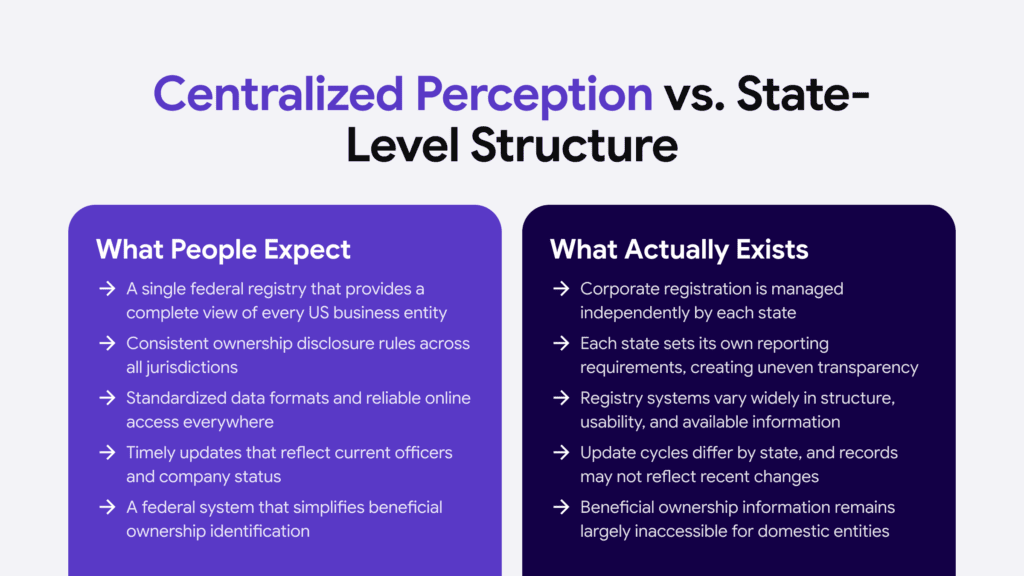
The core problem is that corporate registration isn’t centralized. It’s spread across 50 states, the District of Columbia, and multiple territories, each running its own registry with its own rules, data formats, and levels of public accessibility. For compliance teams, fintech platforms, and regulated businesses onboarding US companies, that fragmentation creates a KYB challenge that tends to catch people off guard.
The Decentralized Registry Landscape
At the heart of the issue is a simple fact: there is no single federal business registry in the United States. Business formation is a state-level matter. A company incorporated in Delaware is registered with the Delaware Division of Corporations. A company formed in California files with the California Secretary of State. And a company operating in New York but incorporated in Wyoming may appear in both states’ records – or neither, depending on the filing requirements.
This decentralized structure means that a KYB provider must navigate dozens of separate data sources, each with its own quirks:
- Data availability. Some states offer real-time online lookups with detailed officer and agent information. Others require manual requests, paper filings, or provide only the most basic company details.
- Update frequency. Certain states refresh their records daily, while others lag by weeks or even months – meaning the data a compliance team retrieves could already be outdated.
- Data depth. States like California and New York tend to offer more granular company information, while Delaware and Nevada – two of the most popular incorporation destinations – are notoriously opaque, often listing only a registered agent and the date of formation.
For companies running KYB verification in the USA, this inconsistency creates a patchwork of data quality that makes it difficult to build a complete, reliable picture of any given business.
Verify businesses, not just people
Automate company verification, UBO checks, and business due diligence with iDenfy KYB.
Explore KYB SolutionDelaware: The Transparency Paradox
Delaware comes up in every serious conversation about US business verification. More than 1.9 million businesses are registered there – including over 68% of Fortune 500 companies. The state’s legal framework, its specialized Court of Chancery, and the flexibility of its corporate laws have made it the go-to incorporation state for decades.
But that appeal has a built-in transparency problem. Delaware doesn’t require companies to disclose their officers, directors, or beneficial owners when they form. Annual franchise tax reports do pull in some of that information, but none of it is easily accessible through public search tools.
For KYB purposes, this means that a company registered in Delaware might show nothing more than its name, a registered agent (often a third-party service), and its formation date. Identifying the actual individuals behind the entity requires additional investigative steps – cross-referencing other state filings, commercial databases, or requesting information directly from the company. This is precisely the kind of opacity that has historically enabled the misuse of US fake companies for money laundering, sanctions evasion, and fraud.
The Corporate Transparency Act: A Shifting Regulatory Landscape
The Corporate Transparency Act (CTA), signed into law in 2021, was designed to address this transparency gap by requiring most US companies to report their Beneficial Ownership Information (BOI) to FinCEN. The goal was ambitious: create a federal database of the real people behind American businesses.
However, the CTA’s implementation has been anything but smooth. After facing multiple legal issues, shifting deadlines, and political pushback, FinCEN issued an interim final rule in March 2025 that removed the BOI reporting requirement for US domestic companies and US persons entirely. The revised rule narrowed the scope to only foreign companies registered to do business in US jurisdictions.
For KYB compliance teams, this means the anticipated federal beneficial ownership database – which would have been a game-changer for business verification – is now effectively off the table for domestic entities. Companies must continue to rely on the same fragmented, state-level data sources that have always made KYB verification in the USA challenging.
Some states are moving to fill the gap themselves. New York’s LLC Transparency Act, which took effect on January 1, 2026, requires certain LLCs to disclose beneficial ownership information at the state level. But a patchwork of state-level rules doesn’t make things simpler – for compliance teams working across the country, it just adds another layer to keep track of.

Fake Companies
The combination of easy incorporation, minimal disclosure requirements, and a decentralized registry system has made the United States one of the easiest places in the developed world to create an anonymous fake company. This is not a new observation – transparency advocates and anti-money laundering organizations have been raising the alarm for years.
A fake company itself is not inherently illegal. Many legitimate businesses use holding structures for tax planning, asset protection, or liability management. The problem arises when these structures are exploited:
- Obscuring beneficial ownership to avoid sanctions screening
- Layering multiple entities across different states to make tracing ownership nearly impossible
- Facilitating money laundering by creating the appearance of legitimate business activity
- Evading regulatory oversight by exploiting gaps between state-level registries
For businesses conducting KYB verification in the USA, distinguishing between a legitimate holding structure and an unusual fake arrangement requires more than a simple registry lookup. It demands cross-referencing data across multiple states, commercial databases, sanctions lists, and adverse media sources – often simultaneously.
Automated KYB
Given the complexity of the US business verification landscape, manual KYB verification in the USA is becoming increasingly impractical. Compliance teams that rely on manual state-by-state lookups face several critical issues:
- Speed. Onboarding a business partner or client cannot take days or weeks in today’s fast-paced financial environment, and manual registry checks across multiple states create bottlenecks that slow down revenue-generating activities.
- Accuracy. Human error in cross-referencing fragmented data sources is inevitable, and a missed connection between entities registered in different states can mean a failed compliance check or an overlooked risk.
- Scalability. As a company grows its B2B operations, the volume of KYB verification for the USA increases proportionally, and scaling a manual process linearly with headcount is neither cost-effective nor sustainable.
- Regulatory exposure. With AML enforcement actions and fines continuing to rise, the cost of getting KYB wrong far exceeds the investment in getting it right.
Automated KYB platforms tackle this by pulling data from multiple state registries, commercial databases, and global watchlists into a single workflow. Instead of manually working through each state’s Secretary of State website, compliance teams get consolidated entity data, officer information, and beneficial ownership details in one place – through a single API call or a dashboard lookup.
An Effective US KYB
Given the unique challenges of the American market, an effective KYB process for US-based entities needs several key components working in concert.
Multi-source company verification is foundational – the platform should pull data from all relevant state registries, not just the state of incorporation, since a company operating in multiple states may have critical information spread across several filings. Beneficial ownership identification must be built in as well. Even without a federal BOI database, effective KYB verification for the USA requires tracing the individuals who ultimately own or control businesses, often through multiple layers of corporate structure.
Every entity and its associated individuals should also be screened against OFAC sanctions lists, global PEP databases, and adverse media sources – and this is not a one-time check but an ongoing monitoring requirement. Business information moves. Officers resign, ownership changes, companies fold. Point-in-time verification captures a moment; continuous monitoring catches what happens after. That distinction is what separates a compliance program that holds up from one that just looks good on paper.
On the due diligence side, not every entity warrants the same level of scrutiny. A risk-based approach means lower-risk cases get through quickly, and the heavier checks go where there’s an actual reason for them.
A Smarter Approach to the US KYB Issue
For compliance teams looking for a practical solution to the US KYB challenge, iDenfy offers a purpose-built platform that addresses the fragmentation and opacity described throughout this article. Rather than requiring teams to manually stitch together data from dozens of state registries, iDenfy aggregates business verification into a single, streamlined workflow.
On the entity verification side, iDenfy provides access to over 180 company registries across 120 countries – including US state-level sources – so compliance teams can retrieve consolidated business data without hunting across individual Secretary of State websites. For US-specific needs, the platform also includes dedicated EIN/TIN verification and Secretary of State search capabilities, which are essential when working with domestic entities where federal beneficial ownership data is no longer available.
Beneficial ownership is handled through iDenfy’s UBO Verification and AI Company Data Crossmatch tools, which trace ownership structures through multiple layers of corporate hierarchy and surface the real individuals behind a business. This is particularly valuable for Delaware and Nevada registered entities, where public registry data is sparse. Key capabilities include:
- UBO identification with real-time shareholder data
- KYC checks on beneficial owners, linking business verification to individual identity verification in a single flow
- AI-generated company reports that synthesize data from multiple sources into a single, audit-ready document
- Custom risk rules that allow compliance teams to flag entities based on their own risk appetite
Sanctions and AML screening are also built in, with coverage across OFAC lists, global PEP databases, and adverse media sources – all accessible through a single API or dashboard, rather than requiring separate integrations for each data source.
For organizations operating at scale, iDenfy’s approach of charging only per successful verification (rather than per attempt) also has meaningful cost implications, particularly for high-volume onboarding environments where declined or incomplete checks can otherwise inflate compliance costs significantly.
Conclusion
The United States presents a KYB challenge that is, in many ways, unique among developed economies. The decentralized registry system, the opacity of popular incorporation states like Delaware and Nevada, the stalled federal transparency legislation, and the persistent fake company problem all contribute to an environment where business verification requires more sophistication, not less.
Companies that treat US KYB as a simple checkbox exercise expose themselves to regulatory risk, financial crime, and reputational damage. Those that recognize the true complexity of the American business landscape – and invest in the tools and processes to navigate it effectively – are far better positioned to onboard with confidence, maintain compliance, and build trustworthy business relationships.
The fragmentation will not resolve itself overnight. But with the right approach, it does not have to be an obstacle.