The logistics industry has always been built on speed – a shipment comes in, documents are checked, customs requirements are met, and goods move from one point to another. The faster that process happens, the better it is for everyone involved.
But speed comes with responsibility.
Every shipment connects multiple businesses – manufacturers, exporters, freight forwarders, customs brokers, carriers, distributors, and buyers. If any one of them is under sanctions or involved in something prohibited, the fallout doesn’t stop at a delayed delivery. Penalties, investigations, reputational damage, broken relationships – all of it comes into play.
Sanctions screening has become a normal part of logistics operations, not something only banks worry about. The challenge is doing it thoroughly enough to actually mean something without slowing everything down.
Who this is for – and what it’s not. For compliance officers, operations leads, and risk teams at freight forwarders, customs brokers, and logistics providers – specifically those handling shipments that touch multiple businesses across jurisdictions and relying on name-only watchlist checks.
Not a guide to customs documentation or export licensing requirements. For the business verification piece specifically, see Know Your Business Solution; this article is the sanctions screening framework – what to check, how often, and why name matching alone isn’t enough.
Why Logistics Companies Face Higher Compliance Risk
Most logistics providers aren’t dealing with one customer at a time. A single shipment can touch several organizations across multiple jurisdictions – different ownership structures, different regulatory environments, different risk profiles.
That complexity creates blind spots.
A freight forwarder might be hired by an exporter while the ultimate consignee is located elsewhere. A shipping company may never have direct contact with the beneficial owner of the receiving business. Documentation often changes hands several times before goods reach their destination.
The difficulty is that sanctions regulations don’t disappear, even though the supply chain is complex. Companies are still expected to carry out reasonable due diligence and avoid facilitating prohibited transactions.
Sanctions Screening Is About More Than Names
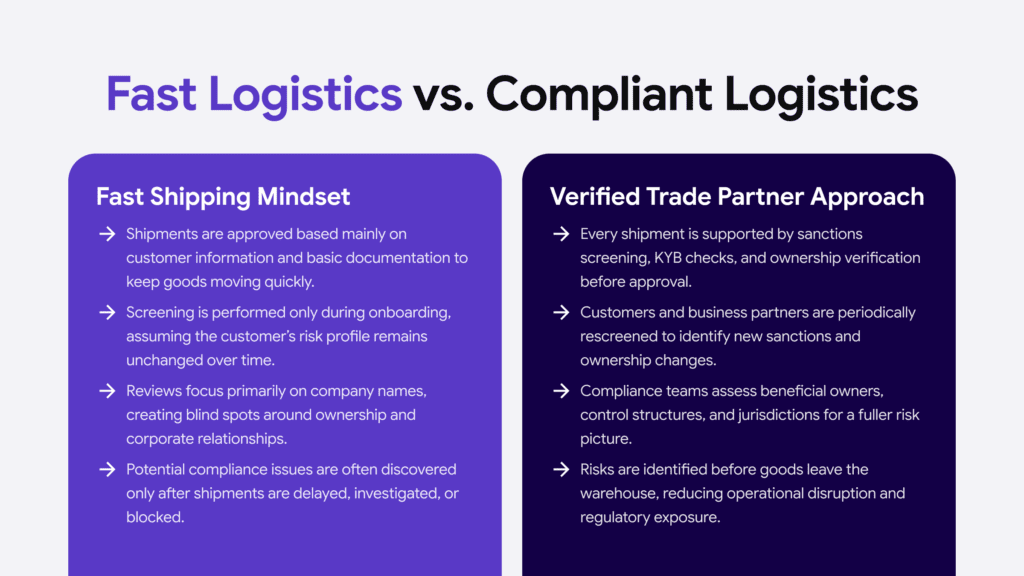
Many businesses still think of sanctions screening as comparing customer names against a watchlist.
A company may not appear on a sanctions list itself, but if it is owned or controlled by a sanctioned individual or entity, the transaction may still require closer examination.
This is why modern compliance programs look beyond direct matches.
They consider ownership structures, beneficial owners, directors, geographic exposure, and other factors that may increase risk.
Looking only at a company name rarely provides the full picture. And the timing matters just as much as accuracy.
Treating sanctions screening as a one-time onboarding task is a mistake. Lists get updated regularly, and geopolitical events can change the risk picture overnight. For logistics companies with long-term customer relationships, periodic rescreening isn’t optional – it’s part of the job.
A shipment that was perfectly acceptable six months ago may require additional scrutiny today.
Know Who You’re Shipping For
Understanding exactly who’s involved in a transaction sounds straightforward – in practice, it isn’t. International shipments often pass through several intermediaries, and focusing only on the immediate customer can leave significant gaps. The broader commercial relationship matters too.
Questions worth asking include:
- Who owns the receiving company?
- Is anyone acting on behalf of another business?
- Are there intermediary trading companies involved?
- Does the declared business activity make sense?
- Are shipment destinations consistent with previous transactions?
These questions don’t necessarily indicate suspicion. They simply provide context. The more context available, the easier it becomes to assess whether something deserves additional review.

Why KYB Checks Strengthen Sanctions Compliance
Sanctions screening works best when it’s combined with broader business verification.
A simple name check may identify obvious matches, but it often misses the relationships that create real compliance risk.
This is where KYB checks become particularly valuable.
Checking company registration, identifying beneficial owners, reviewing corporate structures, and understanding who actually controls a business give logistics providers a much clearer picture of who they’re really dealing with.
That additional visibility helps compliance teams identify situations that deserve further investigation before shipments leave the warehouse.
It also reduces the chances of unknowingly working with fake companies or businesses established primarily to conceal ownership.
Automation Has Changed the Way Screening Works
Manual sanctions screening can quickly become difficult as shipment volumes increase.
Checking multiple businesses individually, reviewing ownership information, and documenting every decision consume significant time.
Automation changes that.
Modern compliance platforms screen businesses against sanctions lists, Politically Exposed Persons (PEPs) databases, adverse media sources, and other relevant datasets in seconds – no manual database hopping required.
That frees compliance professionals to focus on genuine alerts rather than spending hours confirming cases that were never going to be a problem. For logistics businesses moving hundreds or thousands of shipments, that difference adds up fast.
Building a Consistent Review Process
One challenge many companies face isn’t a lack of compliance tools. It’s consistency. Different team members review applications differently. One analyst may approve a customer immediately, while another may request additional documentation for the same case.
Clear internal procedures help reduce that inconsistency.
A practical review process often includes:
- Verifying company registration information
- Identifying beneficial ownership
- Screening businesses and owners against sanctions lists
- Reviewing geographic exposure
- Assessing unusual ownership structures
- Recording the reasoning behind every compliance decision
- Cross-checking across the Secretary of State’s business search (US-based).
Consistency protects businesses as much as individual screening decisions do.
How iDenfy Helps Streamline Compliance Reviews
As onboarding volumes grow, staying organized becomes just as important as the screening itself.
That’s where automation makes a real difference. Rather than manually pulling information from multiple sources, compliance teams get a structured overview through a single workflow – company information, registration details, beneficial ownership, sanctions screening, all in one place. Faster decisions, more consistent outcomes.
And it doesn’t stop at initial verification.
Verification results, ownership information, screening outcomes, and supporting documentation are brought together in one place, allowing analysts to assess applications without switching between different systems.
For straightforward cases, this significantly reduces review time. Higher-risk cases still get escalated for manual review – but compliance officers start with a complete picture rather than having to piece one together. The process moves faster, and the oversight is actually stronger as a result.
Don’t Let Speed Become the Weakest Link
The logistics industry depends on moving quickly.
Customers expect fast processing, smooth customs clearance, and minimal delays. Compliance shouldn’t be what slows that down – but speed can’t come at the expense of due diligence either.
The logistics providers that handle this best build verification into their existing workflows rather than treating it as a separate task sitting alongside operations. When screening becomes part of how the business runs day-to-day, both compliance risk and operational disruption go down.
“We’re building an online platform for Australian transport operators in road freight specifically. A carrier will go onto the platform, send invoices to their existing customers, and the customers will make payments through our platform. We would hold the payment until the job is completed and then make the payment to the carrier. We’d rather have a compliance system set up from the start, which can scale with us – as we get into the hundreds, thousands – than retrofit it later.” – B2B Payment and Compliance Platform Founder
Conclusion
International logistics connects businesses across borders, industries, and regulatory environments – and that complexity is exactly what makes sanctions screening so important.
Compliance isn’t a list you check before a shipment goes out. It’s knowing who you’re working with, who’s actually behind the businesses involved, and whether anything has shifted since you first started working together.
Combining sanctions screening with robust business verification, ongoing monitoring, and automated review processes enables logistics companies to strengthen compliance without making it a drag on operations. The regulatory expectations around global trade aren’t getting simpler – businesses that build smarter verification processes now will be better positioned to keep up.