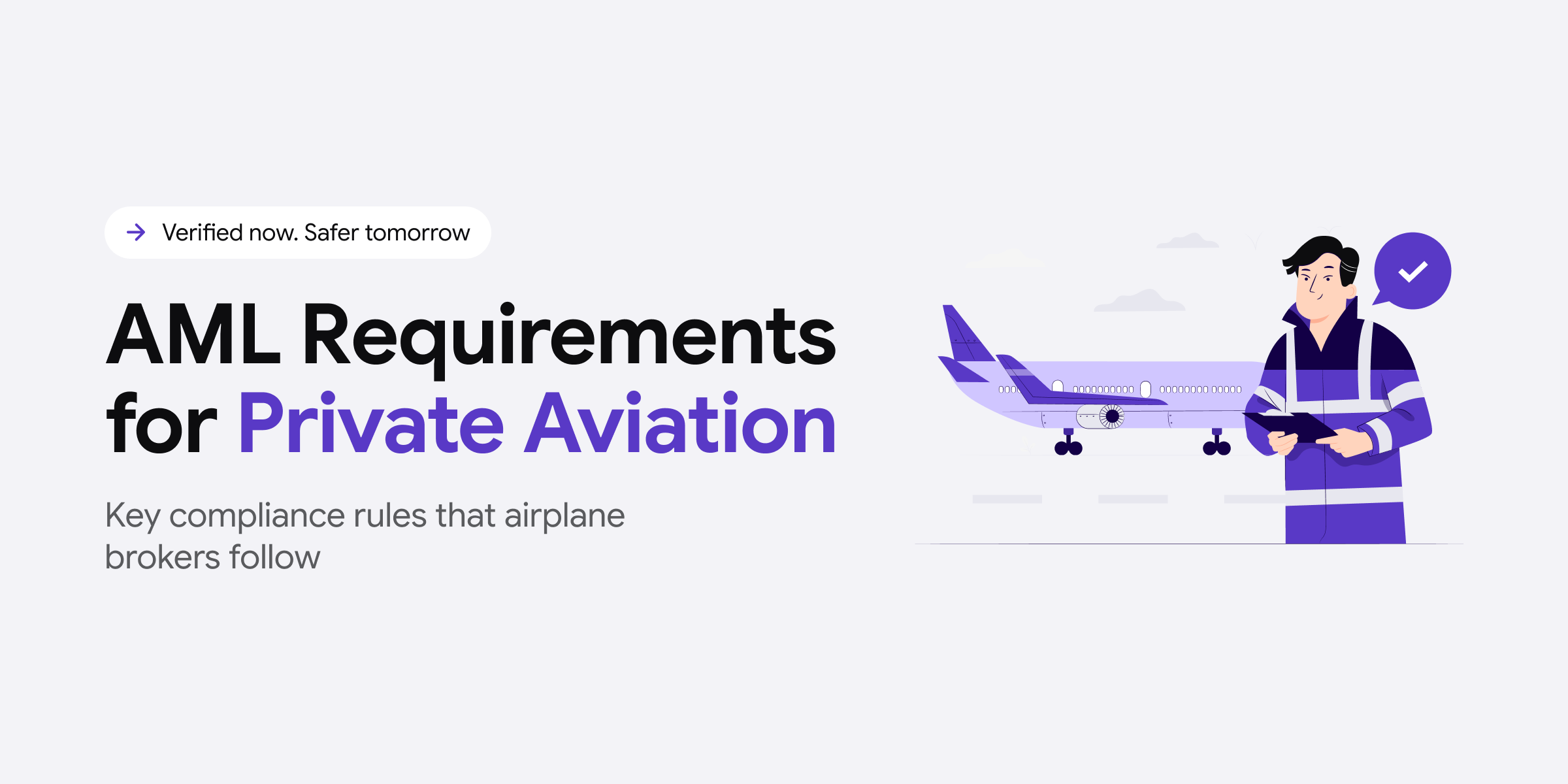
Luxury goods signal a premium category of services or items that are not necessarily vital to everyday life but cater to status and wealth. This includes fine jewelry, art, cars, yachts, and, of course, private jet brokerage and premium travel. In private aviation, client experience means everything, and that means compliance and convenience need to be prioritized at the same level. That means skipping due diligence or not complying with Anti-Money Laundering (AML) regulations can lead to poor consequences, including having your private aviation brokerage firm shut down.
In practice, arranging travel consists of various steps. All parties involved need to be screened and verified, and this includes both clients and vendors. This includes conducting Know Your Customer (KYC) checks and doing the AML part, like screening the transacting party against PEPs and sanctions lists. The main challenge is that most aircraft deals are international.
Various regulations automatically apply, making the need for effective AML software even more important. Different formats, languages, and types of documentation need to be accepted to meet compliance requirements while also satisfying the expectations of Ultra-High-Net-Worth Individuals (UHNWIs).
I’ll explain what practical steps are required for private aviation brokerage firms to meet AML obligations while still ensuring that their clients aren’t overburdened with multiple typically exhausting steps like providing documentation or emailing KYC details via complex, back-and-forth emails.
What is an Aircraft Broker?
An aircraft broker is a professional intermediary who represents buyers or sellers in aircraft transactions, from single-engine turboprops to long-range business jets. An aircraft broker is an individual who finds the jet or is responsible for selling a client’s jet. A brokerage firm is the company they work for.
The main thing to remember is that brokers do not own the aircraft. The client ends up owning the plane. Then, the broker earns a fee for the closed deal for sharing a great understanding of the specifics each aircraft offers that helped the client find the best fit. In contrast, a charter broker, often marketed as a private aviation brokerage firm, helps the client rent out a jet for a flight. The client simply books a trip, while someone else operates and owns the aircraft.
Automate your AML checks
Screen customers against global sanctions, PEPs, and watchlists in real time with iDenfy AML Screening.
AML Screening SoftwareWhat is the Role of a Private Aviation Brokerage Firm?
A private aviation brokerage firm provides a luxury service, aka offering private jets, often to UHNWIs, and handles everything from A to Z. This is required to ensure the “perfect” luxury experience that the audience of this sort of service expects.
Like any platforms that facilitate high-value transactions, private aviation brokerage firms need to attract their clients right from the start. That means balancing security with good user experience. If a platform has its jet listings online and enables remote charter bookings, KYC/AML checks are vital.
At the same time, firms need to focus on:
- A simple and fast client onboarding workflow (even if it requires ID checks, Source of Funds (SOF) checks, etc.)
- An internal solution or third-party software that accepts international clients and different ID document types
- Complete compliance systems (and Know Your Business (KYB) checks) that include the verification of sellers, private jet owners, and other intermediaries (not just end-customers)
The private aviation brokerage firm finds the right aircraft and handles the logistics, all while ensuring safety and compliance, including fair transactions and conducting due diligence.
An example from our partner:
“Currently, we’re leveraging iDenfy’s no-code verification links to securely onboard our VIP clients. This functionality immediately transformed our workflow and replaced the outdated, risky method of emailing sensitive passport copies with a secure, 60-second smartphone verification.”
— Alejandro Leon, CCO, 5 Star Jets
Typically, private aviation companies have the connections and the aircraft listings that might not be that easily and publicly accessible. These firms ensure that clients who want private aviation access it without buying an aircraft. On top of that, due diligence and AML measures are non-negotiable.
What is AML Compliance?
AML, or Anti-Money Laundering compliance, is a set of measures (including conducting due diligence and verifying all counterparties involved in a transaction and during the whole business relationship) designed to help companies detect and prevent financial crime and any type of fraud (including terrorism financing, sanctions evading, and, naturally, money laundering). In the context of private aviation and luxury goods/services in general, the primary AML measure is verifying who you’re actually dealing with and where their money came from before a deal closes.
Typical AML Compliance Measures
Apart from KYC verification and standard client due diligence, in private aviation brokerage, AML measures consist of:
- Screening against sanctions lists. This includes everyone involved: the buyer, the seller, and every other intermediary, checking them to see if they don’t appear in any sanctions lists. Working or starting a business relationship is prohibited with sanctioned individuals in most jurisdictions.
- Verifying the beneficial ownership. This means tracing the ownership structure and finding out the past/true registered owner who actually owns and controls the aircraft. Similar to other industries, private aviation is also prone to hidden ownership structures, which are hard to identify due to methods like shell companies, non-citizen trusts, nominee companies/directors, etc. Sometimes, especially in poorly regulated jurisdictions, a registry check isn’t enough because it’s not mandatory by law to provide this information.
- Monitoring transactions and other suspicious patterns. Facilitating back-to-back deals where beneficial ownership isn’t disclosed or not monitoring high-value transactions, which are typical for private aviation, is dangerous. Third-party payments, international transfers, and escrow accounts make it even more susceptible to fraud if standard and ongoing due diligence measures aren’t applied by the brokerage firm. In this sense, monitoring helps detect potential fraud throughout the whole client journey and before finalizing a transaction.
Keep in mind that some private aviation brokerage firms run AML processes not to comply directly with the same AML requirements as banks do but to ensure that they meet the requirements of financial institutions, escrow agents, and lenders. Simply put, without them, they don’t move further and might not provide their services.
This is also common in any higher-risk industry, and I talked about it in iDenfy’s recent case study with CSGOWin, where the crypto & iGaming platform needed to demonstrate their KYC/AML program, and since iDenfy’s integration and presence in this field was already known to the new payment provider, the process of starting a partnership with them was much smoother.
Why is Private Aviation Prone to Fraud?
The short answer is simple: it’s due to being a higher-risk industry, which is prone to money laundering and facilitating illicit funds. Paying for charters means forwarding large amounts of money that go above the typical reporting threshold. You need to check who’s paying and where the funds came from. Despite that, there are some gaps in this sector’s landscape, which can be interpreted.
Due to the subjectiveness and interpretation, fraudsters are attracted to private jet brokerage firms. That’s because:
- A jet holds enormous value and can come in the form of a single clean movement that’s worth approximately €10-70m via one commercially plausible transaction.
- It’s global and physically mobile, meaning that unlike real estate, the asset leaves a country within hours/overnight before anyone freezes the funds.
- It’s fast, and the funds can be layered through offshore structures, like owner trusts, offshore SPVs, etc.
- Fluid pricing that varies depending on the aircraft, which then makes it more difficult to detect factors like under-invoicing.
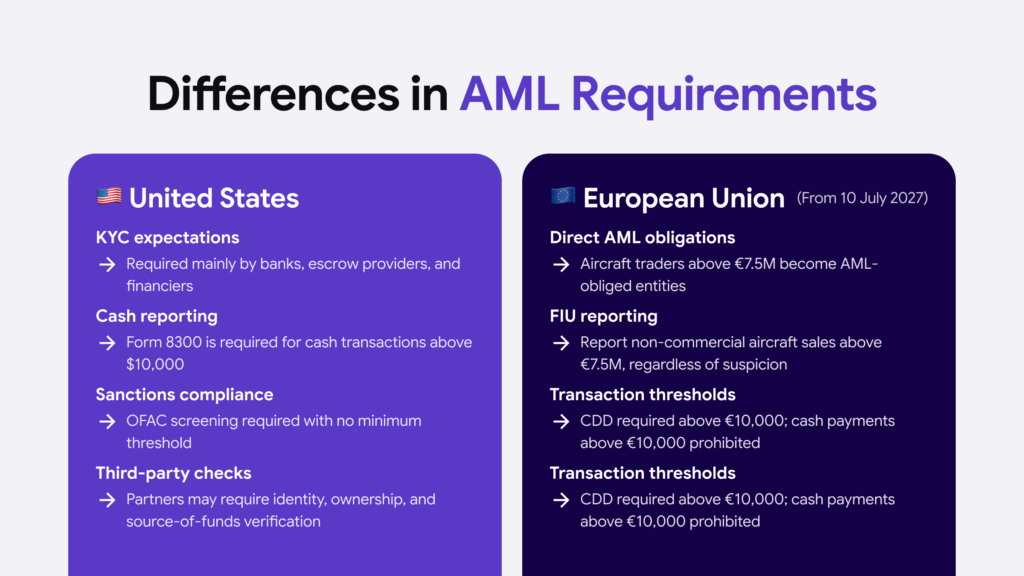
So, while some jurisdictions don’t directly name private aviation brokers as obliged, regulated entities, they’re still exposed to money laundering risks. Yet, we see concrete examples where aircraft brokers are under the radar and are becoming regulated. For example, under the EU’s Anti-Money Laundering Regulation (Regulation (EU) 2024/1624), persons trading in, or acting as intermediaries in the trade of high-value goods become obliged entities, and aircraft are explicitly named in that category.
-> Keep in mind that the regulation applies from 10 July 2027, with no national transposition step, because a regulation applies directly across every Member State (rather than being rewritten into 27 different national laws).
Related: AML Compliance for the Luxury Goods Market
How Aircraft is Used to Hide Illicit Ownership
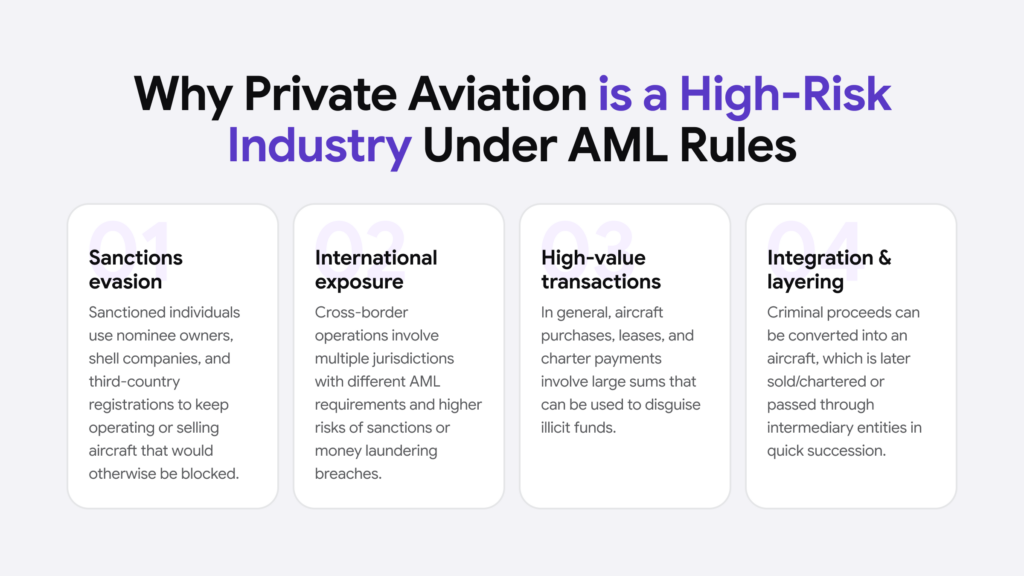
Most AML programs treat risk as something that sits in the payment or is linked directly to the transaction, but the issue is much bigger. Since private jets are worth this much, they are used as a tool to launder funds, and all this is possible due to hidden ownership.
For example, in the US, the FAA registry covers about 300,000 civil aircraft, but it’s based on a principle that it’s a self-declared database. The GAO investigated this case and issued 15 recommendations that would help better verify and identify information linked to applicant identity and aircraft ownership. That said, GAO identified 2,300 aircraft registered to likely shell companies and 3,300 registered to non-citizen trusts.
This is linked to the global phenomenon of not disclosing or using complex ownership structures on purpose.
Other examples provided by GAO were:
- A Malaysian money laundering case. It included an aircraft that used layered structures and multiple intermediaries to hide the true owners.
- An Oklahoma case. The owner of an aircraft title company and several associates were indicted on federal charges including money laundering and aircraft registration violations. As a result, at least 50 pre-owned aircraft transactions were frozen (even though most were not connected to the case).
Yet, this once again becomes a challenge when you’re dealing with ultra-high-net-worth individuals. They simply hold their money and wealth in assets that are known to have limited transparency. It can be anything from precious metals to private company holdings.
This then results in third-party payments, like:
- A company pays for its director’s flight with a private jet
- A sponsor pays for their guest who’s flying out with them
- A family office pays for a principal
So what can you do as a broker? Where the payer is a company, business verification and UBO checks apply. You should use a UBO verification service to assess the ownership chain behind the aircraft. Of course, standard measures for individual clients, such as source of funds (determining specifics about a payment, like which wallet or sale it came from) or source of wealth (asking for proof of the whole accumulated funds of the client), are key. That’s because a customer can show a clean bank statement for their aircraft that’s worth millions but still be unable to explain how they got to this level of wealth.
Related: 6 Steps to Conduct a KYB Verification Check [Guided Explanation]
Common Red Flags in the Private Aviation Industry
If you’re a broker and you’re arranging a private jet charter sale, you need to watch out for common risks, such as:
- Unusual payment amounts (that don’t match the value/purpose of the aircraft transaction)
- Payments from third parties that aren’t related (someone other than the customer who needs to pay for the high-value charter)
- The aircraft is sold through a series of back-to-back deals (if it’s unclear who ultimately owns the aircraft and the ownership is hidden)
- Rapid movements (such as if money is entering an account and is then suddenly transferred elsewhere)
- The aircraft recently changed owners or registration without a genuine sale (for example, the aircraft was transferred between related companies or moved to a new registry without being sold to an unrelated buyer)
- High-risk countries and jurisdictions (when transactions come from locations known to have a higher AML or sanctions breach risk)
- Other repeated activity that seems unusual (patterns that fall out of the customer’s typical profile, especially if they are returning)
Other red flags that you should take into account include things like if the aircraft was sold without an inspection or test flight. This approach can be a sign that the manufacturer, operator, or other parties are no longer able to support the aircraft. Other factors linked to geopolitics are also important.
For example, if the aircraft’s flight history shows links to Russia post February 24, 2022, when the sanctions on Russia were introduced. Yet, indirect, similar red flags are also important, like if the aircraft was moved to a country such as the UAE shortly after sanctions were imposed and then stopped flying.
Related: 10 AML Red Flags [A Quick Breakdown]
AML Requirements That Private Aviation Brokerage Firms Follow
Other tips regarding AML obligations specifically for private aviation brokerage firms include measures like:
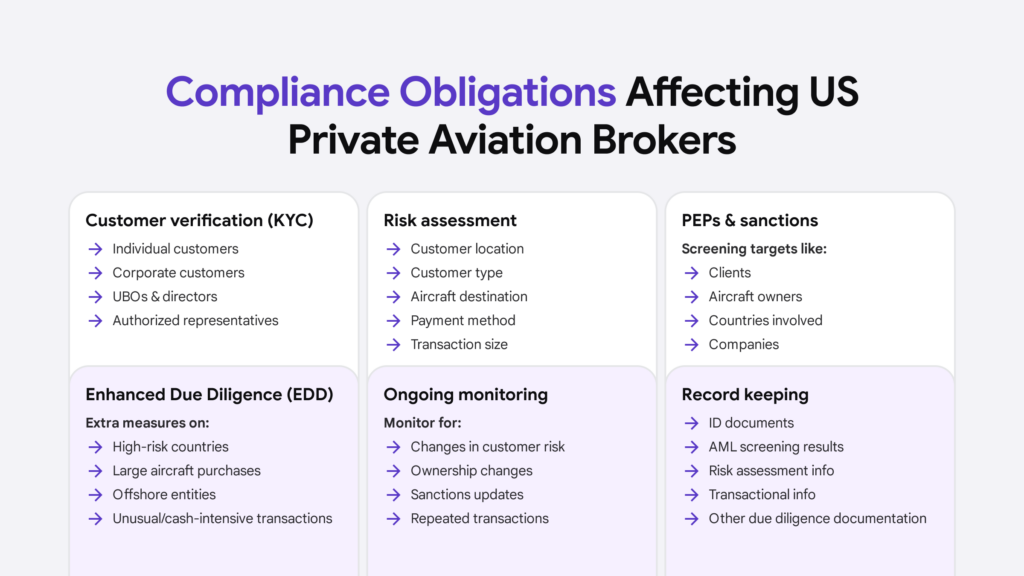
1. Conduct a Risk Assessment
Assess where the risks are most likely to reach your business. Determine who your typical clients are, what they’re buying, how their transactions are structured, or where the money and aircraft will be moving.
Other factors to consider when doing a risk assessment include the client’s country, the aircraft’s registration, whether the buyer is an individual or a company, whether an ownership structure is layered, or whether payment comes from a third party/through digital assets. For example, crypto payments are generally considered to be higher-risk, especially in an industry like aviation.
2. Appoint a Compliance Officer
This is typical of many AML programs. The designated compliance officer is responsible for shaping the whole system and, in a smaller firm, can often be the director or a senior manager. Their responsibilities are reviewing the current processes (and keeping them up-to-date with local/global AML laws) and deciding when a high-risk case needs to be escalated. Sometimes, they also do the customer due diligence and monitor client transactions.
3. Train Both Compliance Staff and Brokers
Brokers deal directly with clients, and they need to be able to recognize the warning signs if something seems off. Before confirming and booking the jet for the client, they need to be aware of the escalation process and need to know what red flags to look for before a transaction moves forward.
4. Apply the Risk-Based Approach
Not every private charter deal carries the same risk. The level of due diligence needs to match the risk and the risk profile the client has, which means a risk-based approach is relevant in aviation as well. Payment methods or the location of the client are very important here. For example, a returning customer paying with a verified card (they used before) or their own domestic bank account automatically presents less risk than a new customer who’s booking a charter for the first time.
High-risk clients can be those who want to book through an offshore entity or those paying with digital assets. Low-risk clients require “softer” due diligence, while high-risk customers go through extra due diligence measures, or Enhanced Due Diligence (EDD).
5. Verify UBOs of Corporate Clients
UBOs, or ultimate beneficial owners, are involved behind every company, and when a hidden ownership structure is used, UBO identification is the first step for breaking down the true owners of an entity. In a private aviation brokerage firm, this includes everyone: the buyer, the seller, the aircraft operator, and the management company. Afterwards, deeper checks are still needed. Sometimes, corporate registries won’t do the trick either.
6. Verify the Source of Funds and Wealth
Simply put, you need to know where the money comes from and where the client received the funds for the aircraft request. This includes high-risk clients and high-value deals, depending on your determined risk strategy and general AML laws.
In practice, this often includes sending out a questionnaire or adding an extra step in the KYC onboarding process that requires the customer to provide additional documentation. In this case, bank statements, financial records, and other documents that could be linked to the concrete evidence. Despite that, a client being known to your brokerage firm for a longer period of time does not automatically make a new high-value transaction low risk.
7. Conduct AML Screening
The standard AML screening package means the client or anyone involved in the financial transaction needs to be checked against sanctions lists, global watchlists, Politically Exposed Persons (PEPs) lists, and, sometimes, adverse media. This can include passengers as well, since the target audience and high-net-worth individuals can be sneaking in a sanctioned individual. The aircraft needs to be screened as well before approving the transaction and as an ongoing due diligence measure.
8. Have Clear Reporting Procedures
This also includes low-value transactions if there are reasonable grounds for suspicion because low-risk does not automatically remove the reporting obligation. In general, in private aviation, there are two different types of reporting:
- First, if a broker suspects money laundering or another financial crime, the transaction may need to be reported regardless of its value.
- Second, certain transactions may have to be reported even when there is no obvious suspicious activity.
Private aviation brokerage firms need to understand which rules apply to their business and when a transaction must be reported to the relevant Financial Intelligence Unit (FIU). Additionally, under the EU AML framework, businesses covered by the rules for high-value and luxury goods may have additional reporting obligations for certain non-commercial aircraft sales.
9. Ensure Compliant Record-Keeping Practices
Five years is a common industry standard, but you should confirm the concrete baseline depending on your jurisdiction. Often, private aviation brokers keep customer transaction records and KYC data because questions can arise in the future, and once you pull out those records, they help uncover ownership structures and other important details required for background checks and ensuring due diligence standards. This is very important in cases where the aircraft is being resold, or if risk profiles change and there are changes in ownership structure.
10. Keep an Audit-Ready Log
Logging your transactions simply demonstrates compliance when you need to read it at your bank, insurance company, or the aircraft owner’s counsel. Clear records of each transaction, KYC results, AML screening results, and which checks were performed need to be logged, as well as other details, like what comments your compliance officers left to each case, why they made the decision, and when these data points were captured.
Key Takeaways
- A brokerage deal has multiple counterparties. Passenger, payer, owner, operator, and management company each need verification and AML screening.
- The registered owner of an aircraft is often not the beneficial owner. That’s why KYB verification and UBO verification are also beneficial in the private aviation industry.
- Source of funds and source of wealth are separate questions. UHNW clients can pass the first and fail the second.
- Sanctions screening has to cover assets and operators, not only individuals.
- AML automation is what makes the standard hold. When compliance takes hours, commercial teams work around it; when it takes 60 seconds, it becomes part of the truly smooth onboarding flow, which is what clients expect when booking a charter.
- Aircraft brokers and intermediaries become obliged entities under the EU AMLR from 10 July 2027. In the US, OFAC strict liability and extraterritorial reach already apply, with no program mandate to hide behind.