DAC8, or the EU’s Directive on Administrative Cooperation, also known as the tax transparency law for crypto-assets, was launched on January 1, 2026. It doesn’t have a standard threshold like financial institutions, which means that all transactions and their details should be recorded and tracked by Crypto-Asset Service Providers (CASPs).
In brief:
-> DAC8 requires crypto platforms to collect and report transaction and customer information to tax authorities.
-> The collected information is then shared between EU countries, giving tax authorities the whole picture of how the funds are taxed across borders, which improves visibility.
-> The first reports for 2026 are due by 30 September 2027, depending on how each EU country implements the rules.
Like many regulations, DAC8 covers entities outside the EU as well. For example, if your crypto exchange is based in the US but offers its services to European customers, you’re obliged to comply with the rules and report their data. Earlier this year, the European Commission took action by sending formal legal notices to 12 member states that have not provided proof of compliance with DAC8.
I explain how not to fall into such a situation and go through the latest updates on DAC8.
What is DAC8 in Simple Terms?
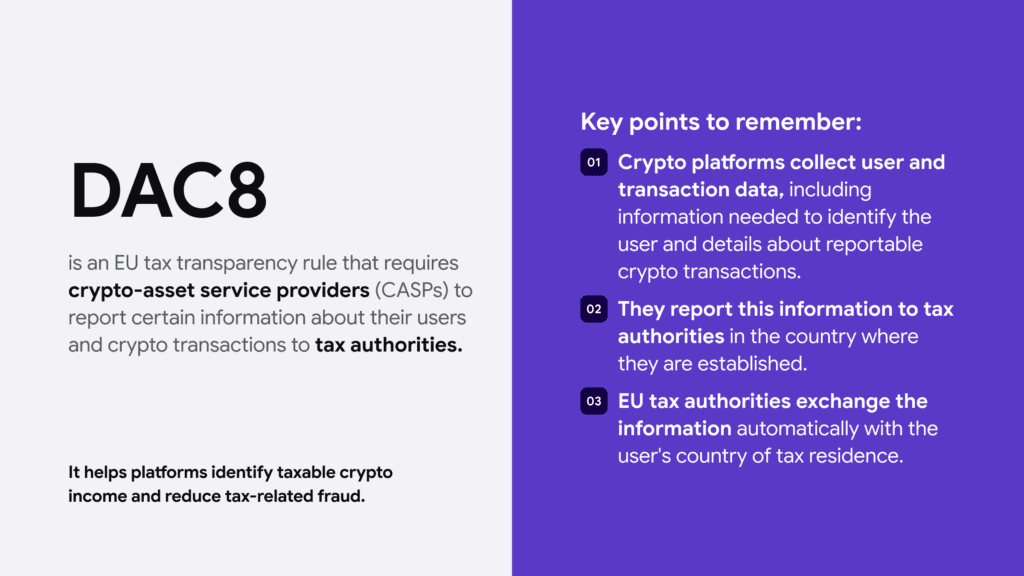
DAC8 is an EU tax reporting rule that covers various crypto firms. It aims to provide a global standard and improve transparency regarding digital asset transactions while preventing fraud and tax evasion. Under DAC8, obligated entities need to share more details about their crypto transactions and where they come from.
Keep in mind that DAC8 covers the reporting part, not tax payments. The Directive gives tax authorities more visibility into crypto transactions. However, individuals are still responsible for calculating and declaring any tax they owe under their country’s tax rules. DAC8 helps provide an automated and more structured approach to cross-border crypto transactions, which are considered more “high-risk” under the general Anti-Money Laundering (AML) rules.
In general, the Directive is the eighth amendment of the original Directive on Administrative Cooperation in Direct Taxation. DAC7 was designed to improve transparency for marketplaces, such as eBay or Vinted. DAC8 expands EU tax reporting rules and covers crypto assets.
KYC for crypto and blockchain
Stay compliant with evolving crypto regulations. iDenfy helps exchanges and DeFi platforms verify users globally.
Explore Crypto SolutionWhat Changes for Firms Under DAC8?
The main change is that crypto transactions are now regulated under the EU’s existing system for exchanging tax information. In practice, crypto platforms are required to collect, verify and report customer information and transaction data.
| Before DAC8 | After DAC8 |
|---|---|
| Crypto platforms had no EU-wide duty to report customer activity to tax authorities | Crypto platforms serving EU residents must report customer activity to tax authorities every year |
| Each country set its own approach to crypto tax, if it had one | One set of rules across the EU, with data shared automatically between countries |
| Onboarding focused on identity and AML checks, with little tax data collected | Onboarding includes tax residence and tax identification number (TIN) checks |
| Tax authorities relied on users declaring their own crypto gains | Tax authorities receive the data directly from platforms and can cross-check what users declare |
| Reporting formats varied and were often handled manually | Reporting follows standardized formats, with data exchanged across the EU in a common format |
Similar to how banks report tax information to tax authorities every year, under DAC8, crypto platforms need to do the same. The information is then shared automatically between EU countries.
What is the Purpose of the Directive on Administrative Cooperation (DAC8)?
DAC8 expands the existing tax reporting framework, specifically covering crypto assets and new forms of digital assets, which have not been previously regulated this way.
The main goals of DAC8 in simple terms are to:
- Help crypto service providers to report information about EU users and their crypto transactions.
- Create a consistent reporting approach across all 27 EU countries.
- Bring certain newer forms, such as e-money products, into existing reporting rules to improve transparency.
- Prevent tax evasion and give tax authorities the needed info.
DAC8 aims to check if the income that comes from crypto is reported properly and is taxed adequately.
What is the Crypto-Asset Reporting Framework (CARF)?
CARF, or Crypto-Asset Reporting Framework, is a global tax reporting framework for crypto-assets developed by the OECD, or the Organisation for Economic Co-operation and Development. It requires participating countries to collect and exchange information about certain crypto transactions and users.
In the context of DAC8, CARF:
- Is a wider, global standard. DAC8 is the EU’s law.
- Sets the grounds for the DAC8 rules. The OECD’s guidance on CARF can help explain DAC8 where the two texts match.
OECD is responsible for international standards on sharing tax information and improving tax transparency (including for crypto-assets, which is relevant for DAC8).
Who Must Comply With DAC8?
Firms that need to comply with DAC8 requirements include:
- Crypto brokers (apps that allow users to buy crypto, including fintech or trading platforms like Revolut or eToro)
- Centralized exchanges (platforms where users trade crypto, such as Kraken or Binance)
- Crypto payment processors (service providers that allow platforms to accept cryptocurrency)
- Crypto ATMs (that swap cash for cryptocurrency)
- OTC desks (that arrange crypto trades for clients)
- Crypto portfolio managers/advisers (those who recommend or manage crypto investments)
- Custodial wallet providers (companies that hold crypto and allow their clients to send/swap it)
- NFT marketplaces (where NFTs are sold or used for payment)
To determine whether DAC8 applies to your business, you need to check whether you’re considered a Reporting Crypto-Asset Service Provider (RCASP). In simple terms, this means that your business facilitates reportable crypto transactions.
Questions Helping to Identify if You Meet DAC8 Reporting Requirements
You need to identify your users and ask some practical assessment questions:
1. Do You Provide Crypto-Related Services?
For example, do you offer any service that facilitates crypto transactions? For example, this includes cases of operating an exchange, trading platform, or a brokerage.
2. Do You Facilitate Reportable Transactions?
In general, crypto-to-crypto exchanges, crypto-to-fiat exchanges, and certain crypto-asset transfers are all covered by DAC8.
3. Do You Have Users Who Reside in the EU?
All reportable crypto transactions that involve EU-based customers need to be compliant with DAC8 rules. This also includes firms outside the EU that have customers who are reporting residents within the EU.

Just to put it out here: not every crypto-related firm is automatically considered to be a Reporting Crypto-Asset Service Provider. There are specific exclusions for DAC8, which you need to check with your particular business model and its operating countries for other specific regulations. For example, if a company doesn’t have any reportable EU users (there might be no information to report), it might not fall within the DAC8 scope.
Additionally, DAC8 expands existing reporting requirements for traditional financial companies, which are now required to report details on central bank digital currencies (CBDCs) (which are government-issued digital currencies (like a future planned digital euro) and certain electronic money products (pre-paid cards, for example, and services linked to balances held in apps like Wise or PayPal).
What About Regular Crypto Users?
Individual users don’t need to file any DAC8 reports. The business and the platform handling their transactions are responsible for the filing.
Despite that, for the platforms to access information, users might be asked to share their name, date of birth, address, and Tax Identification Number (TIN), which are all details common in obligated industries and their Know Your Customer (KYC) verification procedures.
This way, tax offices can compare the received information (of what the users bought, sold and moved throughout the year) and see if there are any mismatches with what was declared.
Related: EIN Verification in KYB Compliance [Dos & Don’ts]
What Information Needs to Be Collected to Comply With DAC8?
Under DAC8, obligated crypto platforms need to collect information around the user’s:
- Identity. Full name, address, and date and place of birth for individuals. For business customers, this includes details of the people who control the entity.
- Tax residence. The country or countries where the user is considered a tax resident, confirmed through a self-certification.
- Tax Identification Number (TIN). The number issued by the user’s country of tax residence.
- Transaction details. The type of crypto-asset, the number of units and the number of transactions, grouped by category (crypto-to-fiat, crypto-to-crypto, transfers and retail payments).
- Transaction value. The total amount paid or received for crypto-to-fiat trades, and the fair market value for crypto-to-crypto trades, transfers and retail payments.
- Wallet addresses. Platforms must keep records of external wallet addresses linked to reportable transfers, even though these aren’t included in the report itself.
What Does Self-Certification Under DAC8 Mean?
This is a special form that crypto platforms are obliged to get from their users under DAC8. It is designed to help verify the user’s tax residence and the related information. The crypto firm is then responsible for checking if the provided self-certification is reasonable. In practice, platforms cross-check the submitted information with pre-verified KYC records.
This is why conversions matter. Having a smooth KYC process from the start directly impacts both DAC8compliance and the overall user experience on the platform. Asking users to resubmit information that should have already been processed and recorded is one example of how KYC drop-off and incompletion rates can increase. Users who don’t tend to share data or feel unsafe are at higher risk of changing platforms and heading to a competitor.
Related: 5 Key Customer Onboarding Mistakes Costing Your Business Growth
What Happens If You Don’t Comply With DAC8?
The classic non-compliance bundle can become a real issue for you if you don’t comply with DAC8 reporting requirements.
This includes:
- Fines and disrupted operations (the exact penalties depend on the jurisdiction)
- User restrictions in cases where they don’t provide required information
- Stricter monitoring and scrutiny from tax authorities (for example, for incorrect or missed reports)
- Reputational damage and adverse media (lost trust among users, partners, or investors)
How iDenfy Helps Stay In Line With DAC8 Rules
At iDenfy, we have the full compliance suite, made up of KYC/KYB and AML tools, all beneficial for the crypto industry and DAC8 compliance obligations. We help automate customer ID verification, screening and monitoring, saving at least 40 hours per week of manual work for your internal analyst team.
For DAC8 in particular, I recommend looking into iDenfy’s:
- Identity verification service (ID doc check and OCR data extraction + selfie biometrics w/ passive or active liveness; reauthentication in high-risk cases for better conversions)
- Address verification tool w/ automated, seamless utility bill verification
- Business verification and a full KYB platform w/ built-in UBO checks, EIN/TIN lookup, AML screening, and more, including custom questionnaires for faster data collection and reporting (you can download a free report on it here)
- AML screening w/ PEPs and sanctions checks, watchlist screening and adverse media screening
- Transaction monitoring to track, monitor and report both fiat and crypto transactions