Quick Intro
CSGOWin’s main users are online gamers who stake Counter-Strike 2 in-game items. It’s a CS2 skin gambling and iGaming platform that juggles a huge audience that’s looking for entertainment: from skin-native modes like jackpot and case battles to casino-style games like mines and Plinko. With a large portion of the CS2 player base being under-18s, the platform needed a way to ensure a secure gaming experience with an effective, user-friendly age verification process before registration. Each step and checkup needed to be polished, or users were more likely to abandon the platform and go to a competitor.
Even though CSGOWin brought together different fields not linked to traditional banking, such as crypto, digital assets, and iGaming, regulations tightened, and lighter onboarding checks were no longer a sustainable approach. The platform’s volumes started to reach over a million in deposits a month, but the audience remained young and global, which is what made the Know Your Customer (KYC) onboarding side of things matter so much for the team. So, CSGOWin simply couldn’t risk losing customers and wanted to ensure the very first step on their platform was seamless.
The Challenges
CSGOWin continued to scale, taking a lead position in its sector. With growing user volumes, the online CS2 skin and crypto gambling platform noticed a higher number of bonus abuse cases, which then came along with other challenges typical to the iGaming sector, like multi-accounting. Additionally, regulations tightened, and CSGOWIN’s payment partners were auditing and acquiring the firm regarding its compliance setup.
🟣 Compliance and User Experience
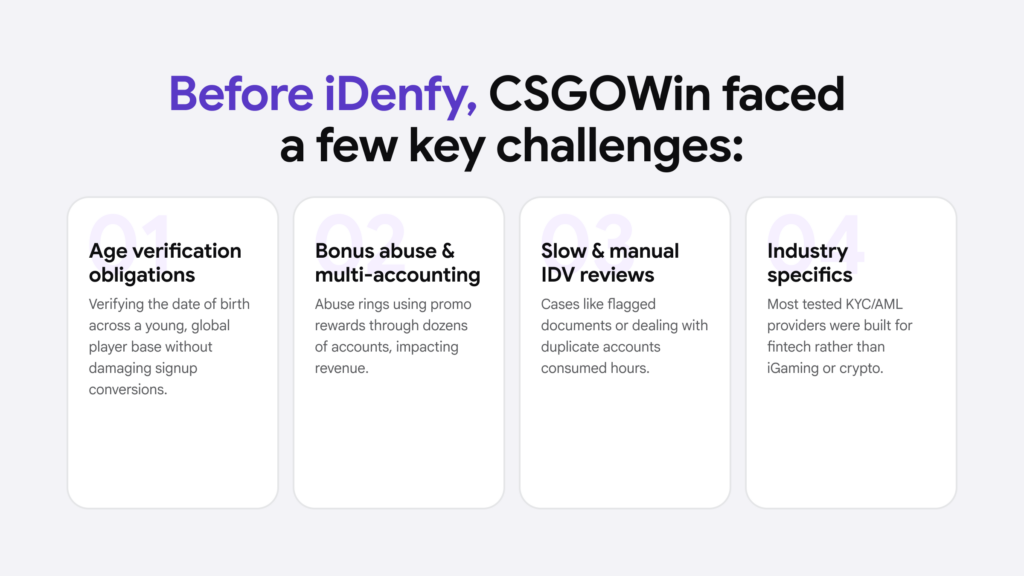
CSGOWin found itself in a unique position, needing to align multiple services across iGaming, crypto, and digital assets. This meant its next KYC provider had to deliver a scalable approach to player onboarding while supporting and truly specializing in all three industries. The platform needed to start with the most important factor: improve the initial registration stage, where users add their credentials and sign up for its services.
Simply put, CSGOWin’s team looked for something that could reliably confirm a user’s date of birth without crushing legitimate signups with friction:
“Early on, we leaned toward lighter checks because we were worried about conversion.”
Rapunzel, the CEO of CSGOWin, who uses this online alias
However, regulatory rules in iGaming and gambling require triggering document-based ID verification checks, which meant the user needed to capture a photo of their physical government-issued ID document to prove their age. The standard onboarding flow would then have to follow up with a second verification layer, or a biometric check with liveness detection.
That’s why too many steps or even small details regarding U/X, for example, if the player is prompted to move their head too much during the liveness check, would have crushed the approval rate and resulted in higher drop-offs. For CSGOWin, this was not the goal at all:
“Every step you add to onboarding costs you users, and in our space, someone can switch to a competitor in seconds, so the instinct is to keep it light and only escalate when something looks off. That stopped working pretty quickly,” explained Rapunzel.
🟣 Bonus Abuse and Multi-Accounting
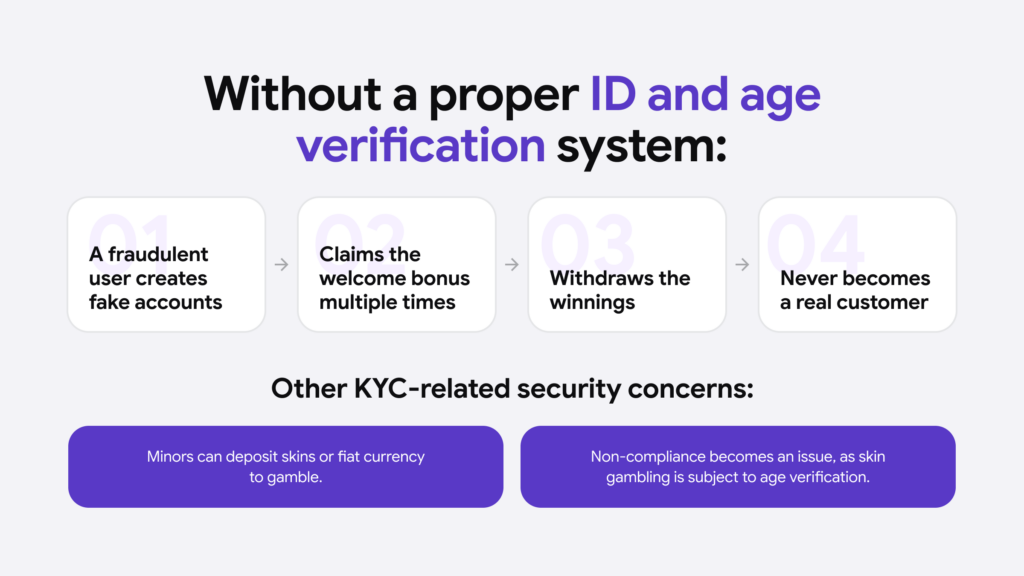
While promotional offers and special discounts to new users are core to acquisition in iGaming, they open doors to illegitimate players as well. CSGOWin didn’t want to keep covering acquisition costs that would go to those who use multiple accounts and abuse its Terms & Conditions. The goal was to attract more genuine players who would hopefully stay on the platform and keep using CSGOWin’s services over time.
“Bonuses automatically mean that you can get hammered by abuse rings creating dozens of accounts to farm such rewards. Without strong identity binding, you’re basically paying CAC for the same handful of bad actors,” said Rapunzel, the CEO of CSGOWin.
Due to scaling and attracting new players, bonus abuse cases became a bigger issue, directly negatively impacting and hurting the ROI on CSGOWin’s marketing. The company would run a creator campaign, and a real chunk of the signups would just be people farming the bonus rather than becoming actual players that convert and use the services in the future.
“Manual player ID reviews were slowing down withdrawals, which is one of the fastest ways to lose a player in iGaming,” said Rapunzel.
Together with the need for better management of multiple accounts, the overall need for a fully automated KYC and Anti-Money Laundering (AML) system became non-negotiable for CSGOWin. The company wanted to scale in a more sustainable way while meeting the compliance standards of the industries it operates in. CSGOWin also needed an audited, compliant KYC stack to demonstrate the reliability of its platform when onboarding a new payment processor.
The Goal
The main requirements for the new vendor from CSGOWin were the ability to automate both ID/age verification and the AML screening process, which was also required for the platform to offer compliant and secure services:
“Apart from KYC automation and fraud prevention, AML was the third piece in our checklist,” said Rapunzel, the CEO of CSGOWin.
CSGOWin’s compliance team spent hours daily manually checking flagged users or edge cases that required double-checking or stricter measures, like re-verification after onboarding. Simpler tasks, such as identifying and filtering out duplicate accounts, were also becoming a hassle due to the lack of a unified, automated KYC/AML system.
So, by removing the manual burden and automating player onboarding and mandatory AML tasks, such as PEPs & sanctions screening, CSGOWin aimed to improve the experience not only for their players but also for analysts who are working on onboarding and account management.
The Solution
After trying out different third-party software providers for KYC onboarding, age verification, and AML screening, CSGOWin chose iDenfy.
The iGaming platform customized its player onboarding workflow, using different features:
-> Document verification. The player on CSGOWin is asked to capture their personal information, including their DOB, to safely confirm they’re of legal age to access the platform.
-> Biometric verification. The user is then asked to capture their selfie, aka their facial biometrics, allowing the system to cross-check it with the photo on the provided ID. This prevents bypassing attempts and duplicates, including deepfakes and the common tricks that illegitimate players use to access bonuses.
-> PEPs & sanctions checks. The user’s information is screened against global AML databases, such as PEPs, sanctions lists, or watchlists, as a way to ensure that prohibited users aren’t allowed to access the platform. High-risk users are automatically flagged, and then CSGOWin sets another workflow in case extra due diligence is required.
“Beyond the product itself, iDenfy also gives us strong tooling for the cases where we need to do a more thorough background check on a user — pulling country of residence reliably from the document, flagging anomalies, that kind of thing,” noted Rapunzel.
CSGOWin tailored the verification flows, triggering ID verification based on specific risk events rather than front-loading it to every user. This helped balance out security and not overburden low-risk, genuine players. For example, now KYC is also triggered automatically later in the user journey, but only in high-risk situations. This includes cases when deposits/withdrawals exceed a threshold, or mandatory AML re-checks and monitoring are required by a default schedule.
Why iDenfy?
CSGOWin chose iDenfy because it offered:
✔️ KYC & AML checks in one place
✔️ Proper age verification technology with liveness
✔️ Customization options and easy iFrame integration
✔️ Pay-per-approved pricing that worked for its volume profile
✔️ Demonstrated iGaming & crypto experience with recognizable operators
The Results
By partnering with iDenfy, CSGOWin switched from a manual player onboarding process to a fully automated KYC/AML system, which now includes a smooth age verification flow, required to welcome new users to the platform.
iDenfy’s software integration helped CSGOWin achieve:
- A KYC pass rate of 90%+ for legitimate signups
- An average ID verification completion time of less than 60 seconds
- At least 30% cost reduction linked to KYC/AML compliance tasks
- A reduced review queue, saving 20+ hours of manual work every week for analysts handling edge or high-risk cases
AML monitoring now runs daily across CSGOWin’s active player base, which would just not be doable manually at its growing volume. Bonus abuse and multi-accounting also dropped noticeably once identity binding moved up front to the initial registration stage.
It’s also worth mentioning that iDenfy’s integration helped CSGOWin demonstrate its trustworthiness in terms of a compliant KYC stack when partnering with a new payment processor:
“The payment processor’s compliance teams already knew who iDenfy was, so we didn’t get the same questions we used to. In our category, where most operators struggle to get banked at all, that recognition has made a real difference in keeping and expanding our fiat on-ramp.”
Rapunzel, the CEO of CSGOWin