Generating billions in revenue, luxury goods companies, such as those in art, wine, jewelry, cards, and private jets, are a primary example of how a picture can be shiny on the outside but rotten on the inside. Beyond the simple act of purchasing luxury goods with funds gained from criminal activities, there’s a lesser-explored channel in the relationship between luxury items and financial crimes.
That’s why only a few know that these goods not only serve as a destination for illicitly obtained money but also play a huge role in facilitating various forms of money laundering. To mitigate the threat of financial crime, luxury goods market companies have adopted diverse anti-money laundering (AML) measures aimed at boosting transparency and adherence to anti-money laundering regulations.
We’ll discuss how money laundering works while pinpointing the importance of different AML compliance initiatives for the luxury goods industry.
What are Luxury Goods?
Luxury goods refer to high-end, typically non-essential items that are often associated with premium quality, exclusivity, and high cost. In the context of AML compliance, luxury goods can be vulnerable to illicit financial activities. In many countries, high-value goods dealers are subject to the same AML laws that apply to banks, iGaming platforms, cryptocurrency, and other industries.
AML regulations require businesses involved in selling luxury goods, such as high-end fashion, jewelry, art, and vehicles, to implement measures to prevent money laundering and terrorist financing. This includes conducting due diligence on customers, monitoring transactions for suspicious activity, and having robust risk assessment and systematic frameworks in place to mitigate the risks associated with these valuable and often portable assets.
Automate your AML checks
Screen customers against global sanctions, PEPs, and watchlists in real time with iDenfy AML Screening.
AML Screening SoftwareWhy is AML Compliance Crucial in the Luxury Goods Sector?
China, France, Italy, Japan, the United Kingdom, and the United States constitute some of the world’s largest luxury markets. In 2023, the revenue in the Luxury Goods market reached $354.80 billion, with an anticipated annual growth rate of 3.38% until 2028. The biggest segment within the market is Luxury Fashion, accounting for a market volume of $111.50 billion. Despite that, while banks are the primary source of suspicious activity reports, luxury goods dealers are known for their low levels of reporting.
Naturally, the scope of the luxury goods market size requires companies to react and implement more robust anti-fraud measures. They are extremely important to prevent the flow of dirty money into luxury assets without any consequences or detection. Especially since this culture of confidentiality has had a negative impact on the luxury art market.
For example, in transactions, buyers and sellers often resort to using foreign and offshore accounts, and mediators, typically engaging in online auctions, play a key role in negotiating and finalizing deals. The Panama Papers, leaked by the International Consortium of Investigative Journalists, exposed instances where high-value art was held through anonymous shell companies to conceal the true owners.
Why are Luxury Goods Companies Subject to AML Compliance Obligations?
Luxury assets are a way to “clean” illicit funds using dirty money for reselling purposes. This method enables criminals to transfer money internationally, evade taxes, and avoid detection by law enforcement agencies. To counteract this global issue, many countries have enacted laws mandating that luxury brands and dealers in high-value goods report suspicious transactions and have a robust AML program.
For example, the Los Angeles Fashion District, spanning over 100 blocks with numerous clothing and apparel stores, was exposed for two fraudulent schemes:
- One involved imported clothing, with over $10 million in customs duties going unpaid.
- The other was a Black Market Peso Exchange (BMPE) scheme, where the company allegedly laundered drug trafficking proceeds and failed to report over $17 million obtained in cash on tax returns.
Some jurisdictions fail to keep up with AML compliance rules, making the luxury goods market an appealing choice for organized criminal networks seeking to launder money or engage in illicit activities.
Risks Indicating Fraud in the Luxury Goods Market
There are signs that illustrate potential risks in terms of luxury goods transactions. Here are the most common money laundering risk examples:
- Cash transactions. Luxury businesses often engage in cash transactions, creating a great channel for criminals to launder money discreetly by making cash purchases and transferring assets to other parties.
- Avoiding reporting. Large cash transactions, especially in foreign currency or structured below the reporting threshold, serve as red flags for potential money laundering activities.
- Insufficient due diligence. Such as identity verification measures and Source of Funds confirmation provides an opportunity for criminals to exploit the luxury goods market.

Compliance Challenges for Luxury Goods Dealers
The key AML compliance challenges linked to the luxury goods industry and its dealers include factors like:
- Limited expertise in compliance. Smaller businesses don’t have the resources to hire compliance specialists or have the right training.
- Complex ownership structures. Some dealers use offshore accounts and intermediaries on purpose to hide the real buyer or the beneficial owners behind the luxury goods firm.
- Cross-border and high-value transactions. These factors set the grounds for why the luxury goods industry is considered to be higher-risk in the first place. It’s harder to deal with multiple payments in different currencies and countries, especially when large sums of money are moved via a single purchase. Tax evasion is also an issue.
Luxury markets are targeted due to the fact that small items like high-value watches or jewelry are easy to transport. They’re compact and can be exported easily, maintaining resale value in any country. Some luxury goods resellers also claim to keep the anonymity of the buyer, making it an attractive opportunity not only in terms of straight-up money laundering, but, for example, sanctions evasion, where certain buyers should have been restricted from getting their hands on luxury assets.
Related: Sanctions Screening Best Practices for Logistics
Real-Life Examples of Money Laundering Using Luxury Goods
The increasing worries about money laundering and terrorist financing involving luxury goods have influenced global financial watchdogs to regulate the sector rigorously. However, strict AML compliance measures haven’t stopped criminals from laundering illicit funds through luxury items.
Here are some actual cases of money laundering in the luxury goods industry:
1. Operation Car Wash
Brazilian law enforcement executed “Operation Car Wash” to unveil suspects engaged in money laundering through luxury goods. Initiated in March 2014 with an inquiry into a modest car wash in Brasília for money laundering, the investigation revealed a major corruption scheme within the Brazilian federal government, particularly in state-owned enterprises.
This money-laundering investigation targeted the state-run oil company, and authorities conducted raids on the homes of deputies, senators, as well as government officials. They discovered hidden cars and money. Additionally, a separate raid on former president Fernando Collor de Mello’s house unveiled a Ferrari, a Porsche, and a Lamborghini, according to police investigations.
2. Teodorin Obiang’s Corruption Case
In late 2016, Dutch authorities seized the $120 million superyacht Ebony Shine, while Swiss officials confiscated eleven of the world’s most expensive cars. These assets were allegedly linked to Teodorin Obiang, the vice president of Equatorial Guinea. The Swiss government had been conducting a prior investigation into Teodorin Obiang on alleged money laundering charges.
A few months prior, they had already seized 11 cars from him. However, a spokesperson for the Malabo government refuted the assertion that Teodorin Obiang owned the cars and yachts, stating to L’Hebdo that these assets belonged to the State of Equatorial Guinea. In 2000, as Obiang started expanding his car collection, Equatorial Guinea was officially the wealthiest African country per inhabitant.
However, a significant majority of the country’s citizens lived below the poverty line. That’s why Obiang’s extravagant lifestyle contrasted with ordinary people’s lifestyle in Equatorial Guinea, where over half the population survives on less than a few dollars a day despite the country being one of Africa’s leading oil producers.
3. The Bribery Affair of Viktor Yanukovych
After pillaging state coffers and being convicted of treason, former Ukrainian president Viktor Yanukovych is now revealed to have funneled EUR 3.7 million through a Swedbank account. Despite that, these funds were associated with a suspected bribe and have been within Swedbank’s knowledge since 2017.
Following the deposition of former Ukrainian President Viktor Yanukovych, various journalists, activists, and regular citizens stormed the country’s palace. During this upheaval, they uncovered many luxury goods, including bottles of Cristal, chandeliers, a Fabergé egg, and even a Steinway piano on which John Lennon sang “Imagine No Possessions.”
In total, Yanukovych and his partners in crime, referred to as ‘the Family,’ were suspected of embezzling up to $37 billion. They were alleged to have concealed these funds in various bank accounts and company shares worldwide, including Latvia, Austria, Italy, Cyprus, and the Netherlands.
Related: Smurfing in Money Laundering
Expected Regulatory Trends in the Luxury Goods Market
Regulators are cracking down on the luxury goods market by trying to find more effective ways to prevent financial crime. However, while physical luxury items pose challenges related to storage and may be challenging to move discreetly, there’s an increasing trend of virtual assets.
Metaverse platforms introduce the possibility of the term ‘luxury goods’ extending into the virtual realm. From a regulatory standpoint, this transformation may facilitate faster transfers, potentially aiding criminals in evading sanctions. Now, especially since Russia’s war on Ukraine, sanctions have seen increased use, resulting in the confiscation of luxury goods and various lists of items currently prohibited from being sent to Russia.
Other regulatory compliance trends addressing money laundering in the luxury goods market include:
- Europe. The EU faces growing regulatory scrutiny as each of its anti-money laundering directives (AMLDs) targets the industry. In 2020, the 5th AMLD directive was implemented, introducing expanded laws regarding luxury goods.
- The USA. After several high-profile public corruption trials in recent years, the Financial Crimes Enforcement Network (FinCEN) in the US has broadened its attention to the role of luxury goods.
- On a global scale. In its report on trade-based money laundering, the Financial Action Task Force (FATF) addressed the issue regarding the luxury goods sector. The report emphasized how the traditions of discretion and confidentiality in the luxury market increase the risk of money laundering, opposing the use of luxury goods for financial crimes.
FATF’s Recommendations for Luxury Goods Compliance
The FATF emphasizes the importance of stringent AML regulations to bring oversight to the luxury goods market. FATF identifies yachts, luxury vehicles, jewelry, and aircraft as major sources of financial crime.
The organization’s AML guidelines to combat this issue include monitoring transactions over 10,000 euros and reporting them to local law enforcement agencies. Failure to comply with AML/CTF guidelines may result in countries being closely observed and potentially included in black or gray lists.
What is a Risk-Based Approach to Money Laundering in the Luxury Goods Market?
The Risk-Based Approach (RBA) is a crucial concept in preventing money laundering and terrorism financing (ML/TF). It requires identifying, evaluating, and detecting potential money laundering and terrorist financing risks unique to a company.
Implementing a risk-based approach involves assessing the risk level linked to a specific customer or transaction, followed by applying appropriate measures to mitigate that risk. For instance, a high-risk customer or transaction may necessitate more extensive due diligence and monitoring compared to a low-risk client.
International organizations like the FATF now widely endorse the risk-based approach as a global standard in AML compliance.
AML Compliance Responsibilities for the Luxury Goods Market
High-value dealers are obligated to conduct due diligence on all customers and beneficial owners before initiating a business relationship or when executing a single transaction exceeding the €10,000 threshold.
Continuous AML compliance measures to Know Your Customer (KYC) rules are mandatory, necessitating comprehensive identity solutions to ensure the customer’s legitimacy. Typically, customers are required to provide documents such as government-issued IDs, proof of address, and occasionally proof of income.
Additionally, luxury goods businesses need to assess the risk associated with each customer, considering factors like the customer’s occupation, country of origin, and the nature of their transactions. For high-risk customers, enhanced due diligence (EDD) is essential, demanding even more rigorous checks in the luxury goods market.
Lastly, luxury goods firms must screen their customers against Politically Exposed Persons (PEPs) and sanctions lists, global watchlists, and negative mentions in the media.
How Does Transaction Monitoring Work in the Luxury Goods Sector?
Transaction monitoring is the process of screening and continuously reviewing transactions automatically as a way to prevent financial crime and detect risks, such as atypical, possibly fraudulent transactions, in real-time. Often, luxury goods marketplaces and similar AML-regulated firms need to implement this measure and use special transaction monitoring software due to the efficiency and easier management benefits.
The goal is to:
- Identify unusual payment and purchasing activity in the luxury goods industry, and
- Analyze transactions against predefined rules and customer risk profiles
- Flag patterns that can indicate money laundering (such as unusually large purchases, third-party payments, rapid resales, or transactions that do not match a customer’s expected behavior)
The transaction monitoring process is part of the bigger AML compliance picture and goes along with measures like KYC verification. That means, if you’re a regulated business, you should collect transaction-related info possibly during the user onboarding process during KYC. However, transaction monitoring can be enabled as a background check if the user’s risk profile changes and they suddenly show possible risks of fraudulent or suspicious activity. When you handle high-risk transactions as a high-value luxury goods dealer, this is vital.
Implementing AML Automation in the Luxury Goods Sector
In the thriving digital marketplace age for luxury goods, evolving criminal tactics create new risks to businesses. Automated AML solutions are now crucial to staying compliant.
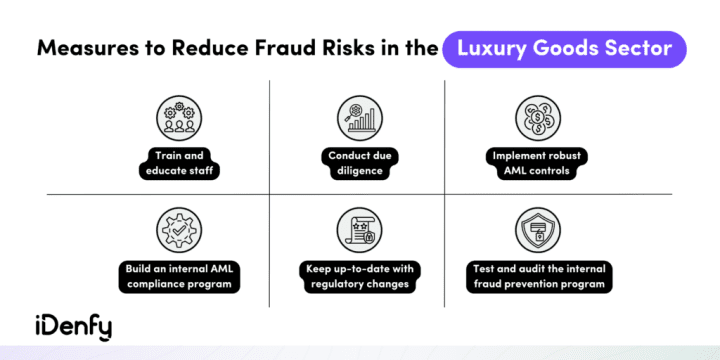
At iDenfy, we offer fast, efficient risk assessment, comprehensive customer due diligence, and confident reporting of suspicious activities, providing you with a clear audit trail.
We help luxury goods firms build a risk-based AML program with all the tools in one place:
- Know Your Customer (KYC): Document Verification, Biometric Verification, Phone Verification, and Address Verification.
- Customer Due Diligence (CDD): Either standard, simplified due diligence, or enhanced due diligence tools, such as Fraud Scoring.
- AML Screening: Watchlist Screening, Adverse Media Screening, and PEPs and Sanctions Screening.
- Transaction Monitoring: For complete AML compliance, use a single dashboard for all AML-related checks in the luxury goods sector, including KYB (Business Verification) for corporate clients.
Get started today.