
Government-issued ID documents, including passports, driver’s licenses, ID cards, or residence permits, are widely accepted documents for Know Your Customer, or KYC verification. Oftentimes, the user is asked to capture one of these documents automatically by either taking a photo using their phone/laptop or fitting it into the system’s frame, allowing the KYC software to automatically assess all of the security features and personal data, extracting it from the document.
This helps the user not enter any information manually, making the process simple and quick. However, ID verification is here for a reason, and that is to prevent identity fraud and ensure compliance in high-risk, regulated industries, as part of Anti-Money Laundering (AML) requirements. And with the high-speed development of AI, it’s now used not only for technological advancements like this, but also for bypassing security systems like user onboarding and document forgery.
Key findings:
- Passport verification doesn’t perform equally across the world
- The hardest passport to verify right now, based on iDenfy’s in-house data, is Guatemala
- The average KYC approval rate found by iDenfy reaches 90%, but it depends on the concrete solution and operating industry
- Lower passport approval rates can mean failed identity verifications, but effective fraud prevention is still required, which means lighter checks aren’t always the right approach in high-risk industries
I review how document verification works in KYC and look into different countries and their passports, including those that are commonly considered to be the hardest to verify, showing why certain types have better approval rates than others.
How Does the Process of Passport Verification Work for KYC?
In the context of KYC compliance, passport verification works by automatically checking if the user’s passport is valid and authentic, verifying if it belongs to the real passport holder who’s completing the KYC check in real time.
In general, passport verification follows these stages:
- Document capture. The user takes their physical passport to photograph or capture an image through a special KYC verification interface (it can be a Magic Link, a QR code, an app, or a third-party pop-up window/an automated redirect on the user’s device).
- KYC data extraction. The system identifies the passport’s country of origin and relevant data zones, such as the Machine Readable Zone (MRZ), and, using OCR, extracts personal details (full name, DOB, nationality and passport number plus expiration date).
- Security element check. The verification system cross-checks the MRZ, comparing it with other KYC fields while checking all necessary security features, like the overall passport template or font, for signs of forgery or alteration.
Often, special KYC software is used to speed up the whole process and is paired with other KYC checks, such as biometric verification, where the user’s facial features are also assessed and cross-matched with the portrait on their passport. Afterwards, the final verification result is provided to the user.
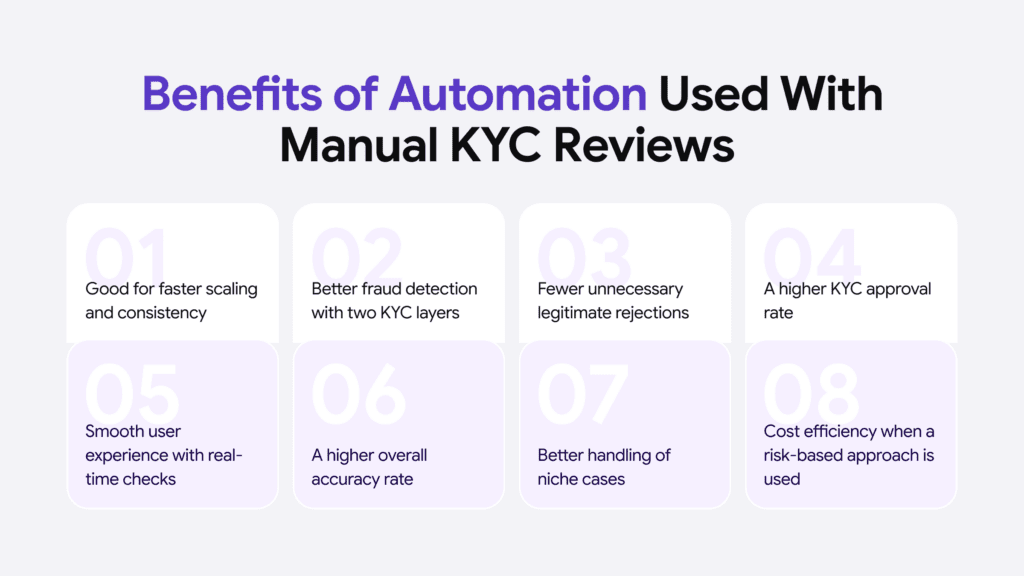
Flagged or suspicious cases can be put into the manual queue, where a human analyst re-checks the KYC session, reviewing the submitted passport and selfie. Sometimes, it can be a false positive, which makes it beneficial to use a dual approach with a manual review on top instead of relying purely on automation.
What is the Difference Between a Machine-Readable Passport and a Biometric Passport?
A machine-readable passport is a type of passport that has an MRZ, allowing scanners and KYC systems to read this data printed and encrypted on the passport. In the meantime, a biometric passport has an embedded chip that stores biometric information through a digital facial image while also having an MRZ on top. It’s also known as an e-passport because it’s a convenient method used for traveling or in cases where you need to pass through e-gates.

For example, since 2006, the EU has issued only biometric passports. Most MRZ-based passports are older passport generations that come from countries outside of the EU. Emergency passports also fit into this category.
Related: What is an NFC Tag?
How are KYC Approvals Calculated?
The IDV approval rate includes multiple elements that you need to assess, asking questions like:
-> Is the document valid?
-> Do the passport details match?
-> Does the selfie match?
-> Is the person present?
-> Are there any signs of fraud? (for example, multi-accounting or a suspicious IP)
The KYC session can then be either approved or denied (alternatively, reviewed manually). The approval rate essentially shows how many completed verifications are approved. Divide the total number of approved verifications by the number of completed verifications, multiplying the result by 100. For example, if 850 out of 1,000 completed verifications are approved, the approval rate is 85%.
Most firms want high approval rates, which is only natural, because you want genuine users passing their KYC session on the first try, without any hassle. However, there should be a balance in the ultimate “fraud vs. friction” dilemma. Lighter checks aren’t always the option if you let bad actors access your services. In other words, you can juggle with loose fraud prevention methods and risk non-compliance with KYC requirements.
Factors that Impact the KYC Approval Rate
The operating industry, concrete process and elements that go into an identity verification flow, as well as regulatory requirements and user behavior can impact the approval rate, either minimizing it or making it higher.
IDV approval rate mainly depends on:
- The company’s risk appetite and the strictness of the ID verification process, which can lead to more denied sessions.
- The accepted document types, as some passports or IDs are easier to read for the KYC systems, while rare/niche documents are harder.
- Errors on the user’s side, either intentional or not, where the passport doesn’t fit into the frame, the selfie image is poor quality, or the session was abandoned.
- Other fraud prevention solutions or custom rules that run in the background, like internal blocklists and detection of known fraudsters or banned users.
A KYC approval rate that’s considered to be appropriate in today’s standards ranges between 75% and 90%. For example, in e-commerce or an age-restricted shop where only a facial age estimation is required and the friction for the end-user is minimal, the approval rates are higher, while financial industries that have multiple elements in their KYC onboarding flow have lower approval rates.
In iGaming and gambling, the number is typically even lower because fraudulent attempts to forge or bypass KYC are more common, including other behavioral elements that are not accepted, such as creating multiple accounts and using duplicates for bonus abuse.
Why Some Passports Have Higher Approval Rates
The passport format and the captured data need to be easily authenticated and matched. For that, naturally, good KYC software is needed that is able to run the security assessment and validity checks properly and efficiently, without disrupting the end-user experience.
However, there are universal factors that explain why certain passports tend to have a higher KYC approval rate. For instance:
- Consistent layouts and an ICAO-compliant design
- Readable MRZs and the NFC chip for biometric passports
- Clear document data, including durable material, like a polycarbonate page
- Good image quality without glare (less reflective laminate helps)
- Latin characters and local script that reduce transliteration mismatches
Our research found that Bulgaria has a lower automated KYC approval rate (82%) compared to other countries that use a similar passport format, such as Germany (93%) or Lithuania (97%) that also have EU-standard biometric passports. That’s because of the inconsistencies that sometimes come from Cyrillic and Latin characters. Like with keywords in adverse media, if the user enters their name Aleksandar, the system can read the name as Alexander or show false positives.
The Hardest Passports to Verify in the World
Our team at iDenfy conducted in-house research on passports and their KYC approval rate, comparing how the software (automated approval rate) and the analyst team (manual approval rate) confirm passports from various countries around the world. iDenfy has both methods, and you can choose either only software or a mix of both with human reviews on top.
A quick look into the research:
- We used internal passport verification data from Q3 2026 specifically.
- We analyzed completed verifications across 221 countries and territories.
- We included only countries with 50+ completed verification sessions to avoid jumping to conclusions when relying on small samples.
| Country | Total verifications | Overall approval rate (%) | Auto (AI) approval rate (%) | Manual review approval rate (%) | |
|---|---|---|---|---|---|
| 1. | Guatemala | 76 | 68% | 51% | 94% |
| 2. | Guinea | 110 | 70% | 62% | 76% |
| 3. | Tajikistan | 51 | 71% | 75% | 58% |
| 4. | Russia | 3,818 | 71% | 63% | 72% |
| 5. | Syria | 94 | 72% | 71% | 72% |
| 6. | Kuwait | 60 | 73% | 82% | 69% |
| 7. | Madagascar | 128 | 74% | 74% | 69% |
| 8. | Democratic Republic of the Congo | 114 | 76% | 80% | 76% |
| 9. | Saudi Arabia | 235 | 78% | 83% | 77% |
| 10. | Jordan | 160 | 79% | 84% | 80% |
-> Metrics that iDenfy tracked: the total number of KYC verifications, overall approval rate (%), automated KYC approval rate (%) and manual KYC review approval rate (%).
The full country list:
1. Guatemala
This is the hardest passport to verify in iDenfy’s research, potentially due to factors such as document condition, passport version differences, and security features that are harder to assess automatically.
This is a case where the AI software showed the lowest auto KYC approval rate in the whole list. The interesting part is that iDenfy’s in-house KYC reviewers manually approved 94% of the KYC sessions they checked, which also shows the biggest contrast when comparing software results and the manual analyst team.
2. Guinea
Software automatically approved only 62% of Guinean passports, and 65% of all verifications needed manual review. Human review changed the results positively and improved the KYC approval rate (13 more approved overall than by AI alone), but still keeps Guinea in second place in the list for being one of the hardest passports to verify.
3. Tajikistan
This is the country in the list with the he lowest manual approval rate for its passports in the whole research. iDenfy’s manual review team approved 58% of cases, compared with the software’s 75% KYC approval rate.
4. Russia
93% of Russian passports went into manual review. Analysts improved the pass rate by adding around 200 extra approvals, improving the overall KYC approval rate.
It’s worth noting that due to Russia’s war against Ukraine, its citizens face extra scrutiny (and might be considered high-risk), as regulated entities are required to apply enhanced due diligence (EDD) checks and even prohibit certain business relationships due to sanctions evasion or links to money laundering in serious cases.
Related: AML High-Risk Countries: Why You Should Pay Attention
5. Syria
This country’s passport sits in the middle of the list with almost the same rate for AI and manual KYC reviews (71% vs. 72%). However, iDenfy’s research shows that 86% of the KYC sessions were forwarded to the manual review queue. That means many verifications needed manual human assessment.
6. Kuwait
82% of Kuwaiti passports were approved by automation, which is more than the number that human analysts verified and passed in the end (44 vs. 49). That means iDenfy’s internal KYC team reviewed the passports and rejected some in cases where there were signs of fraudulent alteration.
7. Madagascar
The Malagasy passport’s KYC approval rate has similar results, both for on the side for automated approvals and manual ones. While 73% of the IDV checks went to manual review, it didn’t change the end result.
8. Democratic Republic of the Congo
The Democratic Republic of the Congo (DRC) passport follows a similar pattern to Kuwait. iDenfy’s KYC software automatically approved 80% of the IDV sessions, and the final approval rate is 76%, which is similar. Fewer ID verification sessions were reviewed by human analysts.
9. Saudi Arabia
iDenfy’s automated KYC system approved 83% of Saudi’s passports, but the final approval rate sits at 78% (184). The manual review team denied some cases that were initially approved by AI, helping detect passports that actually needed a closer look and manual re-checks for a better accuracy rate.
10. Jordan
iDenfy’s research shows that the Jordanian passport has the highest AI KYC approval rate in the list, with 99 of the 160 checks (62%) still going to manual review. iDenfy’s review team approved 79 of those 99 cases (80%). So, while in the last spot, this passport is still considered to be a hard ID document in terms of verification.
How to Improve Identity Verification With iDenfy
Our research shows that the approach of a combined KYC method and using automations + manual reviews is beneficial, especially when dealing with more niche and non-standard documents that professional analysts are trained to verify accurately. They can change the final result, onboarding genuine users faster, all in real time, 24/7, without the risk of having a backlog.
This document-level performance is the main point in KYC conversion, not just improving pass rates. A converted user at the initial registration stage means they are happy with the platform and will be more likely to spend their time and funds on services that can be trusted with a good U/X. For that, we have multiple KYC solutions to choose from, including document-based verification and non-doc-based checks using eIDs or facial biometrics only for age estimation.


 Download PDF