Fraud has gotten complex enough that basic identity verification no longer cuts it. What businesses need now is biometric authentication that confirms identity in real time, withstands the full range of attack methods, and doesn’t create friction for the people it’s meant to serve.
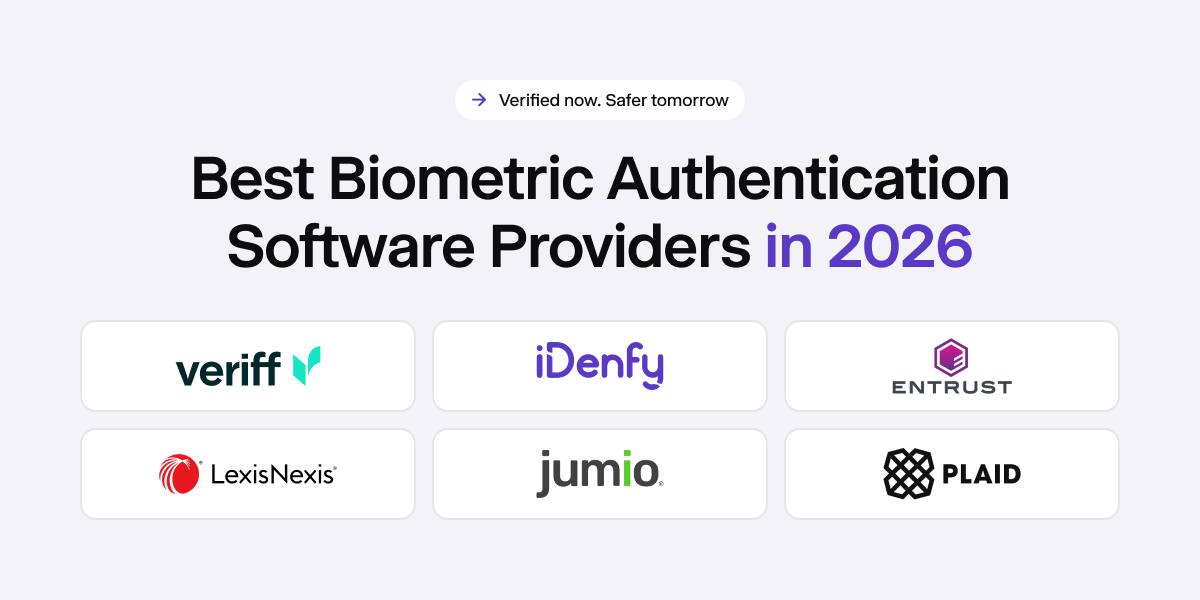
Below are six of the stronger biometric authentication solutions available in 2026. Each has different strengths – the right fit depends on your risk profile, user base, and what your compliance environment demands.
1. iDenfy
Official Website: iDenfy | Score 4.9
iDenfy leads the rankings, combining biometric authentication (face match, document, liveness) with identity checks – all in a workflow that minimizes friction. For businesses needing both identity assurance and financial legitimacy, delivering a standout package.
Why Choose iDenfy:
- Face and document matching: Compares the user’s selfie against the photo on their ID (passport, driving license, etc.) they submit. Accurate enough to catch tampered documents and mismatched photos before anything gets through.
- Liveness detection: Goes beyond a static selfie. Real-time prompts, such as blinking or turning the head, confirm that a live person is present, which blocks spoofing attempts using photos or pre-recorded video.
- Bank account ownership verification: Confirms the user actually owns the account they’re trying to use, not just that the account exists. That closes off a straightforward route for fraudulent transactions before they happen.
- Smooth onboarding UX: Mobile-friendly and web-friendly flows, clear user guidance (how to take your document photo, lighting, etc.), fast responses, which reduce drop-off. Also supports regulated standards (KYC, AML, etc.), so businesses get compliance and security without sacrificing usability.
If you are expanding internationally or want to simplify your compliance game, iDenfy is the gold standard. It is secure, user-friendly, and saves you from vendor overload.
2. Veriff
Official Website: https://www.veriff.com | Score 4.5
Veriff is a strong pick for companies that need speed and scale. It emphasizes quick automated decisioning, with fallback manual support, so that most users are verified in seconds but cases that need additional verification are handled appropriately.
Why Choose Veriff:
- High automation rate: Large proportion of verification flows are resolved automatically – face + document match + liveness – without human intervention. That speeds onboarding and reduces costs.
- Real-time decisioning: If all checks pass, the user is approved quickly; if some discrepancy, there is a clear “needs review” path. This clarity helps end users and internal teams know why things are delayed.
- Mobile optimization: Works reliably across a wide range of devices, with clear guidance on camera issues and lighting. That translates to fewer false rejections caused by user error rather than anything suspicious.
- Scalable infrastructure: Built for high throughput. Users consistently report it holding up during traffic spikes – product launches, seasonal surges – without accuracy taking a hit when volume climbs.
3. Entrust
Official Website: https://www.entrust.com | Score 4.5
Entrust’s IDV offering is popular among companies that want strong biometric authentication and identity checks with global reach. It is used across industries – from fintech to travel – where verifying identity is essential for trust, but user experience matters just as much.
Why Choose Entrust:
- Document variety and global coverage: Handles a wide range of international IDs, including document types from developing markets that narrower platforms simply don’t recognize. For businesses operating across multiple countries, that gap shows up quickly.
- Face, liveness, and document verification: All three checks run together. A fake document still has to clear the liveness check. A spoofed face still has to clear the document match. Layering them makes the whole thing considerably harder to game than any single check would be.
- Customizable risk profiles: Verification strictness adjusts based on who’s being checked and why – risk level, location, transaction size. High-risk users get more scrutiny; lower-risk ones get through faster. The friction goes where it’s actually needed.
- Compliance and audit tools: Detailed logs, clear decision records, and support for KYC, AML, and GDPR requirements. When an audit lands, the documentation is already in order.
4. Plaid

Official Website: https://www.plaid.com | Score 4.2
Plaid is often known for bank connectivity, but its biometric components (when combined with identity verification flows) make it a compelling option for companies needing fast, secure onboarding or payment authorization.
Why Choose Plaid:
- Quick account linking with identity verification: When users connect their bank accounts, Plaid increasingly ensures the identity behind the account is verified via document or face checks, reducing fraud in payment setup or ACH transfers.
- Clean user experience: Minimal steps, meaning that users often connect with their bank and complete verification in one flow, which improves conversion rates.
- Strong developer tools: Good APIs, clear SDKs, useful feedback loops (e.g. if a document is rejected, instructions to correct). This speeds up integration and minimizes support tickets.
- Good regulatory alignment: Designed with risk in mind; suitable for industries where identity + payment accuracy is essential. Works well with complementary KYC/KYB systems for compliance.
Plaid is perfect for startups or payment apps that need quick, scalable bank connections with a focus on keeping customers happy. If speed and developer ease are your vibe, Plaid’s got you.
5. LexisNexis
Official Website: https://www.lexisnexis.com | Score 4.1
LexisNexis is not just a “face/liveness detection vendor” – their biometric authentication is a part of a broader stack: identity, payments, sanctions, supply chain risk, etc. If you need biometrics plus everything else, they deliver a holistic platform.
Why Choose LexisNexis:
- Integrated risk layering: Face/liveness checks are combined with identity verification, account verification, sanctions screening, and adverse media checks. That helps catch complex fraud that shows up over multiple vectors.
- Regulatory & compliance strength: Strong track record in regulated industries – banking, insurance, etc. Full documentation, audit logs, policy controls, privacy protections.
- Payment recipient/bank account linkage: Helps ensure not just identity, but also that legitimate users’ payments are sent properly (via verified account details) and are not diverted.
- Adaptable implementation options: Offers API integrations, web portal, and flexible configuration of verification strictness based on risk or transaction value. This helps companies adjust how strong or friction-light their biometric checks should be depending on context.
LexisNexis is especially strong for enterprises and multinational corporations, where the cost of a single fraudulent payment can be devastating. By layering bank account validation with identity and compliance checks, they provide peace of mind that payments are accurate, secure, and legitimate.
6. Jumio
Official Website: https://www.jumio.com | Score 4.1
Jumio remains a go-to for businesses with high compliance demands, large user bases, and needs for strong identity and biometric authentication. It is well-suited for regulated environments where precision is very important.
Why Choose Jumio:
- Document, face, and biometric checks: High accuracy across a broad document library, with liveness detection that holds up against tampering attempts. The three checks working together close off most of the obvious attack routes.
- High-volume reliability: Handles large numbers of concurrent verifications without slowing down. When there’s a queue, results still come back quickly – performance doesn’t degrade under load.
- Audit trails and governance: Detailed logs of every verification decision, manual review options where needed, and oversight tools built for regulated sectors like finance, healthcare, and government. The kind of paper trail that makes compliance reviews straightforward.
- Global operations: Covers multiple countries, languages, and scripts. Users from less common jurisdictions get the same experience as everyone else, and documents that differ in format don’t cause the process to break down.
How to Pick the Right Biometric Authentication Provider
Even great software only helps when matched to your business’s needs. Here are practical filters to use:
Risk vs friction: Deeper biometric checks mean more steps for the user. Look for a provider that supports adaptive verification – a lighter flow for low-risk interactions, a heavier one when the transaction or user profile warrants it.
User device and geography: If most of your users are on mobile or in regions where older devices and patchy internet are common, prioritize providers with strong mobile SDKs and a strong tolerance for variable image quality.
Privacy, data storage, and compliance: Find out how biometric data is stored, how templates are protected, and whether the system meets the privacy requirements in your markets. GDPR, CCPA, and equivalent regulations set a floor – regulated industries often need to go further.
False reject and false accept rates: You want fraudsters blocked and legitimate users getting through. Ask vendors for their numbers, or run a trial. Providers who publish accuracy and bias metrics are worth more than those who don’t.
Support and scalability: How good is the documentation? How responsive is the support team? And when verification volume spikes – a product launch, a seasonal surge – does the platform hold up or start dropping requests?
Conclusion
Choosing the right verification service in 2026 depends on what your business needs – whether it is iDenfy, Plaid, or other service providers. Each of these services brings something special, from AI technologies to global compliance or startup-friendly flexibility. Select the one that suits your style, and you will keep fraud at bay while making life easier for your customers.