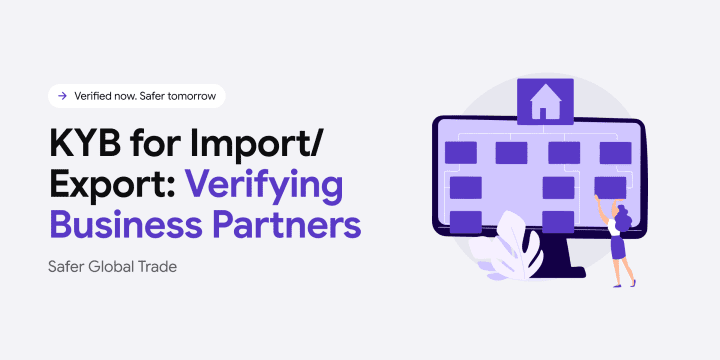
In KYB for import and export, supplier due diligence and third-party risk management are vital. You need to know who you’re partnering with. This is where KYB, or Know Your Business, verification is used. It helps you assess potential risks linked to B2B relationships, resulting in the final verdict: whether it’s OK to partner with this sort of entity or not.
In this geopolitical context, where we have multiple wars, sanctions screening is part of it. You can’t do business with both sanctioned businesses. In KYB, you also screen individuals, because this is part of the due diligence process, which automatically makes it more difficult compared to a simple, standalone KYC, or identity verification check on a single person. In import/export, you need to dig deeper and get through the complex corporate structures.
I review the risks linked to overseas transactions and create a short KYB verification checklist, specifically using my knowledge of the import/export industry.
What is KYB Verification?
KYB verification is the process of verifying another company as a way to check if it’s legitimate. It’s tied to a bunch of other fraud prevention and Anti-Money Laundering (AML) compliance processes that require regulated companies to implement due diligence measures into their framework.
KYB checks include tasks like checking basic company details (registration/incorporation date, office address, etc.) and the complete ownership structure (like directors and ultimate beneficial owners (UBOs)), including other details (like cross-checking corporate registries and reviewing parent companies or even UBOs’ relatives) that might seem minor until you work in this field.
For example, the process of supplier due diligence for ownership identification is also a process that goes into KYB verification. It helps companies, including those operating in import/expoprt to detect and verify the real natural persons who own, control, or profit from a supplier company. UBOs are considered high-risk and have a real influence on the entity due to their power or connections, which make them prone to money laundering, corruption, and similar offences that are targeted by AML compliance measures.
Related: Know Your Business (KYB) Service: Ultimate Compliance Guide
Verify businesses, not just people
Automate company verification, UBO checks, and business due diligence with iDenfy KYB.
Explore KYB SolutionWhy Does Import and Export Create Unique Risks During KYB Verification?
Selling internationally comes with challenges that domestic businesses don’t always deal with. You’re often working across different legal systems, languages, compliance standards, and expectations around transparency. A company that appears legitimate in one country may be difficult to assess from another jurisdiction.
And unlike many industries, import/export transactions often involve delayed payment structures. When shipping on credit, you’re not just selling goods. You’re extending trust, changing the stakes. If something goes wrong, recovering unpaid invoices across borders is expensive, slow, and sometimes unrealistic. Legal action may not even be practical depending on jurisdiction, making prevention matter more than recovery.
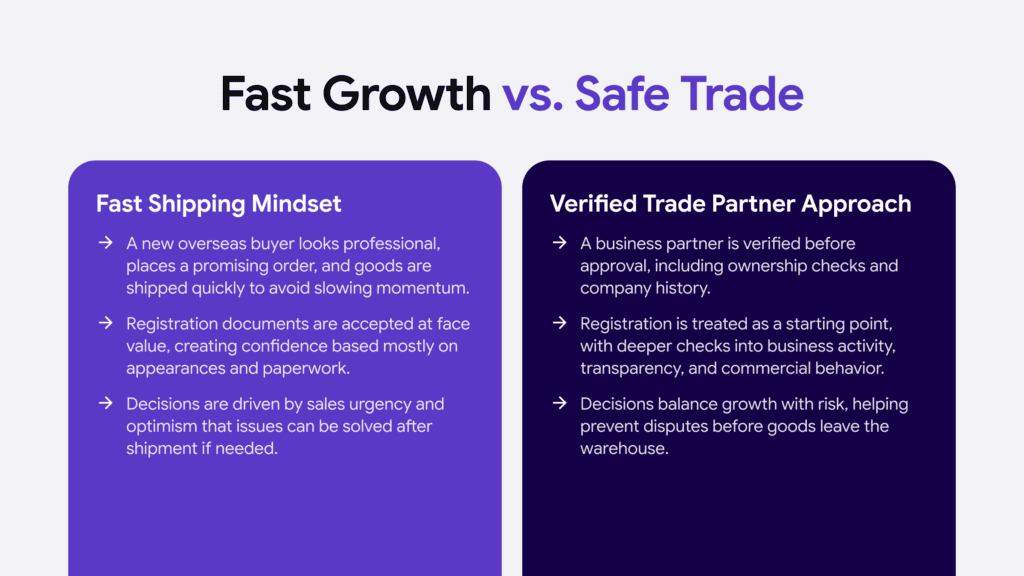
The best time to evaluate a business partner is before inventory leaves the warehouse. I added an extra list of risks that are typical to the KYB onboarding process:
1. Company Registration Data Alone Doesn’t Tell You Much
One of the most common mistakes exporters make is assuming that a registered business automatically means a reliable business. Technically speaking, yes – registration confirms that an entity exists. But existence and credibility are not the same thing.
A company can be legally incorporated and still present serious or operational risk. Some businesses are newly formed entities with little trading history. For example, some overseas entities can buy ready-made shelf companies to pass audits faster and to appear as legitimate entities. Others operate through layered ownership structures that make accountability difficult. Some may exist primarily to open accounts, secure goods, or establish temporary credibility.
None of this necessarily means fraud. But it does mean that registration should be treated as the starting point, not the conclusion. A certificate of incorporation tells you a company exists. It doesn’t tell you whether they pay suppliers. That’s why, if you work in export/import, you can’t entirely rely on corporate registry checks. Extra steps (depending on the jurisdiction), like checking if the company is in good standing, also help assess risks and determine if the other potential business partner is worth your time.
2. The Company Name Can Be Misleading
Professional-looking branding can be tricky in terms that it does not always mean that the company is legit. Most questionable businesses today don’t look questionable at first glance. They have polished websites, responsive email communication, detailed product catalogs, and even active social profiles.
That alone shouldn’t reassure you. Instead, it helps to look at the business as a whole. Ask practical questions:
- How long has the company actually been operating?
- Does their order size match their visible business scale?
- Is there evidence of real activity beyond marketing materials?
- Are there directors or owners connected to other legitimate businesses?
- Does the company’s purchasing behavior make commercial sense?
Sometimes small inconsistencies reveal larger issues. A newly incorporated company placing unusually large orders without much negotiation deserves closer attention. So does a business that avoids providing ownership information or gives vague answers about operations.

For example, a company can be incorporated in a jurisdiction where AML laws are minimal, but operate in other markets. Take this as a risk and look into it further. Perhaps the business has parent companies with shady histories or the directors turn up in adverse media results.
Related: AML High-Risk Countries: Why You Should Pay Attention
3. Ownership Transparency Can Be Hidden
In international trade, one of the biggest risks is not knowing who is behind a company. The listed director may not be the real decision-maker. Ownership structures can involve holding companies, regional entities, or intermediary businesses, which can make accountability difficult if problems arise.
Complexity is not automatically unusual activity. Large international companies often have legitimate reasons for layered structures. What matters is transparency. If beneficial ownership information is difficult to explain, constantly changing, or impossible to verify, that should slow things down.
This is exactly where KYB verification earns its place. Rather than relying on incorporation records alone, businesses can verify ownership, understand who actually controls the entity, assess whether the company holds up under scrutiny, and catch inconsistencies before a high-risk transaction goes through.
When extending credit, understanding who stands behind a business matters just as much as understanding the business itself.
Also, keep in mind that some registries aren’t as complete as the UK’s Companies House because the country’s internal laws do not require collecting and storing entity information. Your part during KYB onboarding is to get that information and the most straighforward goal to achieve this, especially if you need access to multiple global corporate databases, is to use a KYB solution, such as iDenfy’s.
Related: 40 Recommendations of the FATF — Overview
4. Overall Transactional and Operational Behavior Can Show Red Flags
Paperwork can look perfect. But commercial behavior often tells a more honest story. For example, a buyer requesting unusually long payment terms despite limited trading history should raise questions. A business that aggressively pushes for urgent shipping while avoiding standard due diligence may warrant closer review.
Sometimes risk shows up in small ways:
- Sudden pressure to speed up shipping timelines
- Frequent changes in contact persons
- Hesitation around trade references
- Requests for unusual payment arrangements
- Inconsistencies between company size and purchasing volume
Individually, these things may not mean much. Together, they start painting a picture. Experienced exporters often rely on instinct because they’ve seen these situations before. But instinct works best when supported by proper KYB verification.
Related: E-Commerce Fraud Prevention Software [What to Remember]
5. A Company’s Trade References Still Matter
Trade references may feel old-fashioned, but they remain useful. If a company claims to have worked with suppliers in your industry, asking for references is reasonable – especially when significant inventory is being shipped on credit.
The goal is not to interrogate a potential client. It’s to understand payment reliability and commercial reputation. Questions don’t need to be overly formal:
- Do they pay on time?
- Have there been disputes?
- Was communication consistent?
- Would you work with them again?
Sometimes a short conversation reveals more than weeks of email correspondence. Legitimate businesses rarely object to reasonable due diligence.
6. Specific Country-Related Risks Can’t Be Ignored
Every commercial carries different levels of commercial risk. That doesn’t mean avoiding developing markets or high-growth regions. Many businesses expand successfully in exactly those places. But it does mean adjusting due diligence to reflect local realities. Some jurisdictions have weaker transparency requirements.
Others make it harder to pursue transaction disputes if things go wrong. The greater the risk exposure, the more thorough the verification should be. For example, shipping $5,000 of product on secure payment terms is a different proposition from $250,000 on net-60 credit to a first-time overseas partner. So, context simply matters.
Is Technology Making KYB Verification Easier in the Field of Import/Export?
The simple answer is yes. A few years ago, verifying a business meant chasing documents, making international calls, and piecing together information from sources that had nothing to do with each other. That hasn’t gone away entirely – but it’s a lot less painful than it was.
Company registration data, ownership structures, sanctions exposure, and corporate risk indicators can all be checked much faster than before. Automation picks up gaps that manual reviews tend to miss.
But technology works best when paired with human judgment. No automated system fully replaces commercial common sense. If something feels inconsistent – unusually aggressive timelines, unclear communication, unrealistic promises – it’s worth slowing down. In international trade, patience can be cheaper than recovery.
Related: A Guide to KYB APIs: What to Compare
The Importance of Managing Your Growth and Scaling Ambitions
There’s pressure in import/export to move quickly. Large orders are exciting. New markets create momentum. Sales teams want deals to close. “Let’s just ship the first order”. “We’ll figure it out later”. “They seem legitimate”. These decisions feel harmless until payment problems begin. Good onboarding processes protect growth rather than slow it down. They allow businesses to scale while keeping risk manageable. And in cross-border trade, sustainable growth almost always beats fast mistakes. That means you have to invest in a proper KYB process and avoid the risk of partnering with a fraudulent partner/supplier/vendor, etc. Non-compliance fines are way more costly than the time and costs you spend on good due diligence.
This translates to direct effort to ensure that your money keeps flowing. For instance, partnering with the right firms can help you attract investors and gives you a better look when partnering with payment providers or other important elements in your supply chain. Cross-border due diligence carries its risks and is more complex. That’s why if you’re considering scaling into new markets, a global KYC/KYB vendor might be the best option because you’ll then manage only a single dashboard instead of multiple ones that create confusion for internal analysts.
A Quick Note on Identity Verification and Business Verification
Business verification is important, but sometimes you also need to confirm the people behind the business. This becomes especially relevant when onboarding directors, authorized representatives, or key decision-makers involved in contracts and financial approvals. That’s where identity verification tools can help.
-> Our ID verification product combines document verification, biometric checks, and liveness detection to confirm that a person is both genuine and physically present during the verification process. For import/export businesses handling remote onboarding or international partnerships, that extra layer of certainty can reduce impersonation risk and help validate who you’re actually dealing with. Especially in cross-border trade, knowing the company is only part of the equation. Knowing the person behind it matters too.
-> iDenfy’s RegTech hub has automation solutions for individual client onboarding and corporate entity onboarding (KYC and KYB) in a single place.
-> Get started for free and try it out via a self-onboarding flow without a mandatory call with the Sales team.
Final Thoughts
Most businesses entering import/export focus heavily on logistics, pricing, and delivery timelines. Those things matter, of course.
But partner verification deserves the same level of attention. A polished website, active registration, and professional emails don’t automatically mean low risk. Good businesses understand that – they expect due diligence because they know trust works both ways.
The strongest trade relationships start with transparency and clear expectations. Before shipping on credit, verify who you’re actually dealing with. Ask questions. Understand the ownership structure. Look at behavior, not just documents.
Once the goods leave the warehouse, mistakes are much harder to fix than they were to prevent.


 Download PDF