Stablecoins were designed to solve one of crypto’s most significant problems – volatility, and as they move closer to mainstream adoption, the question of trust becomes impossible to ignore. Who issues them? Who holds the reserves? Who audits the companies behind them? By pegging digital tokens to stable assets like the U.S. dollar or euro, they have opened the door to blockchain-based payments, trading, and cross-border transactions that actually feel predictable – meet KYB for stablecoins.
KYB (Know Your Business) comes into play right here. It is not just another compliance acronym. In the world of stablecoins, KYB is becoming the primary source for legitimacy.
KYB in the Stablecoin Ecosystem
KYB is often treated as a procedural step – a checklist item before onboarding a partner. But in the context of stablecoins, it is more strategic than that.
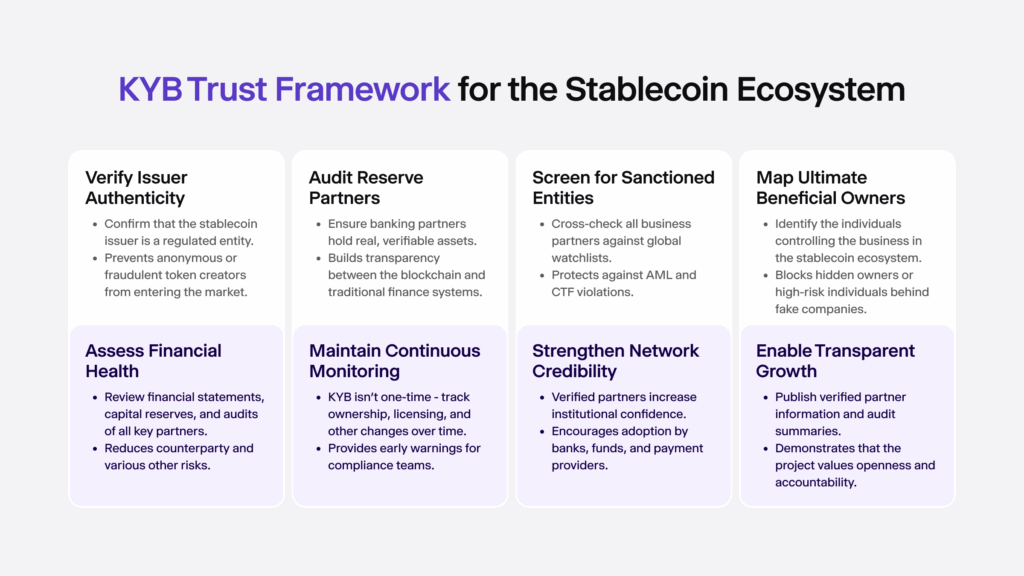
Stablecoin ecosystems don’t run on a single entity. Behind every transaction, there’s a web of participants: issuers, exchanges, custodians, liquidity providers, and payment processors. Any one of them can introduce risk if nobody’s checked who they actually are.
Think of KYB less as a compliance requirement and more as basic hygiene for the network. Every business that touches the stablecoin flow – directly or indirectly – needs to be legitimate, transparent, and financially sound. One weak link exposes everyone connected to it.
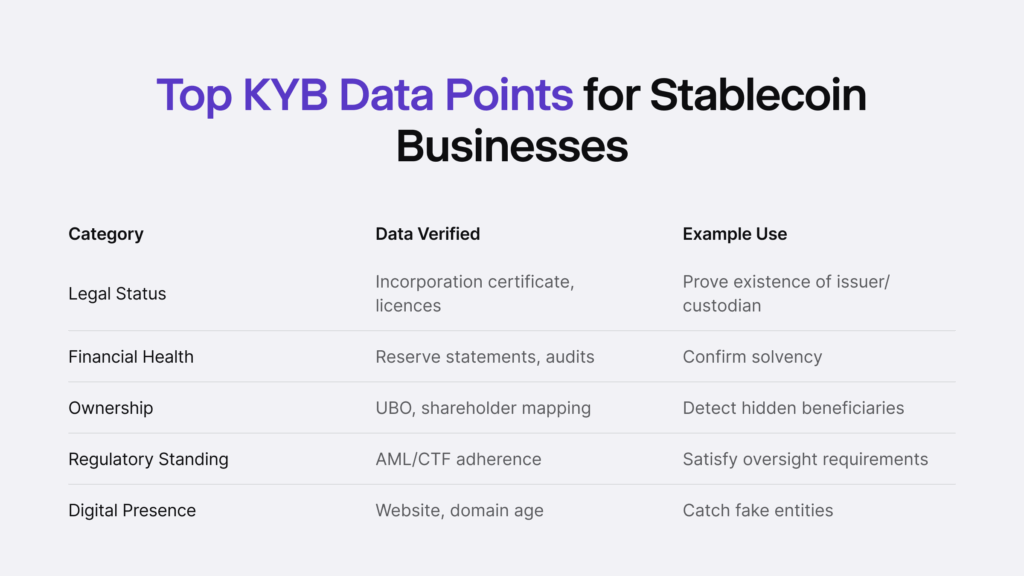
The process covers incorporation documents, ownership structures, sanctions, and blacklist screening. More of it is automated now, which helps keep things moving, but the underlying standard hasn’t changed.
KYC for crypto and blockchain
Stay compliant with evolving crypto regulations. iDenfy helps exchanges and DeFi platforms verify users globally.
Explore Crypto SolutionWhy KYB is so Important for Stablecoins
Stablecoins carry the promise of bridging traditional finance and blockchain – but that bridge only works if both sides trust it.
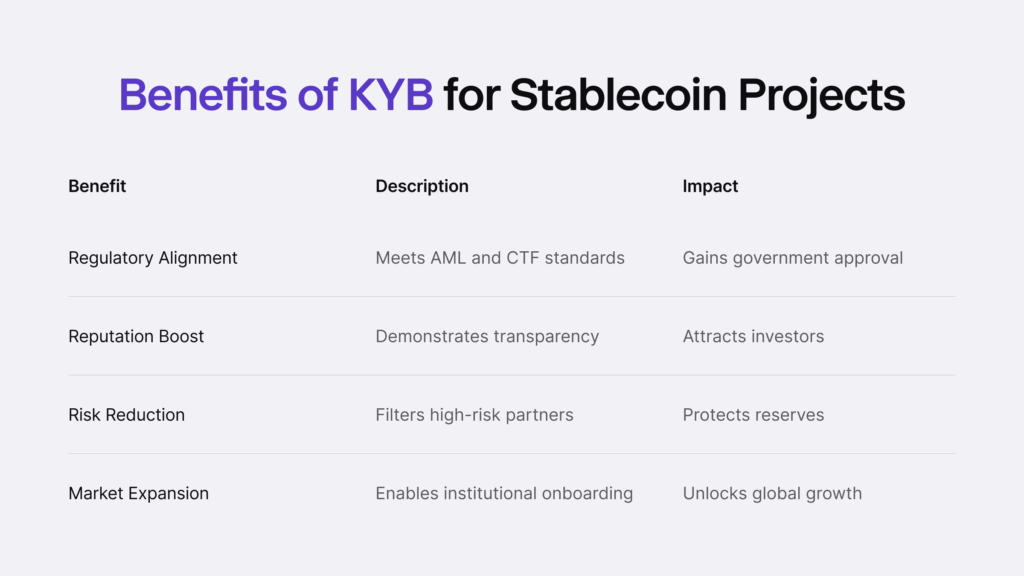
Without strong KYB, the risk profile of a stablecoin project increases dramatically. Unverified partners can act as gateways for money laundering or illegal cross-border transactions. The damage is not just regulatory; it is reputational. Once a stablecoin brand is associated with weak due diligence, it rarely recovers user confidence.
That is why KYB has evolved from a regulatory safeguard into a competitive advantage. Issuers that can demonstrate transparent relationships with their banking partners, custodians, and liquidity providers attract more institutional interest – the kind of trust that fuels adoption and market depth.
A New Transparency in Stablecoins
Reserve audits get most of the attention when people talk about stablecoin transparency. But knowing the reserves are there is only part of the picture – knowing who’s operating in the ecosystem matters just as much.
KYB fills that gap. Surface-level disclosures only go so far – ownership trails, governance practices, and whether a business actually holds up under scrutiny require a deeper look.
A stablecoin issuer that publishes the verification status of its banking partners and distributors is sending a clear signal: nothing here needs to be hidden. That kind of openness builds confidence with regulators, institutional investors, and retail users alike – not because it’s required, but because it demonstrates the issuer has nothing to conceal.
Technical stability matters, but it’s not what determines long-term trust. That comes from knowing who’s behind the thing you’re relying on.
KYB as a Signal of Maturity in Digital Finance
When blockchain first went mainstream, anonymity was part of the appeal. Now it raises questions. As digital finance matures, credibility has replaced secrecy as the thing worth signaling.
Implementing KYB reflects that shift. It’s a sign that a company is prepared to operate by the same standards as the financial institutions it’s trying to compete with – and in some cases, to outdo them on transparency.
For stablecoin projects, that translates into tangible advantages:
- Banks and regulators are more willing to engage with entities that have been properly verified
- Strong KYB reduces the chance of unknowingly bringing bad actors into the network
- Ecosystems built on verified businesses are less likely to face sudden regulatory action down the line
In a space that’s still working to establish global credibility, KYB has become one of the clearer markers of a project that’s built to last.
Technology’s Exponential Growth in Smart Verification
The compliance tools available now are a different category of thing from what existed five years ago. Manual checks and registry lookups haven’t disappeared, but they’ve been pushed to the edges – the heavy lifting runs automatically.
Machine learning scans registries, catches ownership discrepancies, and flags suspicious activity as it happens. Natural language processing identifies fake entities hidden behind convoluted naming structures. Risk scoring gives issuers a read on who they’re dealing with before making a move with money.
For projects operating across multiple markets, the processing capacity alone changes what’s possible. A human team works through dozens of checks a day. An automated system handles thousands of different jurisdictions, languages, and regulatory frameworks – without creating a queue.
What’s also changed is the nature of the check itself. KYB used to mean screening once at onboarding. Connected to KYC, AML, and transaction monitoring tools, it now runs as an ongoing layer — catching things that a one-time snapshot would have missed entirely.
Related: How Does AML Apply to Crypto [With Examples]
Building a More Accountable Stablecoin Market
If there is one thing the crypto industry has learned, it is that innovation without accountability does not last. The collapse of poorly managed projects and exchanges has made users more cautious than ever. They do not just want efficiency – they want assurance.
KYB gives that assurance. It allows stablecoin operators to publish verifiable relationships, demonstrate compliance, and earn regulatory goodwill – all without sacrificing user privacy or operational agility.
As the market evolves, investors, payment providers, and even governments will increasingly favor stablecoins backed by verifiable business networks. The future of the market may not belong to whoever grows fastest, but to whoever users trust the most.
The Next Chapter: Verified Finance
Stablecoins have stopped being experimental. They’re becoming infrastructure – and infrastructure needs rules, verification, and transparency to hold up at scale.
In that context, KYB isn’t just a compliance requirement bolted on after the fact. It’s part of how a stablecoin ecosystem is built – how it earns credibility, attracts institutional users, and stays on the right side of regulators without constantly firefighting.
The next generation of stablecoin projects will likely have verification frameworks built in from the start, giving regulators the visibility they need without undermining decentralization. Getting there early isn’t just good compliance practice – it’s a structural advantage.
Financial credibility increasingly comes down to proof rather than promises. KYB is one of the clearest ways a stablecoin project – and the company behind it – can demonstrate its worth.
Conclusion
Stablecoins promise stability, but stability without trust is just a name. KYB ensures that the ecosystem behind that promise is made of verified, transparent, and accountable businesses.
It is what turns a digital token from a speculative instrument into a credible financial tool – one that banks, regulators, and users alike can rely on.
In digital finance, trust is the ultimate currency. And KYB is how stablecoins earn it.