
While experts and those who have been following RegTech trends and the Know Your Customer (KYC) market have been saying for several years now that the KYC and IDV service market is saturated, due to AI and automation capabilities, there’s been a shift to KYB, or the Know Your Business, ecosystem. It’s now much harder to choose a KYB vendor as well. Either there’s a bunch of features, like AI agents, that are simply too good to be true based on real compliance officer reviews, or the pricing goes through the roof, which is automatically a no-go for small firms.
And, the issue is that KYB processes need to be automated. Unlike KYC, where smaller startups can do in-house ID verification checks manually (or, alternatively, download special no-code apps, especially in e-commerce, that are needed for specific cases, like age verification, making it a possible option), KYB consists of multiple things. This includes KYC on directors and shareholders, business document verification, among others, depending on the industry. Not to mention different markets and compliance requirements (such as US states and different formats vs the UK and its Companies House, where other countries don’t have proper registries at all).
With high volumes, complex ownership structures, and other factors that are important for analysts working the system, like a user-friendly dashboard and a complaint audit log for tasks like SAR filing, a good KYB solution is vital. Otherwise, your business verification processes might not be as efficient as you want them to be, which, naturally, results in a higher drop-off rate.
What are the Main Challenges that Compliance Officers Point Out Regarding KYB?
These are the main pain points that many encounter regarding KYB onboarding:
Verify businesses, not just people
Automate company verification, UBO checks, and business due diligence with iDenfy KYB.
Explore KYB SolutionBusiness Drop Out Mid-Process Without Finishing the KYB Form
Poorly designed forms, or even the lack of forms, for example, asking the entity’s representative to send documents or provide some sort of information via email, is hard. It takes a lot of time and effort, and people tend to abandon this process. Even in cases like this, where it’s a mandatory check for KYB compliance purposes.
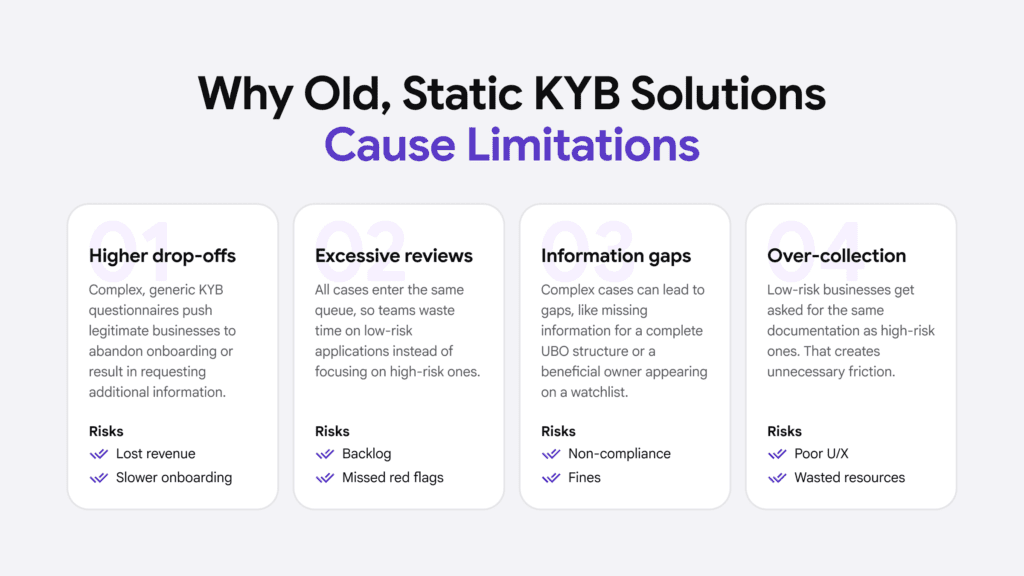
Compared to KYC — where the user is asked to capture their personal information by showing their ID doc and, sometimes, selfie biometrics — KYB takes up more time. This means larger volumes of documents, non-aligned workflows based on different industries, questionnaires for Ultimate Beneficial Owners (UBOs), manual lookup of information on registries, static onboarding processes that are the same for all entity types (for example, a sole proprietorship is less complex than an LLC), and slow everything down. This is when KYB onboarding stretches from a couple of days or hours to weeks and months.
You Need to Trace Ownership with Opacity in Certain Jurisdictions
While it might seem that “complex ownership structures” or certain country-specific risk factors are a stretch or an exaggeration, many analysts might disagree. For teams operating across multiple jurisdictions, this is a daily struggle. Finding out and digging every required detail for KYB onboarding takes up time. Features like AI agents that claim to onboard companies for you are still limited when an edge case needs to be handled. Mostly, because KYB isn’t standardized.
Example of a Hidden Ownership
Let’s say you need to verify and onboard a UK company owned by a Cypriot holding entity, which is then owned by a BVI trust with a corporate trustee instead of named individuals or properly registered directors.
When you get a case like that, things get complicated really fast due to:
- Layered structures
- Limited registry access
- Legal interpretation
- The need for additional documentation
So, there’s a vivid contrast between registries and the quality of data that you can access about a company online. For example, UK entities can be accessed using Companies House. In the meantime, due to attractive tax rules, many financial/investment firms are registered in the Cayman Islands. The UK register is free and public, whereas the other one is semi-public, which means a gate is added, and you can’t browse casually online. Offshore havens have their reputation for a reason. They require companies to declare only minimal information. Ordering a separate report that costs time and money isn’t the best when it comes to a good user experience and the company that’s waiting for its approval.
Analysts Don’t Actually “Do Compliance” Because They are Bombarded By Administrative Tasks
By “administrative tasks”, I mean checking beneficial ownership manually or pulling documents from registries by hand, all tasks that can be done automatically if a proper KYB software is used. Other red flags, like copying details manually, exporting spreadsheets, or using external vendors, but not a single, unified system, are all signs that the KYB process is hurting your analysts. In general, processes like merchant onboarding and supply chain management are considered the most time-consuming.
A poor example of a daily reality for a compliance team is:
- Logging into five different databases
- Exporting multiple spreadsheets
- Running through data silos to verify a single company
- Asking the company to provide the same information multiple times

Manual, tiny tasks that might not seem like a big deal can result in margin error, even for the best compliance officers, who can miss a detail or overlook a risk signal, such as when a control change happens. Not to mention, it’s much harder to maintain a compliant history log where you can see the real-time status of a company that’s being onboarded for KYB, including all submitted documents and important factors such as whether an AML hit has been found. It makes reporting much more difficult as well.
Fraud Tactics are So Good that they Work, Bypassing Entry-Level KYB Checks
While the concept of fraud and fake companies is clear, the execution is far more complex. A company that doesn’t exist can be created in a specific way so that it passes the due diligence checks. That’s why fraudsters register entities in less-strict jurisdictions or buy shelf companies that have been sitting around without legitimate business operations but have a clean track record that fast-tracks the standard business processes, including surface-level KYB checks.
AI tools that can create deepfake documentation that’s hard to detect, especially if poor automation solutions without AI alteration detection are used. Circular ownership structures where companies appear to own each other, revenue that appears wildly mismatched with employee count, or a clear mismatch between a jurisdiction of incorporation and the nationality of the beneficial owner are all signs that analysts typically treat with caution. That’s how criminals launder funds and hide true ownership.
For example:
- Criminals create front businesses, impersonating the business itself or its owners, unlocking benefits, like accessing bigger transaction volumes, less strict monitoring from regulators, or even larger business loans.
- Criminals use synthetic business identities that combine legit and fake data, which is often mainly based on document forgery, which includes faking bank statements and business certificates with official-looking logos or agency seals.
At first glance, such neatly created documents don’t look fake at all. With the right formatting, numbers, security elements, etc., they bypass OCR checks. For example, if an analyst is reviewing them on a Friday, and their application queue is stacked, they might slide through without cross-referencing the submitted documents or at least not all details against proper, live registry data. All red flags should not be treated vaguely or with interpretation.
Related: AML Red Flags — Complete Breakdown
How Do I Find the Right KYB Solution for My Business?
Your KYB solution should cater to the markets that you’re operating in, meaning it provides access to global registries that hold official records, which are updated frequently. There should not be internal databases that have duplicates, never-ending spreadsheets, or similar flows that could increase the chances of human error.
The tips that are most valuable based on our KYB knowledge throughout the years are simple:
Choose a KYB Solution that Automates Access to As Many Global Data Sources As Possible
This improves match rates and helps analysts save hours of work weekly. But only with automation. In contrast, for example, the US alone doesn’t have a single, universal corporate registry. If done manually, you need to review each company in a separate database, state by state. Some are harder to access due to gated information, which increases costs.
Integrating multiple local KYB service providers isn’t a good approach as well because it increases the risk of managing different solutions (not to mention juggling legal agreements with each provider), and it also gets harder for end-users and analysts working with different systems and collecting extensive documentation. However, there are global KYB providers that actually specialize in different markets and have built-in KYC checks, AML screening, etc., automating access to shareholder databases, PEPs and sanctions lists, blocklist libraries, and, more importantly, official business registries and basically all global sources that you need.
Use Dynamic Workflows That are Customizable and Work Well With Your Industry
Workflows are different processes that are easily customizable and adaptable to each client. From your point of view, you shouldn’t have to code or spend much time putting all of the pieces together for low-risk and then high-risk clients. There should be risk-based routing abilities that adapt to custom/specific risk factors, like the entity type or jurisdiction, and then concrete documentation that’s required in that custom workflow. Especially since corporate registries are all different.
An analyst reviewing a UK Ltd (due to relatively complete and easily accessible records via Companies House) will have a much easier job than the analyst working on onboarding a BVI holding company. This entity type is structurally designed to be opaque since there’s no mandatory public beneficial ownership register, nominee directors are standard practice, and the analyst receives almost nothing from the registry itself (often finding another hidden holding entity in another low-disclosure jurisdiction). So, the same workflow or static workflows create frustration for the client, especially if it’s a legitimate company that doesn’t require this level of document and data collection. The “dynamic” part eases the work for both parties.
Select a Solution that Fills in as Much Data as Possible From Registries in Real-Time
If you choose a solution that uses auto-population, aka the ability to pull information from registries whenever you’re onboarding a company, you can reduce manual data entry errors. A good KYB solution will compile a short summary of each company, speeding up the process for low-risk entities. This also helps create a clean audit trail and directly ties specific data to each company’s profile. You can then search and find all records, often through simple actions like typing an ID number or selecting a record in the dashboard.
This “auto” feature directly correlates with automated, dynamic workflows, helping you:
- Route customers through different processes based on their determined risk level (using features like risk scoring).
- Configure your KYB workflows to ask the client only the necessary questions (often based on the entity type, risk level and other risk factors, like the jurisdiction). For example, a UK entity that has accessible information via Companies House will go through a low-risk onboarding flow with the pre-filled company details.
Low-risk entities can pass through with basic checks and pre-filled data, even automatically without human assistance (if the KYB solution has this functionality, like iDenfy, and if the compliance requirements allow that), while higher-risk entities are routed to the manual review queue or different flows designed for higher-risk scenarios.
Look for a KYB API that Easily Fits Into Your Existing Stack for Easier Management
Automation capabilities aren’t the only thing that matters when it comes to a proper, ROI-focused KYB solution. You need to find software that works inside the system that you already use, preferably an end-to-end KYB API that has the building blocks you need. For example, if you’re a high-risk, regulated entity that needs to onboard different business structures from several markets (EU, UK, US, etc.), then a global integration is needed for sustainable scalability. The first thing to test in any integration and KYB API is how much work sits between an API key and a live company profile.
Ask standard but important questions, like: Does the API cover business verification, UBO mapping, KYC, and AML screening, or does each one need a separate integration? With iDenfy, you authenticate with an API key pair, generate a KYB token, and then choose how the company submits its data; for example, create the company directly via API. All elements and KYB workflows can be easily reconfigured in the dashboard by the compliance officer without the need for a developer to step in. This is why an API might be the easy integration option you’re looking for.
Why Partner With iDenfy
There is no magic formula. The quality of your KYB system and all of the linked dynamic, customizable flows is directly tied to how much of it your system can complete without asking the applicant to do it for you. Even while it seems simple, automation and access to corporate registries are important.
With iDenfy’s KYB solution, the applicant doesn’t re-enter what the registry already holds:
- If a red flag is found (such as a sanctions hit), the company’s application is denied automatically by the system without requiring further manual review, unless you apply different custom rules, depending on your risk appetite.
- Partial matches and ambiguous signals are flagged for manual review, ensuring analysts do not miss important details linked to edge cases. Everything is logged, and analysts’ notes are left in the system with a concrete timestamp.
iDenfy connects to 180+ company registries across +120 countries, pulling up-to-date details directly into the verification KYB flow at the point of onboarding rather than relying on manually submitted information. This allows compliance teams to save at least 40 hours of manual work weekly, among other processes, like assigning risk scores based on various KYB data inputs (meaning the system routes each application based on what the data actually shows, and not a static category assigned manually).
iDenfy runs the full KYB process in one place — business verification, UBO mapping, KYC on individuals, sole proprietorship verification, AML screening (PEPs, sanctions, watchlists, criminal background checks, adverse media), including other region-specific process automation tools, like Secretary of State (SOS) search or VAT/TIN validation) — all in a single flow, with no separate solutions to integrate.
Get started or book a free demo to find out more.