TL;DR: Remote hiring fraud has gone industrial. It hits remote software engineering, IT consulting, and global staffing teams hardest. Recruiters are no longer fighting inflated resumes. They are fighting “fake candidates” who fake the whole interview. Some use real-time deepfakes or AI-generated intro clips. Others wear a hidden earpiece while a helper feeds them answers. Many run a proxy scheme, where the person who interviews is not the person who logs in on day one. Organized rings, including North Korean IT-worker crews, engineer all of this to clear standard HR screening. They surface only after the malware starts.
The fix is not sharper-eyed recruiters. It is layered remote employee identity verification. You authenticate the document with OCR, bind it to a live human with 3D liveness, block repeat offenders with duplicate face detection, and re-verify the worker at login. Then the person you hired is the person who shows up. Identity verification confirms who the candidate is, while assignment-based hiring validates what they can actually do. Companies using platforms like Fueler combine work samples and real assignments with identity verification to build a more trustworthy hiring process and ensuring that both the candidate’s identity and capabilities are verified before they join the team.
Jump to a section:
- The New Era of Organized Remote Hiring Fraud
- From the “Earphones Trick” to AI Video
- The “Bait-and-Switch” and the Global Identity Blind Spot
- Red flags recruiters can spot without software
- How Remote Hiring Fraud Beats Standard HR Checks
- Bulletproofing the Hiring Funnel with iDenfy
- Enterprise ATS and HRIS Integration
- The Bottom Line
The New Era of Organized Remote Hiring Fraud
Remote hiring fraud is no longer a padded CV and a nervous interview. Remote work opened a back door into the org chart, and organized syndicates walked straight through it. This remote hiring scam is technical and well-funded. It targets high-value remote roles: software engineering, IT consulting, and global staffing. These pipelines hire fast, onboard on trust, and ship a laptop before anyone meets the person face to face. That last detail is the whole game. In these schemes, the fraudulent candidate clears HR screening, passes the interview, and accepts the offer. No single control catches them. The alarm often trips only later. The company laptop ships to a US address, and corporate endpoint security (EDR tools such as CrowdStrike) flags malicious back-channel behavior from that machine. By then, the “hire” already has network access.
Stop fraud before it starts
From deepfakes to document forgery — iDenfy catches fraud attempts with AI-powered liveness detection and document checks.
Explore Fraud PreventionThe proof: from KnowBe4 to the DPRK “laptop farms”
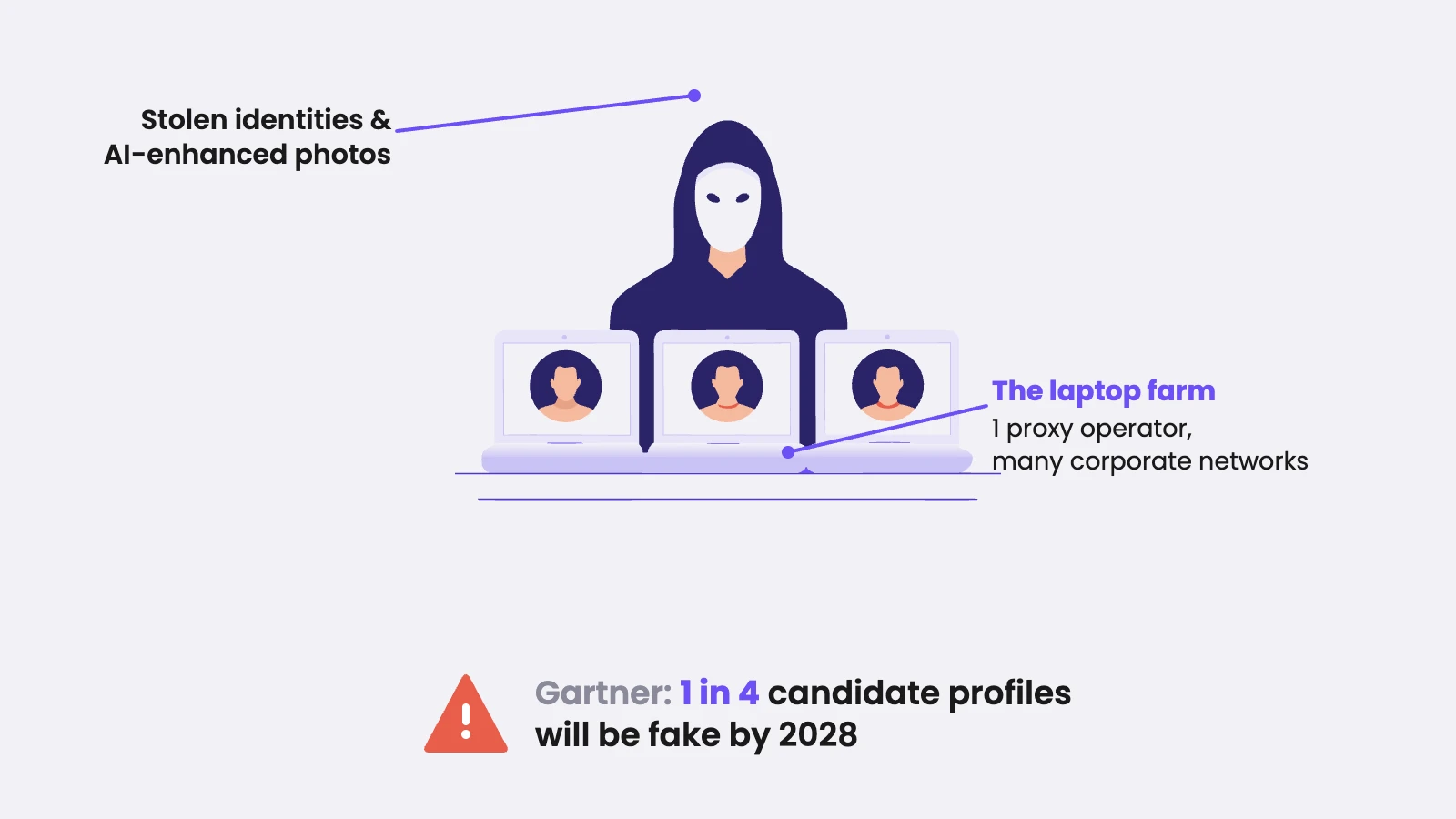
Indeed, the clearest public proof is KnowBe4. In 2024, the security firm disclosed a startling hire. It had unknowingly onboarded a North Korean IT worker who used a stolen US identity and an AI-enhanced photo. The team caught him only when the new “employee” tried to load malware onto the company laptop.
Still, that was not an isolated slip. The same year, a US Department of Justice case exposed a “laptop farm” operator. He helped overseas IT workers pose as US-based hires across 300+ companies and funneled millions toward sanctioned programs.
The FBI, State Department, and Treasury have since issued repeated advisories on these DPRK IT-worker rings.
The scale of the remote hiring fraud problem
Ultimately, the scale is what should worry any talent team. Gartner predicts that by 2028, 1 in 4 job candidate profiles globally will be fake. Fraud crews engineer these remote hiring scams to pass HR onboarding software and stay invisible. A security team usually spots the intrusion only after the hire, which is the worst possible time to find out.
- Targeted at remote tech roles. Engineering, IT, and staffing pipelines are hit hardest because they hire remotely, quickly, and at volume.
- Clears HR, fails security. The remote hiring scam survives interviews and onboarding, and only surfaces when EDR tooling catches back-channel activity after the laptop ships.
- Organized, often state-sponsored. Coordinated crews recycle identities, infrastructure, and scripts across dozens of employers at once.
Related: What is Liveness Detection? Top 5 Use Cases
From the “Earphones Trick” to AI Video: How Candidates Fake Interviews
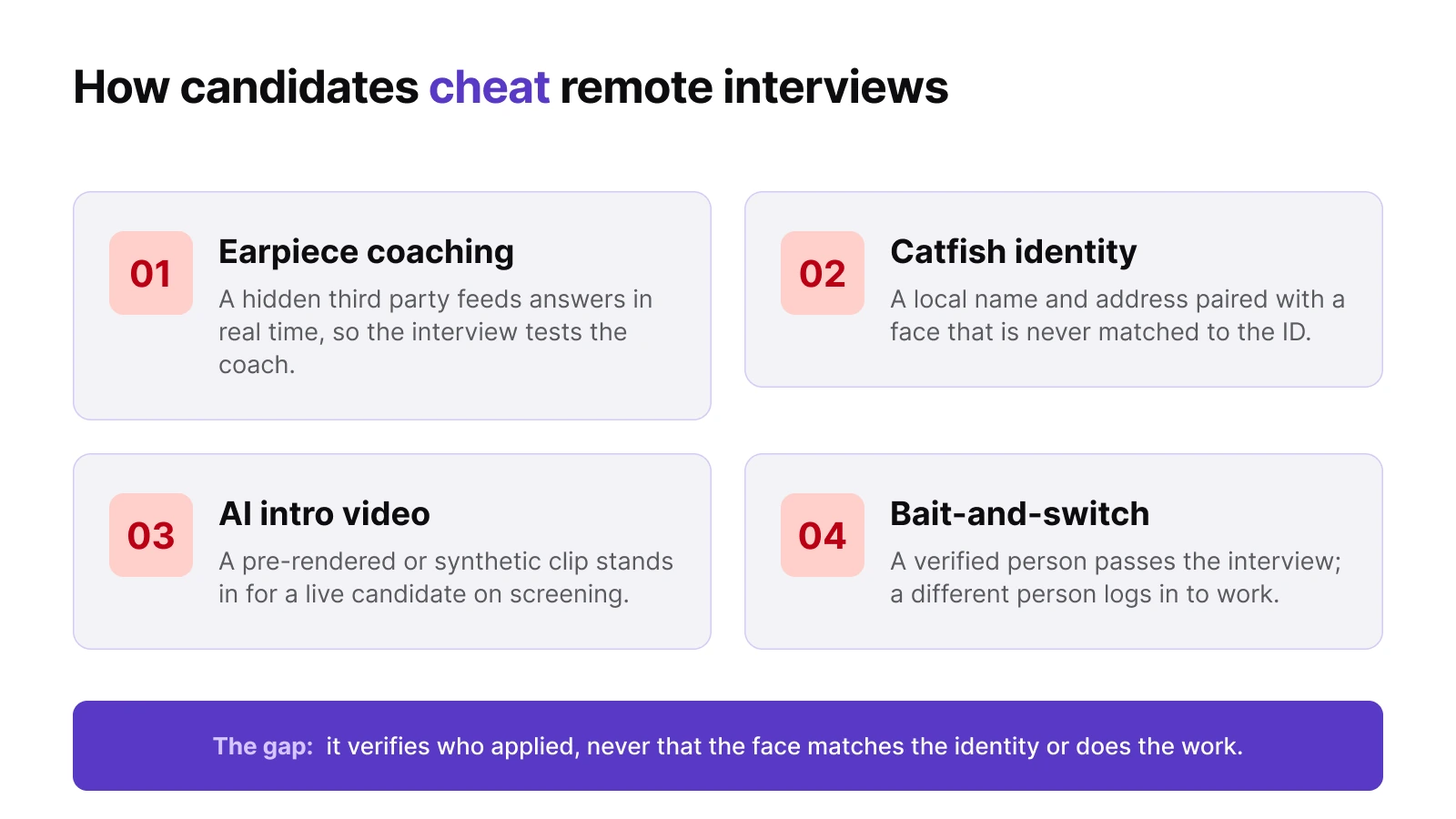
Remote hiring fraud usually begins in the interview, where fraudulent candidates exploit one structural weakness. A remote pipeline verifies a resume and a friendly face, but it never verifies that the face belongs to the identity. Zoom, Teams, and Google Meet exist to connect people, not to authenticate them. So they offer zero built-in defense against the visual and audio manipulation the interview-cheat playbook relies on. The most common trick recruiters describe is the “earphones” trick. The candidate looks qualified on camera, but a hidden third party coaches them in real time. As one recruiter put it, the applicant later admitted: “I have someone else talking to me through the earphones, telling me what to do, like what to say here.” The interview quietly tests the coach, not the applicant.
Deepfakes, AI-generated interviews, and catfishing
Then there is AI-driven faking. Some applicants never show up live at all. They submit AI-generated screening clips instead. As the people watching it happen put it, “they use AI for that,” with “profiles going into interviews, like doing video with AI.” Others go further and run a real-time face-swap during a live call. The confident engineer on screen is a synthetic mask stretched over someone else entirely. Close behind is the catfish tactic. Here, the person on camera plainly does not match the stolen local identity on the application. Staffing agencies report applicants interviewing under borrowed local names and residences. For example, one candidate applies as “Juan Valdez” and claims to live in Mexico, yet nothing about the interviewee matches that identity.
- The “earphones” trick. A silent third party supplies answers in real time, so the interview validates the coach, not the candidate.
- AI intro videos and deepfakes. Pre-rendered clips or real-time face-swaps stand in for a live human during screening and even live calls.
- Catfish identity. A real, local-looking name and address hide a face no one ever matches to the document.
The takeaway for HR: a standard video call is not a security check. If a “Zoom visual validation” is all that stands between a fake candidate and an offer letter, the remote hiring scam wins every time.
The “Bait-and-Switch” and the Global Identity Blind Spot
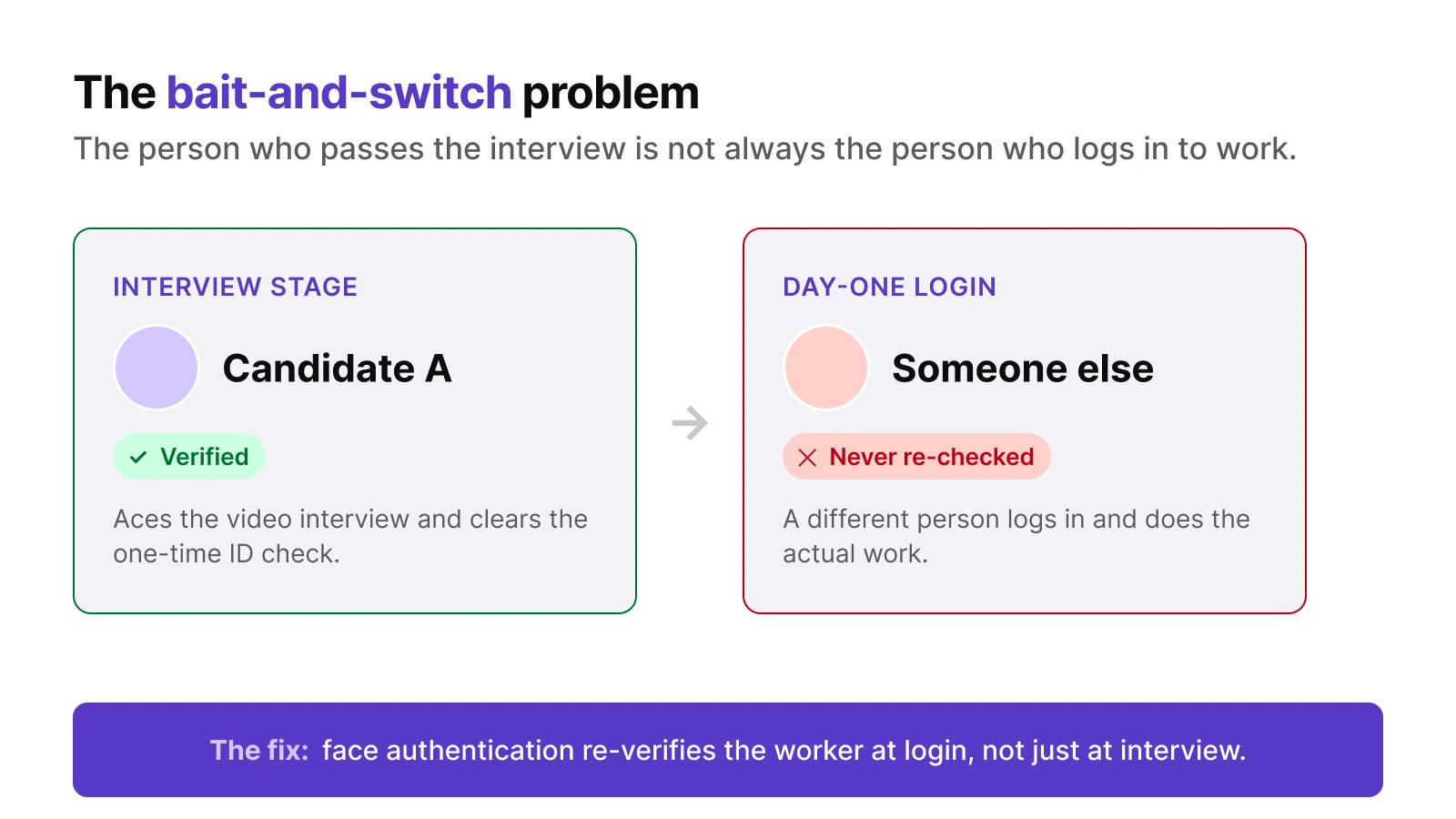
The interview is only half the risk of remote hiring fraud. The other half is the “bait-and-switch.” A skilled, verified engineer aces the technical rounds. Then a completely different, unvetted person logs into the codebase on day one. Prospects describe the proxy candidate bluntly: “I am the face, but I’m not the actual doer of the job. I’m paying someone else to do the job.” The nightmare version is “interviewing with one person and then pops up the other person in the workplace.” Verify identity once at the interview and never again, and that switch stays invisible.
The global identity blind spot
Manual ID review breaks down the moment hiring goes global. Internal HR teams are not forensic document experts. One recruiter summed up the honest limitation: “I wouldn’t know a Jakarta ID from anything, I have no idea what it looks like.” Legitimate identity documents span thousands of formats across 200+ countries and territories. Each has its own security features, fonts, and layouts. A forged residence permit from a country your team has never processed will pass a visual glance every time. Asking staff to visually scan documents over a webcam is not just error-prone. Fraudsters bypass it trivially with fake national-insurance numbers, stolen IDs, and “IDs that aren’t actually them.” For regulated employers, the exposure is not only operational. Hiring a sanctioned individual, even unknowingly, can trigger enforcement action. And you must handle candidate biometric verification under strict data rules (more on that below).
- The proxy “bait-and-switch.” One verified person passes the interview; a different, unverified person does the job.
- Unfamiliar documents. HR reps guess at authenticity for IDs they have never seen, so forgeries slip through.
- No re-verification. A single check at application leaves the entire employment relationship unverified.
- Sanctions exposure. An unverified hire from a high-risk network can carry real regulatory consequences.
Red flags recruiters can spot before buying software
Verification software is the durable fix, but you do not need a purchase order to start screening for remote hiring fraud today. A trained recruiter can catch many fake candidates with a few deliberate checks. Treat these as first-line triage, not proof.
Watch the live interview
The interview itself leaks the most tells:
- Audio and video desync. Lip movements that lag the voice, or a face that warps at the edges on turning, can signal a real-time deepfake.
- Off-screen glances and odd pauses. Repeated looks to the side and unnaturally delayed answers often mean someone is feeding responses through an earpiece.
- Reluctance to go live. Pushback on a screen-share, an unscripted task, or a quick “hold your ID next to your face” request is a strong warning sign.
Cross-check the paper trail
Fake profiles rarely hold up to a second look:
- Thin or brand-new LinkedIn. A sparse network, a recently created profile, or a work history that does not match the resume are common with proxy candidates.
- Identity mismatches. An accent, time zone, or working hours that do not line up with the stated name and location deserve a closer look.
Check the technical footprint
A few background signals are easy to verify:
- VoIP numbers and mismatched IPs. A virtual phone number, or an IP and VPN location that contradicts where the candidate claims to be, is a classic remote hiring scam pattern.
- Odd shipping requests. Asking to send the company laptop to a different address than the one on file is a hallmark of laptop-farm operations.
Still, these checks fail exactly when it matters most. Modern deepfakes now sync audio convincingly, organized rings rehearse around every scripted question, and no recruiter can eyeball genuine IDs from 200+ countries by sight. Manual vigilance also does not scale past a handful of interviews. That is why the reliable layer is verification, not vigilance, which is where the controls below come in.
How Remote Hiring Fraud Beats Standard HR Checks
Each remote hiring fraud tactic targets a specific weakness in the traditional funnel, and each maps to a specific control that shuts it down. The table below is the quick reference we walk HR and talent-platform teams through on sales calls.
The pattern is clear: no single check is enough. Liveness detection without document authentication misses forged IDs, and document authentication without liveness misses the synthetic face presenting it.
Bulletproofing the Hiring Funnel with iDenfy
In short, you do not beat remote hiring fraud with sharper-eyed recruiters. You beat it by layering identity verification for hiring, so each control closes the gap the last one leaves open. Better still, every control maps to a headache HR teams describe on our sales calls. The table below does precisely that.
Document, liveness, and duplicate detection
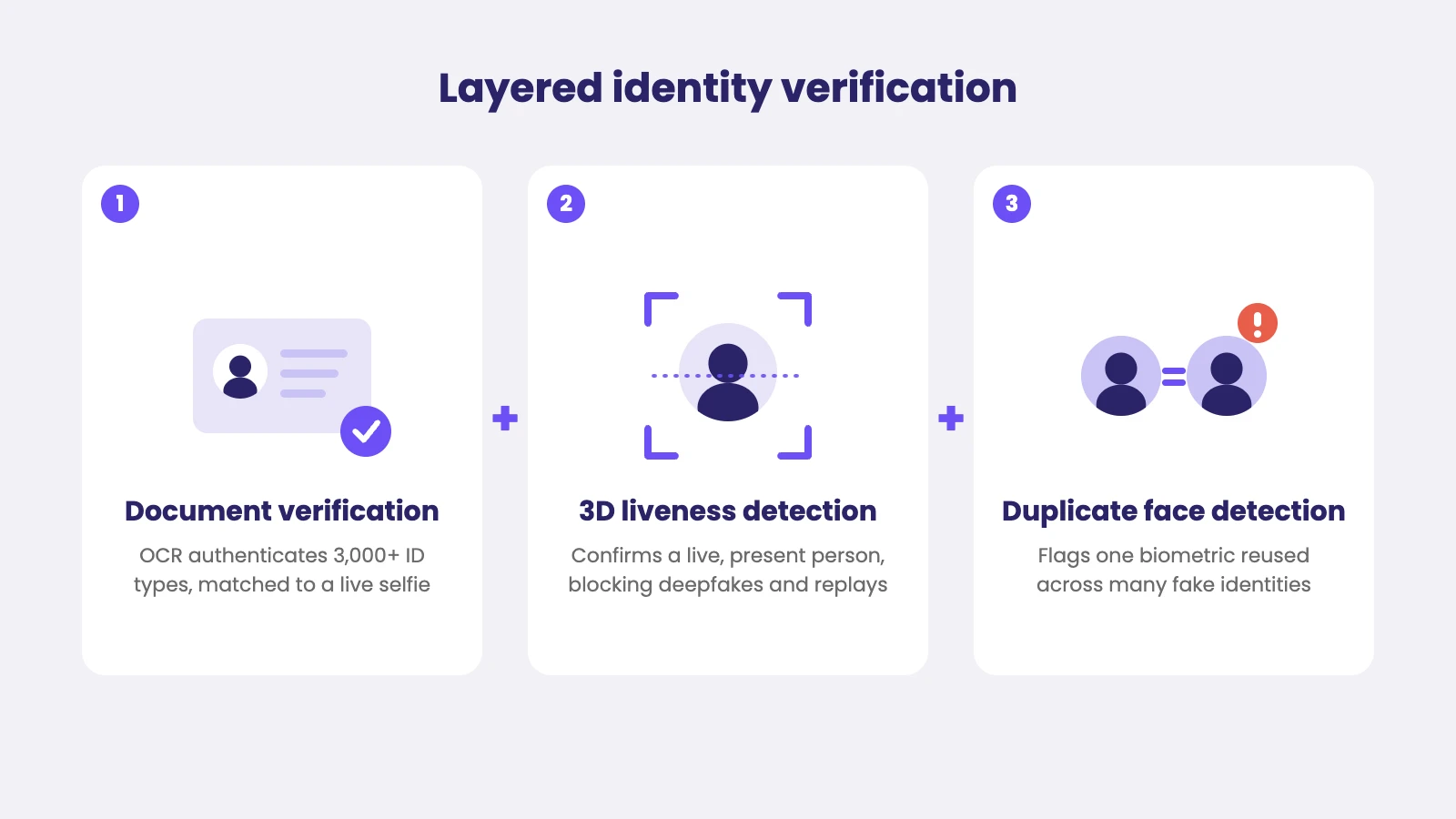
That layering is exactly what we built at iDenfy. Our document verification reads and authenticates more than 3,000 document types from 200+ countries with automated OCR. Your recruiters never have to judge an unfamiliar foreign ID by eye. It also matches the ID photo to a live selfie, so no one can wear a stolen local identity behind a different face.
In addition, the 3D liveness layer defeats the on-camera tricks. Passive and active liveness confirm the face belongs to a live, present person. That rules out a replayed clip, a mask, an AI-generated intro video, or a deepfake piped through a virtual camera. It is the difference between trusting the video feed and actually testing it.
Finally, duplicate face and biometric detection breaks organized rings. Say a scammer applies for several roles under different names using the same biometric profile. The system flags them instantly. It is how you stop a rejected fake candidate from quietly re-entering your pipeline under a fresh stolen or synthetic identity.
Re-verify at login to kill the bait-and-switch
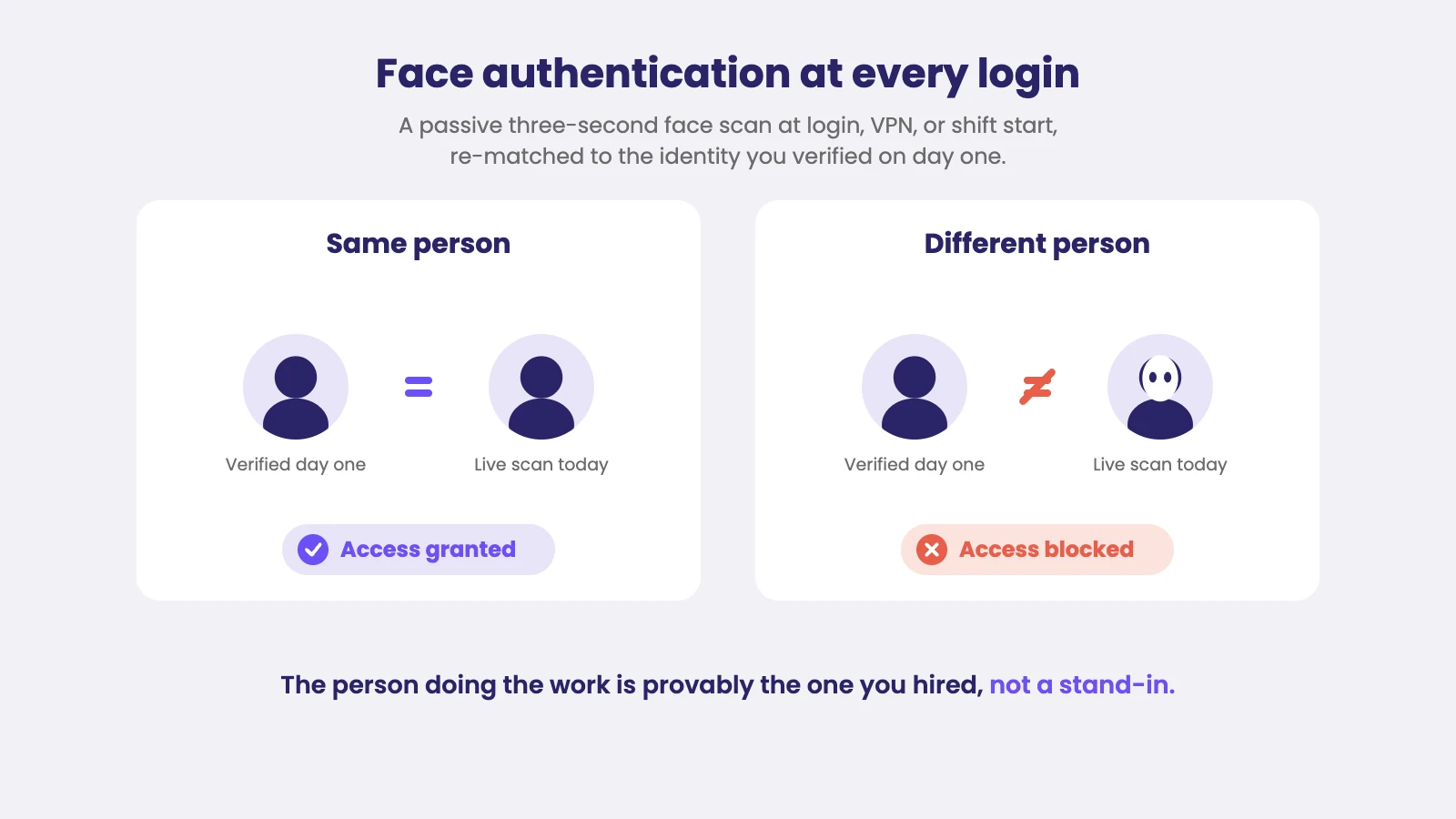
To kill the bait-and-switch, verification cannot stop at the offer letter. A document check runs once during onboarding. It proves nothing about who actually logs in three weeks later. This is where face authentication, our re-verification layer, earns its place in an HR stack. You can require a quick, passive three-second face scan at any sensitive moment: when an employee signs into internal servers, connects to the corporate VPN, or clocks into a shift. The system re-matches that live face against the identity you verified on day one. If a different person sits at the keyboard, the scan fails and blocks access. The person doing the work is provably the same person you interviewed and hired, not an unvetted stand-in.
Keeping biometric verification legal
This part matters for HR. Biometric data counts as a special category under GDPR Article 9. Laws like Illinois’ Biometric Information Privacy Act (BIPA) govern it tightly. So candidate verification must run on a clear legal basis, with proper notice and consent. Our platform captures that consent and keeps an audit trail. You get the security without inheriting a privacy liability. Want to see it stop a deepfake in real time? Book a free demo, and our team will walk your HR or platform stack through a live verification flow.
Enterprise ATS and HRIS Integration
These controls only scale if they live inside the tools your recruiters already use, and they must not add manual work for HR. iDenfy’s verification plugs directly into both applicant tracking systems (ATS) and HR information systems (HRIS) through a documented API and webhooks. It triggers, returns, and logs each verification automatically inside your existing hiring workflow. So you can verify identity early, during the application stage through an ATS like Greenhouse, Lever, or Workable. Or you can verify right before contract signing, through an HRIS platform such as Oracle HCM or Workday.
In practice, you configure the flow once. A candidate reaches the verification step and completes ID verification and liveness checks on their own device. The pass-or-fail result and the audit record then land back in your ATS or HRIS, with no manual review. It removes a large administrative burden instead of adding one. That is usually the difference between a policy people follow and one they skip.
Related: Face Authentication for KYC and Reverification
The Bottom Line
Remote hiring fraud has professionalized faster than most HR stacks have. The human eye is now the weakest link in the funnel. Deepfakes, AI intro videos, the earphones trick, catfish identities, forged foreign documents, and the proxy bait-and-switch all beat a recruiter’s visual check. Organized rings exist to exploit exactly that. They often surface only after the laptop ships and the intrusion begins.
As a result, the defense is layered identity verification, wired into your hiring flow. You authenticate the document with OCR, prove liveness, detect duplicate biometrics, and re-verify at login. Done right, it runs quietly in the background. It stops the bad actor at the application step, instead of after they land on your payroll.
At iDenfy, we bring ID verification, 3D liveness, duplicate face detection, and face authentication together on one platform, with native ATS and HRIS integration. Let’s talk, and we’ll give you a free dashboard tour of how it fits your hiring funnel.