Imagine trust as a currency for a minute, that drives deals and accelerates partnerships, but there is one significant problem: trust is harder to earn and easier to lose. With rising incidents of business fraud, ownership structures, and increasing regulatory demands, companies can no longer afford to take their partners at face value – KYB (Know Your Business) verification becomes critically important.
KYB is a decent way to build credibility, hold long-term partnerships, and protect your company from mistakes that could be costly. Let’s see why KYB verification is central to having trust in B2B relationships, how it works, what it is, and what best practices can help your business implement it effectively.
What Is KYB Verification?
Know Your Business (KYB) is the process by which companies verify that the businesses they deal with are legitimate. Not just registered on paper, but genuinely legitimate, properly structured, and run by people who can be identified.
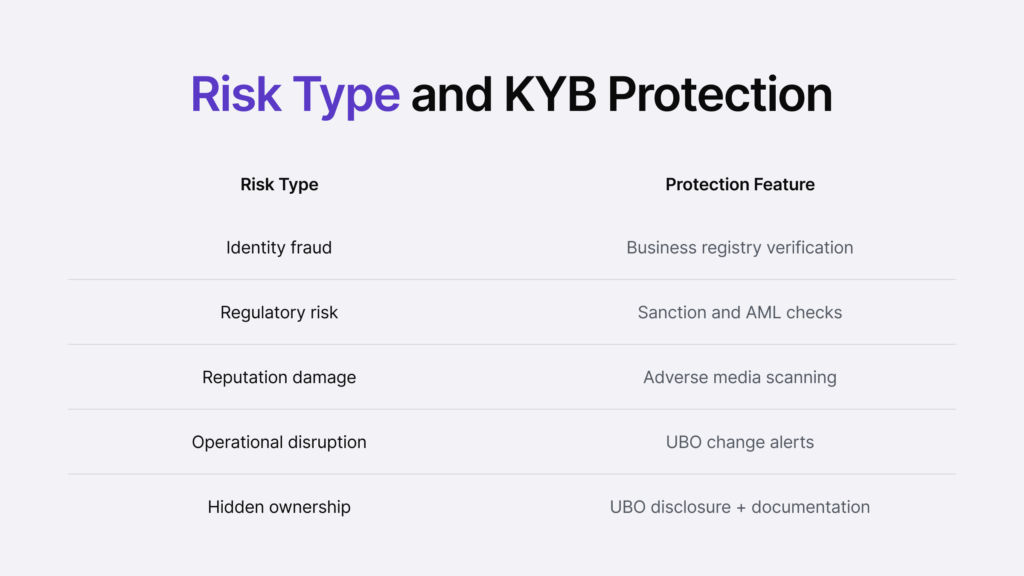
KYC verifies people. KYB verifies businesses – their legal standing, who’s behind them, and what risk they bring. That covers registration details, ultimate beneficial owners, sanctions and adverse media screening, and documents like business licenses and tax IDs.
The whole thing comes down to one question: Is this business actually what it claims to be?
Related: The Guide to KYB Onboarding
Verify businesses, not just people
Automate company verification, UBO checks, and business due diligence with iDenfy KYB.
Explore KYB SolutionKYB and Its Importance to B2B Trust in 2025
Businesses operate across borders and digital platforms, and the risk of encountering a fraudulent entity has grown alongside them. In B2B relationships, the exposure is bigger – contracts are larger, responsibilities run deeper, and the reputational fallout from getting it wrong is harder to recover from.
KYB reduces those risks by ensuring the businesses you work with are who they say they are.
Fighting Corporate Fraud
Fraudulent businesses often operate as shell companies or fronts for illicit activities. Partnering with them – knowingly or not – can result in serious consequences. KYB identifies patterns early by verifying credentials and ownership structures before any transaction or partnership begins.
Regulatory Compliance
Financial institutions, fintech startups, and marketplaces that handle transactions are under increasing scrutiny from regulators. Anti-Money Laundering (AML) laws require businesses to check their partners thoroughly. KYB satisfies these regulatory requirements and protects companies.
Trust With Growth Together
Growing companies can end up onboarding hundreds or thousands of vendors, partners, and clients before long. Manual checks at that volume are slow and inconsistent – things get missed. Automating KYB keeps assessments consistent, reduces onboarding time, and keeps the team from being buried in paperwork.
Related: KYB vs KYC — What is the Difference? [Explanation Guide]
KYB and Trust in B2B
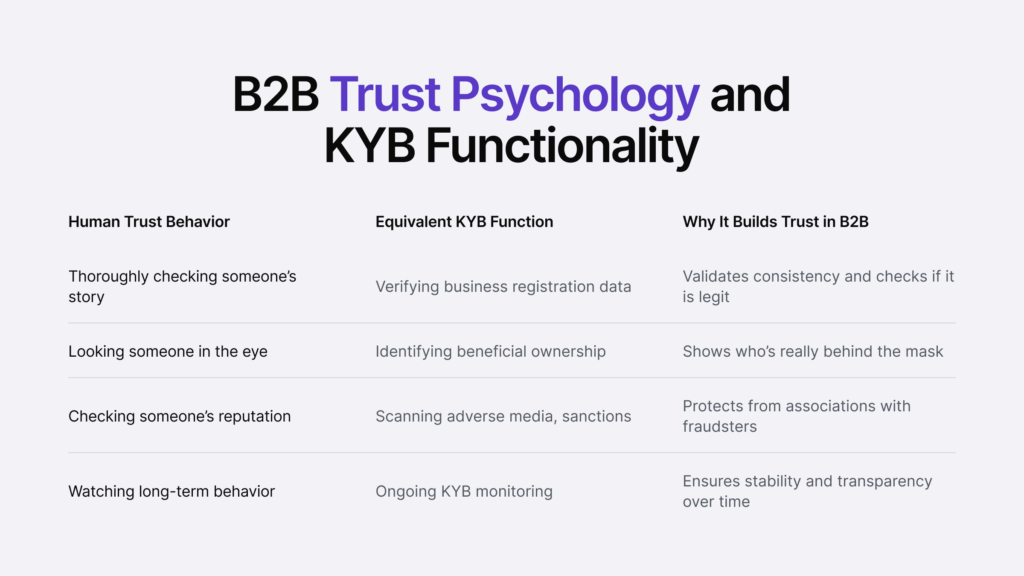
Trust in B2B relationships comes down to transparency, predictability, and compliance. KYB delivers all three.
When a business undergoes KYB verification, its credentials are cross-checked against official government databases, credit bureau reports, and third-party data sources. Ownership structures are mapped, red flags such as sanctions or ongoing legal proceedings are surfaced, and the company’s operational status is confirmed.
It’s not about ticking a box. When you’re working with a fully verified partner, you know exactly who you’re dealing with – no ambiguity, no hidden ownership, no compliance problems showing up later when they’re harder to deal with.
Verified partnerships lead to:
- More confident negotiations
- Shorter onboarding timelines
- Easier internal approvals
- Improved platform integrity
- Enhanced regulatory readiness
Here are some more details about how KYB builds relationships in B2B:
1. Legitimacy Verification
Trust starts with legitimacy. Before your business can confidently onboard a supplier, partner, or third-party vendor, you need to confirm that the business is who it claims to be. KYB helps you:
- Confirm that the company is legally registered and in good standing
- Validate the company’s structure and location through government databases
- Assess if the business has the authority to operate in a given jurisdiction
This prevents fraudsters from entering your ecosystem and makes sure that every relationship begins with a foundation of verified facts, not assumptions.
Example: A logistics platform working with international freight companies uses KYB to screen new carriers. By verifying licenses and legal registrations, the platform filters out fraudulent operators before shipments ever begin.
Related: How to Check if a Company is Legitimate [10 Steps]
2. Transparency Establishment Around Ownership
In B2B, who you are really dealing with matters. Many companies have complex ownership structures, with shell companies or nominee directors hiding the true beneficiaries.
KYB makes ownership transparent by identifying Ultimate Beneficial Owners (UBOs) – the individuals who ultimately control the business. This helps build trust by:
- Ensuring you know exactly who is behind the company
- Avoiding entanglements with sanctioned or high-risk individuals
- Demonstrating your own compliance commitment to regulators and investors
When businesses disclose this level of detail, it signals openness and accountability—two critical ingredients in any trust-based relationship.
Related: The Main KYB Risk Factors You Should Know
3. Mutual Commitment Demonstration to Compliance
Trust goes both ways. When both parties in a B2B relationship invest in compliance measures like KYB, it creates a mutual understanding: “We take risk seriously, and so do you.”
That shared commitment builds:
- Confidence in business continuity (you are less likely to be affected by a partner’s compliance failure)
- A stronger brand association (your company is not at risk by proxy)
- Peace of mind during audits or regulatory reviews
In highly regulated sectors, such as fintech, procurement, SaaS marketplaces, and logistics, this commitment to compliance can be the difference between a quick onboarding and a deal falling through.
4. Long-Term Support Collaboration
B2B relationships are not built on one-off transactions. They transfer into long-term collaborations involving data sharing, various agreements, ventures, and financial dependencies. The deeper the relationship, the greater the need for consistent, verifiable trust.
KYB supports long-term partnerships by using:
- Ongoing monitoring of business status, ownership, and risk profile
- Alerts when a company changes directors, UBOs, or legal standing
- Better visibility into a partner’s health and compliance posture over time
This is especially important when your partner’s regulatory or financial position can directly impact your business.
Example: A SaaS company integrating third-party developers into its ecosystem uses KYB monitoring to detect sudden changes in vendor structures. If a key vendor is sanctioned, they are alerted immediately, protecting system integrity and compliance.
The Role of Business Verification in Protecting Platform Integrity
One fraudulent or non-compliant entity can damage the credibility of the entire platform.
KYB here prevents fake businesses, sanctioned organizations, or politically exposed persons (PEPs) from gaining access. That kind of screening is necessary to keep on growing without weakening trust.
Automated KYB tools can flag risks during onboarding, monitor ongoing changes to business status, and strengthen verification based on jurisdiction or transaction volume. This makes sure your platform remains open and secure.
Best for Business Verification in 2025
Implementing KYB does not have to be complicated. Here are some practices that can help you balance trust, speed, and compliance.
Choose an Automated KYB Solution
Manual verification slows down onboarding and has inconsistencies. A better approach is to use an automated KYB provider that pulls data from global business registries, integrates UBO data, and screens for sanctions or media alerts.
Related: 6 Steps to Conduct a KYB Verification Check [Guided Explanation]
Match verification depth to risk level
Not every business relationship needs the same level of scrutiny. Onboarding a small software vendor is a different proposition than partnering with a high-risk financial institution. A tiered approach – adjusted by risk level, jurisdiction, or service category – means you’re not running the same process on everyone regardless of what’s actually at stake.
Don’t make it harder than it needs to be
A well-designed KYB process should be straightforward for the other side, too. Make it easy for partners to submit documentation, understand why it’s being asked for, and get updates on where things stand. Unnecessary paperwork and unclear instructions don’t make the process more rigorous – they just slow it down and create friction where there doesn’t need to be any. For more on finding the right fit, see the guide to the best KYB providers in 2025.
Handle the data properly
KYB involves sensitive information, and how you protect it matters. Encryption, access controls, and compliance with GDPR or whatever regulations apply in your markets aren’t optional extras – they’re part of the process. The way you handle a partner’s data is itself a signal about how seriously you take the relationship.
What Happens If You Skip Company Onboarding?
Skipping or delaying KYB may save time in the short term, but it exposes your business to significant risks. You may end up partnering with non-existent or fraudulent companies, failing audits, facing compliance violations, or ruining your brand reputation. Worse, if regulators catch you onboarding unverified individuals.
In the worst-case scenario, a lack of KYB processes could even derail your fundraising or exit opportunities. Investors and acquirers want to see that your compliance operations are scalable and mature.
Conclusion
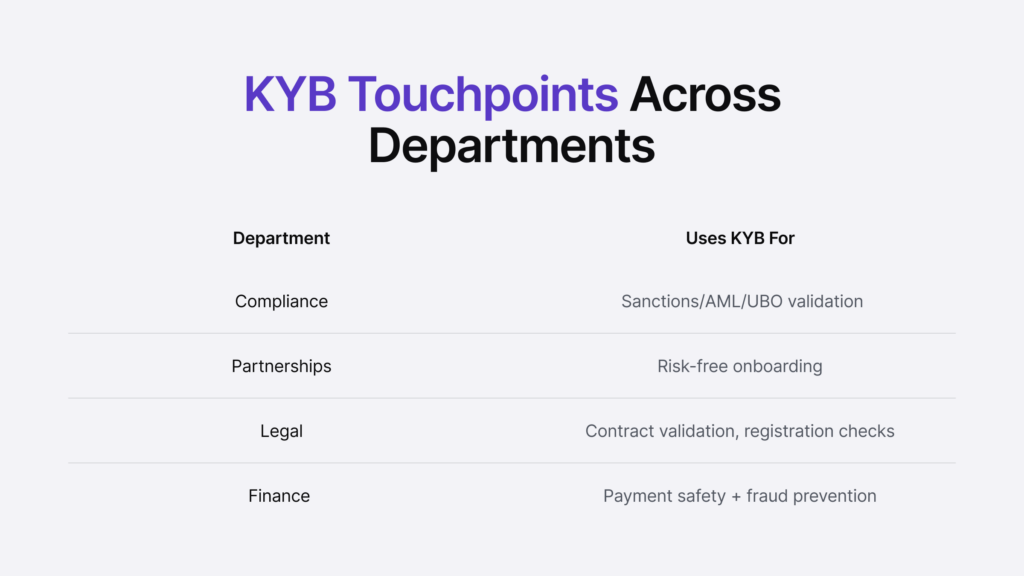
Every fintech startup, a B2B marketplace, or a software provider working with enterprise clients needs to have KYB, which helps you vet potential partners quickly, stay compliant, and protect your brand. More importantly, it creates a business environment where transparency and accountability are the norm, not the exception.
Investing in a streamlined, risk-based KYB process helps you build partnerships that are safer, stronger, and scalable for the long run.