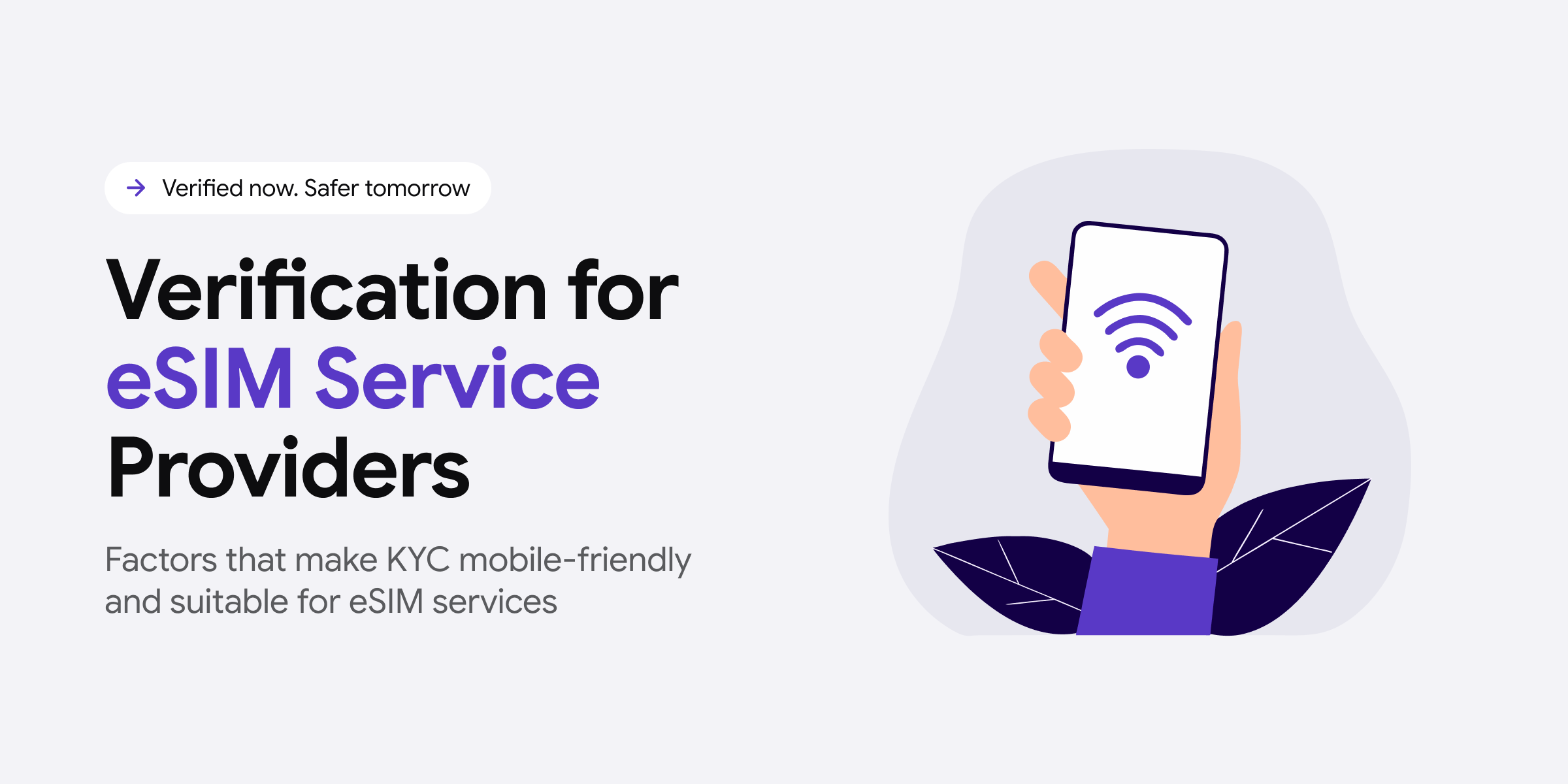
eSIM service providers and their users are mobile-first, meaning they use the app to activate their SIM and mobile plan, often on a global level, where different countries and eSIMs are offered. In the context of Know Your Customer (KYC) verification, as an eSIM platform, you need a vendor that offers a simple user experience on the mobile app and one that works globally, onboarding and activating different eSIM plans for users all over the globe, especially if you want to scale and convert more returning clients in the future.
Unlike traditional SIM cards, eSIMs are very convenient, and with this sort of accessibility, as a provider, you need to ensure that your services aren’t being abused and used for fraudulent purposes. In practice, a KYC-compliant eSIM platform is often the one that has integrated age and identity verification. Previously, telecom providers would onboard users via video calls or ask the client to come in and show their ID in person. This would take days, instead of a maximum of a few minutes, which is the industry standard for modern eSIM service providers and their identity and age verification procedures.
I review what you need to know from a compliance standpoint and what kind of challenges eSIM providers face when implementing identity and age verification measures below.
What is an eSIM?
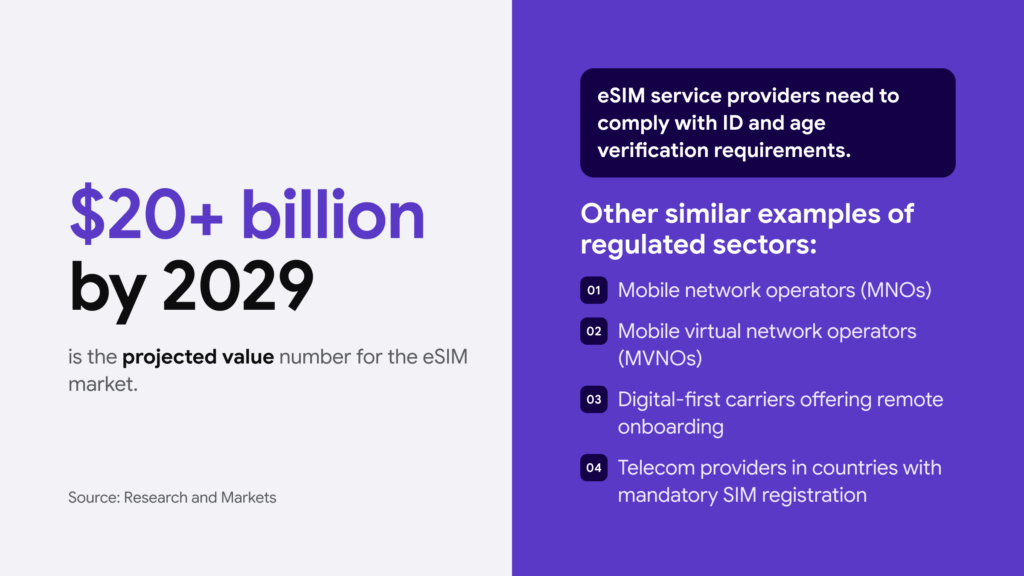
An eSIM, or an embedded SIM, is a digital alternative to a traditional SIM card, which is built directly into the user’s mobile device. Some new models, like the iPhone Air, are already e-SIM-only devices and don’t have the space built to store a physical SIM. Often, an eSIM can be activated via an app download or a method like scanning a QR code that then redirects to further instructions.
Part of that, depending on the country and the specific eSIM, also includes verifying the user’s identity and age. This helps ensure the person won’t be using the eSIM for fraudulent purposes. This is important, as impersonation scams and various telephone-related schemes remain popular ways for scammers to lure money from their victims, especially among older people, who are often less tech-savvy.
Automate your identity verification
See how iDenfy helps 1,000+ companies verify customers in seconds with AI-powered KYC.
Explore iDenfyeSIM vs a Physical SIM
The biggest difference between the two is that a physical SIM requires a new card to switch carriers, while an eSIM service allows users to switch carriers without changing any physical hardware.
Additionally:
- An eSIM is carrier-independent
- A physical SIM supports one carrier at a time
- An eSIM can be uninstalled, but can’t be lost or stolen
- A physical SIM is removable and can be lost or stolen
- An eSIM can be activated and switched digitally
- A physical SIM requires manual insertion and replacement
That’s why eSIM services are now used for mobile internet and travelling as a way to save costs, similar to how a fintech might be a better option cost-wise or user-experience-wise, compared to traditional banking.
What Should I Expect from eSIM Service Users?
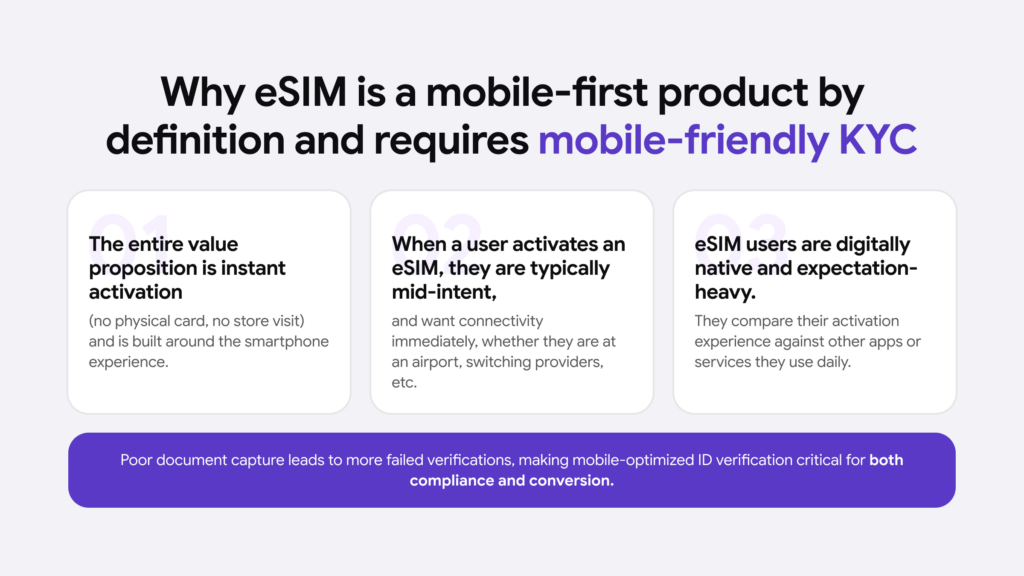
The more common persona for an eSIM service buyer is someone who knows how to use various platforms and has already completed at least a single remote KYC check in their life. That’s why eSIM service clients are digitally native and, often, expectation-heavy. Users can compare the U/X and the overall feel of the identity and age verification process to the other one they had to complete on another platform, and if it’s worse, their trust in the brand is damaged.
So, even if it’s not a banking app and a “simple” eSIM activation experience, the user will most likely compare it against the smoothest app they use daily. Even a single out-of-place verification step signals that the provider has not thought through the product experience, which is crucial, since the onboarding and the verification step can happen both at the account creation or eSIM activation stage, or later on, throughout the whole business relationship.
What are the Advantages of eSIMs for the Providers?
eSIM services are becoming more popular, creating opportunities for new businesses or existing telecommunication firms as a way to scale their service scope. For example, eSIMs solve the challenge of distribution, enabling users to reach their service without having to distribute physical items, so there’s no need for a retail touchpoint. With a good onboarding process and a responsive support team, eSIM service providers can welcome new customers 24/7. And there’s a need for such services. People have multiple devices, tablets, smartwatches, laptops, etc., which need connectivity, even if it’s a secondary device, especially for backup.
Other important benefits include:
- Real-time service access. eSIM services offer simple U/X and plan activation, where users top up or cancel their eSIM plans within a few simple clicks.
- Better data analytics. eSIM services can access more statistics and track details like eSIM activation rates, usage patterns, country-related data, and important info like churn signals, which is traditionally not possible with physical SIM cards.
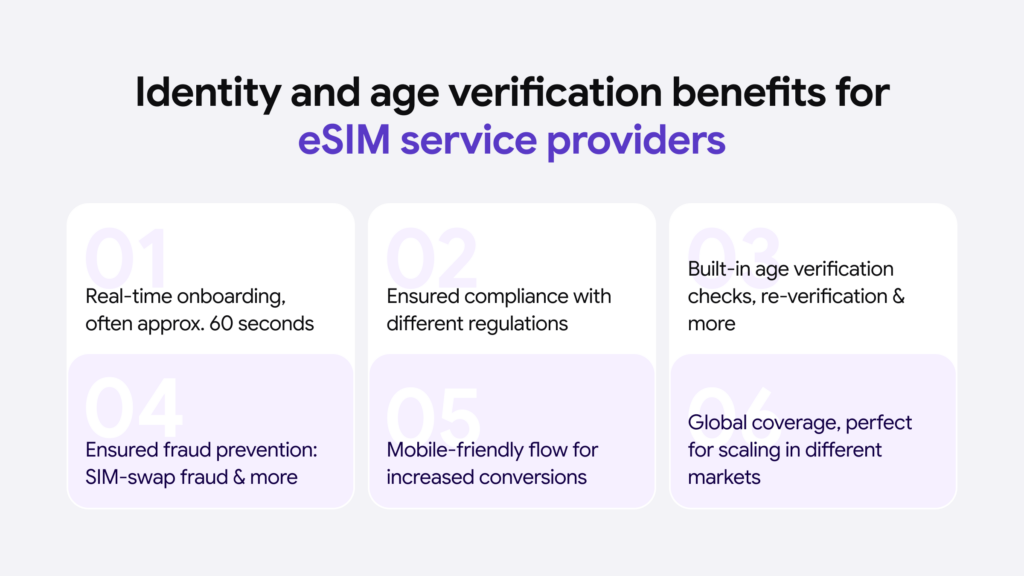
- Security and compliance. eSIM service providers that integrate identity verification or age verification into their eSIM activation process ensure that users’ data is secure and the services are compliant with global regulatory standards that are designed to prevent fraud.
For eSIM providers, this model is relatively cost-efficient because it’s based on a simpler operating system that doesn’t need SIM manufacturing, logistics, or inventory. Users don’t have to wait for a card in the mail. eSIM service providers reduce this friction and offer instant, global connectivity. You can literally get on a plane and have your eSIM activated in the air if there’s an internet connection. From a business standpoint, this is a scalable, digital-first model that can be turned into onboarding thousands of new users in real-time.
How Does Identity Verification and Age Verification Work for eSIM Providers?
Both measures, identity verification and age verification, are part of the automated Know Your Customer (KYC) onboarding process, which is sometimes referred to as the eKYC flow, in line with the eSIM services and the digital nature behind it. During an identity verification check, the user is asked to capture their government-issued ID photo, and then, often, take a quick selfie so that the system can check the facial biometrics and see if the match the document’s photo in real-time.
For age verification, a database can be used as the second KYC layer (often, government-backed databases that hold personal details and the date of birth) or age estimation and other age assurance workflows (for example, the system is selfie-based and reviews your face to determine whether you pass the threshold, such as if you’re over 18). Age verification can also be identical to the standard KYC (doc-based) check since the ID document capture shows the person’s DOB.
If the user passes the identity/age verification, they can access the eSIM. Identity verification on an eSIM app can also be triggered by specific parameters, depending on the business. For instance, the USA has stricter laws (depending on the state), so that means not all eSIM users need to be verified. Reverification can also be triggered in higher-risk situations, such as if unusual activity after the onboarding was detected or if the person has reached a payment threshold.
KYC checks, no matter the industry, are part of a bigger framework, Anti-Money Laundering (AML) compliance, designed to prevent fraud, such as users registering under fake/stolen identities and then conducting illicit transactions. For eSIM services, the principle is the same: they need to ensure that their users are genuine and are accessing eSIMs using legitimate information and not hiding under synthetic identity fraud and fake personas.
Related: Age Gating vs Age Verification
Why Do I Need Age Verification for my eSIM App?
Age verification is a more specific process that verifies the user’s date of birth, which is extracted from their ID document, and checked against the minimum age threshold for the eSIM service or country in question. If you’re required to integrate age verification for your eSIM services by law, it’s mandatory, of course. Beyond that, it works as a security measure that’s impossible to bypass.
This matters since age gates that are based on self-declaration (such as a box that you have to mark or a date-of-birth field you fill in yourself) don’t work and can no longer be accepted as a fully secure or compliant age verification method. Regulators are imposing stricter laws and new frameworks like the UK Online Safety Act or Australia’s social media ban and age verification legislation, showing that this measure will soon be mandatory in more new industries.
Is a Mobile-Friendly Identity and Age Verification Solution Important for eSIM Providers?
Yes, there’s no doubt about that. eSIMs are based on a value proposition that promises their users real-time eSIM activation seamlessly, without the need to spend hours going to a physical branch to get a physical SIM card. So, it makes eSIMs a mobile-first product by definition, meaning you need to find a vendor that offers near-perect U/X for your identity and age verification workflows.
A mobile-friendly onboarding process is important because:
- A poor user experience that’s not frictionless directly contradicts the core reason a customer chose eSIM services in the first place, whether they’re at an airport, switching providers, etc.
- A user who wants to activate their eSIM is mid-intent, which means they want connectivity immediately, and if that doesn’t go according to plan, abandonment rates increase.
Identity verification or age verification details matter to the overall onboarding experience because, otherwise, the user can drop off, and as a business, you lose revenue. No automated document type or country detection, manual input where it’s unnecessary, endless QR codes or even desktop redirects, slow document capture, no customization, or suspicious third-party logos during the KYC process can intimidate the user to leave their session.
There are other important factors that some eSIM businesses might not think about unless they start digging into different verification services to compare them. For example, the document capture quality on the user’s mobile differs, depending on the solution, but it directly affects the verification accuracy. So, if the IDV or age verification SDK is not built for mobile camera conditions (like varying lighting, angle, motion blur, etc.), it produces poor image quality. This can trigger manual review and put the user on hold until they can access their eSIM, even though they’re not a fraudulent account.
Related: How to Improve KYC Verification? Tips For a Frictionless User Experience
Identity and Age Verification Requirements That eSIM App Owners Should Be Checking
When looking for a reliable solution that would help your eSIM platform onboard users faster without losing conversions, you need to assess multiple features and know which factors make an identity and age verification solution worth your time.
The requirements that you can’t miss for eSIM services include:
Scope and Global Document Coverage
Coverage of at least 10,000+ document types (passports, national IDs, driver’s licenses, residence permits) across 200+ countries is a realistic requirement for an eSIM solution that operates in various markets and is looking for a valuable KYC vendor. This is important because eSIM services market themselves as those that provide borderless connectivity targeted at an audience that travels.
Global scope means the ID verification or age verification vendor should verify any new eSIM account, regardless of where the user’s document was issued. eSIM activation is also expected to happen instantly, across any time zone, unlike the traditional onboarding flow in a financial institution, where there’s a 24-hour review waiting time or delays due to bank holidays or the weekends.
〰️ What to look for in a vendor
- Number of supported documents and countries/jurisdictions
- Support for digital/eID formats, not just physical documents
- Fallback flows for unrecognized documents rather than instant rejections
- Liveness detection that works across diverse facial profiles and lighting conditions
Liveness Detection Standards
Liveness detection technology is responsible for instantly confirming that the person submitting a selfie or facial scan is a real and physically present (not a photograph, printed mask, deepfake video, silicon mask, etc.). Combined with a standard document check, also part of IDV, these two methods are considered to be the most effective identity and age verification workflow in the market, including for eSIM services.
There are two types of liveness: passive and active.
-> Passive liveness analyzes a static image for spoofing artefacts.
-> Active liveness requires the user to complete some sort of action, like moving their head or blinking.
AI-based passive liveness is still capable of analyzing subtle signals, like skin texture, lighting consistency, or the user’s micro-movements, using their capture without prompting extra action from them. This is naturally the lowest-friction option for high-volume activation flows. For eSIM providers, passive liveness is often the practical default given the expectations that users come with when registering for such services. Based on regulations and the level of friction, you should choose whether passive liveness is enough for your case.
〰️ What to look for in a vendor
- Passive liveness option for low-friction flows without sacrificing detection accuracy
- False acceptance rate (FAR)/false rejection rate (FRR) benchmarks
- Regular model retraining cadence (due to deepfakes and their sophistication)
- Geographic bias testing (since liveness models trained on narrow demographic datasets perform worse on certain skin tones and facial profiles, which then creates a drop-off and potential discriminatory outcomes in some markets)
Specifics Regarding Data Retention
It depends on the jurisdiction, but there are country-specific requirements that require that eSIM service providers don’t store biometric data after processing. So, this means a liveness check or facial match should process the image, return a pass/fail signal, and discard the underlying biometric. Companies can handle hundreds of eSIM activations across dozens of jurisdictions, with different retention obligations.
This goes not just for ID verification and age verification workflows but also for other solutions (under the GDPR and similar data protection regulations), like bank card verification, where the user is asked to capture their credit card details as a way to ensure they’re using and registering a legitimate, not stolen, credit card for their account, as part of the platform’s fraud prevention program. Your identity and age verification vendor should also be fully customizable user-experience-wise. For example, if the user needs to be verified but is from a high-risk country, you should be able to apply different onboarding workflows and not the same process for all users.
〰️ What to look for in a vendor
- Proper KYC history logs with dates for auditing and reporting purposes (ask what exactly is recorded for each verification, in what format, and for how long)
- Support for jurisdiction-specific data retention requirements (for users from the EU, UK, US, etc.)
- Clear data processing agreements that explain where biometric data is processed, for how long, and under what legal basis, etc.
How iDenfy Helps eSIM Providers Comply With Identity and Age Verification Requirements
At iDenfy, we specialize in various, custom-made onboarding workflows that include identity or age verification methods, depending on your app/platform and its use case. We currently have major clients that offer eSIM services, along with other regulated industries that aren’t financial or banking, but rather industry-specific, like proxy service providers, cloud infrastructure services, etc., including higher-risk workflow options for industries like iGaming.
We know that eSIM platforms prioritize security and user experience, especially on mobile devices. That said, iDenfy offers all of the needed, KYC-compliant options for eSIM activation:
- Government-issued ID verification
- Non-doc digital identity verification options
- Biometric verification w/ passive or active liveness
- Database verification and cross-matching
- AML screening: PEPs & sanctions, watchlists, adverse media
- Age verification (including custom plugins for Shopify, WooCommerce, etc.)
- KYB, or Business Verification, for your potential partners and vendors
- No-code Magic Link or other user-friendly integrations
- Other fraud prevention add-ons, like SMS/email verification, risk scoring, or IP address detection
Feel free to visit our identity verification platform and try it out for free. For a closer look at other possible onboarding workflows for eSIM services, book a demo.