Having an age verification system for some businesses is mandatory. Regulated entities, such as adult-oriented platforms, online gaming sites, or alcohol companies, must check their customers’ age by law.
That means they are required to build a customer onboarding flow where users are asked to confirm their age. What counts as an acceptable check is now a legal question rather than a design preference. Since June 2025, roughly half of US states have brought age verification requirements into force, and two new regulatory layers have appeared above the website level: app stores and device operating systems.
Quick facts to remember about age verification systems:
- An age verification system is a set of technical checks that confirms a person is old enough to access a product, service, or piece of content before access is granted.
- The check can rely on an identity document, a data record, a payment instrument, a biometric estimate, or a signal passed from the device operating system.
We’ll discuss the main methods for verifying age and, later on, get into more details on how to implement an age verification system in practice that both ensures security and a smooth experience for the user.
What is Age Verification?
Age verification is a security measure that is designed to check whether the person trying to access services or products is in the appropriate age range, as required by laws or regulations. Companies can verify the customer’s age in person or electronically.
Depending on the method, organizations can verify the customer’s age using identity document checks, data records, or biometric checks to see if the person isn’t lying about their date of birth. Most importantly, an age verification system ensures that the company is complying with Know Your Customer (KYC) requirements and follows age restrictions on the services or products they offer.
Automate your identity verification
See how iDenfy helps 1,000+ companies verify customers in seconds with AI-powered KYC.
Explore iDenfyWhat is an Online Age Verification System?
An age verification system is a set of measures designed to confirm a person’s age, typically used by businesses that sell age-restricted products or services. E-commerce platforms, iGaming sites, or adult content apps use age verification to prevent minors from accessing restricted content. This process often involves collecting and verifying personal data, such as a government-issued ID, credit card, or biometrics.
An online age verification system checks the user’s personal identifying information (PII) against various data records and sources, ensuring that they can legally access the desired services or products. For an age verification system to be effective, it needs to prioritize two key aspects: providing a seamless user experience and ensuring that minors cannot bypass this security measure.
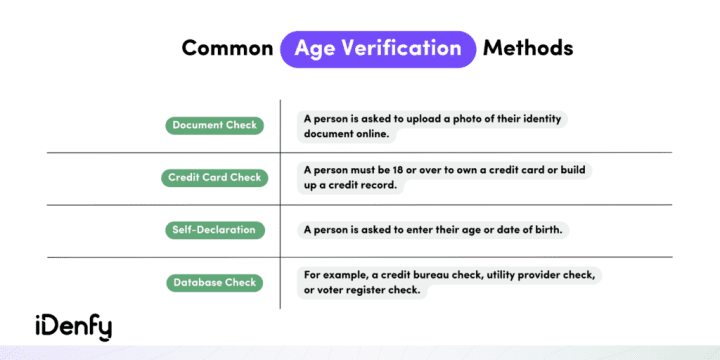
An age verification system typically:
- Verifies that a user meets a minimum age threshold, typically 18 or 21, before allowing access to a restricted product or service.
- Differs from an age gate, which asks the user to state their age without checking the answer against any record.
Age verification systems can take different forms, such as a simple checkbox or more thorough methods like video calls, where candidates are asked to show their ID during a job interview. In general, all modern age verification solutions mainly rely on electronic methods that use artificial intelligence (AI) and facial recognition technology.
Often, companies build an age verification system that’s both secure and user-friendly using document verification. That means the customer is asked to upload a driver’s license, passport, or national identity card. Then, the system verifies the document’s authenticity and extracts specific information, such as the name, date of birth, and other security features.
How is Age Verification Related to Identity Verification?
The age verification process is commonly conducted alongside Know Your Customer (KYC) procedures. KYC is a mandatory procedure followed in industries such as Fintech and other regulated sectors when onboarding new customers. In these cases, confirming a person’s age is just another aspect of the broader identity verification process.
Age verification is a mandatory requirement in industries such as e-commerce, even without KYC compliance. In practice, the age check is a rule applied to an identity verification session: extract the date of birth from the document, match the face to the document photo, then flag or reject the session if the user falls below the threshold. This need arises when businesses sell age-sensitive products and services.
-> While there are situations where identity verification may not be required, it is still the responsibility of companies to ensure that they are interacting with adult customers.
Related news: iDenfy Receives EU Funding for a New Age Identification (AI) Project
Why Do Companies Use Age Verification Systems?
Having an age verification system for businesses means that they are showing their responsibility to protect minors, even though it’s happening online, which is an even more complex process, since you can’t see the person in real life. A secure system helps guarantee that minors can’t bypass the security and age verification measures on an age-restricted platform, like an adult-only content creator platform.
So, ultimately, it all boils down to a few key reasons, like:
- As a way to protect minors. Age verification systems help confirm the age of buyers when purchasing restricted goods like alcohol or tobacco, or cannabis. For example, iDenfy provides such a system via a no-code app that can be directly downloaded from the Shopify store.
- To ensure regulatory compliance. E-commerce sites and applications are required to ensure compliance and integrate mandatory age verification checks to avoid legal penalties or reputational harm. This includes other sectors as well, such as gambling or micromobility and car-sharing sites that need to check drivers’ licenses and ensure the person is of age remotely.
By implementing reliable verification systems, businesses can strengthen trust, maintain their reputation, and simply show that they care about their customers and ethical values.
What is Age Estimation?
Age estimation is a type of age verification process that is considered easier for the end user because it doesn’t require uploading a government-issued ID document. Instead, age estimation software uses AI and machine learning to analyze the person’s face and biometric features; this way, it can determine whether they are over 18, for example. Keep in mind that some jurisdictions and industries don’t consider age estimation a compliant option for a company’s age verification system because it can be inaccurate at certain times, increasing security risks.
Despite that, age estimation is gaining recognition, with plans to be implemented in various industries, not just digital platforms. For example, grocery stores with self-service shopping stations are working on using age estimation checks for alcohol and other age-restricted items, such as energy drinks. This way, a human supervisor won’t be necessary in the future, or they will have less physical work. Keep in mind that age estimation needs to be very accurate in order for it to actually work.
Usually, there is around a 1-5 year average age assurance threshold, while at iDenfy we manage to get it to 2.5 years with an additional fallback option to a regular ID verification flow.
That’s why heavily regulated industries implement at least two layers of verification for both ID checks and age checks. For example, a document check is paired with selfie verification or database verification, which cross-checks onboarding data with a government database to see if it’s valid.
Age Assurance vs Age Verification vs Age Estimation
Three terms are used interchangeably in coverage of this topic and mean materially different things. Regulators have started distinguishing between them, so the distinction now has compliance consequences:
- Age assurance is the umbrella term. It covers any method of establishing a user’s age or age range, at any confidence level, including self-declaration.
- Age estimation infers an age range without a credential, most commonly by analysing a selfie. It returns a probabilistic answer with a margin of error rather than an exact DOB.
- Age verification establishes age deterministically, often using a copy of the user’s captured government-issued ID, or a government/credit-reference record, or another authoritative source (database).
The reason this hierarchy matters is that statutes accept different tiers. Adult-content laws in most US states require a government ID check or another “commercially reasonable” method, which generally excludes estimation. For example, iDenfy offers both standard age estimation service (non-doc workflow) and doc-based age verification workflows, as well as digital IDs, another non-doc onboarding method used to verify one’s age.
Do Age Gates Actually Work?
Thanks to all the apps and the general zero-hassle policy towards e-commerce platforms, it’s as easy as 1-2-3 to buy age-restricted products for minors online. The use of basic age gates on websites, which typically involve a checkbox asking users if they are over 21, has become ineffective.
As a result, the birthdate provided in these age gates is often left unverified. This allows children of any age to easily bypass them by simply lying about their age. Other examples of age gating include:
- Adult entertainment sites that rely on individuals selecting their age from a drop-down menu before proceeding face the same challenge.
- Online liquor stores ask consumers to confirm that they are over 21.
- Social media platforms or dating sites require users to enter their birthdays for access.
💡 Related: Age Gating vs Age Verification — Protecting Minors Online
Why is Facial Recognition in Age Verification Important?
Facial recognition technology is crucial in online age verification systems because it ensures that the person whose age is being verified is real. Typically, an age verification system consists of two stages — an ID document check and a selfie match:
- ID document scanning. The user begins the age verification process by photographing their ID card, driver’s license, or passport. The age verification system then employs advanced image processing technology to verify the validity of the uploaded document.
- Selfie matching. The user is asked to capture a selfie, which serves two purposes: liveness and likeness. The liveness technology ensures that the user taking the selfie is a real person and not a static, photoshopped image. The age verification system then confirms that the person in the selfie matches the face shown on the ID document.
The entire process is automated and typically shows results within seconds after the images are captured. That’s why many e-commerce businesses, particularly those in regulated industries like pharmaceuticals, go for online age verification systems.
What Businesses are Required By Law to Have an Age Verification System?
Age verification is mandatory for businesses that offer age-restricted products, services, or content.
Examples of industries that require age verification include:
- Tobacco and alcohol sales
- Cannabis
- Gambling, betting and iGaming
- Adult-only platforms
- Adult-only dating sites
- Social media sites (depending on the country/state)
- Online gaming and e-sports
- Medical and pharmaceutical services
- Other social media platforms and online communities
For example, Utah became the first state in the US to pass an age verification law restricting minors from using social media without parental consent. This sparked similar laws in other states, aiming to verify users’ ages using methods like selfie verification and document verification. That’s why age limits and verification requirements vary by country, so businesses must follow local regulations and adopt secure, automated age verification systems to ensure regulatory compliance.
How Do Affected Companies Usually Verify Digital IDs?
The most common method for companies to verify age is through digitized identification cards. In practice, this means:
- Asking users to take a picture of their ID document
- Cross-checking the provided information against various databases for authenticity
- Using biometric facial recognition scans to estimate age and ensure that the person’s face is genuine and matches the photo on their uploaded document
This ensures that the person attempting to access age-restricted content is indeed of legal age. In this case, no-code third-party plugins, like Shopify KYC, can also be used to confirm the buyer’s age online. For an e-commerce store, this helps integrate directly into the existing environment.
However, there are other, relatively new methods for age verification, like non-doc workflows via digital IDs, which are approved by the government in a country, such as a bank ID that you use to access your fintech app. In the age verification context, you integrate this workflow, and the end-user accesses their age-restricted items before checking out without presenting the physical document or capturing its photo. It helps improve conversions by at least 20%, based on our internal research at iDenfy.
In-Person Age Verification vs Online Age Verification
While people were used to being identified in person, many businesses now face the challenge of checking the person’s age online. Depending on the verification method, the process can look very different.
We explore the main differences between in-person age verification and online age verification below.
In-Person Age Verification
The traditional example of an in-person age verification would be a person purchasing an alcoholic beverage in a liquor store. In this case, the seller asks them to provide a government-issued document that has a photo. This may be a passport or a driver’s license.
Similar to how a staff member at your local bank verifies your identity in person, the seller in the store must also verify your identity and age. They’re required to check if the document is legit by reviewing special security features, such as NFC chips or barcodes.
They also do this by examining the document for any signs of forgery, such as unusual font or holographic foils, which indicate possible tampering. In general, they need to carefully inspect the photo, compare it to your face, and verify the listed date of birth on the document.
💡 Related: How to Spot Fake ID
Online Age Verification
The process of confirming a customer’s age online follows a similar principle, but there are key differences. Instead of the physical presence of a seller, an online government ID verification is conducted. Currently, this method is widely regarded as one of the most dependable ways to remotely verify identity documents in the market and confirm a person’s age.
How the online age verification process looks step-by-step:
- Step 1: The user takes a photo of their government-issued document, such as a passport or driver’s license.
- Step 2: The automated online age verification system extracts data and analyzes the user’s photo for authenticity.
- Step 3: The user uploads a series of selfie photos for further verification.
- Step 4: The age verification system compares and matches the selfies against the user’s identity document photo.
- Step 5: The online system determines the user’s age, either rejecting them or allowing them to purchase age-restricted goods.
An advanced age verification system remotely analyzes a scanned copy of the user’s ID and verifies the age in seconds. These systems offer several advantages. They can extract details like name, date of birth, and passport number. Most importantly, they can read and verify important security elements such as the Machine Readable Zone (MRZ).

5 Different Age Verification System Methods
Here are a few examples of different age verification methods put into systems used for verifying age and onboarding users online:
1. Document Verification With Facial Cross-Matching
The user photographs their physical ID: passport, driver’s licence, or national ID card. The system then verifies the document, extracts the date of birth, and compares the user’s selfie against the document photograph. The face comparison is an important identity proofing layer because it prevents deepfakes and other popular bypassing attempts.
In other words, it helps ensure the person in front of the camera is physically present rather than a photograph or a synthetic image, and that they match the document. For example, this is the method most US adult-content websites use due to stricter mandatory age check requirements and the nature of the industry.
2. Database and Record Checks
The user submits their name, address, and date of birth, and the system cross-references the details against credit-reference, electoral, or government records. For example, it can be a credit bureau.
No document image is captured, which reduces friction. Some companies use database verification as the third and last age assurance check to add another layer of security. Also, details like SSNs are widely used for fraud, so if you cross-match this info on top, you prevent a large portion of fraudulent applications, especially in industries like banking or insurance, where several checks, not just age, need to be conducted.
3. Digital Identity and Non-Document Flows
In markets with a mature national or bank-issued digital identity scheme, the user authenticates with the credential they already hold and consents to release an age attribute. No document is photographed, and no image is uploaded. For example, a digital ID age verification method is Smart-ID in the Baltics or OneID for the UK.
Completion rates are higher than document capture because the user is performing a familiar action and doesn’t require carrying their physical ID in their pocket. The only constraint is geographic: the age verification method exists where the scheme exists on a national level. However, you can solve this by offering an alternative workflow.
4. Facial Age Estimation
The user takes a selfie, and the system returns an estimated age range. No credential is required; only showing your face, which makes it the lowest-friction option available.

An example of iDenfy’s age estimation solution and the results the software retrieves
Estimation is accepted in some jurisdictions and for some content categories, and rejected in others. Because it returns a probability rather than a fact (the exact age), it is generally deployed with a buffer and a fallback: users estimated comfortably above the threshold pass, and users near it escalate to a document check. This allows for the age estimation system to remain accurate and still ensure compliance.
5. Credit Card Checks
A card is treated as a proxy for adulthood on the basis that the holder had to be of age to obtain a card in the first place. Some statutes name it explicitly as an acceptable method. However, keep in mind that in iGaming or adult-only platforms, this method won’t be a compliant age verification system, at least in most cases (depending on the jurisdiction as well).
It is the weakest of the verified methods. Card details can be stolen, and a minor using a parent’s card defeats the check entirely.
Related: What is Card-Not-Present (CNP) Fraud? [5 Detection Tips]
Why is Age Verification Important?
If you’re an online platform selling age-restricted products or services, you must verify your customers’ ages to:
- Comply with regulatory requirements.
- Safeguard minors from accessing your services.
- Build a good reputation by maintaining robust security measures.
In the post-pandemic environment, where e-commerce is booming and delivery or takeout services are on the rise, companies must find a way to verify their customers swiftly. That means to outdo the competition, companies must ensure both security and a frictionless age verification experience. Otherwise, they’re risking losing the customer to another platform.
For example, the Virginia Age Verification law, also known as SB 1515, requires that adult websites verify users’ age and identity, but they can choose the specific method of verification. For example, they can ask users to upload photos of government-issued IDs or use other technologies like biometrics.
That said, keep in mind that a robust age verification system can be beneficial for a variety of age-restricted products, not just limited to alcohol.
Which Platforms Need Proper Age Verification Systems?
Any online retailer that facilitates age-restricted activities or provides services that must be backed by adult consent needs to have an age verification system.
This requirement applies to the following markets in the US:
- Adult content and R-rated movies
- Online gaming and gambling
- Lottery tickets
- Aerosol paint
- Social media platforms and dating sites
- Guns (depending on the type)
- Razors (depending on the type)
- Fireworks (depending on the state)
Selling age-restricted items to minors is not only illegal but also generally unethical. It can leave your company exposed to negative media coverage and loss of customer trust. That’s why integrating a reliable, hard-to-trick age verification system can help you avoid a negative impact.
Real-Life Examples of Industries Using Age Verification Systems
While we’ve covered some products and services that are regulated, there are other markets where age verification must be implemented.
These include businesses that offer:
1. Food Delivery Services
Companies providing food delivery services must use age verification for customers who purchase alcohol. Whether alcohol is included as part of a larger order or is purchased independently, delivery drivers ask for a valid ID document before handing over the order.
2. Vending Machines
Vending machines are self-service machines, so the age verification process is fully automated. Vending machine age verification is designed to ensure that age-restricted products are sold to verified, genuine, and age-appropriate buyers. Common industry examples include tobacco, alcohol, vaping, and CBD products that are accessible through vending machines. That’s why it’s only natural that such businesses are required by law to check customers’ ages before accepting their payments for such items.
Age verification in vending machines typically follows these steps:
- The customer initiates a purchase of an age-restricted product.
- The machine prompts for age verification.
- The verification method is applied.
- The machine analyzes the provided data to confirm the age.
- If age is verified, the transaction proceeds; if not, it’s denied.
By verifying the buyers’ personal information and their age, the business behind the vending machine ensures that its products aren’t sold to minors, preventing children from accessing alcohol or other products not suitable for those under 18 years of age. This process offers convenience for buyers as it is fully automated and straightforward.
3. Online Gambling
The success of online gambling also brought stricter regulations, particularly regarding the verification of players’ ages. For example, the legal gambling age varies across states. States such as Oklahoma have a minimum age of 18, whereas the majority of states have opted for a minimum age of 21.
4. iGaming
Despite regulations, many of the newly established post-pandemic online gaming platforms didn’t effectively prevent underage individuals from participating. In general, gaming sites comply with the same age requirements as traditional casinos, which are set at either 18 or 21 years old.
5. Medical Services
Companies providing medical services must verify the ages of their patients. As telemedicine becomes increasingly prevalent, the expectations for both age and identity verification will get stricter in the future. Currently, patients must be at least 18 years old to provide informed consent for medical services.
➡️ Age verification laws you need to know: The California Age-Appropriate Design Code Act (AADC), also known as the California Law, is applicable to businesses that are accessible to children. Under this law, such businesses are obligated to establish stronger privacy policies specifically for users under the age of 18. Failure to comply can result in penalties of up to $7,500.
6. Alcohol and Tobacco
When it comes to tobacco, age verification is mandatory for vapes, cigarettes, smokeless tobacco, cigars, hookah pipes, dissolvable tobacco, and nicotine gels. The sale of tobacco products is restricted to individuals over the age of 21. However, the compliance regulations for cannabis differ. Many states allow the use of medical marijuana for individuals aged 18, but cannabis is limited to those who are 21 years old.
➡️ Age verification laws you need to know: At the federal level, the National Minimum Drinking Age Act of 1984 mandates that businesses must confirm that customers are at least 21 years old before allowing them to purchase or receive alcohol. Prior to this implementation, each state had the authority to establish its own laws regarding the minimum drinking age, resulting in inconsistencies similar to the current landscape of marijuana regulations.
7. Adult Entertainment
Companies selling or distributing adult-oriented content online must verify that users who are accessing their platforms are at least 18 years old. Previously, many sites used the mentioned age-gating methods, which left security gaps in the system. However, the state of Louisiana enforced stricter age verification measures. The new regulations mention government ID verification and database verification as more robust age verification solutions.
➡️ Age verification laws you need to know: Act 440, known as the Louisiana law, targets companies involved in the online sale or distribution of pornography. This law mandates that businesses must verify that users are at least 18 years old before granting access to adult content. In the US, particularly, a growing number of states have introduced their own age verification laws.
Alongside California and Louisiana, Florida now requires platforms that host adult or otherwise harmful content to verify a user’s age before granting access. The Florida Age Verification Law, or HB 3, is a legal requirement to verify minors online, targeted at adult-only websites and those that provide access to violent or harmful content, considered inappropriate for children.
Under the law, “reasonable methods” for age verification are required, which don’t concentrate on a specific technology but rather on a range of options. For example:
- Using a third-party KYC service provider, such as iDenfy
- Implementing a document verification solution for confirming IDs (passports, driver’s licenses, etc.)
- Integrating a biometric verification solution with built-in liveness detection
Other states have followed with their own rules: Utah, Mississippi, North Dakota and Virginia have each passed age verification laws covering adult content or minors’ access to social media. For example, in Virginia, the bill requires adult websites to use more stringent age verification protocols in order to prevent minors from seeing them. That means sites providing age-restricted content must confirm that users are at least 18 years old before allowing them to view the content.
-> Outside the US, Australia has gone further with a social media ban for younger users backed by strong age assurance.
💡 Related: How Does Age Verification in the Adult Industry Work?
Age Verification Laws Around the World
Age verification is now enforced law in most major markets rather than an emerging requirement. What differs by jurisdiction is the age threshold, the method that counts as adequate, and who is obliged to perform the check.
United Kingdom
The Online Safety Act obliges adult-only services and services likely to be accessed by children to deploy highly effective age assurance. Ofcom’s guidance is deliberately technology-neutral, with four qualitative criteria rather than a numerical accuracy threshold, but it explicitly rules out self-declaration for services required to prevent child access.
Two developments are pending: a statutory report on app store protections due by January 2027, and a UK social media minimum age for under-16s.
European Union
Article 28 of the Digital Services Act requires platforms accessible to minors to ensure a high level of privacy, safety, and security. The Commission’s July 2025 guidelines on the protection of minors set the operative standard, taking a risk-based approach, which is verification for adult sites, gambling, and other services with a statutory minimum age, and estimation where terms set a lower threshold.
The EU’s answer to the privacy objection is architectural. The Commission has published an open-source age verification blueprint, known as the mini-wallet, built on the same specifications as the European Digital Identity Wallet. It returns a proof of age without disclosing anything else, and Member States must make robust privacy-preserving verification available by 31 December 2026.
Australia
It’s safe to say that Australia has gone furthest in the mandatory age verification field. The Social Media Minimum Age obligation took effect on 10 December 2025, requiring platforms to take reasonable steps to prevent under-16s from holding accounts, which, you can say, is a prohibition rather than a restricted experience.
Ten services are in scope, including Facebook, Instagram, TikTok, YouTube, Snapchat, Reddit, Threads, Twitch, X, and Kick. Platforms removed access to roughly 4.7 million under-16 accounts within the first week. The method requirement is the part worth noting, because it runs opposite to the US model. eSafety expects successive validation, a waterfall of layered signals, and rejects self-declaration as the sole or primary basis.
United States
The US remains the most fragmented market. Following Free Speech Coalition v. Paxton in June 2025, which upheld state adult-content verification under intermediate scrutiny, roughly 26 states now have adult-content laws in force requiring a government ID check or another commercially reasonable method above a content threshold.
Texas, Utah, and Louisiana have added app-store obligations requiring a verified age category and parental consent for minors’ downloads, and California’s Digital Age Assurance Act will require operating systems to pass an age-bracket signal to app developers from January 2027. Social media laws remain heavily litigated, and there is still no federal mandate.
Other Jurisdictions
Brazil’s Digital ECA took effect in March 2026, requiring verification and guardian account linkage for under-16s. Malaysia began enforcing an under-16 social media prohibition on 1 June 2026 for platforms above eight million users. Similar legislation is pending in France, Norway, Denmark, Canada, New Zealand, Austria, and Belgium.
Why Automated Age Verification is the Best Option in the Market Right Now
To effectively use an age verification system, you should choose a solution that balances speed and security. What you must consider when choosing an age-verification solution provider:
- If your age verification process is confusing and sluggish, users will likely seek alternatives and take their business elsewhere.
- Age-restricted companies that implement both automated age verification and identity verification procedures mitigate the risk of significant fines due to negligence more easily. At the same time, they ensure a frictionless process for their customers.
- Liveness detection and biometric verification are crucial for a foolproof age verification system, especially in light of easily accessible spoofing, deepfakes, and other fraudulent activities.
Good news! iDenfy ensures all of these measures are put in place for an effective IDV and age verification system. We can help you build an efficient, fully compliant, and automated age verification process. Improve user experience, customize your onboarding flow, and, depending on the risk level, add or remove age verification checks during your KYC process.