Inconsistent formatting and fragmented registries, language barriers, hidden ownership structures, and different Know Your Business (KYB) regulations around the world add to the hassle of verifying and onboarding another company. It becomes a lengthy process and, more importantly, a costly one. For this reason, many high-risk regulated entities, such as fintech, banking, or crypto platforms, now use KYB APIs to automate many Business Verification onboarding tasks, especially vital ones, such as collecting required documentation, detecting Ultimate Beneficial Owners (UBOs), or even doing a fully self-service low-risk entity onboarding 24/7.
KYB APIs are designed to automate corporate entity verification and access to official government registries. Often, most API solutions also provide built-in Know Your Customer (KYC) checks on individuals, such as the entity’s directors and shareholders, instantly verifying the company’s standard details (such as its registration number or legal incorporation date), and, at the same time, conduct other linked processes, such as screening against Anti-Money Laundering (AML) databases as a way to ensure you’re not entering a new business relationship with a sanctioned or illegitimate entity.
Quick facts to remember:
- A KYB API screens government registries, verifies legal status and ownership, screens the company and its beneficial owners against sanctions and PEP lists, and returns structured data your system can act on.
- Any business that onboards other businesses under AML obligations (banks, payment providers, lenders, crypto platforms, marketplaces, etc.) needs to comply with KYB requirements, which often result in assessing various KYB APIs
- A company’s status, directors and shareholders change continuously, and sanctions lists update daily, which is why data freshness matters in KYB compliance
But what exactly should good, complete KYB APIs do for you? The answer comes down to which automation capabilities it actually carries, and which due diligence tasks are still left for your compliance team to manage manually. I break it all down below.
What is a KYB API?
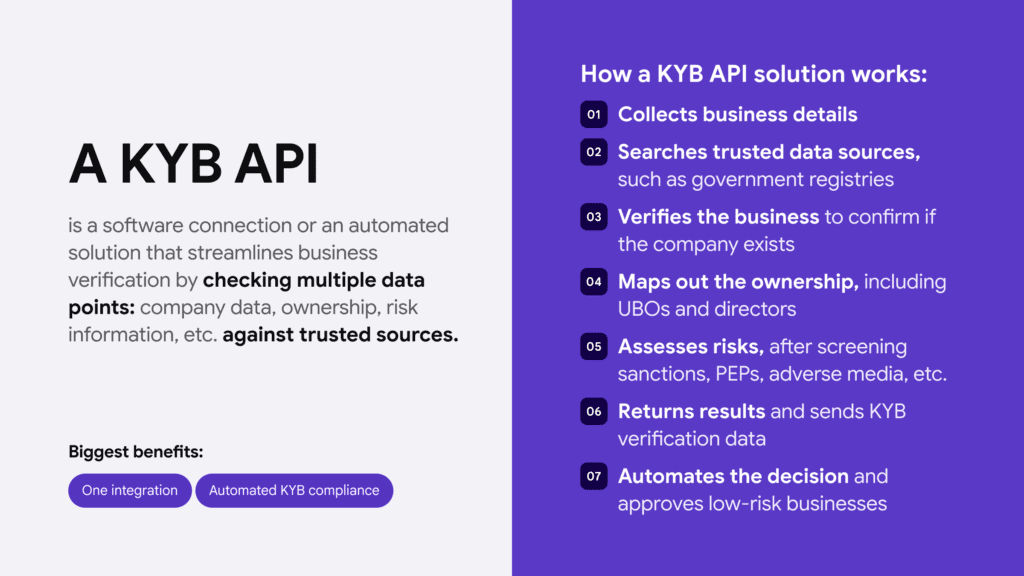
A KYB API (Application Programming Interface) is a software solution that’s built to streamline Business Verification, or KYB, checks for entities that are legally obliged to verify who they’re partnering with as a safety measure and a way to prevent fraud. Doing KYB manually is practically impossible unless you’re operating at low volumes, since it’s a more complex compliance process compared to KYC verification (individual client verification).
Most KYB APIs automatically extract official government database data and instantly check where the red flags are without the traditional, manual paperwork or emailing the company representative back and forth endlessly just to get a single document.
The essence of KYB APIs is to break down the ownership structure and verify the people behind the company. Some entities are harder to onboard and verify because they are registered in jurisdictions like Panama, where partially semi-anonymous corporate structures are allowed because the country registry has less strict and transparent filing requirements. In contrast, jurisdictions like the UK have Companies House, which is considered to be one of the most detailed and centralized registries on a global scale.
How Do KYB APIs Work?
KYB APIs help companies determine if the company that’s undergoing the KYB verification check is suitable to work with and if it goes in line with its internal risk appetite and general legal compliance requirements.
Typically, KYB APIs have a similar workflow:
- The system asks you to enter some necessary information to start the KYB verification. Either you, as a company, do this step yourself, or the end-user, aka your client, who is the company representative in this process.
- The system then sends an API request with the standard company data (name, country, registration number, etc.)
- The KYB API solution automatically accesses official government registries or credit bureaus via APIs to further verify company-related information, such as ownership details. It depends on the exact KYB API you’ll be using, as not every provider enables real-time company lookups.
- The KYB API service cross-matches extracted data, verifying that the records, such as registration details, match, helping discover red flags that might need further manual review. Some Know Your Business Verification API solutions also provide company risk scores and AI-powered summaries/notes, helping analysts automate and enable further checks, such as PEPs and sanctions screening.
- The API returns results and you decide whether the company is approved, flagged for further review, denied, or if additional documents are still needed to complete the KYB onboarding. Some solutions have used rule-based or AI-powered Dynamic Workflows builders/templates that enable fully autonomous company onboarding, especially in cases where the company’s profile matches your low-risk entity checklist.
KYB API solutions and platforms, if they work properly, drop onboarding time from days or weeks to minutes, saving at least 40 hours of work for internal compliance teams weekly. An API returns results instantly, and you should see registration status, address, or the entity’s ownership structure in seconds.
Data That KYB APIs Should Verify
There isn’t a single, standardized KYB process, as it depends on factors like operating markets, industries and jurisdictional compliance requirements.
Despite that, a good KYB API solution will automate company-related data verification tasks like:
- Standard business identity data. Checking the entity’s legal name, registration/incorporation number, tax identification, and registered business address.
- Regulatory standing. This means checking the company’s active legal status and if they have specific licenses and permits, typical of some industries. For example, in the US, this section is linked to checking if the business is in good standing.
- UBOs. Verifying those who own/control the company (25% or more) and have direct power over it, making them higher-risk individuals.
- Corporate structure. Verifying the ownership chain further (other directors or executives) and checking if the entity has any parent companies or subsidiaries that also need to be verified.
- Other risk-related screening processes. This includes conducting stricter KYC checks on certain individuals and checking the company itself (including parent companies) against global sanctions lists, watchlists, or adverse media.
Related: 6 Steps to Conduct a KYB Verification Check [Guided Explanation]
What’s the ROI of a Good KYB API Platform?
Checking another company during KYB onboarding means verifying individuals and checking multiple government registries. This includes both KYC and AML elements, which increases the mandatory steps regulated platforms need to take to ensure a compliant KYB process.
But the biggest turning point regarding the ROI of a KYB API platform is the end-user experience and the time-to-approval factor. It directly affects the fact whether you onboard the company or lose it, or prolong the process, frustrating the client and affecting the whole chain negatively. Often, incomplete records and missing documents prolong the process.
With KYB automation, you can minimize this and achieve greater ROI, as well as:
-> A higher KYB approval rate. Your customers are more likely to complete their KYB form if the U/X and flow feel seamless and relatively easy. This also helps analysts and reduces the backlog for them when they have the needed documents (not fragments) faster to make the final decision.
-> Lower KYB compliance costs. KYB APIs identify mismatches and incorrectly provided or missing data, detecting fraudulent patterns (like a shelf company that has a shiny facade) in real-time, as opposed to an analyst having to review multiple different registries by manually googling or going through them.
So that’s why you can’t overlook the end-user experience. Both analysts working the API solution and end-users filing the questionnaires and submitting the documents need to feel like they are welcomed and guided throughout the process. At the same time, a KYB API platform removes the hassle as much as possible, helping analysts onboard entities faster and trigger automated re-screening to periodically review entities based on received alerts and changes in their risk profiles.
Why Users Drop Off During KYB Onboarding
There’s an alarming trend in B2B onboarding that shows that users are more likely to drop off during their KYB onboarding simply because KYB is harder than KYC and it requires more effort from the client, even when a well-developed KYB API solution is used by the business.
You also need to have a complete audit log with reasons why a certain decision was made. Ownership structures need to be mapped and checked properly, and there are many firms registered in one jurisdiction and then actually operating in a whole different country.
At iDenfy, there are solutions to minimize the abandonment rate, for example, by sending out automated reminders to company representatives, letting them know which documents or fields still need to be added from their side. This helps ensure they are converted and they actually complete the onboarding flow faster.
Related: Why Your KYB Solution for Business Verification Isn’t Working
How to Compare KYB APIs
Assessing and comparing different KYB API vendors based on their price alone isn’t the most accurate approach. Costs or speed alone aren’t enough. Important add-ons like native KYC verification and AML screening on a KYB API platform are vital. Additionally, testing out the solution and how it handles edge cases is vital, because this is where the gaps show up.
I also recommend analyzing other aspects, like:
API Response Times
This is how fast the API solution works, including its response times and error handling, and how it responds to edge cases. It should return structured data, no matter the business type or its jurisdiction. Analyze and review how the API handles newly registered companies or cases where missing data is an issue, which would typically require manual intervention. Using a proper KYB API means that your compliance team spends time only on flagged, edge cases and doesn’t waste time on clear/low-risk applications because automation takes care of it.
-> Bonus tip: The service provider should have clear API documentation with defined API limits and access to testing environments. You can review iDenfy’s documentation as an example.
Data Freshness and Coverage
All details used in the KYB onboarding process need to be up-to-date. Ask the KYB API service provider what the timeframe for updating data and whether the frequency is compliant and appropriate for you. Ownership structures change, sanctions compliance also changes frequently, and without a proper monitoring system, it is risky to use static databases. Also, look for providers that are global if you’re operating in multiple countries. Some specialize only in the UK or the US.
-> Bonus tip: Good KYB APIs connect directly to official government registries and do not rely on third-party databases. Primary sources are the safest option and the key to accessing updated details.
KYB API Automation Capabilities
Check in with the Sales team and all of the vendors you’re comparing whether they live up to your expectations automation-wise. Sometimes, the marketing tactics have good intentions, but the reality differs. A proper KYB API solution should not only automate access to different corporate registries but also offer a sort of no-code workflow builder that allows you to customize the KYB onboarding process and add various automation elements.

For example, at iDenfy, we have both Dynamic Workflows and the Questionnaire feature that lets you easily create the KYB process with a single API, adding corporate registry and credit bureau reports, UBO identification and verification (built-in KYC checks), AML screening (PEPs and sanctions, adverse media), risk assessment and scoring, as well as other workflows, such as a separate pre-made template for sole proprietorship verification.
-> Bonus tip: Some KYB APIs have pre-made corporate entity onboarding templates that already have the setup based on common industry standards. Others have an AI-based option, where you can describe requirements and the automation will run the workflow suggestion for you.
Integration and Audit Trails
Your chosen KYB API should easily integrate into your existing system, fitting your stack. If you’re just starting out or handling large volumes already, the principle’s the same, and extra manual workload should not be created if you’re already using an API. Often, larger companies have compliance teams that consist of multiple members.
That means your KYB API should have the option to leave notes, escalate a certain case to another analyst and always provide all data regarding the applicant, with internal comments from all reviewers throughout the whole onboarding process. It helps when records from months and months of work are requested by regulators and you need to provide evidence and exact KYB sources used with timestamped records.
-> Bonus tip: KYB APIs should be adaptable based on your industry. Look for reliable vendors that can back their experience with case studies and a track record that shows they can handle large volumes, especially if that’s what you currently need or have plans to scale in the future.
What’s the Difference Between a Single KYB API and Using Multiple Vendors?
An end-to-end KYB solution helps save costs and gives you the biggest benefit of not having to manage multiple vendors and their dashboards. The information is then provided in one place and you can reach out to one support team if you need assistance. It’s also easier for compliance and auditing purposes since you can extract and compile KYC/KYB and AML data in one PDF report. Key KYB compliance components, like UBO verification, access to government registries, or AML screening, are in one place.
When it comes to changing or creating new onboarding workflows, it’s less difficult to maintain them or update company profiles. You get the whole picture via a single KYB API call, including notifications during ongoing monitoring. If you’re planning on scaling to new markets, a global vs a local KYB API service provider also wins, since this approach ensures you’re compliant before you need to worry about different markets or entity structures in various jurisdictions.
How FTMO Scaled its KYB Onboarding With iDenfy’s API
Over the years, at iDenfy, we have helped 500+ partners to automate their onboarding processes, including switching to a fully streamlined KYB system. One such successful example is FTMO. The prop-trading platform needed a feature-rich API that would be end-to-end and include both KYC/KYB and AML checks. In particular, when FTMO’s traders are onboarded under a business entity, they need to complete a full KYB process.
Key results achieved:
- 98% overall success rate
- Overall faster KYB completion
- 40+ hours saved every week
- Significantly fewer client follow-ups
Its previous semi-manual setup created delays, unnecessary follow-ups, and onboarding that could take several days. With iDenfy’s KYB API Integration, FTMO automated key KYB steps, including UBO and shareholder verification, AML screening, registry checks, and extra, custom risk-based document requests.
Get Started With iDenfy’s KYB API
iDenfy’s Know Your Business solution enables you to create multiple onboarding workflows using the Dynamic Workflow builder depending on the entity type and the risk they pose during onboarding. You can decide what elements go into the process using various KYB API automation capabilities. The system reviews responses and triggers the appropriate KYB process without any manual setup.
Using the AI KYB Compliance Agent feature, applicants who meet your risk threshold are approved automatically, including on weekends and bank holidays when no analyst is available to review them.
Other quick facts to remember about iDenfy’s API for Business Verification:
- You get instant connection to 180+ company registries across more than 120 countries
- You can trigger auto Address Verification, checking if the company’s address exists
- You get built-in KYC checks for shareholders and related company reps, with all individual records still attached to the general company record
- You choose how you want to assess the entity’s ownership structure: either the first-level ownership option or the full structure breakdown is available to reduce friction
- You can do a single AML screening check or enable ongoing AML monitoring with scheduled reviews after the initial onboarding stage
- You can create your own blocklist (based on flag/block risk signals), automatically rejecting certain company applications (for example, sanctioned Russian entities)
The custom Questionnaire tool automates the data collection (for example, good for checkups like Source of Funds verification) process and groups questions into titled sections, adds custom fields for your use case, and then assigns risk scores to the client’s submitted answers without any coding or extra development.
Still not sure where to start? Book a quick KYB API demo.