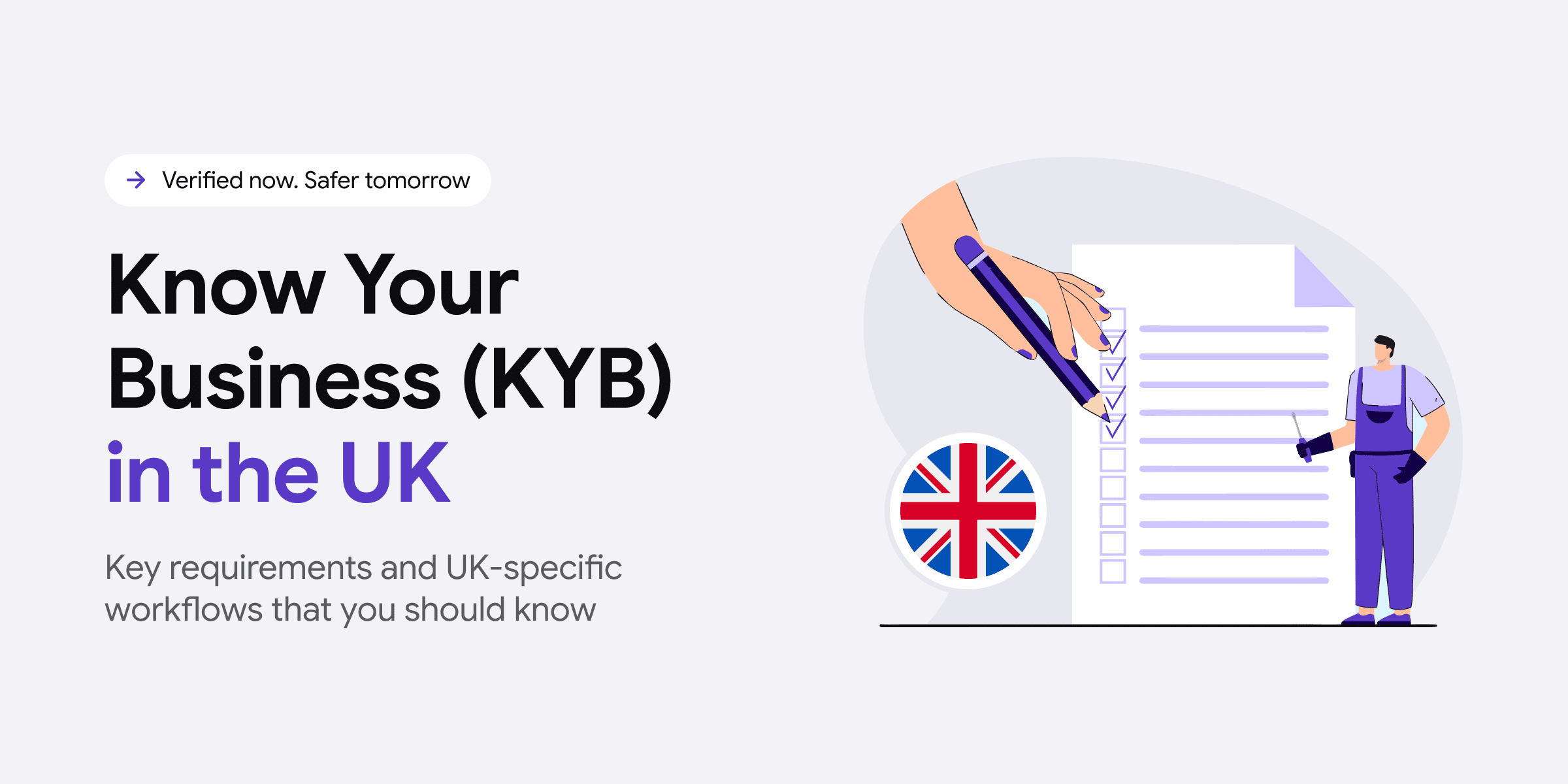
The UK has one of the most easily accessible corporate entity registers, Companies House, leading as a country that has clear Know Your Business (KYB) rules and corporate governance. Yet, KYB compliance for UK entities is much more complicated than a single check of the Companies House database. For example, the mandatory filing of beneficial owners and stricter due diligence even for companies operating outside the UK or with foreign directors aims to help the country maintain a transparent KYB verification process.
However, the issue is that the Companies House register is self-reported, putting the responsibility entirely on the firm and its representatives on how and what sort of information is registered and then checked when building new B2B relationships, like onboarding another company or business partner, vendor, supplier, etc. So, what exactly is KYB, how to check if a company is legitimate in the UK, and what are the key challenges and limitations of this background check for UK firms? I explain below.
What is Know Your Business (KYB) Verification?
Know Your Business (KYB) is the process of verifying another firm through multiple controls, similar to how Know Your Customer (KYC) verification is, but the process is designed to onboard corporate entities. It’s popular not only in the UK, but in many jurisdictions, mandating mandatory background checks on other companies in regulated industries, such as banking, crypto, real estate, insurance, and others, where the risk of fraud and money laundering is traditionally higher. KYB helps assess if the firm is legally registered and if its ownership structure is detectible and properly registered (to see who actually owns and controls the entity).
To put it simply, KYB helps:
- Find out if the people running the business aren’t linked to crime
- Determine if the business is real (not only exists on the register or “on paper”)
- Assess if it’s safe to work with and aligns with your internal risk appetite (for example, isn’t sanctioned)
In the UK, the Companies House register is the number one tool for that. In general, KYB verification was created to fill the regulatory gap that was left when criminals used companies and hidden ownership structures, offshore entities, and other related tactics to launder funds. That’s why KYC should be done on all related individuals of the firm, especially those who have a higher percentage of rights or ownership in the company and are more likely to abuse their power. This is part of the bigger Anti-Money Laundering (AML) framework, which KYB is part of, and also consists of other processes like AML screening (against PEPs and sanctions lists).
Related: KYB vs KYC — What is the Difference? [Explanation Guide]
Verify businesses, not just people
Automate company verification, UBO checks, and business due diligence with iDenfy KYB.
Explore KYB SolutionWhat is the UK’s Companies House?
Companies House is the UK’s official company register, which currently has over 5 million active firms registered, with at least half a million new companies incorporated and registered yearly. You can search any UK firm by entering the company name, number, or officer name. Every company (limited company, LLP; any entity operating in England, Wales, Scotland, and Northern Ireland) must register with Companies House.
The register shows information about the UK firm, such as:
- Its status, incorporation date, and legal structure
- Office address, company name, and registration number (CRN)
- Current and former directors (and secretaries) and their appointment dates
- Its ownership control details (People With Significant Control (PSC))
- Details linked to the annual financial accounts (some records are only in PDF format)
- The filing history, like director appointments and resignations, or charges and security interests
That’s why, due to the strict filing requirements, this database is considered to be a reliable tool for KYB verification in the UK.
Related: UK Sanctions Screening [4 Key Steps]
Why Does KYB Matter in the UK?
In the UK, under AML compliance and the Money Laundering Regulations 2017 (MLRs), UK firms need to conduct Customer Due Diligence (CDD) before starting a new business relationship with a corporate client, which means they need to apply KYB verification measures in order to verify the identity of another firm. However, criminals also use the UK’s system to hide since it offers a credible environment and a reputable register.
For example, it costs approx £100 to incorporate a company at Companies House, and it takes as little as a few minutes, which means that the level of accessibility and self-reporting goes both ways: it offers analysts a good channel for cross-matching company information, but it’s also a way to make up front companies that, from first glance, can be shiny on the surface.
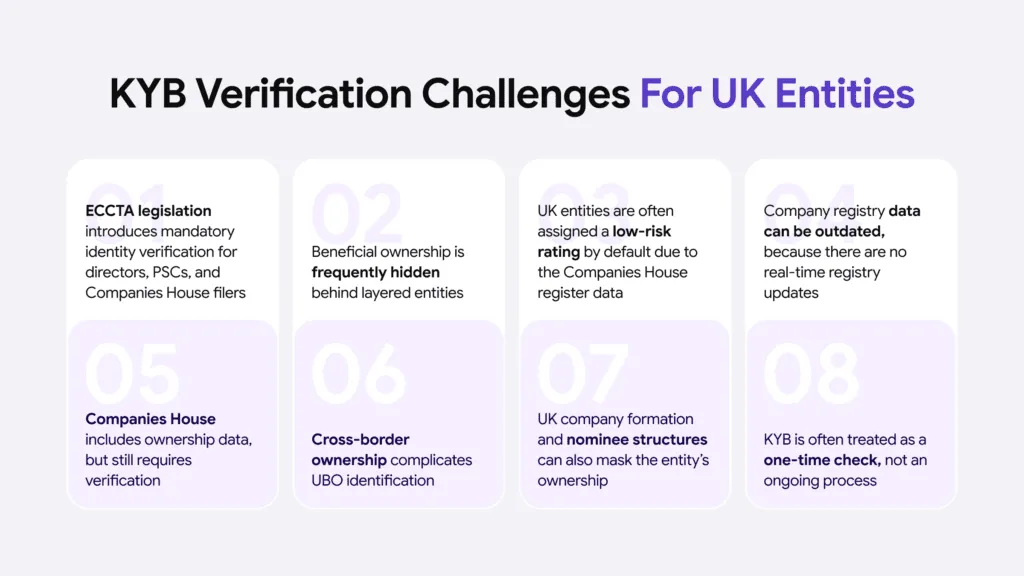
Analysts reviewing the UK firm’s onboarding info know the red flags and the patterns that are found during KYB checks, like a newly incorporated limited company that doesn’t have (or has limited) trading history, its address is registered at a formation agent’s office, and, finally, the director turns out to be a nominee. In contrast, businesses buy shelf companies (that were marinating on a shelf before being sold) to avoid being flagged and remain more “credible”.
Which Companies Need to Conduct KYB Checks in the UK?
Any regulated entity in the UK that onboards other companies, aka corporate clients, is required to perform KYB verification, as part of the requirements for the UK’s MLRs 2017. No matter if it’s a third-party vendor or contractor, due diligence and background checks are still required before entering a business relationship. This includes banks, fintechs, e-commerce platforms, proptech and real estate firms, law firms, insurance businesses, and similar establishments with monetized transactions that need to be monitored under AML laws. For example, a neobank is onboarding an Ltd company as a business account, and must verify it through KYB measures.
Different Entity Types in the UK and Their Nuances Linked to KYB Verification
KYB can be complex due to the variety of different entity types in the UK, which include:
- Private Limited Companies (Ltd) (the most popular type)
- Sole traders and partnerships (that aren’t registered at Companies House)
- Limited Liability Partnerships (LLPs) (designated members need to be verified
- Trusts (which are subject to separate registration requirements under the Trust Registration Service (TRS))
- Charities (which are registered with the Charity Commission for England and Wales, or equivalent bodies in Scotland and Northern Ireland)
- Overseas entities (registered via the Register of Overseas Entities (ROE), held by Companies House)
What About the UK’s Beneficial Ownership Regime?
The 25% ownership threshold for People with Significant Control (PSC) is straightforward on paper, but in practice, UK firms face complex corporate structures (LLPs, Scottish LPs, and overseas entities) where tracing ultimate beneficial owners involves looking up multiple registries and collecting missing details by requesting extra documentation, which adds friction for the end-user. By contrast, the US FinCEN Beneficial Ownership Information (BOI) registry under the Corporate Transparency Act (CTA) operates as a single federal system with more standardized thresholds.
That’s why the UK’s beneficial ownership regime, while being known for its mandatory data filing, can still be seen as demanding operationally because:
Control Can Be Registered Without Disclosing Direct Share Ownership
Under the PSC regime, an individual can qualify as a PSC through voting rights, board appointment powers, veto rights, etc. As a result, analysts must review extra details like partnership agreements and other governance documents, which complicates KYB onboarding for UK firms, along with other challenges, such as the fact that there are multiple different legal structures.

Keep in mind that a UK firm can register that it has no PCS (if the threshold isn’t met) and can list the company as a Relevant Legal Entity (RLE). Both scenarios don’t automatically means that the company doesn’t have any relevant individuals or shareholders who need to be verified and KYC’ed properly. This is especially important in niche or high-risk cases where analysts need to understand the whole shareholder picture
Trust Ownership is Often Less Transparent
Where trusts sit within the ownership chain, analysts frequently need to identify settlors, trustees, protectors, beneficiaries, and other controlling parties of the UK entity. Much of this information is not publicly available through a single source, despite having access to Companies House. Analysts frequently need to verify ownership details, including foreign registry extracts, because filings can be outdated, incomplete, or simply not enough (changes to PSCs, directors, and shareholders can be made) to verify the entity’s ownership structure.
Related: How Complex Corporate Structures Conceal True Ownership [KYB Guide]
How Does the KYB Verification Process Work For UK Firms?
The process differs, yet there are mandatory elements that are universal for KYB verification for most UK firms:
1. Basic Company Data Cross-Matching
This includes collecting the information from the client, often using an automation solution, such as iDenfy’s KYB platform and its Dynamic Workflow builder, which helps create custom questionnaires that ease the application process for the entity’s representative. Then, this collected information is cross-matched against the details in the Companies House register:
- Checking if the name and company number match
- Assessing the registered address, if it’s a virtual office or a trading address (since this carries different risks and if the address doesn’t show up as a proper office building (if the business matches this environment), then it can be a red flag)
- Reviewing the status: active, dissolved, dormant, etc.
- Analyzing the SIC code and the registered nature of the business (this is a unique five-digit code that doesn’t change, unless the business files a special form (CS01))
Companies House has its own API system, but some KYB software solutions, including iDenfy, streamline access to the register, extracting and cross-referencing information directly on the platform without the analyst having to Google separate corporate registers simultaneously.
2. Ownership Structure Identification
This includes identifying and verifying who has significant power within the company and who actually controls it. In this stage, UK firms have the PSC register (started in 2016 via Companies House) for those who:
- Hold more than 25% of the entity’s shares or voting rights, or
- Have the right to appoint or remove the majority of the board, or
- Exercise significant influence or control within the company.
If the direct shareholder of the UK firm is another corporate entity, you need to review the ownership structure further and trace a natural person (the first layer of ownership is not enough), often an Ultimate Beneficial Owner (UBO). In this case, for an entity onboarding, specific KYB documentation is required, such as articles of incorporation (or equivalent constitutional document), full shareholder register or UBO declaration for all individuals above the 25% threshold, proof of registered business address, and so on.
3. Identity Verification and KYC on High-Risk Individuals
All the identified individuals tied to the company that carries more risk need to be properly KYC’ed through a doc-based check, similar to how a person goes through identity verification during the account opening stage. That said, KYC includes multiple steps:
- Capturing the person’s government-issued ID (passport, ID card, or driver’s license)
- Verifying proof of address (PoA), often a utility bill or bank statement (dated within days)
- Screening against the UK Sanctions List and other relevant sanctions lists
- Conducting Politically Exposed Person (PEP) screening and watchlist screening
- Looking up adverse media linked to the individual and the company
Companies House includes an identity verification status field, which means that if a company director isn’t verified, you’ll see it through the register.
4. Risk Assessment
This involved applying a risk-based approach and looking into some AML red flags (if any were flagged and found during the previous steps). Typically, if no automation is used, the analyst onboarding the UK firm during KYB needs to determine what level of risk they’re dealing with and which due diligence measures are required. EDD is applied in edge cases.
Some risks that are considered to be looked into during KYB include:
- Complex corporate structures with entities registered in opaque jurisdictions
- Short operating history linked to the stated business
- Nominee directors or shareholders
- The industry, for example, crypto, which is considered to carry an elevated risk
- Other risk factors, like PEP findings related to beneficial owners or the company’s senior management
This is the stage where your compliance team decides if the UK firm is legitimate and, more importantly, appropriate to start a business relationship based on the risk assessment results. You either accept or reject the entity. In KYB onboarding, this is generally a complex and multi-step process, so the drop-offs are higher. That’s why you should use a KYB software solution that helps you make the onboarding more efficient and ease the work for analysts who need to keep a compliant audit log and document each conclusion.
Related: 6 Steps to Conduct a KYB Verification Check [Guided Explanation]
5. Ongoing Monitoring
This isn’t optional. You’re required to maintain ongoing monitoring on clients under the MLRs 2017 Regulation 28, as a way to ensure that you know about the client and changes throughout the whole business relationship. UK firms can be acquired or acquire subsidiaries. Similarly, ownership restructuring can happen, as well as changes in behavior and sudden shifts in transaction volumes, which trigger review and should be screened periodically, depending on your operating industry and clients.
For example, after onboarding a UK Ltd company, which had a new PSC filed at Companies House six months later, and if you hadn’t checked and kept the data up-to-date, you might not have seen that the person was a sanctioned individual from a high-risk jurisdiction that acquired 30% of the company’s shares. This is why monitoring is mandatory. Big players like Starlink Bank have been fined for non-compliance due to the gaps in ongoing monitoring (£29m fine in 2024).
What Does Record-Keeping in KYB Look Like?
At any UK firm, analysts maintain records of the CDD measures taken and the information obtained for a minimum of five years from the end of the business relationship:
- What verification steps were carried out
- What information was collected, and from which source
- The risk assessment and the reasoning behind it
- Any escalations, exceptions, or senior management approvals
- The date on which checks were completed, and comments if multiple analysts worked the case
UK entities are sometimes automatically labeled as non ‘high-risk’ due to the Companies House register and its “full” log, compared to other jurisdictions and their register/reporting requirements. However, this isn’t the best approach. You should always document all of the stages and explain why and how the risk assessment was made. Vague records are not approved. Documentation and monitoring also help improve the UK entity onboarding process as a whole.