In the UK, companies are obliged to conduct sanctions checks and screen all of their clients, including individual customers and corporate entities. This applies to various industries, not just financial service providers. In this sense, sanctions screening helps ensure that you’re not doing business with sanctioned parties, which is illegal. This also helps prevent fraud and illicit activities while detecting potential risks linked to the parties that are being screened.
Along with other Know Your Customer (KYC) and Anti-Money Laundering (AML) measures, sanctions screening applies to everyone involved in financial transactions, including vendors or beneficial owners. The UK is known to be a powerful player in the international sanctions ecosystem due to its good economic, political and social standing. There are strict penalties for non-compliance with the UK sanctions regime. For example, you can end up in prison for seven years or be fined for hundreds of thousands of pounds, even if the breach was a slip and not intentional.
UK sanctions screening isn’t a one-and-done matter. The UK sanctions list is updated regularly. It must be conducted during the customer onboarding process and throughout the whole business relationship. Corporate entities need to be verified properly and are required to have shareholders (beyond 50%) screened. Other important processes, like risk assessment and identifying involvement in high-risk jurisdictions, are non-negotiable as well.
Screening process requirements, niche details on automation (and if it works), key compliance rules for the UK, and practical tips on handling sanctions screening on UK firms, and more. Follow the blog post for answers below.
How Does UK Sanctions Screening Work?
UK sanctions screening means that you have to cross-check a government-maintained sanctions list, aka the UK Sanctions List (UKSL), and other sanctions lists (depending on the client and your operating markets) to detect potential risks and sanctions breaches. Before doing so, you need to collect personal information, such as the client’s full name, date of birth, and address, as part of the KYC process, which goes as the first layer of verification, next to a sanctions check.
The UK sanctions regime is governed by the Sanctions and Anti-Money Laundering Act 2018 (SAMLA) (which came into force in December 2020). It’s a separate compliance obligation and does not come from the EU or US sanctions regulations.
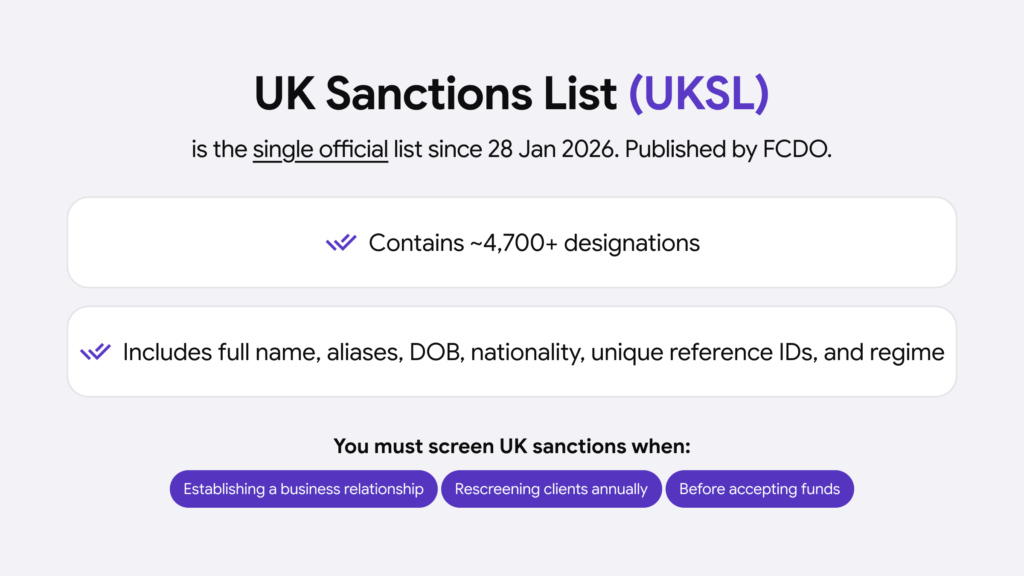
➡️ Keep in mind that the OFSI Consolidated List closed in January 2026, and the UK Sanctions List is now the official sanctions source for UK clients. Your policies and screening should be up-to-date and be used in accordance with the newest UKSL data.
Automate your AML checks
Screen customers against global sanctions, PEPs, and watchlists in real time with iDenfy AML Screening.
AML Screening SoftwareWho Needs to Perform Sanctions Screening in the UK?
Basically, any business that handles transactions, since in the UK, the obligation is sector-agnostic, and every business that provides professional services and conducts transactions is in scope of sanctions compliance. That means every firm, from real estate firms or charities, to AI startups and export businesses.
Why is UK Sanctions Screening Important?
Financial penalties, reputational protection and, naturally, legal compliance obligations make the UK sanctions screening process inevitable and important on a global level. Since many firms move funds across borders and operate internationally, various regimes, not only the UK Sanctions List, need to be screened, as part of AML compliance requirements and global efforts to prevent fraud, financial crime and terrorism financing.
OFSI imposes penalties for sanctions compliance violations in the UK, which can be £1m or 50% of the total value of the breach, to the greater of £2m or the total value of the breach (based on the new enforcement rules). There are non-monetary penalties, but in this case, OFSI has the right to publish a public statement that shows the breach to the whole world, which is far from ideal in terms of the company’s reputation.
What are the Main Types of Sanctions Imposed By the UK?
Screening a customer means screening them against multiple sanctions regimes all at once. For example, a sanctioned firm may not be sanctioned and not put into any sanctions lists, yet it can still face restrictions (for example, from accessing UK-based services or buying certain goods). To avoid confusion, and more importantly, ensure a compliant sanctions screening process in the UK, you need to assess multiple risk factors on top, for instance, ownership risks, financial/trade risks, etc.
It’s important, as in the UK, there are different types of sanctions that can lead to banning travel, freezing assets, limiting services, as well as restricting trade or preventing payments. For example, agencies that govern export controls are responsible for trade sanctions, whereas financial sanctions are part of OFSI’s obligations. So, the responsibility splits across departments, depending on the sanctions type, which I reviewed in more detail below:
Economic Sanctions
Typical examples include restrictions on investment or financial services and asset freezes. OFSI enforces economic sanctions on a civil level, as part of His Majesty’s Treasury (HMT). Some sanctions include “smart” asset freezes that don’t apply to the entire population and target only specific individuals, such as oligarchs or those who finance terrorism. Asset freezing means that the person can no longer access their wealth and has their foreign accounts blocked.
Financial sanctions are applied to companies as well, and part of that is to screen entities and their ownership and control. This is where the UK’s 50% rule is relevant. If a designated person owns or controls (directly or indirectly) more than 50% of an entity, or exercises control over it, that firm is also subject to the freeze even if not itself listed on the sanctions list. In the UK, companies can be fined for not complying with sanctions compliance even in cases where they didn’t know about it, as there’s strict liability.
Trade Sanctions
These include bans on import or export of goods and services as a way to protect national security and push the focus on making it harder for the sanctioned country or organization to operate. In the UK, arms and embargoes (you can read more about it here and subscribe for alerts from the Department for Business and Trade and the Export Control Joint Unit) are a common example of trade sanctions. For example, sanctions can also mean increasing tariffs or limiting the quantity of items allowed into the country to make trading more difficult.
Similar to how financial sanctions apply to individuals and companies, trade sanctions also have multiple targets. They are designed to reach goods, technology and services and not just separate individuals, which makes it a complex process for analysts working on screening. A standard UK Sanctions List check and a PEP screening process won’t be enough, as you need to also assess the nature of the transaction (in compliance with the Export Control Order 2008 regulation), the user and the destination country.
Ships and Aircraft Sanctions
Also known as transport sanctions, for analysts, aircraft and shipping sanctions are even more complex and require extensive research. The UK’s Department for Transport is responsible for managing these sanctions and restrictions on the movement, ownership, and registration of ships and aircraft. Russia’s ongoing war with Ukraine complicates this sanctions section further.
Russia uses sanctioned vessels and removes them from legitimate ship registries on purpose, which is one of their “shadow fleet” techniques. For example, recently, on the 19th of May, 2026, the UK government added new sanctions requirements, including a ban on importing fuel products that were made from Russian crude oil as a way to close the gap and the “refinement loophole.”
So, if the firm is exposed to trade finance, marine insurance, commodities or even corresponding banking, their compliance teams in the UK often closely monitor individual vessels through their IMO number, which is unique and won’t be changed, even if the ship’s ownership is altered. Of course, you can’t forget the UK Sanctions List screening on top of that, as well as specific vessel-level due diligence measures
Immigration Sanctions
Also known as travel bans, immigration sanctions restrict sanctioned individuals from entering or staying in the UK. The Home Office is responsible for the enforcement of these sanctions, which are often tied closely to other financial complications, such as economic sanctions (however, this isn’t always the case). It’s possible that a person can be subject to a travel ban without having their assets frozen. That’s why it’s important to conduct enhanced due diligence (EDD) on high-risk individuals or entities when assessing risk exposure during sanctions screening.
Related: The Complete Sanctions Screening Guide
Key Stages of Sanctions Screening in the UK
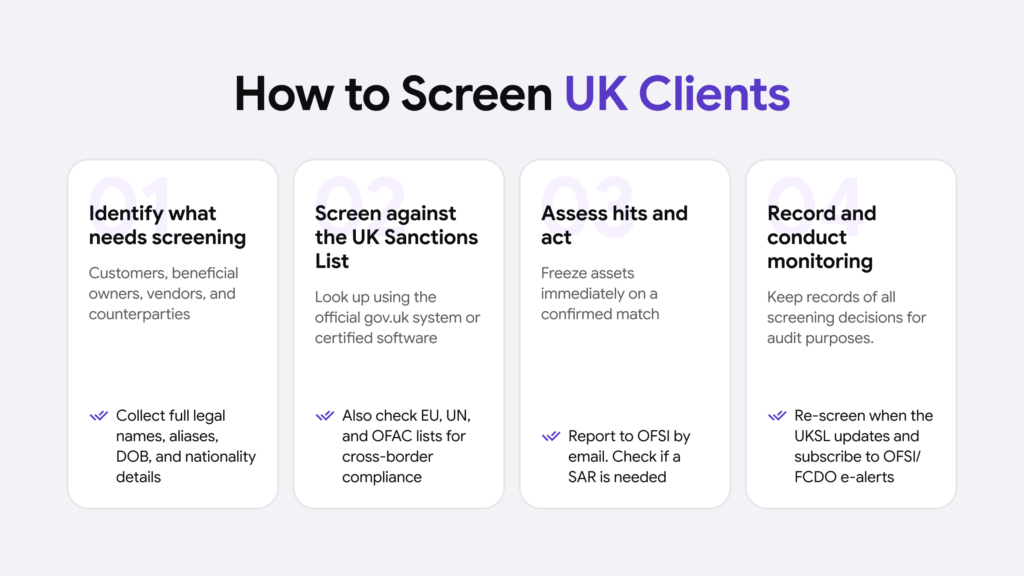
The key steps that all analysts stick to include:
1. Data Collection
- For individual clients: collect personal details like their full name, DOB, address, and nationality.
- For corporate clients: identify ownership structure and apply the UK sanctions 50% rule (which imposes that an entity is considered as sanctioned if a designated person directly or indirectly owns 50%+ of its shares or voting rights (or can appoint or remove most of the board).
➡️ UK sanctions screening also applies to Ultimate Beneficial Owners (UBOs) or People With Significant Control (PSCs).
2. Sanctions List Screening and Matching
- Use the UK Sanctions List and its search system to cross-check the collected details to see if they are identical.
- You can use the extended search filters (for example, select the sanctions regime or choose the concrete source (UK/UN/UK|UN).
- Enable fuzzy matching, especially in cases where names are translated and written in different alphabets, such as non-Roman scripts, such as Chinese or Arabic.
3. Alert Review and Confirmation
- Filter out false positives and onboard legitimate customers. If you’re using an additional AML software with features like risk-scoring, make sure to compare data and prioritize high-risk alerts.
- In ambiguous cases, put the client into manual review and apply EDD in high-risk cases. Re-screen customers when their risk profile changes.
➡️ If a person appears to be on a sanctions list, it doesn’t automatically mean that they’re actually sanctioned. Spelling mistakes or differences, especially for very popular names, cause false positives.
4. Monitoring and Reporting
- If the sanctions match is confirmed and not a false positive, report it to OFSI (a mandatory requirement and a separate form in addition to any SAR obligations that you might already have).
- Freeze the sanctioned applicant’s assets and stop providing them with your services. They can’t move their money unless they get permission from legal authorities (there are exceptions where OFSI grants access for certain payments and limited activities with an official government license that you need to apply for).
- Continue to monitor the client relationship and subscribe to receive real-time alerts about sanctions compliance (there’s a joint FCDO/OFSI/OTSI email alert service)
Under the Sanctions and Anti-Money Laundering Act 2018 (SAMLA) regulation, UK companies are required to pay extra attention to regime-specific sanctions, like Iran, Russia and Belarus, or Myanmar. These are high-risk countries that operate independently of UN Security Council mandates. Also, the UK sanctions list doesn’t match the US (OFAC SDN) or EU lists (UK ≠ EU ≠ OFAC), and there’s a difference now, post-Brexit. If you’re using an outdated third-party software or simply miss this, you can get penalized for non-compliance.
When to Conduct UK Sanctions Screening
Typical phases of the customer cycle where you need to screen them against sanctions lists include:
- Before accepting or releasing funds
- At the user onboarding process and before starting a new business relationship
- When specific changes are recorded, such as a change of ownership and new beneficial owners
- As per OFSI’s updates, in cases where updates are published that require “immediate effect”
- As part of your ongoing compliance efforts (for example, you can re-screen your clients at least annually or quarterly in high-risk, highly regulated sectors)
This is just the basis. There are other measures and industry-specific risk factors that analysts consider, depending on the firm and its concrete case. For example, in real estate, sanctions screening in the UK affects third parties, transaction counterparties, beneficial owners, and all intermediaries or agents that are involved in the deal. That means screening foes beyond the direct client level to avoid any breaches. So, in this sense, it’s a time-sensitive task and requires a proper workflow (real-time screening and not scheduled reviews are vital in regulated industries) to please both the client and the regulator.
Related: Third-Party Money Laundering Risks Explained
How Exactly Do False Positives Occur During the UK Sanctions Screening Process?
If the false positive queue gets out of hand, analysts can struggle with the noise that false sanctions alerts have created.
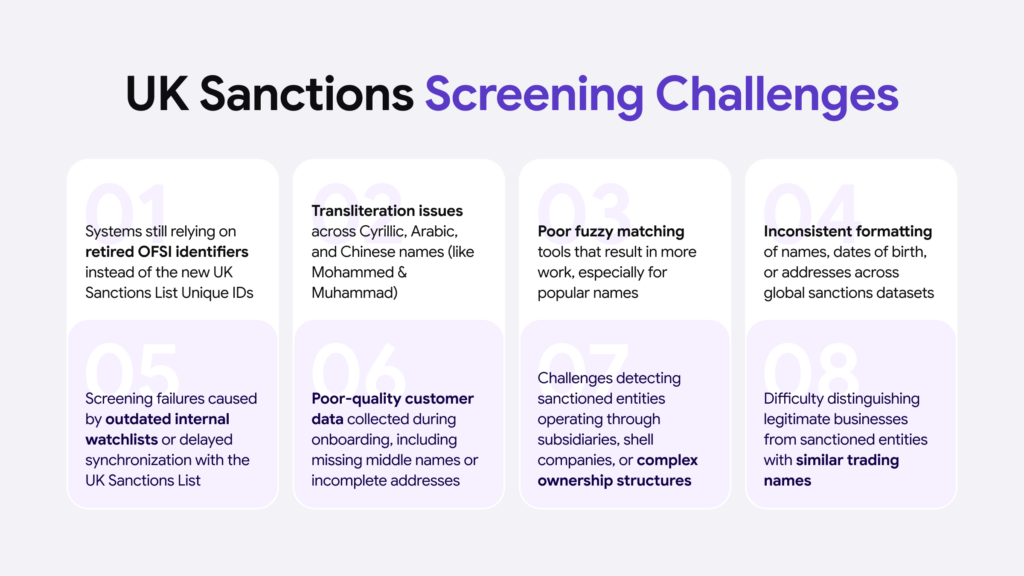
Once that happens, high-risk cases can get deprioritized. With UK sanctions screening, this happens due to:
- Similar/popular names. A popular name like Noah can generate tons of alerts and partial matches, which still require manual review and a good filtering process. Similar names, such as Steven Clarke vs Stephen Clark, also trigger a match, depending on whether you’re using the fuzzy matching logic and what sort of threshold is used.
- Alternative names. Sanctioned individuals use aliases, trading names, and sometimes maiden names as a way not to get captured and detected. This can create inconsistencies in your match rate, depending on the extra sanctions lists that you need to screen.
- Generic match thresholds. If you’re using a third-party AML software with built-in sanctions screening and access to databases like the UK Sanctions List, but you need to screen the client against multiple sanctions lists, you need to adjust your workflow/custom rules and not set maximum sensitivity. This results in more false positives that will be disproportionate to your risk appetite.
Analysts also document the log and provide key reasoning why some alerts were dismissed (or escalated). This is part of the risk-based approach to AML compliance and also a mandatory requirement if there’s a need for an audit as a way to provide proof to the regulator.
Final Tips on UK Sanctons Screening
At iDenfy, our experience shows that three areas matter most: the data and the quality of it (yet, it’s your responsibility to collect it and maintain clean records), the in-house processes that you have and the vendor (AML/sanctions screening solution) that you’re using, and the analyst team who’s working for your firm (their experience and skillset).
Our AML screening platform has all the features required for a compliant UK sanctions screening process, including built-in risk-scoring with proper, weighted models and custom workflows, PEP screening, adverse media screening, watchlist screening, ongoing monitoring based on match thresholds, custom client questionnaires when specific information is required (no-code), as well as various, easy, documented implementation options. We’re global, transparent, and also carry leading compliance tools for the full cycle (KYC/KYB as well).
Feel free to book a quick demo to get a better understanding of the software.