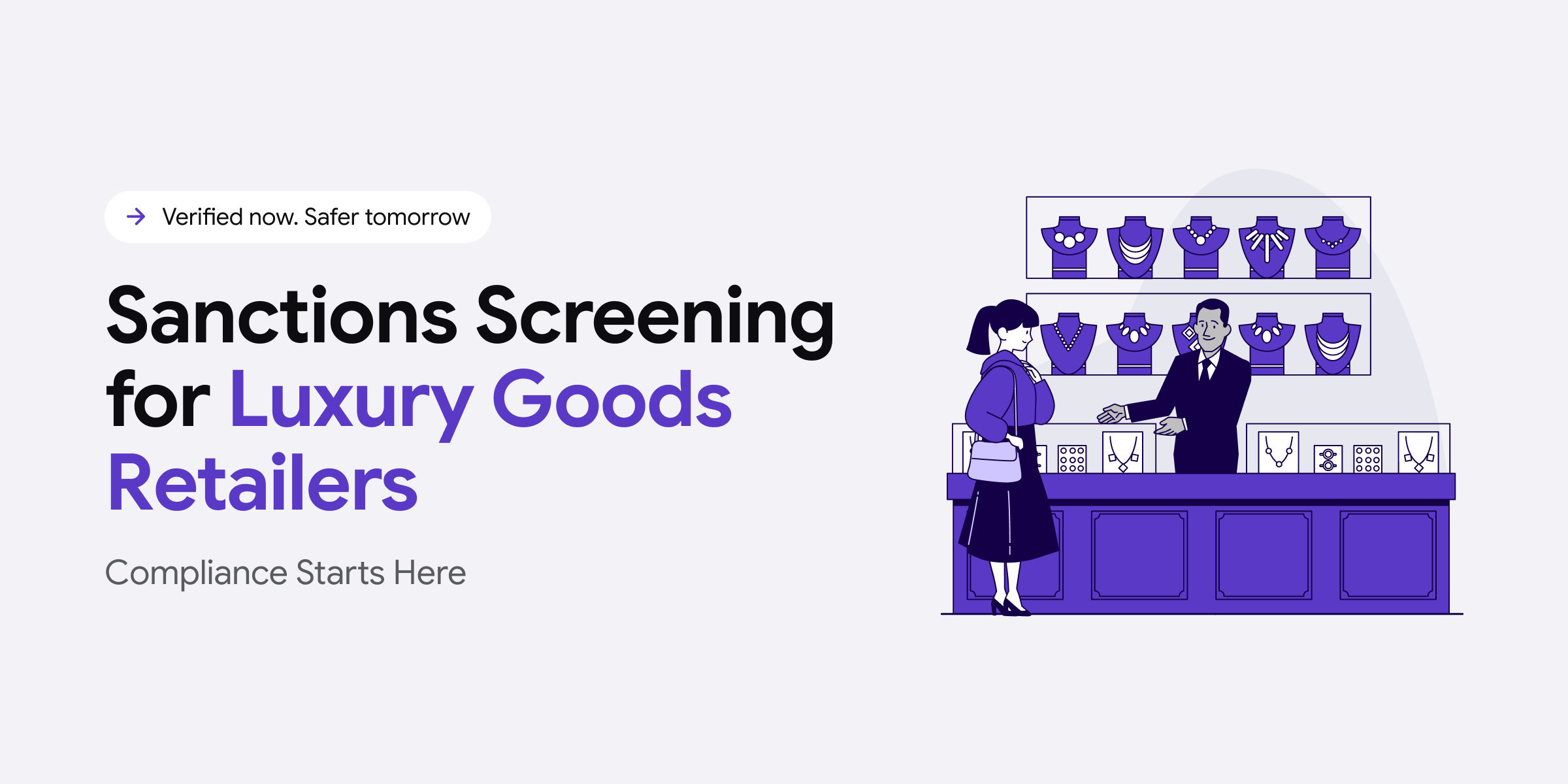
Luxury goods retailers have spent years operating at the edge of sanctions compliance – aware of the rules in a general sense, but rarely treated as primary enforcement targets.
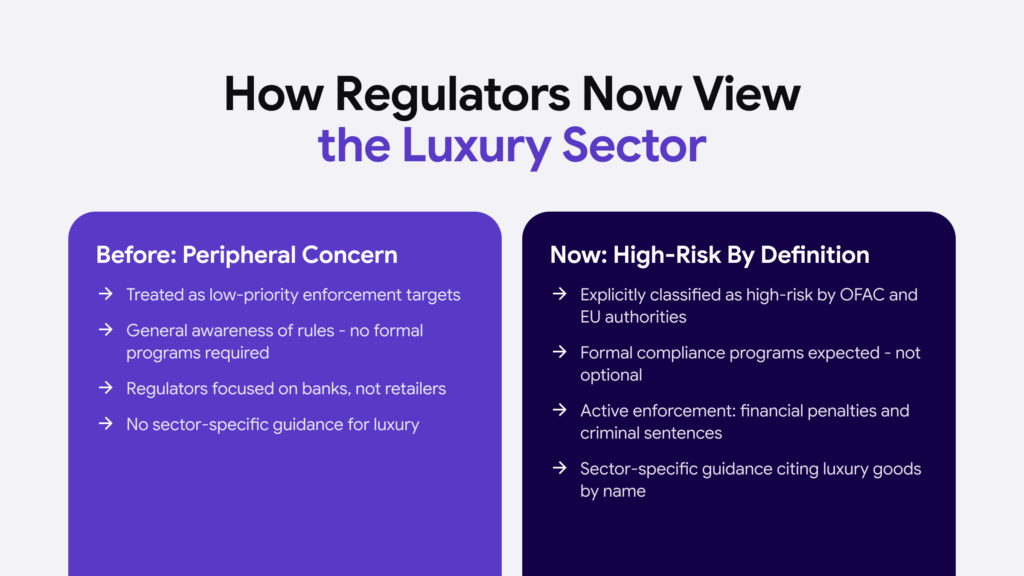
The enforcement record of the past two years makes clear that regulators on both sides of the Atlantic now view the luxury sector as high-risk by definition, not by exception. High transaction values, wealthy international clients, significant cash volumes, and a customer base that regularly includes politically exposed persons (PEPs) – the luxury sector has every characteristic that compliance frameworks are designed to address.
And regulators have started saying so explicitly.
Who this is for – and what it’s not. For compliance officers, legal counsel, and operations leads at luxury retailers, auction houses, and dealers in high-value goods — specifically those shipping internationally or serving high-net-worth and PEP clients who haven’t yet been through an OFAC or EU sanctions enforcement action.
Not a substitute for legal advice on a specific enforcement matter or a full breakdown of every national sanctions regime. For the screening mechanics themselves, see Sanctions Screening; this article is the risk map — where luxury retailers actually get caught, and what regulators expect to see instead.
Why Luxury Retailers Are Now a Compliance Priority
The case that put the issue on the map was the Richemont/Cartier OFAC (Office of Foreign Assets Control) settlement. Two Cartier boutiques sold jewelry to a customer who directed shipment to an address in Hong Kong. The recipient turned out to be a Specially Designated National under OFAC’s narcotics trafficking sanctions regime – and the name and address were exact matches on the SDN list.
OFAC didn’t just fine the company. It explicitly called on retailers that ship goods internationally to adopt formal sanctions-compliance programs and noted that the luxury goods market’s inherent money-laundering risk was an aggravating factor in the penalty calculation.
That case set a precedent that has been reinforced repeatedly since. OFAC’s 2025 enforcement actions resulted in total penalties and settlements exceeding $265 million, compared with approximately $49 million in 2024.
A luxury car dealer in Cologne shipped 38 cars and 2 motorbikes to Russia between April and October 2022. €4.7 million. Not a mistake – he knew. Two years suspended, €20,000 fine, 200 hours community service.
These aren’t edge cases. They’re the examples regulators cite to demonstrate that the luxury sector is being watched.
Automate your AML checks
Screen customers against global sanctions, PEPs, and watchlists in real time with iDenfy AML Screening.
AML Screening SoftwareWhat Makes Luxury So Exposed
Understanding why the sector is under this level of scrutiny requires examining how it differs structurally from most retail.
Luxury goods are high-value, easily transferable, and can move across borders with relatively little friction. A watch worth €80,000 can be purchased, shipped, and resold without generating the kind of paper trail that a bank transfer would. That combination of value and portability makes luxury goods an attractive vehicle for moving illicit funds – and regulators know it.
Several factors compound the risk:
- Anonymous and near-anonymous purchases – high-value goods still get bought with cash, through intermediaries, or via structures put in place specifically to hide who’s actually paying.
- High-profile customers – the luxury sector naturally attracts wealthy individuals, politically exposed persons, and international clients, some of whom may have connections to sanctioned regimes
- Complex ownership structures – luxury companies may unknowingly do business with entities that have ties to sanctioned individuals through shell companies or hidden beneficial ownership chains
- Global supply chains – luxury brands often operate across multiple jurisdictions, including regions with weak regulatory frameworks, increasing the surface area for exposure
- Use in illicit activities – luxury goods are frequently used in bribery, corruption, and as a store of value by sanctioned individuals trying to maintain assets across borders
The result is a sector where a basic compliance program – one that works fine for a mainstream retailer – is genuinely insufficient.
What US Rules Require
Under US law, the relevant authority is OFAC, which administers and enforces economic and trade sanctions on behalf of the Treasury Department.
The scope is broad: all US persons, companies, and often their foreign affiliates must comply. For luxury retailers specifically, four requirements stand out.
SDN list screening
The Specially Designated Nationals and Blocked Persons List is the baseline. Every customer, counterparty, and shipping recipient must be verified.
As the Cartier case showed, failing to find an exact match is very hard to defend. “We didn’t check” isn’t a mitigating factor – it’s an aggravating one.
Beneficial ownership
Screening needs to go beyond direct customers to cover subsidiaries, affiliates, and ownership structures. A customer paying in their own name may be purchasing on behalf of a sanctioned individual.
For high-value transactions – watches, jewelry, art, high-end vehicles – the obligation to look beyond the presenting party is real.
Documentation
Every compliance decision, including how potential matches were handled, must be documented. In an enforcement action, a demonstrable, systematic process is often the difference between a reduced penalty and the maximum penalty.
What EU Rules Require
The EU framework operates through Council Regulations, which are enforced at the national level by member state competent authorities. The rules have expanded significantly since 2022.
“All the watches are above $10,000. So with the Anjouan gambling license that we will be getting, we would need everybody to KYC.” – Watch Shop Fun (luxury Rolex/AP/Patek raffle platform)
The 2025 AML Package
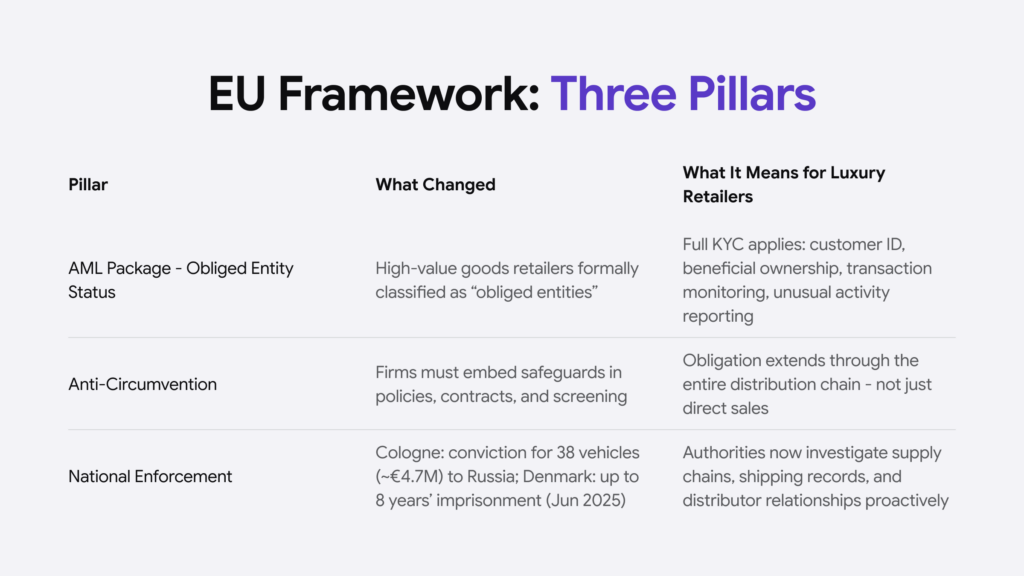
Beyond sanctions, the 2025 Anti-Money Laundering (AML) regulatory overhaul has directly transformed the luxury sector’s obligations. Businesses involved in trading high-value goods are now officially categorized as “obliged entities.”
That means full KYC obligations apply: customer identification, beneficial ownership verification, transaction monitoring, suspicious activity reporting, and ongoing due diligence. For retailers that previously assumed AML was a banking problem, this is a significant shift.
Anti-circumvention provisions
EU sanctions rules now require companies to embed anti-circumvention safeguards into internal policies, contracts, and screening processes.
For retailers operating through distributors, resellers, or agents, the obligation to prevent circumvention can extend through the entire distribution chain – not just the direct sale.
National enforcement is accelerating
The Cologne conviction was one of many. In Denmark, a June 2025 amendment to the Criminal Code increased penalties for sanctions breaches to up to eight years’ imprisonment.
National competent authorities are no longer waiting for obvious violations – they’re investigating supply chains, shipping records, and distributor relationships.
Where the Compliance Gaps Are
Most retailers that end up in enforcement actions didn’t set out to violate sanctions. The violations tend to cluster around a few recurring weak points.
Shipping address screening
The Cartier failure was basic – the ship-to address was a direct SDN match, and nobody checked. For any retailer with e-commerce or international shipping, the screening program needs to cover shipping recipients, not just the purchasing customer’s name.
Third-party and intermediary exposure
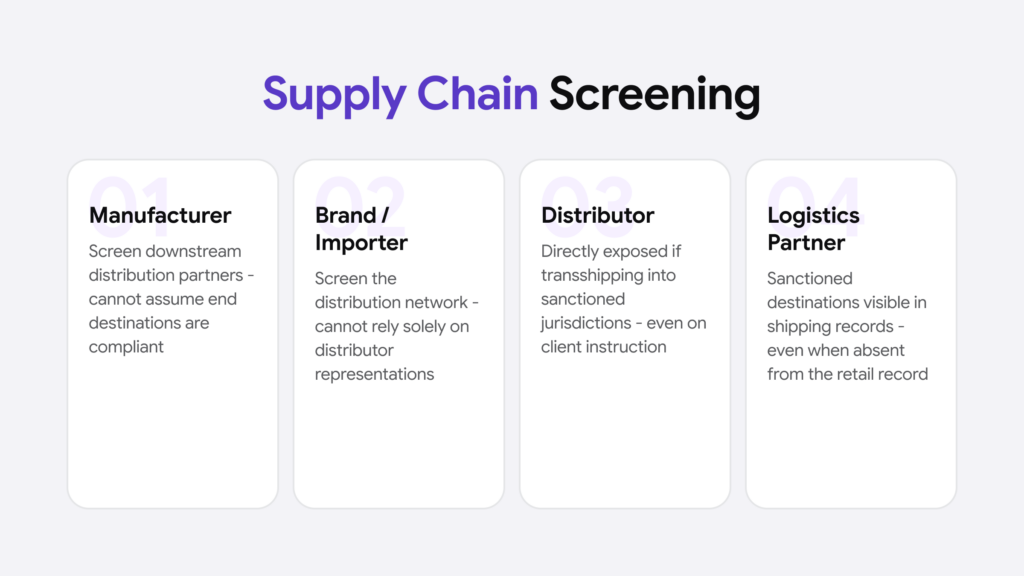
A luxury retailer selling through a regional distributor who then transships goods into a sanctioned jurisdiction faces real exposure – even without knowing the final destination. Supply chain mapping is no longer optional.
The risk runs through every link in the chain – manufacturers, distributors, and retailers each carry obligations. A trusted counterparty can become a restricted one overnight when a new designation drops. That unpredictability makes ongoing monitoring of the full supply chain a genuine operational requirement, not just a compliance aspiration.
List currency
Sanctions lists change fast, particularly when geopolitical events shift quickly. A screening program running against a list updated monthly will have gaps. For higher-risk transactions, real-time screening is worth the additional cost.
High-value cash and near-cash transactions
Luxury retail is one of the few sectors where large transactions still regularly involve cash, banker’s drafts, or payment structures that obscure the beneficial payer. Under the EU AML framework, enhanced due diligence on unusual payment structures is increasingly required – not just recommended.
Enhanced Due Diligence (EDD) means going beyond confirming a customer’s identity. It means understanding their funding source, the purpose of the transaction, and whether the overall profile is consistent with that of a legitimate customer. For luxury firms, EDD is the mechanism that bridges sanctions screening with the broader AML obligations that the 2024 regulatory changes have now formalized.
Related: The Complete Sanctions Screening Guide
Building a Defensible Program
There’s no prescriptive template, but the elements regulators consistently look for are well established:
- A genuine risk assessment – an honest analysis of where exposure actually lies: which markets, product categories, distribution channels, and customer profiles. The risk assessment shapes everything else.
- Systematic, documented, and current screening – re-screening on a defined cycle and on trigger events (new designations, unusual transaction patterns). Screening at onboarding and never again isn’t a program.
- Clear escalation procedures – when a potential match arises, staff need to know who reviews it, how, and within what timeframe. A hit sitting unreviewed for two weeks is a documented failure, not a compliance process.
- Front-line training – boutique staff, customer service teams, and logistics coordinators are often the first to encounter something unusual. If they can’t recognize a concern or don’t know how to escalate it, the back-office screening system has a gap at the front door.
Conclusion
The regulatory trend is unmistakable. Throughout 2025, the EU continued expanding its sanctions regimes with the explicit aim of increasing companies’ compliance obligations. New measures, broader categories, and stricter national enforcement all point in the same direction.
On the US side, OFAC has consistently signaled that it views luxury goods retailers as high-risk and expects them to operate accordingly. The Cartier settlement wasn’t a one-off warning – it was an opening statement.
For luxury retailers that have treated sanctions compliance as a peripheral concern, the time to build a proper program is before the next enforcement action, not after.