iGaming aggregators often find themselves between a rock and a hard place.
The casino and sportsbook operators you serve want players signed up and ready to play with minimum fuss. Those same operators also need to meet Know Your Customer (KYC) requirements in the markets where they operate.
If you’re an iGaming aggregator that provides player account management and onboarding software, your platform needs to support both demands across multiple operator clients. Each may have different verification requirements and review processes, making your KYC partner choice a bit more complicated.
Luckily, there are plenty of KYC solutions on the market. Finding one that fits your platform takes a clear set of criteria, though.
In this guide, I’ll give you the lowdown on why KYC compliance can be more challenging for iGaming aggregators and what to look for when choosing a vendor.
What Are iGaming Aggregators?
iGaming aggregators are technology platforms that connect online casinos to different game studios through one integration. They combine slots, live casino games, and various other titles into one catalogue, which makes it hugely convenient for operators to source games from various creators in one place.
A casino looking to offer games from 15 studios could work with all 15 directly. But that would mean sorting out contracts and getting its software connected to each provider’s system.
It’s much easier to work with an aggregator that carries those games and can take much of that work off the operator’s hands. One connection gives the casino access to the games, with fewer separate integrations and provider arrangements to manage.
KYC built for iGaming
See how iDenfy helps gambling and betting platforms meet compliance requirements while keeping onboarding fast.
Explore iGaming SolutionWhat Role Do iGaming Aggregators Play, and Where Does KYC Fit In?
iGaming aggregators primarily handle the technical connection between operators and game developers. Some also offer a complete tech stack to help operators manage more of their business through a single platform.
In practice, that can involve:
- Handling game launches. Processing requests containing information such as a player ID, session token, selected game, and currency, then returning the game URL used to launch the session.
- Coordinating wallet transactions. In seamless-wallet integrations, relaying balance queries and bet, win, and transaction rollback requests between game providers and the operator’s wallet system.
- Supporting player operations. Some aggregators also offer player account management (PAM) and compliance tools, giving operators a back office to manage player accounts, perform KYC checks, and review verification documents. Operator teams can also use these tools to review Anti-Money Laundering (AML) screening alerts, investigate flagged cases, restrict accounts, and set responsible gambling limits.
Offering these KYC tools through your platform makes your choice of verification partner important to the operators you serve.
Related: KYC in Online Gaming
4 Reasons Why KYC Can Be Tricky for iGaming Aggregators
KYC compliance comes with extra ifs and buts when you’re serving multiple operators.
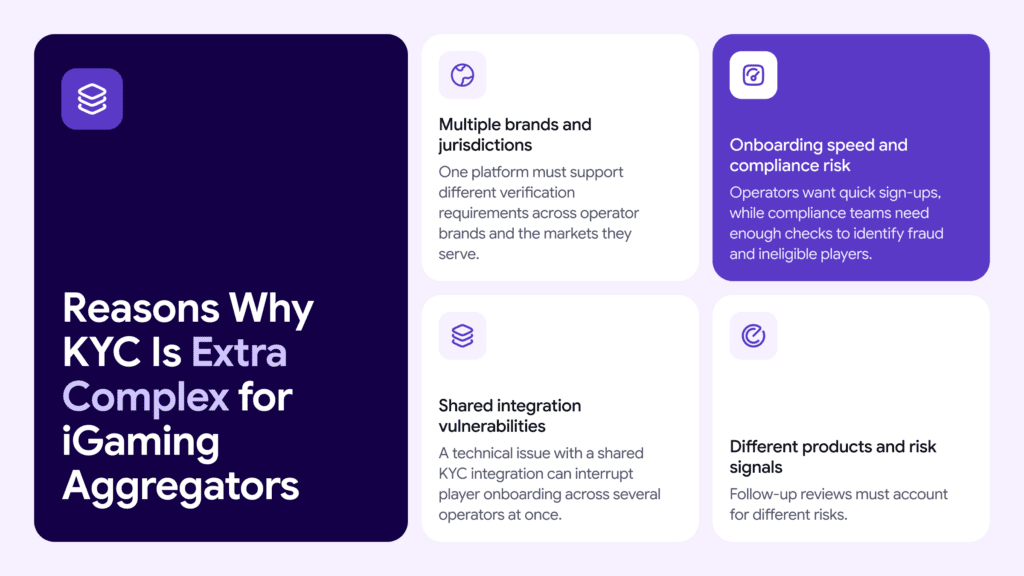
1. Multiple Brands and Jurisdictions
The first big hurdle is keeping each operator’s verification process aligned with the rules of the markets it serves.
Take online casino gaming and sports betting: the minimum age is 18 in Great Britain, compared with 19 in Ontario, Canada. An 18-year-old therefore meets the age threshold in one market but not the other.
Your KYC provider needs to support those different thresholds. A blanket 18+ setting won’t cut it across both markets, so finding a partner that can accommodate each operator’s requirements is the first challenge.
2. Balancing Operator Conversion Rates with Liability
Players want to play. If signup turns into another ID verification followed by a long wait, they may start browsing other casinos before the review is finished.
Your operator clients want to keep those players interested, not churning away due to a slow ID check. They also need the checks required in their markets completed, so simply waving everyone through isn’t an option.
Take a surname mismatch, for instance. A player may need to explain a name change rather than undergo a fraud investigation. Still, that clarification can hold up their sign-up.
According to iDenfy’s Cross-Industry Identity Threat Index Report (2026), 61% of iGaming verification flags are classified as friction-related.

Across your operator network, your KYC partner needs to support different workflows for clarifying those mismatches and investigating more serious issues, such as suspected multi-accounting or bonus abuse. And do so quickly to retain player loyalty.
3. Shared Integration Vulnerabilities
There are technical challenges, too. A shared KYC integration means several operators are counting on the same provider to stay up and keep up. If there’s an outage or network disruption, player verification can stall across multiple brands.
Now imagine a major sporting event like the World Cup, with several sportsbook clients attracting new players before kickoff. That’s a lot of verification requests arriving at once. The difficulty is finding a KYC partner with a strong track record of handling those peaks without letting the queue pile up.
4. Adapting Follow-Up Checks to Different Gambling Products
Compliance work doesn’t end with the initial KYC check. When you offer onboarding and compliance tools, your operator clients expect a complete package that supports ongoing player checks, too.
That can mean further AML screening, identity re-verification, or requests for source of funds (SoF) evidence or proof of address (PoA) as new risks emerge.
How do you keep all those follow-ups manageable? Different products can trigger different checks, and your KYC integration needs to support them without creating a separate manual process for every operator.
What to Look for in a KYC Vendor as an iGaming Aggregator
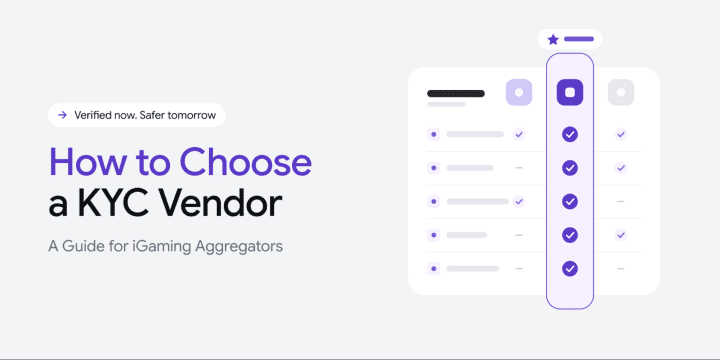
So, what separates a good KYC vendor from the rest? Here’s a simple framework to compare providers across six criteria.
Document Coverage In Your Operators’ Target Markets
One of the most important considerations is worldwide ID coverage, and it pays to get picky. Look for support for the documents your operators accept in each market, from passports and national IDs to driver’s licenses and residence permits.
iDenfy, for example, supports 16,000+ ID document types from 200+ countries and territories, giving you broad coverage to grow into new markets.
Still, the number of countries isn’t everything. It needs to be the right documents for the markets your operators serve. A case in point is Casino.si, a Slovenian iGaming brand that struggled to find an OCR-based solution that could accurately read Slovenian names. iDenfy adapted its KYC software to recognize local characters, helping prevent mismatches and speed up player onboarding.
Accurate Age Checks and Fraud Detection
Your operators need to establish both who a player is and whether they’re old enough to gamble. For example, iDenfy offers age verification that checks a player’s date of birth against a configured limit, alongside age estimation that estimates age from a selfie and routes borderline cases to a full document verification.
In the UK, the Gambling Commission’s 2025 survey found that 8% of 11–17-year-olds had gambled online in the previous year, despite the legal age being 18. Some people will always try to bypass age checks, but that isn’t the only challenge.
iGaming operators also face players with stolen identities, altered documents, and repeat registrations intended to abuse bonus offers. Self-excluded players may also try to regain access using a relative’s ID document or credit card. For cases like these, Denfy’s bank card verification helps flag mismatches between the cardholder’s name and the player’s verified identity.
So, at a bare minimum, look for a provider that combines document-authenticity checks, face matching, and liveness detection with age thresholds you can configure for each operator’s market. Stronger KYC vendors should also detect:
- Synthetic identities
- Digitally altered documents
- Deepfake impersonation attempts
Ask prospective providers how they detect these threats and what testing supports their claims, particularly for the documents and markets your operators serve.
Flexible Workflows and Manual Review
As you’re aware, verification doesn’t always follow a straight line. Some players may need additional checks or human review, so your KYC provider should let you adapt the process accordingly.
Look for a flexible workflow builder that lets you tailor verification flows by:
- Operator
- Jurisdiction
- Player risk
That could mean adding proof-of-address verification for a particular market or requesting further checks when suspicious activity is flagged. Ask whether your team can make those changes through no-code controls.
Also, when automation can’t resolve a case, who reviews it? Ask which cases the vendor’s reviewers handle, how long reviews take, and which decisions stay with the operator’s compliance team.
Integration Into Your Onboarding Flow
Do you want a KYC solution that’s bolted on or one that fits seamlessly into your ecosystem?
Ideally, identity verification should integrate directly into your platform’s onboarding flow, with operators managing checks and follow-ups in one system. They have enough moving parts to oversee without adding disconnected tools, and players shouldn’t need a detour just to get verified.
As you narrow down your shortlist, ask vendors to give you access to a dedicated testing environment. You can use it to test the full verification flow, review API responses, and experience the process as a player without affecting live data. It’s a good litmus test for whether the service delivers what the vendor promises.
Related: How to Implement a KYC API [3 Steps to Get Started]
Continuous Lifecycle Screening and Audit Readiness
Most gambling regulators now require ongoing monitoring, so look for a KYC vendor that can support your operators beyond onboarding. That includes helping them identify changes in player risk and keep the records they need to demonstrate how compliance decisions were made.
On the screening side, the vendor should support recurring checks against:
- Sanctions lists
- Politically exposed person (PEP) databases
- Relevant watchlists
As part of your evaluation, find out how frequently those sources are updated, when existing players are rescreened, and how new matches reach the appropriate operator’s reviewers.
Beyond screening, operators need to understand how players use their accounts. iDenfy’s Transaction Monitoring helps detect financial risks in real time through configurable rules that flag unusual transaction patterns. It also supports safer gambling practices by monitoring player activity for potential signs of gambling harm, giving operators alerts they can investigate and act on.
Your operators also need a clear audit trail of how each screening alert was handled. Records like screening results, timestamps, reviewer actions, and decision notes should be accessible and exportable for each operator in case they need to explain decisions during an audit or regulatory review.
Related: Screening and Ongoing Monitoring: Using AI Tools for AML Compliance
Pricing, Performance, and Support at Peak Volumes
As you sift through KYC vendors, you’ll notice different pricing models. For instance, some charge only for verifications that pass, which helps avoid charges for failed or abandoned attempts. Other vendors may bill per attempt or sell packages. Compare what each model would cost at your expected volumes, including retries and abandoned checks
Alongside the costs, you need to know whether the vendor can keep up as your operators’ verification volumes grow. Average verification times are useful, but how do they hold up during busy periods? Ask about processing limits and uptime commitments, so you know what to expect before you commit.
Finally, check customer support. You want a partner you can count on when problems arise, with clear support hours, agreed response times, and a straightforward way to escalate urgent issues. iDenfy provides all partners with a dedicated account manager and best-in-class technical support, with our G2 customer satisfaction rating reflecting that commitment.
Red Flags to Watch for in a KYC Vendor
Alongside the desirable features, it helps to know which weaknesses could cause problems for your platform. These are worth keeping on your radar:
- Consistently low pass rates for genuine applicants in your operators’ markets
- Poor accuracy that lets fraudulent applications through or wrongly rejects legitimate players
- Checks limited to ID verification and liveness, without ongoing screening or integration with additional fraud-prevention tools
- Involvement in fraud or data breach scandals
How iDenfy Supports KYC for iGaming Aggregators
The KYC provider needs to keep pace as your network grows and operators enter new markets, while keeping player verification fast and compliant.
iDenfy brings identity verification, fraud prevention, and AML tools together in one global RegTech platform. Our gambling verification solution supports:
- Document and age checks covering 16,000+ ID document types from 200+ countries and territories
- Face matching and liveness detection, with 24/7 human review for cases automation can’t resolve
- Follow-up checks, including address verification, reauthentication, and ongoing sanctions, PEP, and adverse media screening
- API and SDK integration, giving you ready-made tools to add verification to your platform and receive the results
iGaming aggregators such as NuxGame use iDenfy for identity verification and AML screening within their platform. With a platform offering 17,500+ games, 210,000+ events per month, and integrations with 140+ providers, NuxGame uses our API integration to let operator clients verify players within the onboarding flow and manage compliance in one system.
Talk to our team today to explore how iDenfy can support player verification across your platform and operator network.