Gaming, also known as gambling, or in the digital space iGaming, is spreading like wildfire across multiple regions, especially for platforms such as online casinos, sports betting sites, and similar establishments. With a level of convenience like this, players around the world can access their beloved games without setting foot outside. While this is beneficial for the player, at some point, with time, gamers can develop poor habits, leading to irresponsible gaming practices.
To prevent such consequences, gaming operators have strict, responsible gaming policies so that their services can represent a fun and enjoyable experience. In most countries, implementing responsible gaming practices is mandatory. For example, in 2023, the UK Gambling Commission issued a record £19.2 million penalty against William Hill Group for non-compliance with responsible gaming practices that included letting self-excluded customers back onto its platforms. That means if gaming operators don’t comply, they face huge fines and can get backlash really quickly due to maintaining an unethical environment.
And this is no surprise, as online casinos, similar to fintech platforms, are already under the radar due to being high-risk, highly-regulated sectors due to increased money laundering and terrorism financing risks. That’s why gambling businesses and iGaming platforms need to follow Anti-Money Laundering (AML) procedures and implement proper identity verification checks while showing strong social responsibility in order not to let self-excluded individuals or blacklisted gamers play.
But what does it look like in practice, and is this really an achievable goal? We provide some expert insights and explain from the operators’ perspective.
What is Responsible Gaming?
Responsible gaming, sometimes called responsible gambling or safer gambling, refers to practices that promote safer gambling and raise awareness in casinos, betting, iGaming, and similar establishments. It covers everything from age verification at signup to deposit limits, self-exclusion schemes, and behavioral monitoring for signs of problem gambling. These measures protect both operators and players by fostering a fair, transparent, and secure gaming environment while addressing problem gambling.
Responsible gaming legally requires gambling operators to implement specific measures under most licensing regimes. Ultimately, responsible gaming revolved around two goals:
- Helping better understand and manage gambling risks while encouraging healthy and secure gaming habits.
- Enabling players to gamble in a way that doesn’t overpower their daily lives or pose any potential harm.
“Never gamble more than you can afford to lose” is the golden rule for the player. However, the reality is that gaming platforms attract all sorts of individuals, including those who are more likely to develop an addiction. For this reason, proper responsible gaming measures are vital. They promote fair and enjoyable gaming while safeguarding vulnerable players from potential harm.
Automate your identity verification
See how iDenfy helps 1,000+ companies verify customers in seconds with AI-powered KYC.
Explore iDenfyWhat are the Main Measures of Responsible Gaming?
There are a few key practices that gaming and gambling establishments should follow to ensure the safety of their players. These include:
-> Preventing Underage Gambling
This means ensuring that only individuals of legal age can access games and register for iGaming services. In practice, this requires strict age verification measures and ongoing efforts to promote awareness about legal age restrictions across all platforms, including other gaming platforms, such as sports betting operators, which often deal with other issues, including arbitrage betting.
-> Encouraging Limit Setting
This is achieved through standard practices like setting thresholds and spending limits, or time that can be spent on games online. This helps maintain healthy boundaries and ensures that players don’t get addicted to spending too much time or money on gaming activities.
-> Offering Self-Exclusion Options
This is a very important factor for players who are more vulnerable to having an addiction. Self-exclusion helps restrict access for a set period of time, which helps take a break and avoid bad gaming habits. Additionally, individuals can do this themselves without having to go through multiple steps easily.
-> Promoting Awareness
For example, responsible gaming practices need to help at-risk players and raise awareness about the risks of gambling. This includes providing access to tools and resources that help prevent the development of problematic behaviors. Ultimately, all players who use such services need to understand the risks involved. This means knowing the odds of winning and how gaming works clearly and transparently, without hidden policies or rules.
Related: Can You Combat Bonus Abuse in iGaming?
Why is Responsible Gaming Important?
Prioritizing trust and responsibility in the gaming sector leads to better scaling opportunities. In general, if you want to succeed with a business, you’ll probably need to go all in. For iGaming platforms, this means ensuring ongoing compliance — using Know Your Customer (KYC) measures and age verification processes that check the user’s age and identity before flashing the green light of approval. Without these processes and responsible gaming measures, there’s no sustainability in terms of maintaining healthy, long-term engagement with the platform’s users.
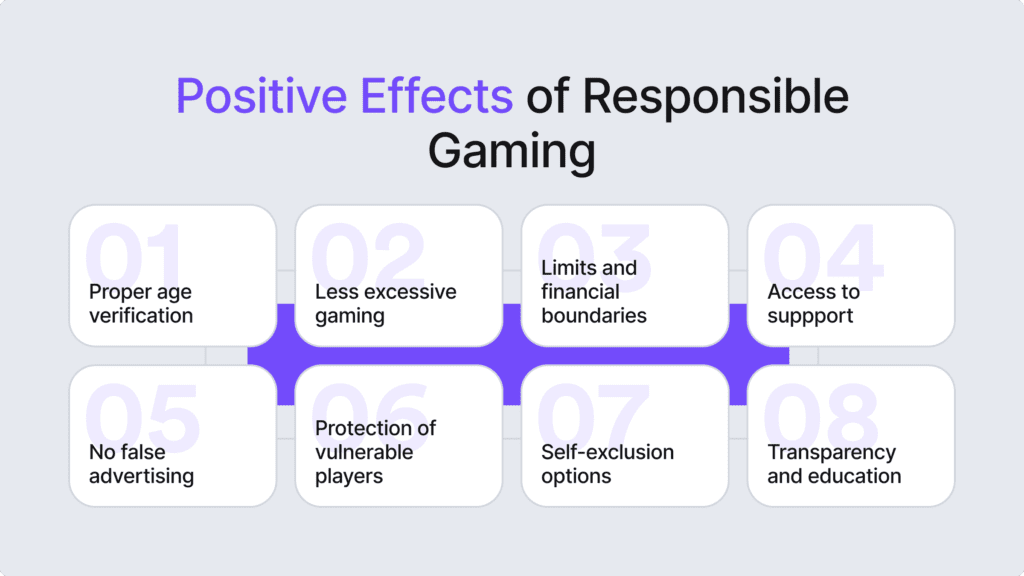
Responsible gaming includes measures like:
- Preventing minors from accessing platforms
- Providing resources on gambling addiction
- Setting time and financial limits
In general, responsible gaming is important because it helps ensure that gaming remains a form of entertainment while preventing minors and other prohibited players from accessing gambling establishments. Since gambling, casinos, and sports betting have gone digital, this has become more challenging because access control requires a simple and effective solution that actually solves the problem without reducing conversions. Many users might choose another gambling site if the signup process becomes too complicated.
Related: How to Improve KYC Verification? Tips For a Frictionless User Experience
What are Some Player-Facing Controls that iGaming and Gambling Platforms Use in Practice?
These special controls show a platform’s social responsibility and consist of responsible gaming tools that help users control and manage their own gambling. Regulators then audit platforms, checking if these sorts of controls are actually there, complying with standards, like:
- Deposit limits. It’s the maximum amount a player can deposit per day/week/month.
- Loss limits. This is another type of ceiling on a player’s net losses over a set period, no matter how much money they’ve already deposited.
- Wagering (stake) limits. These are the restrictions on the amount placed by the user per bet/spin.
- Session and time limits. These are the caps put on continuous play, often paired with other measures, such as forced log-outs, especially once the limit is reached.
- Other on-screen prompts. These work like reality checks and are set at specific intervals, showing time played and net position (only common in some jurisdictions, like the UK).
- Time-outs. These are short-term breaks for cooling off in between gaming, typically 24 hours to six weeks, that players can activate instantly.
- Self-exclusion. This is the strongest control in responsible gaming that can be applied when the user wants to block themselves from gambling.
How Does Self-Exclusion Work in iGaming?
Self-exclusion is the process that allows a player on an iGaming platform to voluntarily ban themselves from gambling for a specific period. It’s typically six months and can go up to five years. Permanent self-exclusion is also an option. Once registered, the gambling operator is required to close the player’s account. This includes completely blocking re-registration attempts and removing the user from all lists, including those for promos or marketing.
The biggest challenge around self-exclusion is the misconception that it’s a one-and-done measure. Often, excluded players still try to return and bypass their own bans. This involves using multi-accounting and simply another account with a fake identity (an altered name, a different email address, a family member’s payment card, a different location/IP, etc.) For this reason, KYC verification and a standard document check help beyond compliance and also serve as an ethical foundation for ensuring safety when dealing with self-excluded individuals.
What are Some Safer Gaming Tips for Players?
To keep gambling fun and secure, players who often use gaming services should follow these suggestions revolving around fair and secure gambling:
- Gamble for fun, not to win back losses.
- Set a budget based on loss limits and stick to it.
- Stop playing if gambling starts causing anxiety or stress.
- Plan gaming sessions with breaks to avoid overindulgence.
- Ensure that gambling doesn’t interfere with work or family life.

Being constantly fixated on gambling, such as thinking about getting your hands on a quick blackjack strike all day, can be a sign of addiction. The same goes for chasing losses, losing control, or even considering borrowing money to gamble, which are serious signs. There are also subtler indicators, like denying having an issue altogether or experiencing mood swings, which can also be a bad sign.
3 Responsible Gaming Principles That Gambling Operators Should Follow
One of the most important parts of the idea behind responsible gaming is to prevent gambling addiction and to identify risky/vulnerable players who start showing signs of potential addiction as soon as possible. Since the negative narrative around gambling and casinos is that these companies want to profit off people who lose to the house, naturally, they don’t want to implement proper controls to prevent such players from leaving money at their establishments.
Standard controls that gaming and gambling companies implement include these examples:
1. Player Protection
This includes controls like limits to cap the amount a player can deposit and time limits to control the overall gaming duration, including other measures like exclusion programs where family members can request a player’s ban on a gambling platform. According to some gambling establishments, problem gamblers aren’t ideal, contrary to belief, because they are often known for compulsive gambling, which leads to debt and a bad reputation for the platform.
The most common approach when verifying players online is to use these automation solutions:
🟢 Identity verification. Players are required to submit government-issued ID documents, like ID cards, driver’s licenses, or passports, along with proof of address (PoA), such as utility bills, bank statements, or pay stubs. The gaming platform’s compliance team then reviews these documents to verify the player’s identity and residency address. Sometimes, such a document check is combined with a selfie (a biometric facial scan) verification step or a database check to ensure that the player’s newly provided data matches the photo and details on their ID document.
🟢 Age verification. This measure is used in all sectors where age-restricted services or products are involved. Some online gaming platforms use age gates or age estimation solutions. However, the person’s ID is required for age verification, for it to be the most effective and not easily bypassed. So, in a sense, the age verification step can be done within the identity verification, or KYC verification, flow. An AI-powered automated age verification solution analyzes a scanned copy of the player’s ID and verifies their age in seconds. It instantly extracts details like the user’s name and date of birth.
So, looking from a long-term perspective, player protection processes are vital to keep up with the competitive gaming industry. This includes access control and proper RegTech tools to ensure that the gaming platform approves and welcomes age-appropriate players and those with legitimate documents (not with fraudulent intentions to scam or launder money).
2. Responsible Advertising
Some jurisdictions have banned or are planning to restrict gambling ads completely. However, betting and online gaming companies are known to be long-term sponsors of different sports events worldwide, well-known sports teams, etc., so advertising is a big part of the business. With stricter compliance regulations, responsible advertising means that companies should avoid excessive gaming promotion and ensure ads are not misleading, harmful, or targeted at minors. In other words, gaming operators should set clear limits in their marketing campaigns, reflecting a truly committed approach to responsible gaming.
3. Education and Collaboration
Informational resources on gambling addiction and responsible gaming solutions should not be hard to find on a gambling website. The operator is responsible for providing clear and transparent data, including risks of excessive gambling, as a tool to educate players. In the same sense, platforms should make self-exclusion or channels to seek support easy to access. Awareness campaigns should show players how they are supposed to gamble responsibly and “healthily.”
This is important, as counseling is one of the main roots of responsible gaming, and nobody wants players who are soon to be banned due to developing problematic behavior. Gaming establishments also need to collaborate closely with regulatory bodies to ensure they comply with responsible gaming standards. On top of that, monitoring and adjusting responsible gaming measures are vital because the industry evolves and changes over time, which can make maintaining compliance challenging. This can be solved by reviewing internal policies regularly.
Related: Online Casino Scams
What are the Signs of Problem Gambling that Operators Should Monitor?
Gambling firms are regulated entities that need to identify possible players that show unusual activity fraud-wise (like bonus abuse, multi-accounting, cheating at games, or financial-related crimes like using dirty funds to gamble), and ethical/tranparent gaming-wise.
Gambling operators often monitor and flag actions linked to:
- Chasing losses (quick re-deposits, especially after a losing streak)
- Deposit escalation (a spending sum that is way above the player’s typical history)
- Limit manipulation (this includes repeatedly raising or removing previously set deposit/loss limits)
- Canceled withdrawals (this often includes requesting a payout and then quickly reversing it to keep playing)
- Multiple payment methods (often, adding multiple different cards or wallets, which signals either financial distress or fraud)
That’s why verification at player account opening isn’t enough. Gaming operators need to monitor all players and their behavioral data to identify at-risk players as a responsible gaming practice.
Final Thoughts on Why You Should Simply Prioritize Responsible Gaming
Responsible gaming relies on a unified approach across the entire industry, with casinos, sports betting sites, iGaming platforms, and regulators working together to protect players. By integrating responsible gaming measures and raising global awareness, this sector can truly promote safer gambling practices that are built around fun, not profit. It’s also crucial to highlight the potential risks associated with gambling, ensuring players stay informed and make responsible choices.
With AI-powered solutions like identity verification, you can guarantee that all players are legitimate, reducing the risk of fraudsters and their illicit practices, like account takeovers or multiple account fraud. By incorporating tools such as AML screening and transaction monitoring, your platform can prevent smurfing and other fraudulent techniques used to launder money in real-time, helping you protect your platform’s reputation and maintain trust.
iDenfy’s Approach Regarding KYC/AML and Safer Gaming
At iDenfy, we have all the needed tools in one place, helping your gaming business ensure KYC/AML compliance, including ongoing due diligence, with newly added features from our side, such as automated customer risk assessment or KYC risk scoring, which can be easily added to your onboarding flow, along with address or age verification checks.
So, the possibilities and fair gaming practices are truly endless, at least in a sense. Let’s talk, and our team will show you our solutions.