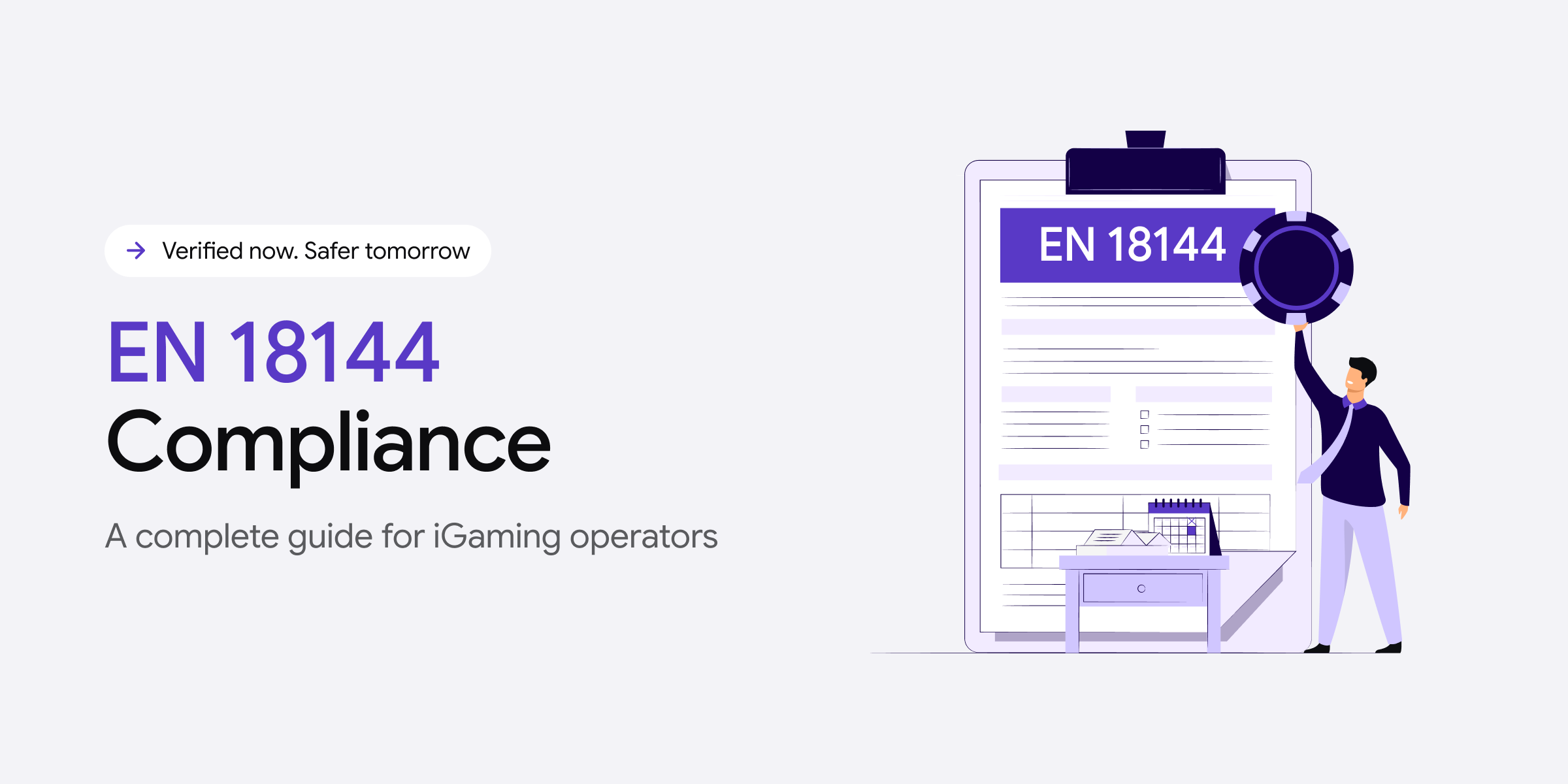
The European Gaming and Betting Association (EGBA) has recently presented EN 18144, a European standard and framework designed to prevent risky gambling activities and help iGaming and gambling operators assess their current responsible gaming measures through the new markers of harm.
Understand in a second:
- EN 18144 presents new “markers” that help businesses identify when a player shows signs of risky or harmful behaviour.
- EN 18144 was approved by the European Committee for Standardisation (CEN) in October 2025 and became available through national standards bodies across Europe by 31 May 2026.
- It’s the first official European iGaming standard that provides companies with a clear system through its behavioural markers.
I’ve compiled a short compliance guide for you, looking into the key things to remember about EN 18144 and its nine markers of harm, explaining how monitoring or clear intervention measures should be applied.
What is EN 18144?
EN 18144 is a European standard that describes behavioral indicators (such as deposit volume or session duration) and possible risk signals that can be linked to gambling-related harm. It sets out a minimum set of behavioural and financial indicators to help operators assess gambling-related risk.
“Online gambling – Markers of harm in support of identification and prevention of risky and problem gambling behaviour.”
EN 18144 Standard preview
These indicators, or “markers,” don’t automatically put a label on a player indicating they have a problem with gaming on your platform.
Instead, they:
- Spot risk signals through real-time user activity (before they become a bigger issue)
- Support the platform’s overall risk assessment
- Help identify ongoing changes in player behavior/patterns
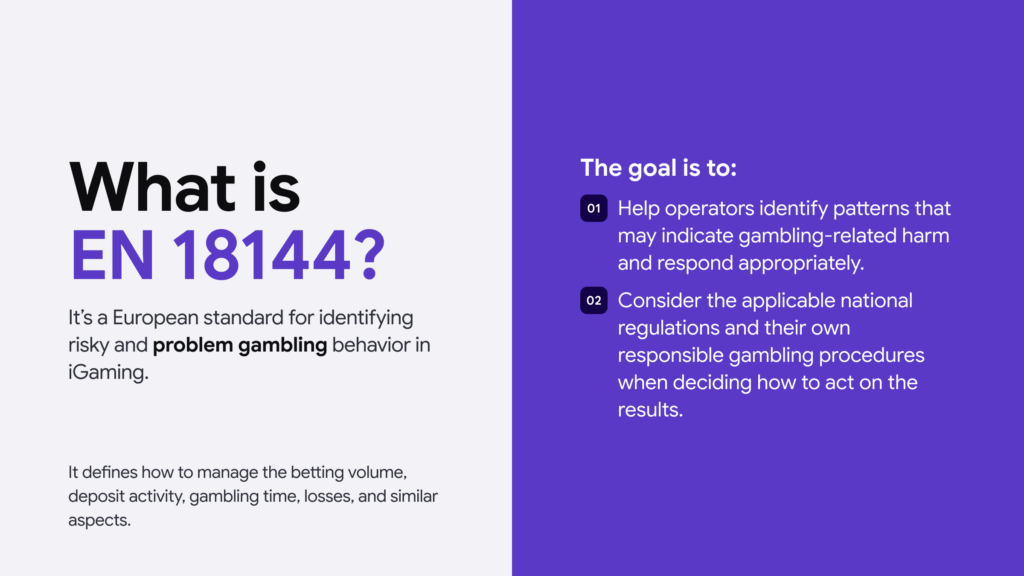
EN 18144 is designed to help iGaming platforms and gambling operators detect at-risk players and guide appropriate intervention measures while promoting responsible gambling practices. In other words, EN 18144 protects users and helps gaming companies follow the same standardized approach to safer gambling measures.
Automate your KYC process
iDenfy verifies customers from 200+ countries in seconds. AI-powered, compliant, and trusted by 1,000+ companies.
Explore KYC SolutionWhat Does EN 18144 Cover?
The EN 18144 framework covers these areas:
- Nine markers of harm, which are the unified minimum standard required for gambling operators
- Behavioral biometrics that analyze changes or suspicious patterns in player activity over time (for example, across defined periods, not relying on a single event)
- Multiple risk signals to track and see how the markers interact with each other to better detect potential harm
- Evidence-based approach that supports research-based decisions, not speculation
- A unified baseline that works as a European standard for all iGaming/gambling operators, working to support consistent player protection measures
| Date | Event | What happened | What it means for iGaming |
|---|---|---|---|
| 2022 | Standard proposed | EGBA proposes a European standard on markers of harm to CEN. | Work starts with operators, national authorities, academics and harm prevention specialists. |
| 26 October 2025 | Approved by CEN | CEN and its national members approve the standard, drafted by technical committee CEN/TC 456. | The content is final, and the standard is officially referenced as EN 18144:2025. |
| 31 May 2026 | Available across Europe | The standard is available from national bodies across Europe. On 1 June, EGBA announces its members will align with it. | Industry alignment begins, and regulators can choose to reference or require it. |
CEN technical committee CEN/TC 456 developed EN 18144 in 2025 after EGBA proposed the standard back in 2022.
What makes EN 18144 Compliance Unique?
The EN 18144 compliance framework for iGaming companies is unique because it’s considered to be the first European standard of its kind. It provides firms with a clear rulebook that is shared and unified. EN 18144 helps identify risky play, an essential part of any gambling platform that wants to create a safe, entertaining environment.
However, the standard does not specify mandatory intervention thresholds. That means platforms need to ensure and decide which sort of gambling solution and specific actions they’ll use to comply with EN 18144.
Is EN 18144 Mandatory for Gambling Operators?
No. EN 18144 is considered a voluntary standard, not an EU-wide legal requirement for gambling operators. It sits alongside national gambling rules.
So, that means:
-> For iGaming and gambling operators, using EN 18144 is voluntary unless local rules require it.
-> For regulators, EN 18144 provides a common framework and sort of guidelines how to approach the system for detecting risky player behavior and patterns linked to harmful activity.
According to EGBA:
“Most members already monitor all nine markers.”
EGBA’s members hold 321 online gambling licences across 21 European countries.
| Group | Countries |
|---|---|
| EU member states (27) | Austria, Belgium, Bulgaria, Croatia, Cyprus, Czech Republic, Denmark, Estonia, Finland, France, Germany, Greece, Hungary, Ireland, Italy, Latvia, Lithuania, Luxembourg, Malta, Netherlands, Poland, Portugal, Romania, Slovakia, Slovenia, Spain, Sweden |
| EFTA countries (3) | Iceland, Norway, Switzerland |
| Other CEN members (4) | North Macedonia, Serbia, Türkiye, United Kingdom |
| Total | 34 countries |
EN 18144 is now a national standard in 34 European countries
-> By May 2026, all 34 countries had adopted it nationally, including examples such as Lithuania, Germany, France, Italy, Spain and the UK.
There’s a chance that your national regulator will introduce requirements to follow the EN 18144 standard or parts of it under local rules. That’s because the standard itself notes that it lets gambling authorities require operators to follow it.
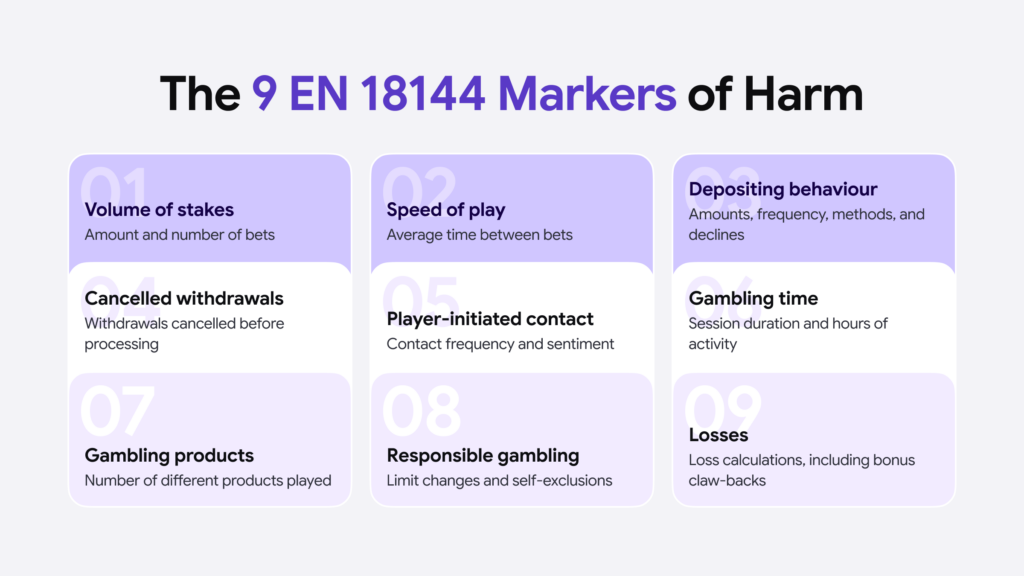
What are the EN 18144 Markers of Harm?
EN 18144 standard’s main focus is its nine markers of harm. They can be categorized into a few areas, such as spending, playing habits, or other risks linked to player activity.
All these measures/markers help companies that offer gambling services detect and prevent risky and problematic user behavior:
1. Volume of Stakes
This includes how much and how often a player wagers, or, simply put, how much money they put on their bets. If a user on an iGaming platform typically doesn’t go over a €50 limit and starts to go into the thousands or hundreds stage, it could be a sign of risky behavior. That said, this marker also includes bets made using bonus funds, not just the player’s own money.
2. Speed of Play
This means monitoring and checking whether the person is not playing too much based on signs like how quickly they place bets. Gambling operators compare different players’ baselines and their usual pace instead of using the same threshold template for all users on their platform.
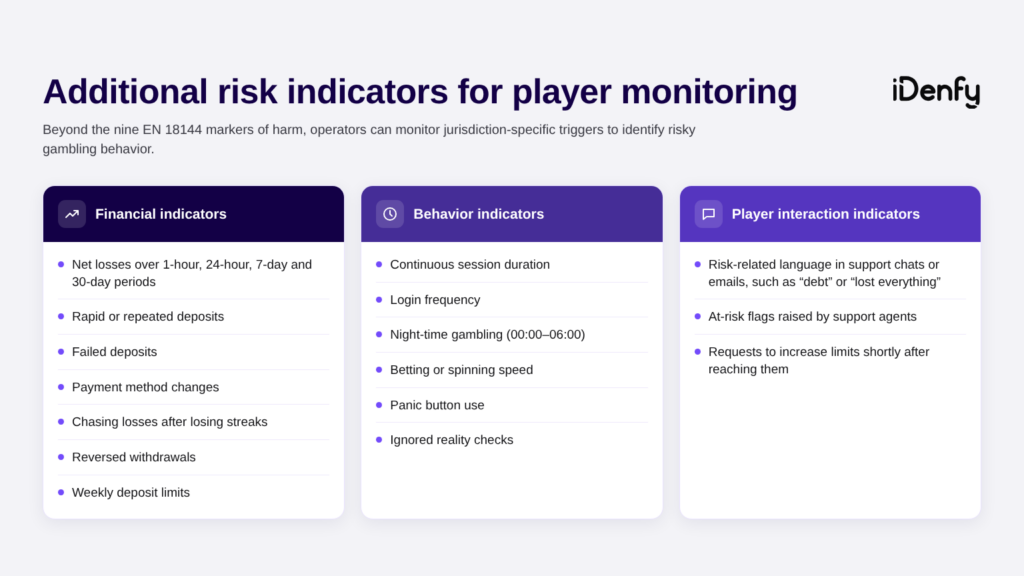
Other solutions like real-time risk-scoring and flags on atypical/suspicious speed-related activity include sudden jumps in bets per minute in one session. You also need to look at the whole picture. In-play bets during a live match are different compared to a fast play on a slot.
3. Depositing Behavior
This includes activity related to how often the person tops up or deposits funds in one session/evening. Failed deposits should be tracked as well. For example, if the player attempts to deposit using a card that declines several times, this can be a sign of financial strain. Topping up within minutes, especially if the player reaches a balance that’s close to zero, can be a sign of chasing losses. You need to assess the overall player profile.
There are certain red flags, such as depositing from a card that is registered in someone else’s name. Special tools like bank card verification help prevent this in a secure, compliant, and timely manner that doesn’t frustrate the user further. Additionally, unusual deposits can be a sign of money laundering, not just a marker of harm, as some suspicious signs overlap with standard AML risk signals.
4. Withdrawals and Cancellations
Players who are cancelling their withdrawals can mean that they decided to stop and then changed their mind and kept on going and chasing the win. In contrast, players who constantly gamble but never withdraw their winnings are recycling their funds on the platform.
That’s why all markers of harm should be monitored collectively, including deposit spikes, timing, like late-night sessions or the gap between winning money and moving the funds out of the iGaming account.
5. Player-Initiated Contact
This means the times the player themselves initiated contact by messaging the gambling platform’s support team. For example, using the live chat feature, especially if the messages suddenly start to increase. Topics and the context here are also important to use as a measure to prevent harmful behavior.
If the user asks about losses, payment issues, or limits frequently, this can be a red flag. The timing matters as well. For example, if the player only reaches out after big losses or asks the support team to raise their limits or remove a time-out.
6. Gambling Session Duration
This is the time of play or the user’s session time, including the times or how frequently they gamble on the platform. To comply with this marker of harm, iGaming and gambling firms need to track activity, such as how long a player stays logged in, the total time (per week or per day) across all sessions, and how users react in a more unusual scenario, for example, right after they get paid and if they turn to the platform right after. For example, if the player isn’t sleeping or is gambling during work hours, it can be treated as a red flag.
7. Use of Multiple Gambling Products
This includes the games and types of gambling the player is involved in, such as how many slots, live casino, bingo, poker, or sports betting activities they are active in. If a player is suddenly interested in starting new gambling products they’ve never tried before, or they’re playing multiple games at once, it can be a sign of harmful activity.
That’s because switching to a fast, high-intensity gambling activity tends to increase both the player’s spend and time played. This marker of harm is important because it helps track the overall picture while monitoring whether the user isn’t moving from one platform to another just to win their funds back after losing a bet.
8. Net Losses
This includes the total loss trajectory over time that a player compiles by calculating the stakes minus the winning percentage (or deposits minus the player’s withdrawals). Gambling platforms need to always keep an eye on signals such as whether the losses are growing and if the player can afford to lose this much.
In practice, this means monitoring loss streaks and recovery behavior, determining if the user is behaving adequately after a big loss (or, in contrast, raising again, or switching gambling products). This marker is the strongest financial harm indicator in gambling.
9. Changes to Safety Tools
This marker of harm describes how often the user on an iGaming platform changes their responsible gambling settings, for example, their deposit limit. There’s a chance the platform allows you to increse/decrese or remove the deposit limit altogether. Other setting examples include time limits and edits to the frequency or the time of play. Gambling firms also need to provide the opportunity for players to enable self-exclusion.
| Area | EN 18144 | UK (SRCP 3.4.3) | Malta (Player Protection Directive) | Lithuania (Law on Gaming) |
|---|---|---|---|---|
| Legal status | Voluntary European standard | Binding licence condition | Binding licence requirement | Binding law, detailed in LPT responsible gambling rules |
| Who it applies to | Online operators that adopt it, or where a regulator requires it | Remote gambling licensees serving customers in Great Britain | Operators licensed by the Malta Gaming Authority (MGA) | Online and land-based operators licensed by the Gaming Control Authority (LPT) |
| Spend and deposits | Volume of stakes, depositing behaviour (incl. declined deposits), losses | Customer spend, patterns of spend | Deposit amount and frequency | Amounts spent, recorded on a certified platform |
| Payment methods | Not a named marker | Not a named marker | Use of multiple payment methods | Not a named marker |
| Withdrawals | Cancelled withdrawals | Not a named marker | Reversed withdrawals | Not a named marker |
| Gambling time | Session length and time of day (a session ends after 5 minutes without a bet) | Time spent gambling | Not a named marker | Time spent gambling, recorded on a certified platform |
| Gambling behaviour | Speed of play, gambling products | Gambling behaviour indicators | Not a named marker | Continuous monitoring; operators define their own problem gambling indicators |
| Customer contact | Player-initiated contact | Customer-led contact | Not a named marker | Not a named marker |
| Safer gambling tools | Changes to responsible gambling tools | Use of gambling management tools | Not a named marker | Daily, weekly and monthly deposit limits must be set before online play |
| Thresholds and interventions | Not set; left to operators and regulators | Timely action, with automated processes for strong indicators of harm | Appropriate steps once risk is detected | Inform at-risk players and point them to help; report actions to LAKIS at least every 30 days |
Key differences in how EN 18144 and national regulations approach the iGaming and gambling sector
You should also monitor the repeated use of self-exclusion and how often the player changes their safety controls. So, the issue here is not setting a limit as a process or excluding yourself from gambling, since it’s a positive sign, but how often you change the settings and whether the pattern is no longer positive. EN 18144 compliance is designed to track this sort of behavior and not penalize players who are responsible about their gaming activity.
How Does EN 18144 Compliance Require Operators to Analyze Risk Markers?
EN 18144 treats all markers of harm as a whole, recommending designing a system that helps gambling operators detect harmful player behavior early on.
The EN 18144 standard and its nine markers of harm are set out to help:
- Compare patterns. Gambling operators should assess values and changes in the user’s behavior over time by flagging atypical activity that doesn’t match their usual gambling behavior.
- Analyze multiple risk points. iGaming firms need to assess all markers of harm at the same time, as one risk signal is not enough to determine the whole profile of a player. Potentially harmful gambling is often based on multiple risk signals.
- Filter out false positives. Gambling operators need to consider individual profiles and circumstances when assessing flagged players. Intervention is not needed in any case, as some higher betting amounts might be considered OK gambling behavior for a higher-income player.
The easiest to analyze and measure out of the nine markers of harm are the financial ones (deposits, withdrawals, losses and stakes). That’s because it’s objectively relatively clear. You need to monitor transaction amounts, frequency, and the overall financial/gambling activity over time.
In the meantime, to measure gambling duration, you need to group bets into the same session.If a player places their bet at 8:00, 8:03 and 8:07, these all count as one gambling session. A five-minute or longer gap between bets starts a new session. iGaming and gambling operators typically apply this standard when using bet timestamps or time intervals recorded by their internal systems.
Why is it Challenging for Operators to Meet Safer Gambling Requirements?
There are challenges making it harder to implement EN 18144 and safer gambling standards. These include:
There is Limited Time to React
Certain jurisdictions set specific response deadlines, but this isn’t a global standard. You can be expected to address signs of harmful play (intervene) in real time on your platform.
The Information About the Players is Scattered
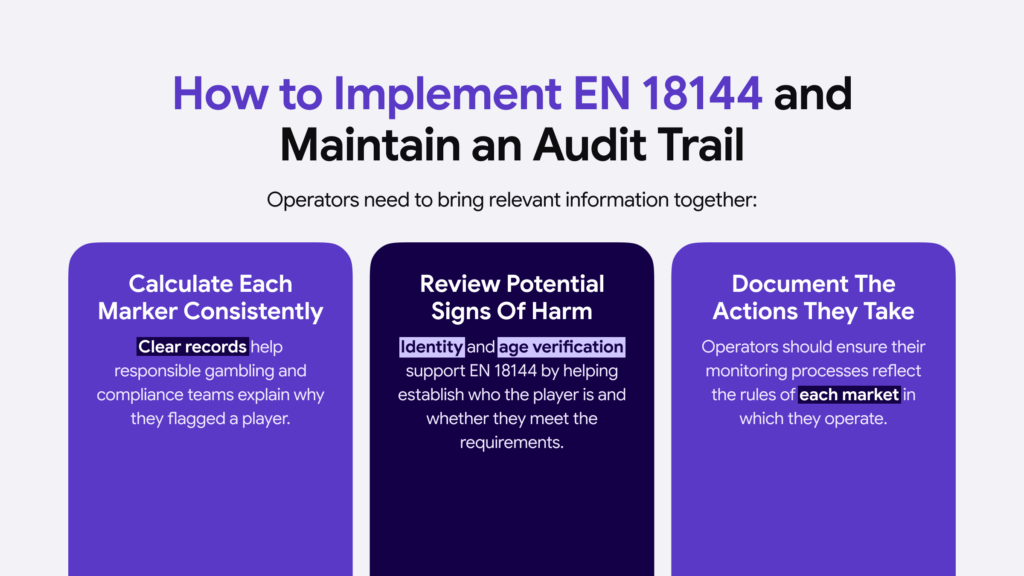
Some internal operator systems aren’t connected to one another, and, as a result, the details about the player are scattered. This makes it difficult to spot markers of harm and build a full risk profile.
Deposit records can only be accessed through the payment provider, session data sits in gaming systems, and warning signs appear in customer support conversations. You need to track every risk signal and connect these sources.
Marketing Campaigns Can Affect At-Risk Players
Operators have special “VIP” programs and promos that can also target at-risk players who can potentially be harmed. You should segment ads and such campaigns, monitoring other behavioral data on your platform. The easiest way is to connect to your player’s risk profile. This helps send bonus offers for those players who are low-risk and do not show any signs of gambling-related behavior.
Risk Models are Difficult to Maintain
Cases where hard-coded player risk scoring rules and thresholds are used make it harder to keep accurate risk profiles.
“You need to really tailor your detection scenarios to the actual activity of your platform, and ideally to the specifics of your client. If you have a one-size-fits-all approach, you will not see every aspect and every trigger that you should consider in the eyes of the regulation.”
Baptiste Forestier, Compliance Professional and France Chapter Board Member, ACAMS
For example, if a regulator introduces a new deposit threshold or shortens an intervention deadline, operators need special engineering support to update their systems. That’s why iGaming firms need to focus on making it easier for their compliance teams to manage changing regulations or internal risk policies.
How Can Gambling Operators Prepare for EN 18144?
You need to implement all markers of harm and monitor player activity throughout the whole cycle while they are on your platform. The goal is to detect gambling-related harm as soon as possible and before the situation escalates, keeping a safe gambling environment.
In a more practical sense, you need to:
- Monitor the EN 18144 markers of harm. This helps detect risk indicators, such as gambling duration or deposit patterns, and comply with national/global regulations.
- Assess player risk. Gather information and combine detected risk signals to build a player’s risk profile. Most operators classify players as low, medium, or high risk based on their activity and predefined thresholds.
- Take action. Trigger manual reviews or interventions when certain risk thresholds are met. Depending on your internal policies, these can include temporary cool-off periods, session restrictions, or stopping communications regarding perks like bonuses.
- Record detected indicators. Keep track of player activity to keep a ready-made, compliant audit trail with timestamps and recorded decisions to adequately respond to potential player-related gambling harm if needed.
Gambling operators need to follow a proactive player protection program and not wait for the players to keep on choosing drastic measures, such as self-exclusion or reporting the issue themselves. Responsible iGaming platforms detect the risks and prevent gambling-related harm in a safe and timely manner.
Related: Case Study: TOPsport
Final Thoughts on EN 18144
To adopt the standard’s recommendations and comply with EN 18144 markers of harm, you need to set out internal rules. Move from a single-marker framework to a points-based score or a model that monitors all nine markers. Ensure all data sources (deposit (including declined deposits), withdrawal, session, product, contact) are compiled and tracked to build a complete and reliable risk profile.
iDenfy’s Transaction Monitoring platform is specifically designed to fit the gambling and iGaming industry. It measures every EN 18144 marker on the same platform as your KYC/AML checks, with custom rules you set per licence and a tamper-proof record of every decision.