One of the practical steps of Anti-Money Laundering (AML) compliance is to screen your customers against “AML databases”, which, in practice, means running the user’s collected Know Your Customer (KYC) data against global sanctions lists, watchlists, Politically Exposed Persons (PEPs) lists and adverse media to check if there aren’t any hits/findings. These alerts signal a higher risk and can potentially ban you from working with such a client, especially if they’re sanctioned. This applies to both individual clients and companies.
But what about false positives? Setting AML screening rules too loosely increases the false positive rate, flagging more genuine customers and putting extra manual work on your analysts. With large volumes and the goal of speedy onboarding when AML screening is part of it, this can drain out your resources.
For company screening, iDenfy’s data shows that the false positive rate is 2.6 times higher than for individual screening, creating an even bigger manual workload.
I explain how to reduce the false positive rate and focus on genuine alerts, keeping the AML screening process as effective as possible.
What are False Positives in AML?
False positives are alerts that an automated AML system (can be a third-party software like iDenfy or a native, in-house automation solution) flags as a potential match to a risk signal found in an AML database. It can be a sanctions list match, a watchlist finding, a flagged transaction (during transaction monitoring), or any other AML database that flags the customer as suspicious even though they’re a genuine client who isn’t linked to any actual fraudulent activity.
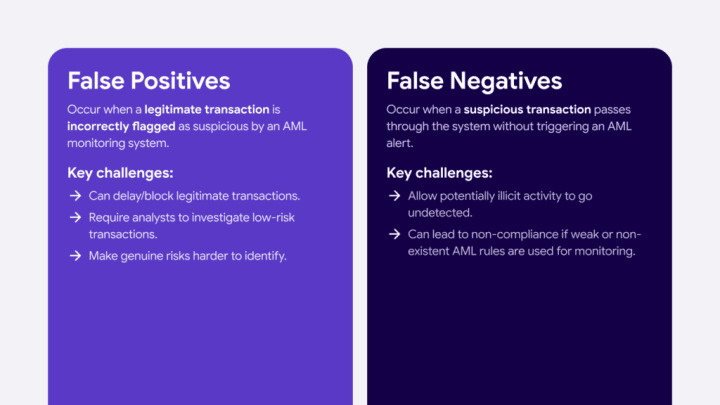
Common reasons why false positives in AML happen include cases like a client getting flagged because their name matches another individual who’s sanctioned and appears in a sanctions list.
For example:
- Similar personal info. Different people with different identities can have very similar names that only differ by a few letters (for example, Mohamed Hassan and Mohammed Hassan). Extra factors like transliteration from Arabic and other non-Latin writing systems also cause these similarities.
- Overlapping business names. The same principle of nearly identical names can be applied to corporate entities and common terms like “Trading”, “International”, or “Group”.
This is why such AML findings are called “false” positives because they are not linked to the identified risk.
Automate your AML checks
Screen customers against global sanctions, PEPs, and watchlists in real time with iDenfy AML Screening.
AML Screening SoftwareWhich Databases Does AML Screening Cover?
AML screening databases are information sources that are used as a base to cross-reference and compare the person’s or company’s name (and other credentials, as it depends on the concrete case) to identify risks and links to money laundering, fraud, sanctions breaches, and other financial/compliance risks. The standard databases include international and national sanctions lists, PEP databases, regulatory and law enforcement watchlists and adverse media screening.
As a regulated company, you decide which components are required, as not every applicant needs to be screened the same way, using the same AML lists. That’s why the risk-based approach to AML is applied to identify and categorize customers from low to high risk and then apply appropriate screenings and measures.
| Database | What it covers | Why it triggers false positives | What usually clears the hit |
|---|---|---|---|
| Sanctions lists | Individuals, entities, and vessels under financial sanctions, for example, OFAC SDN, EU Consolidated List, UN Security Council, UK Sanctions List | Transliterated names, multiple spelling variants, and low-quality aliases. Some entries carry few identifiers beyond a name | Date of birth, nationality, and document numbers listed on the entry; filtering out weak aliases |
| PEP databases | Politically exposed persons, their family members, and close associates (RCAs) | Broad scope, from heads of state to local officials. Includes relatives and former PEPs. Common names match thousands of profiles | Date of birth, country, and public role; risk-based rules for PEP tiers and ex-PEPs |
If a person appears to be a PEP, it raises the level of due diligence (family members of PEPs are also considered to be higher risk due to the same elevated risk of corruption or financial crime). Sanctions findings are very serious, as some regulations do not allow the release of funds to a sanctioned person/company (for example, this includes EU restrictive measures due to Russia’s war on Ukraine). You can’t treat all database findings the same.
This saves analysts time but, more importantly, allows analysts to react to high-risk, prioritized cases where the false positive appears to be a true match. In cases where suspicious activity is a genuine concern and a real threat, a Suspicious Activity Report (SAR) needs to be filed.
🔗 Related: How Does an AML Investigation Work? [5 Steps]
Why Do False Positives Happen?
When AML software incorrectly flags a client as a potential match, it happens due to name matching. It’s a method that AML screening is based on and is considered to be a normal outcome, not an error.
False positives in AML screening often result from:
- Transliteration. Different spellings but similar names, such as Darius and Darijus.
- Partial names. This includes examples like a watchlist entry containing “J. Smith,” and then the “J” part matches unrelated people and other names like James or Jane Smith, creating more false positives.
- Common names. This includes popular names that people around the world share, such as Maria or the surname Wang.
- Nicknames. This can happen when generic aliases are used and then are matched to unrelated people who, in reality, don’t have a connection to the person that the system flagged.
| AML Finding | Database | Context | Further workflow options |
|---|---|---|---|
| Daniel Novak | PEP | Former deputy minister in Slovakia, born in 1965 | False positive: year of birth and country of residence differ |
| D. Novak | Regulatory watchlist | Accountant sanctioned by a Canadian regulator; no date of birth provided | Requires further review: insufficient identifiers to confirm or rule out a match |
| Daniil Novakov | Sanctions | Similar transliterated name, born in 1990, listed as a Belarusian national | Requires human review: the birth year matches, but nationality and identity need verification |
An example of what kind of results you can expect when assessing AML false positives
In other words, you can’t avoid false positives, but you can control what you do with them and how you minimize them (alert fatigue is not the goal here), so that they don’t take away the time you spend on real matches and real AML risks.
What Issues Do False Positives in AML Screening Cause?
There’s a reason why false positives in AML screening take a big part of the narrative and can actually become a big issue for your business due to these factors:
1. Friction in the End-User Experience
If the false positives flood the compliance team, chances are they will need additional supporting documents from the client before approving them during the initial user onboarding or as a re-screening measure before approving a high-risk transaction.

This adds friction to the user experience and can delay the approval process due to the manual checks that are needed if AML hits are found.
2. Alert Fatigue With More Manual Reviews
Analysts are obliged to look into the AML findings just to find out that the matches are irrelevant and are only a bunch of false positives. This also delays the detection and handling of true matches and real risks that require extra actions, such as reporting or Enhanced Due Diligence (EDD).
3. Higher Operational Costs
It depends on the software you use, as some providers claim to have low AML screening fees but charge every time a client is rescreened and returns new results, which include false positives as well. So, in general, the more AML hits are found and the more noise is in your AML screening system, the more likely it is that the bill is going to be higher. Having a highly skilled compliance staff in-house is also an expense that some, especially smaller firms, can’t afford.
💡 Good to know: iDenfy charges one flat fee per monitored subject, which includes the initial check and all daily rescreens. False positives never add extra costs, so your AML budget stays predictable.
🔗 Related: Click here to find out how Rebell Pay lowered its AML screening and KYC verification costs by 15%.
How Many AML Flags are False Positives?
The short answer: most of them.
Our in-house team at iDenfy collected data from 71,000+ AML screening checks on both individuals and companies across the globe using internal data from our partners and the real workflows they use.
Compliance teams reviewed and resolved 1,300+ of the potential matches found during AML screening and 95% of them (when individual client and company AML screening were combined) turned out to be false positives.
How the calculations were made:
The false positive share of reviewed flags means that not every flagged check gets a final decision straight away. Some flags can be forwarded to a compliance analyst for extra review, depending on the severity and risk of the AML flag. To show how many flags turn out to be false positives, we only counted the flags that had already been reviewed manually and closed as either a true or false positive.
| Type | Total AML checks | Flag rate | False positives | False positive share of reviewed flags |
|---|---|---|---|---|
| Company | 3,456 | 23.61% | 233 | 89% |
| Person | 67,804 | 9.07% | 1,047 | 97% |
-> Download the full version of iDenfy’s report on false positives and AML screening for free.
The false positive share is the number of false positives divided by all reviewed flags. For example, a 97% share for individuals means that for every 100 reviewed flags on people, about 97 were false alarms.
Key takeaways from iDenfy’s research on false positives:
- Company AML checks generate a 2.6× higher false positive rate than individual client screening.
- Compliance teams are required to review more alerts when screening businesses than when screening individuals, increasing the manual workload involved, especially during Know Your Business (KYB) onboarding.
🔗 Related: Click here to see how FTMO automated KYB and AML screening, UBO verification, and other elements to save 40+ hours of manual work weekly.
What to Do to Handle False Positives But Still Not Miss True Matches
The more data you have and the more you customize your AML screening settings, the less likely you are to bump into incomplete or outdated data that also affects the false positive rate.
In practice, these actions can help you manage false positives:
Set Matching Criteria Based on Risk
If you require three or more matching criteria as a way to reduce false positives, keep in mind that a strict threshold can cause genuine risks to go undetected. For example, PEP records can only contain the client’s name and country (which is two data points). If three matching criteria were set as a mandatory base, the results wouldn’t possibly show up.
To avoid this, assign different weights to AML screening and its matching criteria. A full name and date of birth match provide stronger evidence than a name-only match. However, even a weak match often still requires manual review if the AML hit found by the system is linked to a potentially high-risk individual.
Prioritize Alerts by Match Strength
False positives are harder to eliminate when AML screening records contain limited information. That’s why the golden rule always remains to aim to detect genuine risks and not to focus on ruling out every false positive as quickly as possible.
This challenge can be solved by prioritizing AML alerts with multiple matching identifiers can receive priority for further investigation, while name-only matches and cases like common names can receive a quicker initial review (no extra supporting evidence simply means the analysts can close the case).
Remove Bias and Document Decisions
Your analysts need to have evidence and not rely on assumptions. For example, if a customer’s name matches a PEP record but no other supporting evidence links them to that person, analysts should document their checked identifiers and what they found, aka the reasons for closing the alert.
This also keeps a clear, audit-ready AML log and helps your team and other analysts who perhaps weren’t working on that particular case to get on the same page. This also helps demonstrate that you followed your AML processes consistently.
How iDenfy Helps
iDenfy’s AML Screening solution is designed to reduce unnecessary AML alerts by offering you an easy no-code workflow design via its dashboard, where you can adjust the screening rules/criteria and collect complete KYC data using the same tool.
-> Click here to download and keep the PDF version of our research.
With iDenfy, you can:
- Adjust fuzzy matching thresholds and choose between PEP (filter out by PEP level) and sanctions screening, watchlist checks and adverse media screening
- Combine ID verification with AML screening, using verified data, such as the user’s address, date of birth, or nationality
- Build workflows using custom rules (based on risk factors such as the user’s jurisdiction) to automate approvals for cases without AML hits while forwarding flagged cases for manual review
- Download custom PDF reports and access original data sources with comments and timestamps from all your compliance officers
-> Cleared matches stop triggering alerts unless new information appears. One fee, daily rescreening is included. Book a quick demo for more info.


 Download PDF