While focusing on safer gambling remains the top priority for gambling and iGaming operators, regulators aren’t stopping here, as they’re breathing down their necks with new, stricter age limit rules. Instead of allowing access to gambling products at 18, new recommendations in various countries are pushing the age to 21.
iDenfy’s data shows that iGaming brands might not be happy about this, as some platforms experience a jump in new, young customers as soon as they reach the legal age. According to EGBA’s research, in the UK alone, the iGaming market reaches €11.1 billion within a single year. But the dilemma remains. Is it OK to expose young individuals to both risky and entertaining products this early?
Having that in mind, we looked into the KYC statistics of users in iGaming and found a pattern backed by real, in-house data. For example, more than 1 in 3 verifications with a Latvian ID document come from 18- to 20-year-olds. That’s exactly the group Latvia’s 21+ bill, now in parliament, would ban. And this is just a single country in the EU.
Keep reading for more expert insights.
What Stood Out the Most
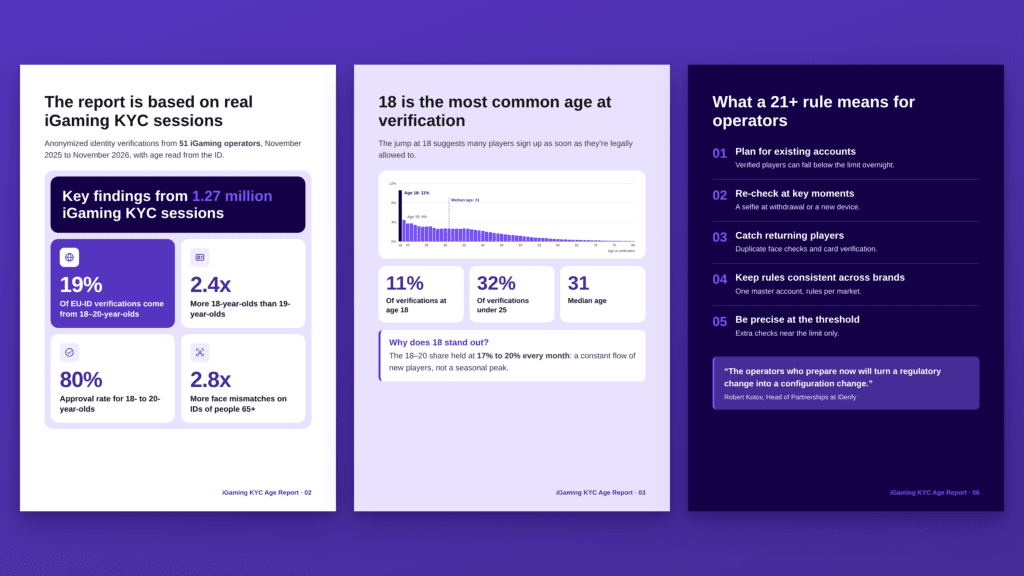
- 1 in 5 ID verifications in iGaming involve very young individuals who are 18- to 20-year-olds. They account for 19.4% of all users who completed their KYC check with an EU-issued ID document.
- There are 2x more 18-year-olds registering for iGaming services than 19-year-olds, showing a pattern that some young individuals wait to hit the legal age to access these age-restricted services.
- Underage users attempting to access iGaming services are still rare, with users under 18 accounting for 0.18% of verifications, which is approximately 1 in 560.
The goal of the research was to measure how many verifications a 21+ gambling age limit would affect and how verification outcomes differ by age.
-> Download the full iDenfy report here.
We filtered out over a million anonymized KYC sessions that our identity verification software processed within a single year (from November 1, 2025 to November 17, 2026). Data from 51 companies specifically operating in the iGaming and gambling industries were used.
KYC built for iGaming
See how iDenfy helps gambling and betting platforms meet compliance requirements while keeping onboarding fast.
Explore iGaming SolutionOther Interesting Patterns
🟣 Younger Users are Tech-Savvy and More Likely to Convert
-> 18- 20-year-olds pass their IDV session on the first attempt, maintaining a steady 80% KYC approval rate, which is the highest among others, especially older individuals.
Only 7.6% of 18- to 20-year-olds abandon verification after scanning their ID, compared with 19.1% of users aged 65 and older.
iGaming operators benefit from this predictable acquisition window and welcome a bunch of new players who just turned 18. However, from a regulatory standpoint, age verification becomes an important part of registration to safely onboard and approve individuals.

iGaming platforms can expect a consistent influx of newly eligible players who just turned 18
Younger players on iGaming platforms are generally more comfortable with onboarding because they are used to a similar KYC process on other platforms. When the U/X is familiar and well-explained (for example, the user isn’t redirected to multiple third-party windows, the process shows their progress and how many steps are left, etc.) This explains their lower verification drop-off rates found in our research.
iDenfy also found that the challenge is to ensure a secure process while making it as quick and easy for the user as possible, no matter their age. So, while younger players are comfortable with the KYC checks at onboarding, operators are required to find a way and ensure that the same person will be using the account.
“Raising the age limit doesn’t make younger players disappear. Overnight, many existing accounts could be locked out, and some of those players will look for a way back in, through shared accounts or account takeover. Operators need to be ready for that, not just at sign-up, but throughout the player’s whole lifecycle.”
Robert Kotov, Head of Partnerships at iDenfy
For reverification, the rules are the same. A highly converting KYC workflow should be used, preferably one that’s based on the user’s face and liveness detection in cases where their ID document is already pre-recorded and saved in the system.
🟣 Older Users are More Likely to Show Signs of Fraud
-> Most mismatches and signs of potential misuse during KYC happen within the 65+ age group, where the submitted ID doesn’t match the player’s face during the biometric check 2.8 times as often as checks using an ID of an 18- to 20-year-old.
| Signal | 18–20 | 65+ |
|---|---|---|
| ID shown from a screen | 0.3% | 1.6% |
| Face doesn’t match the ID | 1.3% | 3.8% |
| Fake face (liveness spoof) | 0.6% | 1.6% |
| Forged or fake document | 1.6% | 3.3% |
| Face check inconclusive | 1.3% | 4.0% |
| Face used before (duplicate identity) | 2.2% | 6.1% |
| Data mismatch | 15.6% | 10.3% |
The age in our data comes from the ID (as iDenfy uses document-based age verification in iGaming for the initial registration step that extracts the player’s DOB from their captured ID document photo), which isn’t always the person holding it. Checks using the ID of someone 65 or older show far more fraud signals than checks using the ID of an 18- to 20-year-old. The biggest gap is an ID shown from a screen instead of the physical document, which is 4.7 times as common.
Additionally, up to age 34, drop-off and rejection rates remain stable, but from 45 onward, both start increasing with every age group. iDenfy’s research shows that players who are 65+ abandon 19.1% of verifications after scanning their ID, against 7.6% for the 18- to 20-year-old category.
iDenfy’s earlier Identity Threat Index report found that iGaming had more flagged sessions than any of the 20 industries analyzed. Duplicate face checks, which catch the same person signing up again, were the most common red flag that affected the KYC pass rate.
What the 21+ Rule Means for Operators
A 21+ age threshold won’t stop every underage player from trying to regain access using different details, especially if they are hit with a pop-up one day without any previous notice or explanation on why they need to resubmit their KYC details, or, worse, get locked out of their existing account.
According to iDenfy’s KYC experts, a short selfie at the first withdrawal, a login from a new device, or a change of payment method using tools like Bank Card Verification, matched against the face from the original check, can solve this issue and quickly confirm that the right person is still behind the account.
The comment of Domantas Ciulde, the CEO of iDenfy, when talking about the importance of adapting to a higher age limit (18 vs. 21) in iGaming
That’s why iGaming operators need to reassess existing profiles, not just apply stricter age checks at user onboarding. Otherwise, affected players aged 18-20 who previously met the legal age requirement are likely to try to bypass the new restrictions through shared accounts, borrowed IDs, or, worse, account takeover fraud, where the existing, age-approved account is stolen via phishing or similar deceptive tactics.
iDenfy’s contact information:
-> For more details or media-related collaborations, please reach out to our team at [email protected].
-> To get a demo, contact our Sales team.


 Download PDF