KYB onboarding verifies that a business is legally registered, its beneficial owners are identifiable, and its risk profile is understood before you open a relationship. This is important, as the digital economy is facing some challenges that include fraud, money laundering, identity theft, embezzlement, and other forms of criminal activity, particularly linked to using illicit funds and hiding them via corporate entities. A common example is establishing a firm in an offshore jurisdiction, where you don’t need to file with a corporate register and can hide better from the authorities.
Although a small organization is more likely to get this kind of attack, it does not matter, because even banks, SaaS platforms, and major companies are at risk of being affected by fraud, and that is exactly why you need a proper Know Your Business (KYB) solution and its onboarding process guide. It helps collect and gather information about another company in a manner that helps save time for your analysts and doesn’t leave them with a pile of documents or manual googling and looking up sanctions lists.
I cover what KYB involves, how to design onboarding flows that actually work, and what happens if you skip certain steps during your corporate due diligence.
What is KYB Onboarding?
KYB onboarding is the process that verifies the identity, legitimacy, and risk level of a business before establishing any relationships with them, whether financial or commercial. Although KYB differs from KYC (Know Your Customer), which mainly focuses on individuals, KYB targets organizations, companies, partnerships, and other business structures.
The main purpose of KYB is to ensure that a business:
- Is legally registered and operational
- Has verifiable beneficial owners (UBOs)
- Is not engaged in money laundering, fraud, or terrorism financing
- Complies with relevant regulatory frameworks like AML (Anti-Money Laundering), CTF (Counter-Terrorist Financing), and GDPR
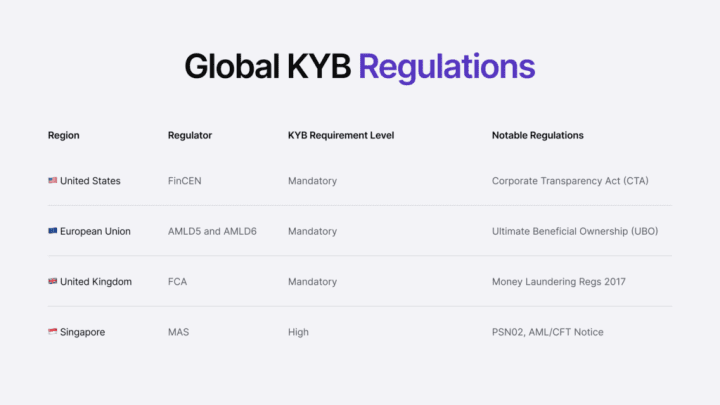
KYB onboarding is mainly monitored by financial regulators in many regions — for example, FinCEN for U.S. businesses, FCA for UK businesses, MAS for Singapore, and the EU’s 5th and 6th AML Directives. Often, regulated entities use KYB Software to ensure that efficiency expectations are met and analysts can work with corporate clients more easily. That is why automation is practically mandatory, especially in cases where organizations cater to large customer volumes.
Related: Why Your KYB Solution for Business Verification Isn’t Working
Verify businesses, not just people
Automate company verification, UBO checks, and business due diligence with iDenfy KYB.
Explore KYB SolutionWhy is KYB Important?
Many people know that they need to implement KYB in their organizations, but sometimes they forget why it matters. Here are the four core reasons.
1. Regulatory Compliance
Financial institutions and various other regulated organizations are legally required to conduct due diligence on the businesses they work with. Non-compliance can lead to substantial fines and lasting reputational damage.
2. Fraud Prevention
KYB helps detect fake companies, shell corporations, and fraudulent organizations, reducing the chances of getting involved in illegal activities. Fraud that reaches onboarding is costly — not just in direct losses but in the operational effort required to unwind a bad relationship.
3. Risk Assessment
Through KYB, businesses can assess the financial and reputational risks of taking a new corporate client — verifying and reviewing ownership structures, business activities, and past sanctions exposure before the relationship begins rather than after.
4. Trust and Transparency
The most important factor of KYB implementation is trust between businesses. By verifying a company’s legitimacy, platforms and partners signal that they are serious about ethical and secure collaboration — which attracts higher-quality clients and deters bad actors.
The Role of KYB Onboarding in Platform Integrity
If you are running a marketplace, payment network, or any platform where businesses connect with each other, one bad actor getting through onboarding does not just create a problem for that one relationship. It chips away at trust in the platform as a whole. Everyone else who onboarded properly ends up sharing the reputational risk of the one that did not.
That is really what KYB onboarding does at the platform level. That said, it’s less about paperwork and more about keeping the wrong businesses out before they ever get in. Sanctioned organizations, politically exposed persons (PEPs), fake companies posing as real ones. Automated tools help here because they can catch much of this at the application stage, monitor it after approval, and adjust the level of scrutiny a business receives based on where it is located or how much volume it is moving. That is what lets a platform keep growing without quietly lowering its standards to do it.
What Does the KYB Onboarding Process Involve?
The main KYB onboarding process typically includes several key steps:
Collecting Business Information
- Legal company name
- Company registration number
- Incorporation documents
- Registered address
- Tax identification number
- Business type and industry
Identifying Ultimate Beneficial Owners (UBOs)
A UBO is a person who owns or controls more than a certain percentage of the business (usually 25% of shares). Verification of UBOs involves:
- Government-issued ID
- Proof of address
- Date of birth
- Ownership percentage
For example, iDenfy recently conducted its in-house research, where the team collected information on 70+ real KYB workflows, taken as examples from real partners who use iDenfy’s KYB software and its dashboard to configure automations. The report showed interesting patterns, such as sanctions screening being more common among individuals, but not for companies, even though this happens during the KYB onboarding process. Other notes to take in: most teams changed and customized the UBO threshold, setting their own thresholds based on their internal risk appetite (for instance, 25% for medium-risk clients and 10-11% for high-risk ones).
Sanctions and Watchlist Screening
This step checks whether the business or its stakeholders appear on PEPs and sanctions lists, or in adverse media reports.
Corporate Document Verification
Manual reviews and automated tools are used to verify documents for authenticity. The business’s risk profile is then assessed based on various factors, like industry, transaction volume, and ownership complexities.
Ongoing Monitoring
Businesses must conduct ongoing monitoring to detect changes in ownership, legal status, or risk levels over time. KYB is not a one-time check — ownership structures change, sanctions designations update, and adverse media can emerge months or years after onboarding.

Issues Linked to KYB Onboarding Practices
KYB onboarding fails in predictable ways. The problems are rarely technical — they are structural and organizational. Let’s walk through the most common issues:
Complex Ownership Structures
Global businesses often have layered corporate ownership stretching through multiple regions. Tracing beneficial owners through holding companies, trusts, and nominee arrangements can be time-consuming and, with manual processes, prone to errors.
Related: How Complex Corporate Structures Conceal True Ownership [KYB Guide]
Manual Processes
Some organizations still rely on manual reviews of documents and spreadsheets, which leads to delays, inconsistency, and an audit trail that is difficult to maintain. It’s also a time-consuming process for analysts who are required to collect documents, verify shareholders and directors, screen multiple sanctions lists, look up potential adverse media, ask for proof of funds, review parent companies, etc.
-> In contrast, there are multiple success stories, such as the one from FTMO, which shows that after implementing iDenfy’s KYB onboarding workflows and using the custom Questionnaire builder, compliance teams save at least 40 hours of work weekly with automation.
Data Inconsistencies
KYB data comes from various sources. Common sources include government registries (such as the UK Companies House), credit agencies, and internal systems. Yet, the issue is that they might not always be aligned or up to date. Reconciling conflicting records without automated tooling is one of the biggest time sinks in corporate onboarding.
Related: Know Your Business (KYB) for UK Firms [Guide]
User Experience (UX)
If onboarding workflows are not designed well, they create frustration for legitimate businesses — leading to drop-offs and lost revenue. Asking for the same information twice, providing no status visibility, or presenting an undifferentiated document request list are all common failure points.
How to Design a KYB Onboarding Flow That Works
B2B onboarding has grown significantly more complex over the last few years. Increased regulatory expectations, layered business structures, and fraud moving upstream into the onboarding process itself. At the same time, businesses face pressure to move quickly. Deals are expected to close faster, partnerships to launch sooner, and delays are rarely tolerated.
The answer is not simplification; it’s the overall design and the intention behind it. A well-designed KYB onboarding flow manages complexity without creating friction that blocks legitimate applicants.
Build Workflows Around Your Risk Appetite
The most important reframe in KYB onboarding design is this: every step should exist to support a specific decision, not to complete a task for its own sake. Each document request, each check, each review stage should answer a defined question that moves the application toward approval, escalation, or rejection.
Well-structured onboarding follows a clear progression: confirm basic legitimacy first, trigger deeper review only when something requires closer attention, and avoid treating every case as high-risk. This sequencing prevents teams from applying maximum scrutiny to every application — which slows low-risk cases without improving outcomes on high-risk ones. When delays occur in a well-designed flow, they are intentional rather than accidental.
Keep in Mind That Speed Does Not Equal Quality
The most common misconception in KYB onboarding is that speed and compliance are opposing forces. They are not — slow onboarding is usually the result of confusion, not caution.
Clear sequencing resolves the tension. Some checks are essential before onboarding can proceed; others can happen in parallel or after activation. Separating what must happen now from what can happen later keeps the critical path short without lowering standards. A business that understands exactly what you need, in what order, and why, will provide it faster than one navigating an undifferentiated document request.
Collect Only Relevant Data
More information does not lead to better decisions. In KYB onboarding, excessive data collection creates noise, slows reviews, and makes it harder for analysts to identify what actually matters. Low-risk entities should go through a simpler KYB workflow. This is important, as KYB conversions are considered to be lower in all industries if we compare them with a simple KYC process for an individual client. That’s why software providers like iDenfy have special automations and KYB auto notifications that send out reminders to applicants who missed a step in their KYB onboarding or didn’t attach a requested document required to finish the process on their end.
When requests are purposeful, applicants are more likely to comply without delay, and internal teams are better equipped to interpret what they receive. The practical rule: for every document or data point in your flow, define the specific risk or compliance question it answers. If you cannot define one, remove it.
Use the Risk-Based Approach For Every Applicant
A domestic sole-trader in a low-risk sector does not present the same risk profile as a multinational distributor operating across multiple jurisdictions. Forcing both through identical workflows slows one down unnecessarily and fails to scrutinize the other properly.
Effective KYB models adapt depth to context. The structure stays consistent — the same steps apply to every applicant — but the depth of review, the documents required, and the review time allocated scale to the actual risk level. Low-risk businesses move through quickly; high-risk cases receive the attention they warrant.
Related: What is an AML Risk Assessment? [With Examples]
Align Your Internal KYB Processes Before Adding New Software
Many KYB onboarding problems stem from internal misalignment rather than missing technology. Compliance, sales, legal, and operations often approach onboarding with different goals and no shared framework for resolving conflicts. Without clear ownership, decisions are delayed or revisited. Without documented exception handling, edge cases become permanent workarounds that never make it into the audit trail.
Companies that handle KYB onboarding well define three things before selecting any tool:
- Who owns final approval — and at what risk levels that authority changes
- When exceptions are allowed — and what documentation they require
- How disagreements between teams are resolved — with a defined escalation path
This clarity reduces complexity more effectively than any software addition. Automation is valuable in KYB onboarding — particularly as volumes grow and manual review becomes a bottleneck. But technology works best when it supports human judgment rather than attempting to eliminate it.
Good KYB systems surface inconsistencies, flag unusual ownership patterns, and document decisions clearly. They accelerate routine cases and route complex ones to reviewers with enough context to make an informed decision. They do not attempt to fully automate reviews where jurisdiction-specific context, unusual structures, or adverse media signals require interpretation. The right balance keeps onboarding efficient without making the process blind.
Related: OSINT-Based KYB: How to Verify East African Businesses
What Happens If You Skip KYB Onboarding?
Skipping or rushing KYB onboarding might save a few days upfront, but it shifts the risk further down the line — usually to a point where it is more expensive to fix. Businesses that bypass proper checks can end up onboarding shell companies, failing an audit, or breaching AML obligations without realizing it until a regulator flags it.
The reputational side is just as costly. Getting linked to a sanctioned or fraudulent entity — even indirectly — can undo years of building trust with customers, partners, and regulators. And if your business is ever raising capital or preparing for an acquisition, weak KYB history is one of the first things investors and acquirers check. A messy or inconsistent onboarding trail signals that compliance was an afterthought, not a system.
In short, the cost of skipping KYB onboarding rarely shows up immediately — it shows up later and in a bigger way.
Related: 6 Steps to Conduct a KYB Verification Check [Guided Explanation]
Best Practices For Efficient and Conversion-Oriented KYB Onboarding
This is a short checklist that I recommend looking into:
Automation
Leveraging RegTech tools to automate data collection, ID verification, document verification, and sanctions screening reduces human error significantly and accelerates onboarding. Automation is not about removing judgment — it is about reserving judgment for the cases that need it.
Different Onboarding Models
Some businesses pose a higher risk level; some a lower one. Implement risk-based approaches: simplified due diligence for low-risk entities, standard for the majority, and enhanced due diligence (EDD) for higher-risk ones. The EDD tier should have a defined checklist and an explicit approval requirement.
Related: The Main KYB Risk Factors You Should Know
Good, Optimized Design For the End-User
It is easy to design KYB onboarding around what is easiest for your compliance team and forget there is a business on the other end trying to get through it. A good process makes it obvious what documents are needed and why, lets people upload them without friction, and gives some sense of where their application stands instead of leaving them guessing. Allow businesses to receive real-time feedback and track application status.
Easy and Documented API Integration
Choose KYB providers that offer APIs so that verification can be completed directly within your platform or application — without manual steps or data re-entry. Registry lookups, UBO tracing, and sanctions screening all become faster and more consistent when triggered programmatically.
Related: A Guide to KYB APIs: What to Compare
Compliance Team Collaboration
Ensure that compliance, legal, and onboarding teams collaborate and receive real-time alerts on unusual activities or changes in regulations. Isolated teams create isolated processes — and isolated processes create the gaps that regulators find.
Handle Data Properly
You are going to collect sensitive information during KYB onboarding: ownership records, ID documents, and tax details. How you store that matters just as much as how thoroughly you verify it. Encryption, tight access controls, staying on the right side of GDPR (or whatever applies where you operate) — none of that is optional. How carefully you handle a partner’s data says a lot about how seriously you take the relationship in general.
-> Still not sure where to start? Book a free demo, and our Sales team will give you a quick KYB onboarding tour using our dashboard.


 Download PDF