Best KYC Software Providers of 2026

Explore the latest coverage of best KYC software providers and recommendations on where each of the service excels the best.

Best KYC software providers in 2026

This guide compares the best KYC software providers for 2026 across document coverage, liveness detection, AML screening, KYB, integration options, pricing models, and security certifications.

# Provider G2 Capterra TrustRadius Gartner Average
1 iDenfy 4.9 4.8 5.0 4.8 4.88
2 FOCAL 4.6 4.60*
3 Identomat N/A*
4 SEON 4.6 5.0 4.80
5 ID.me 4.7 4.5 4.6 4.60
6 Onfido 4.4 4.8 3.0 4.3 4.13

* FOCAL score is G2 only; Identomat reviews are pending. Rankings reflect feature coverage and compliance depth alongside review scores.

Last updated: May 21, 2026

Notable Mentions

# Provider What They’re Known For
7 LexisNexis Established in 1970, one of the key players in global regulations and compliance. Deep database-driven KYC for financial institutions across 80+ countries.
8 Sumsub Full-cycle KYC/KYB/AML platform with highly customizable workflows. Handles 50,000+ verifications daily across 220+ countries.

LexisNexis Risk Solutions. Established in 1970, LexisNexis is not a consumer-facing KYC API in the modern sense — it’s an enterprise data provider whose risk and identity data underpins the compliance programs of large banks, insurance companies, and government agencies across 80+ countries. If your use case is institutional-scale PII matching against authoritative data sources, LexisNexis belongs in the evaluation. If you need document capture, biometric verification, or a modern developer-friendly API, the architecture doesn’t fit.

Sumsub. Full-cycle KYC/KYB/AML platform handling 50,000+ verifications daily across 220+ countries. The workflow builder is genuinely flexible, AML screening is native, and the KYB layer covers corporate verification alongside individual KYC in a single dashboard. Pricing is per completed check — including rejected sessions. In high-fraud environments where rejection rates are meaningful, that billing model is a real cost variable to model before committing. For a more detailed breakdown, see our Sumsub comparison.


KYC Software Feature Comparison (2026)

Side-by-side comparison of the top KYC software providers across the features that matter most for compliance teams.

Feature iDenfy FOCAL Identomat SEON
Supported Countries 200+ All (some GCC-only) 193+ 200+
Document Types 7 (incl. visa, military) 4 8,800+
3D Active Liveness
Passive Liveness
Human Review (24/7)
PEP Screening (all 4 levels)
Sanctions Screening ✓ (daily, per-country filter) ✓ (1,300+ watchlists)
Adverse Media ✓ (proprietary algorithm)
Ongoing AML Monitoring ✓ (dashboard + webhook) ✓ (real-time)
KYB / Business Verification
KYC Risk Scoring ✓ (weighted categories) ✓ (custom scoring)
No-Code Integration ✓ (Shopify, WooCommerce, Zapier)
ISO 27001 + SOC 2
Cyber / E&O Insurance ✓ (Lloyd’s of London) No public info No public info No public info
Pricing Model Pay per approved Per customer Pay per verification Pay per completed


Feature ID.me Onfido
Supported Countries US & Canada only 195+
Document Types 4 4
3D Active Liveness
Passive Liveness
Human Review (24/7)
PEP Screening (all 4 levels) Partial ✓ (24h recency)
Sanctions Screening Partial ✓ (real-time)
Adverse Media No public info
Ongoing AML Monitoring
KYB / Business Verification
KYC Risk Scoring
No-Code Integration
ISO 27001 + SOC 2
Cyber / E&O Insurance No public info No public info
Pricing Model Pay per completed Pay per each


The KYC software market in 2026 has more options than it did three years ago — and more variance between them. A platform that works well for a fintech onboarding individual retail customers looks very different from what a crypto exchange needs when it also has to verify corporate counterparties. The providers listed here represent the strongest options available right now, evaluated across the criteria that matter in a real compliance environment: document accuracy, biometric reliability, AML integration depth, and what happens when a session doesn’t go cleanly.

Where compliance teams once relied on manual document checks and in-house review queues, they now expect KYC software to handle document capture, liveness validation, AML screening, and risk scoring in a single automated flow. But the automation ceiling matters. The difference between a platform with a 24/7 human review backstop and one that’s algorithm-only shows up exactly when it counts — damaged documents, non-Latin scripts, and verification sessions that would otherwise sit in a rejection queue until someone on your team handles them manually.

Criteria for the best KYC software provider

When choosing the right KYC vendor, the important considerations are based on the vendor’s experience working with identity verification, AML screening requirements, and business verification. Not every vendor covers all three at the same depth. Some are strong on document coverage but thin on AML. Others have solid biometrics but no KYB layer — meaning you’ll eventually need a second contract to cover corporate client onboarding.

The core requirements for any identity verification flow:

  • Document verification with multi-country and multi-type coverage;
  • Biometric selfie matching with active and passive liveness detection;
  • AML screening for PEPs, sanctions, and adverse media — including ongoing monitoring post-onboarding;
  • Risk scoring with configurable thresholds by country, document type, or user attribute;
  • Integration options that match your technical stack — whether that’s a full API build or a no-code flow;
  • A clear pricing model that doesn’t turn your fraud rejection rate into a billing liability;

Because an automated KYC tool can reject a legitimate customer that a human reviewer would have passed, the vendor needs to be reliable — not just fast. Speed without accuracy creates churn. The best KYC providers offer configurable workflows that adapt to different use cases rather than forcing compliance teams to work around a rigid product.

How we compiled this list

We’ve used our expertise and gathered insights in the industry throughout the years to evaluate different KYC vendors. On top of that, our team researched publicly available G2 scores, Capterra reviews, documented feature sets, and other important factors, like regulatory compliance coverage or customer case studies.

Ultimately, we assessed each KYC software solution across six dimensions: (1) document and country coverage, (2) liveness and biometric detection quality, (3) AML/PEP screening capabilities, (4) integration flexibility (API, SDK, no-code), (5) verified customer reviews from G2 and Capterra, and (6) regulatory compliance coverage (GDPR, AML5/6, eIDAS). Scores represent a weighted composite of these factors.

Keep in mind that iDenfy is included in this list as the publisher of this post. We’ve disclosed our own platform’s capabilities as transparently as possible so you can compare them against alternatives.

How We Evaluated All Listed KYC Vendors

Our ratings are based on published reviews and comments about what users say when evaluating each KYC platform. We gathered sources like G2, Capterra, TrustRadius, and Gartner Peer Insights, based on published reviews as of May 2026. A dash indicates no published reviews were available on that platform at the time of review. The rankings are not based on ratings alone — we assessed each feature based on what compliance teams actually need when using KYC automation at scale.

Full breakdown of common features of identity verification software

Countries support. Depending on the regions your company onboards customers from, it is essential to choose a provider with compatible countries. Also, there should be an option to specify a blocklist of countries, ensuring that jurisdictions with high-risk scores would be unavailable during the KYC process or return the blocklist attribute as part of the JSON response.

Document types. The identity verification provider has to provide options for multiple document types in case the user needs to provide a driver’s license or residence permit instead of a standard passport or ID card. Simultaneously, there should be an option to blocklist specific document types.

Liveness verification. With the rise of deepfake technology, it becomes crucial to determine whether the selfie is from an actual human being or manufactured. Two options are typically chosen: passive and active validation. Passive usually requires only a single photo, while active requires additional facial gestures.

Automated vs Human-Supervised ID Verification. Even the most sophisticated identity verification solution does not guarantee 100% accuracy due to poor document quality or simply human error. Thus, the option for the manual review team plays a crucial role in the overall success rate of the KYC process. The critical question is whether that team is on the vendor’s side or yours.

Pricing options. If the identity verification provider is too expensive or the pricing is unreasonable, it might not be worthwhile to automate the KYC process altogether. While choosing the identity verification vendor, it is critical to evaluate what exactly is being charged. Pay-per-approved and pay-per-completed are not the same model, and in high-fraud environments the difference compounds quickly.

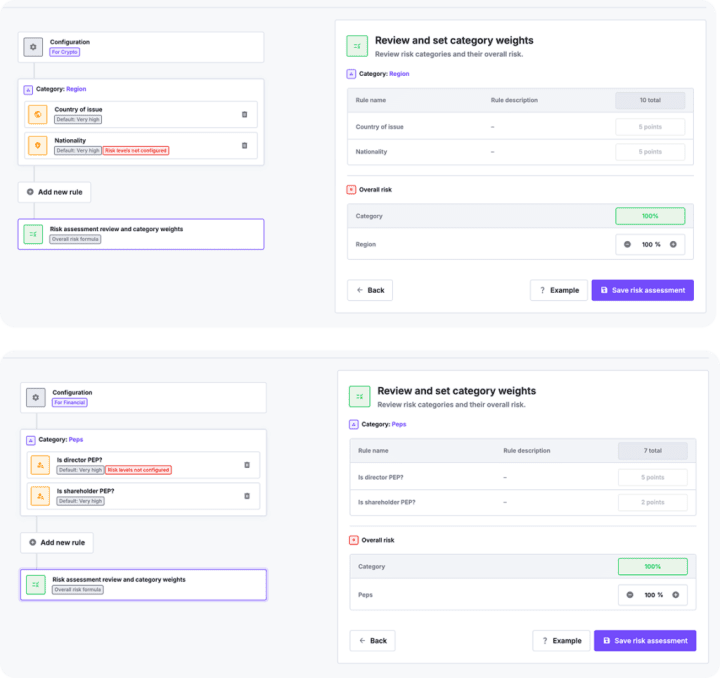
KYC Risk Assessment. Client risk scoring is essential for businesses to evaluate potential risks, prevent fraud, and ensure regulatory compliance.

The general rule is that the system calculates each category risk by its weight and sums up everything ((1 Category risk * 1 Category weight) + (2 Category risk * 2 Category weight) + (2 Category risk * 2 Category weight)…).

This means that if you have two categories – nationality data (weighted at 50%) and income data (weighted at 50%) – a person may still be assigned a high-risk status.


AML screening software capabilities

In the best AML providers coverage, we have covered the top 5 AML screening solutions and explained how each of the vendors offers PEPs, Sanctions, and Adverse media screening.

PEPs screening. The correct approach is to provide real-time PEP data and ensure that whenever new findings are available, all 4 levels are identified.

Sanction check. They have to be updated daily and should offer an option to get the source (the URL) of the found dataset. Also, filtering by specific country lists has to be configured.

Adverse media. The software has to provide options from multiple data sources and context-aware alert reports, which identify whether the company or individual in the news actually had criminal charges or perhaps the company was falsely accused.

Ongoing monitoring. After a successful identity verification process, every individual has to be checked across the sanctions and PEPs list, but they also need to be included in ongoing monitoring – with daily changes in the dashboard or Webhook notifications.

Compatibility of business verification software with KYC

Since the 5th AML directive, business verification has become an important part of the KYC process. For business, key requirements are the identification of the UBOs, verification of gathered company information across registry reports, and ongoing sanction checking of the company. There are more KYB requirements, but those are related to the correct business verification process, not necessarily to KYC. If you need to onboard both individual and corporate clients, the best fit for you is a solution that carries both KYC and KYB onboarding software capabilities under the same roof.

Mandatory features that a good KYC solution has include:

Identity verification check. There has to be an option to generate an identity verification session for all the UBOs, or even shareholders, on demand.

AML checks for individuals. KYB needs to provide an automated way to include the shareholders in the daily AML monitoring software.

Automated questionnaires. This includes a pre-made template with the ability to add custom questions and automatically send them to fill out and provide required corporate documents, no matter the industry.

AI assistant. This is a relatively new feature that should help you see alerts faster, such as red flags or information mismatches, that need to be investigated manually, but still saves time for compliance teams.


#1 iDenfy

iDenfy logo with the ranking of 4.9 out of 5 stars.

4.88 Average Score · (4.8 Capterra | 4.9 G2 | 5.0 TrustRadius | 4.8 Gartner)

iDenfy website: idenfy.com

iDenfy runs the full KYC compliance process in one place — document verification, biometric selfie matching, liveness detection, AML screening, and a 24/7 human review layer, all in a single flow. The hybrid model is the core differentiator: AI processes the session first; a trained reviewer handles anything that comes back flagged, before it ever reaches your compliance team’s queue. That’s why the verified success rate sits at 99.9% across 16,000+ document types in 200+ countries and territories. Edge cases — damaged documents, non-Latin scripts, unusual formats — don’t get auto-rejected.

Beyond the core KYC product, iDenfy provides the full compliance suite under a single contract: KYB with UBO mapping, Secretary of State API, EIN/TIN checks, and Perpetual KYB; AML screening covering PEPs, sanctions, watchlists, adverse media, and ongoing monitoring; automated Proof of Address via utility bill verification; bank account and IBAN verification; and face authentication with liveness for returning users.

KYC features of iDenfy

Supported Countries

  • 200+ countries and territories;
  • Country Block List functionality;

Document Types

  • Document types supported (passport, passport card, identity card, driving license, residence permit, visa, military card);
  • Document type allowance functionality;

Liveness Detection

  • 3D Active Liveness detection;
  • Passive Liveness detection;

Automated vs Human-Supervised ID Verification

  • Automated ID verification system;
  • Hybrid ID verification system (automated system with human supervision);

Pricing Models

  • Pay per approved ID verification;

KYC Risk Assessment

  • Built-in support with different weight adjustments.

AML features of iDenfy

PEPs screening

  • All 4 levels supported;
  • Up-to-date data;

Sanction check

  • All sanction lists supported;
  • Option to select specific lists per country;

Adverse media

  • Fuzzy matching;
  • Proprietary context-aware algorithm to reduce false positives;

Ongoing monitoring

  • Automatically included after successful verification;
  • Alerts in dashboard and API;

KYC and KYB features of iDenfy

Identity verification check

  • Create verification links and send them via email after the onboarding form is filled;

AML checks for individuals

  • Create custom rules, which will trigger AML checks for the company and individual after the onboarding form is filled;

Security and Compliance

  • ISO 27001 certified (certificate no. TIC 1512120135);
  • SOC 2 certified;
  • ETSI 119 461-1 certified;
  • GDPR compliant;
  • Cyber insurance and Technology E&O by Lloyd’s of London Coverholder;

What We Want to Highlight Specifically

The feature that separates iDenfy from every other platform on this list is the 24/7 human review layer — and specifically that it sits on the vendor’s side, not yours. When the AI flags a session, a trained reviewer handles it before it hits your compliance team’s queue. At low volumes, that’s easy to underestimate. At 10,000+ monthly verifications with a 5–10% edge case rate, it’s hundreds of manual reviews per month that you either absorb internally or pay someone else to handle. iDenfy absorbs that work as part of the standard offering.

The pay-per-approved model compounds this. Most KYC platforms bill per completed or per attempted verification — every session your fraud filters correctly reject still generates a charge. iDenfy doesn’t charge for denied sessions, abandoned sessions, or failed image captures. In a high-fraud environment where 15–30% of sessions result in rejections, that billing difference narrows the effective cost gap significantly. The iDenfy savings calculator lets you model this against your actual volumes, and also covers integration savings — roughly 80 developer hours and $10,400 in one-time development cost saved. For integration: full REST API and SDK for custom builds; Magic Link for teams that need no-code verification live in hours; and native plugins for Shopify, WooCommerce, WordPress, Bubble, Zapier, and Magento.

What Clients Say About iDenfy

G2 reviewers across fintech, iGaming, and crypto consistently highlight two things: verification accuracy and the responsiveness of the human review team on flagged sessions. A G2 reviewer from a crypto exchange noted that after switching from a different IDV provider, the false rejection rate on legitimate users dropped noticeably — and that iDenfy’s team handled integration questions faster than expected. Another reviewer running an iGaming platform flagged document coverage depth as a decision factor, specifically noting that document types from markets their previous vendor struggled with were verified without issue.

The most consistent critical theme: initial configuration — particularly risk scoring weights and country-specific rules — takes time to set up correctly. Once configured, reviewers describe the platform as largely autonomous. A Capterra reviewer summarized it plainly: “takes some upfront setup, but once live it runs itself.”

Best for: Compliance teams that need KYC, KYB, and AML under one contract — with a human review backstop that handles edge cases before they reach your internal queue. Also a strong fit for regulated businesses in fintech, crypto, iGaming, and e-commerce that need pay-per-approved billing where fraud rejection rates are high.

Back to list

#2 FOCAL

Focal logo with the ranking of 4.8 out of 5 stars.

4.60 Average Score · (— Capterra | 4.6 G2 | — TrustRadius)

FOCAL website: www.getfocal.ai

FOCAL by Mozn is an AI-powered fraud prevention and AML compliance platform built specifically for the GCC financial services landscape and beyond. Its core pitch: replace fragmented compliance tooling with a single platform that handles real-time watchlist screening, customizable risk scoring, and AML case management — without the implementation overhead that comes with most enterprise compliance vendors. For Middle East–based businesses operating under SAMA, CBUAE, or similar regulatory frameworks, FOCAL’s native understanding of regional requirements is a genuine differentiator.

Where FOCAL differs from traditional KYC platforms is in emphasis. It’s AML-first, with identity verification as a supporting capability rather than the primary flow. For businesses where database-driven AML screening is the compliance priority, that’s the right architecture. For businesses that need full document verification, liveness detection, and biometric binding as the primary mechanism, FOCAL’s capabilities in that area are thinner.

KYC features of FOCAL

Supported Countries:

  • All countries, but some products, are limited to GCC countries.

FOCAL AML Suite:

FOCAL uses advanced name matching, real-time watchlist screening, and customizable risk scoring to ensure compliance, streamline onboarding, and enhance decision-making.

Profile Screening:

  • AI Phonetics Engine
  • 1300+ Watchlists
  • Sanctions/PEP/RCA Screening
  • KYB Integration

Risk Profiling:

  • Customizable Rules
  • Customer Segmentation
  • Dynamic Monitoring
  • Build Your Own Scoring

Case Management:

  • Intuitive Dashboard
  • Logs for Auditing
  • Reporting
  • Alerts & Cases Workflows

Real-time Monitoring:

  • Supported

National ID verification:

  • FOCAL leverages its native integration with official national databases to cross-reference an individual’s ID number provided from government registries or your choice of trusted data providers, offering diverse and robust verification.

Verification Document Types:

  • Passport / National ID / Address / Commercial Registration Check

Automated vs Human-Supervised ID Verification

  • Automated verification system;

Pricing Models:

  • Per Customer

KYC Risk Assessment

  • Additional support available

What We Want to Highlight Specifically

FOCAL’s AI Phonetics Engine is the clearest example of where the platform punches above its size. Arabic name matching is a well-documented compliance challenge — transliteration produces dozens of valid spellings for common names, and basic string matching creates both false positives and false negatives at meaningful rates. FOCAL’s phonetics layer is designed for this specifically, making it more reliable than a generic name-matching engine for Middle East–centric compliance programs.

The “build your own scoring” risk profiling is also genuinely flexible. Most platforms give you preset risk categories with fixed weights. FOCAL lets compliance teams define the model — which is valuable if your risk framework doesn’t map cleanly to whatever default weighting another vendor has decided is standard. That flexibility adds setup time, but it means the scoring reflects your actual risk appetite rather than a vendor’s best guess at what that looks like.

Best for: GCC-based financial institutions and fintechs that need a deep AML compliance layer with regional database coverage and regulatory familiarity. Also a fit for businesses where AML screening and risk scoring are the primary requirements, and document capture is less central to the verification flow.

What to watch: Some FOCAL products are limited to GCC countries, which matters if your onboarding base is international. Liveness detection is not prominently advertised, and there’s no published accuracy rate or 24/7 human review layer for document verification. For businesses with a global user base that need biometric binding alongside AML screening, FOCAL’s architecture requires supplementing with a separate document and biometric verification layer.

Back to list

#3 Identomat

identomat logo

N/A Average Score (Reviews are pending)

Identomat website: https://www.identomat.com/

Identomat is an AI-powered identity verification and KYC/AML platform built for remote onboarding, biometric authentication, and fraud prevention. Its standout feature in this comparison is document coverage: 8,800+ supported document types — including all ICAO Machine Readable Travel Documents — the largest document library on this list by a significant margin. The platform covers 193+ countries, supports passive, active, and adaptive liveness detection (iBeta Level 2 certified, ISO 30107-3), and offers a hybrid model combining automated processing with human-in-the-loop review.

Identomat is newer to the market relative to Onfido or SEON, and the absence of published reviews on G2, Capterra, or TrustRadius makes independent performance validation difficult at this stage. That’s not a dealbreaker for buyers willing to run their own proof of concept, but it’s a real gap for procurement teams that rely on peer review data as part of their vendor evaluation process.

KYC features of Identomat

Supported Countries

  • 193+ countries and territories;
  • Country Block List functionality;

Document Types

  • Supported: 8,800+ documents (including all ICAO Machine Readable Travel Documents)

Liveness Detection

  • Passive, Active, and Adaptive, iBeta Level 2 certified

Automated vs Human-Supervised ID Verification

  • Automated & Hybrid (automated + human-in-the-loop)

Pricing Models

  • Pay-per-verification with volume discounts, no setup fees

KYC Risk Assessment

  • Built-in support available

AML features of Identomat

PEPs screening

  • All 4 levels supported;
  • Up-to-date data;

Sanction check

  • All sanction lists supported;

Adverse media

  • Multiple data sources;

Ongoing monitoring

  • Supported via dashboard and API;

KYC and KYB features of Identomat

Identity verification check

  • Supported only in KYC currently;

AML checks for individuals

  • Supported

What We Want to Highlight Specifically

The 8,800+ document library deserves direct attention. Most KYC platforms support anywhere between 4 and 16,000+ document types — what matters is whether the specific documents your user base presents are in the library and how well the model handles them at the edge. Identomat’s iBeta Level 2 liveness certification (as opposed to Level 1, which most platforms carry) indicates a higher bar for biometric spoofing resistance. This is relevant for regulated industries where liveness standard compliance comes up in vendor due diligence — specifically for frameworks that require demonstrable resistance to 3D mask attacks and advanced presentation attacks.

Best for: Businesses that need the widest possible document type coverage — particularly platforms onboarding users from markets where document variety is high and standard libraries come up short. iBeta Level 2 liveness certification is a differentiator for regulated industries where biometric standard compliance is a procurement requirement.

What to watch: No published reviews means no independent performance validation from real deployments. KYB is not part of the Identomat offering, so businesses that need to verify corporate clients will need a separate solution. Before committing, run a parallel proof of concept against your actual document mix — the library breadth is a genuine strength, but real-world performance across your specific geographies is the number that matters.

Back to list


#4 SEON

SEON logo with the ranking of 4.8 out of 5 stars.

4.80 Average Score · (5.0 Capterra | 4.6 G2 | — TrustRadius)

SEON website: www.seon.io

SEON is a cloud-based fraud prevention platform — and that distinction matters when comparing it to the other providers on this list. SEON’s primary capability is multi-signal fraud scoring: device fingerprinting, email intelligence, phone analysis, IP geolocation, and behavioral signals combined into a risk score that runs in real time before or alongside a verification session. It integrates with traditional KYC checks rather than replacing them. For businesses already running document verification through another provider, SEON adds a fraud intelligence layer that catches synthetic identities and high-risk sessions that document checks alone don’t surface.

What SEON does not do is provide document verification or biometric liveness detection in the traditional KYC sense. Businesses that need to comply with AMLD6, FCA identity verification standards, or FinCEN CIP requirements — where document capture and biometric binding are the compliance mechanism — are looking at a gap. SEON is best understood as a fraud orchestration layer that works alongside a KYC platform, not as a standalone compliance solution.

KYC features of SEON

Supported Countries

  • 200+ countries and territories;
  • Country Block List functionality;

Document Types

  • No information was found. Contact SEON directly;

Liveness Detection

  • No information was found. Contact SEON directly;

Automated vs Human-Supervised ID Verification

  • Automated verification system;

Pricing Models

  • Pay per completed verification;

KYC Risk Assessment

  • Built-in support available

AML features of SEON

PEPs screening

  • All 4 levels supported;
  • Up-to-date data;

Sanction check

  • All sanction lists supported;

Adverse media

  • Multiple data sources;

Ongoing monitoring

  • Supported via dashboard and API;

KYC and KYB features of SEON

Identity verification check

  • Not supported currently;

AML checks for individuals

  • Not supported currently;

What We Want to Highlight Specifically

SEON’s multi-signal fraud scoring is genuinely useful as a pre-KYC gate or a supplemental layer on top of document verification. Email intelligence — checking whether an email address is connected to real social accounts, created recently, or disposable — catches patterns that a document scan won’t surface. Device fingerprinting and IP analysis add a behavioral layer that catches session replay attacks and coordinated fraud rings. For iGaming platforms and fintech lenders running high volumes against synthetic identity fraud, this pre-verification scoring layer meaningfully reduces the share of sessions that even reach the document verification step.

What Clients Say About SEON

G2 reviewers consistently rate SEON highly on fraud signal coverage and API reliability. A G2 reviewer from a lending platform noted that SEON’s email and phone intelligence caught patterns that their previous fraud tooling missed entirely, particularly on synthetic identity submissions. The Capterra score of 5.0 reflects strong satisfaction from teams that understand what they’re buying — a fraud layer, not a compliance-grade KYC replacement.

The recurring critical theme: teams that came to SEON expecting a full KYC replacement — document scanning, biometrics, regulatory-grade identity binding — found the product didn’t cover those use cases. That’s a scope mismatch, not a product failure. If you’ve read the feature list and understood what SEON is, the reviews are broadly positive.

Best for: Businesses that already have a document verification solution and need an additional fraud intelligence layer — particularly iGaming platforms, fintech lenders, and e-commerce marketplaces where multi-signal fraud scoring on top of an existing KYC flow reduces synthetic identity fraud and account takeover risk.

What to watch: Pay-per-completed billing means rejected or abandoned sessions still generate charges — factor this in if you’re operating in a high-fraud environment. No KYB offering and no publicly documented document or liveness capabilities for regulatory-grade identity verification.

Back to list


#5 ID.me

ID.me logo with the ranking of 4.6 out of 5 stars.

4.60 Average Score · (4.5 Capterra | 4.7 G2 | 4.6 TrustRadius)

ID.me website: www.id.me

ID.me is a digital identity verification platform built specifically for the US market — and for US government–adjacent use cases in particular. It’s used by the VA, the IRS, state unemployment agencies, and a range of US federal and state programs to verify citizen identities. That government trust relationship is a real differentiator for US businesses operating in healthcare, benefits, government services, or any sector where federal identity verification standards apply. Outside of the US (and Canada, to a limited extent), ID.me is not the right tool.

The geographic restriction is not a detail to gloss over: ID.me supports only the US and Canada. For any business with a meaningful international user base, ID.me cannot be the primary KYC provider without supplementing it with a separate solution for non-US users — which reintroduces the integration complexity and dual-vendor overhead that a unified platform avoids.

KYC features of ID.me

Supported Countries

  • Supported countries are the US & Canada. For more information, contact ID.me directly.

Document Types

  • Document types supported (passport, passport card, identity card, driving license)

Liveness Detection

  • 3D Active Liveness detection;

Automated vs Human-Supervised ID Verification

  • Automated ID verification system;
  • Hybrid ID verification system (automated system with human supervision);

Pricing Models

  • Pay per completed ID verification;

KYC Risk Assessment

  • Built-in support available;

AML features of ID.me

PEPs screening

  • Supported via API;
  • The specific lists are not disclosed on the website;

Sanction check

  • Supported via API;
  • The specific lists are not disclosed on the website;

Adverse media

  • No information on the website;

Ongoing monitoring

  • Supported;

KYC and KYB features of ID.me

Identity verification check

  • Not supported currently;

AML checks for individuals

  • Not supported currently;

What We Want to Highlight Specifically

ID.me’s network of pre-verified users is the capability that’s hardest to replicate. When a user who has already verified through ID.me for one service — the VA, for example, or state unemployment — attempts to verify for another ID.me-connected organization, the re-verification friction drops significantly. For US government–adjacent businesses where your users may already be in the ID.me network, this reduces onboarding drop-off in a way that a standard document scan can’t match.

What Clients Say About ID.me

G2 and Capterra reviewers from US government–facing sectors consistently highlight the federal trust relationship — several note that government agency endorsement was a deciding factor in vendor selection — and the verification success rate on standard US document types. A Capterra reviewer from a benefits administration organization noted that ID.me’s pre-verified user network meaningfully reduces friction for returning users who have already verified elsewhere in the ID.me ecosystem.

The consistent critical theme: the US/Canada limitation is a hard wall. Reviewers from organizations that expanded internationally after initial deployment describe managing two separate KYC vendors as operationally difficult. AML coverage specifics are also flagged — the specific sanctions and PEP lists are not publicly documented, which creates transparency issues for compliance teams that need to specify their AML vendor’s coverage in regulatory submissions.

Best for: US-focused businesses in government-adjacent sectors — healthcare, benefits administration, federal program access, or any use case where federal identity verification standards and the ID.me pre-verified user network are a procurement advantage. Not the right fit for businesses with international users or those that need KYB for corporate client onboarding.

What to watch: Pay-per-completed billing with no pay-per-approved option. AML screening specifics are not publicly documented — confirm coverage details directly with ID.me before committing if AML is a hard requirement. The geographic restriction to US/Canada is a firm ceiling, not a soft limitation.

Back to list

#6 Onfido

onfido logo with the ranking of 4.1 out of 5 stars.

4.13 Average Score · (4.8 Capterra | 4.4 G2 | 3.0 TrustRadius | 4.3 Gartner)

Onfido website: www.onfido.com

Onfido is a well-established global identity verification platform, founded in 2012 and used across fintech, mobility, e-commerce, and gig economy platforms. The document library spans 195+ countries and territories with passive and 3D active liveness detection, real-time sanctions screening, and a hybrid model that combines automated verification with human review. For organizations evaluating a recognized, established name in the IDV space with a real track record at enterprise scale — Onfido belongs on the shortlist.

The TrustRadius score of 3.0 is worth addressing directly. Capterra at 4.8 and Gartner at 4.3 tell one story; TrustRadius at 3.0 tells a different one. TrustRadius reviews tend to come from more technical buyers and go into more implementation detail. The gap likely reflects friction in advanced API usage, support response consistency, or pricing transparency — the kind of things that surface after implementation, not before. Read the TrustRadius reviews specifically before committing.

KYC features of Onfido

Supported Countries

  • 195 countries and territories;
  • Country Block List functionality;
  • Custom Flows functionality;

Document Types

  • Document types supported (passport, identity card, driving license, residence permit)
  • Document type allowance functionality;

Liveness Detection

  • Passive Liveness detection;
  • 3D Active Liveness detection;

Automated vs Human-Supervised ID Verification

  • Hybrid ID verification system (automated system with human supervision);

Pricing Models

  • Pay per each ID verification;

KYC Risk Assessment

  • Built-in support available;

AML features of Onfido

PEPs screening

  • Supported via API;
  • Information is of 24-hour recency.

Sanction check

  • Supported via API;
  • Information is real-time;

Adverse media

  • No information about the algorithm and data sources on the website;

Ongoing monitoring

  • Supported;
  • Included after verification using custom flow settings;

KYC and KYB features of Onfido

Identity verification check

  • Not supported currently;

AML checks for individuals

  • Not supported currently;

What We Want to Highlight Specifically

Onfido’s Custom Flows builder is a genuine product strength. Compliance teams can configure which verification steps run, at what point, and under what conditions — without engineering work every time the flow needs to change. For regulated businesses that need to adjust friction based on user risk level or update their flow when a regulatory requirement shifts, this kind of configurability matters operationally. Most platforms require a development ticket for flow changes; Onfido does not.

What Clients Say About Onfido

Capterra reviews reflect strong satisfaction on document coverage breadth and the quality of automated verification on standard document types. A Capterra reviewer from a mobility platform noted that Onfido’s onboarding flow reduced driver identity fraud incidents meaningfully after replacing a manual review process. G2 reviewers in fintech highlight the API documentation quality and webhook reliability as operational strengths.

The critical themes are consistent across both platforms and worth naming directly. Support response times — particularly for non-enterprise accounts — come up repeatedly. Pricing transparency on volume discounts is flagged by several reviewers. The adverse media capability has no publicly documented algorithm or data sources, which creates a gap for compliance teams that need to specify AML vendor methodology in regulatory filings. The TrustRadius score of 3.0 likely reflects implementation-layer friction rather than core product failure — the pattern of high Capterra scores alongside low TrustRadius scores often signals that the product works well for buyers who implement it simply, and runs into friction for those running advanced configurations.

Best for: Established businesses in fintech, mobility, and gig economy platforms that need a recognized IDV vendor with a broad geographic footprint and a configurable no-code flow builder. Best evaluated with TrustRadius reviews read alongside G2 and Capterra to get a complete picture before procurement.

What to watch: Pay-per-each billing means abandoned and rejected sessions are charged — in high-fraud environments this adds up faster than a pay-per-approved model. No KYB offering. Adverse media coverage not publicly documented. Confirm TrustRadius concerns directly with the Onfido team if advanced API use cases are part of your implementation plan.

Back to list

Final Thoughts on Choosing the Right KYC Software

Every decision here ultimately comes down to three things: what your compliance program actually requires, what your budget can sustain at your verification volumes, and how your team will live with the tool day to day. The cheapest vendor is not the best vendor. A missed red flag, or a manual review queue that scales with your fraud rejection rate, costs more than the per-check savings that made a cheaper option look attractive in the first place.

One pattern shows up consistently in KYC vendor evaluations: teams underestimate the operational cost of platforms without a vendor-side human review layer. The per-check pricing looks clean. The edge case rate looks manageable at low volume. Both assumptions erode as volume scales. If 5–10% of your sessions are legitimately ambiguous — damaged documents, unusual formats, non-standard scripts — and they all land in your internal queue, that’s a headcount cost that doesn’t appear in any pricing comparison.

A note on scope: several platforms on this list are not full KYC solutions in the regulatory sense. SEON is a fraud orchestration layer. ID.me is US/Canada only. FOCAL’s geographic coverage is GCC-first for several products. If your use case requires global document verification, biometric binding, and regulatory-grade AML screening under a single contract, the shortlist narrows quickly. That’s not a criticism of the other platforms — it’s a scope clarification that should happen before procurement, not after implementation.

Before committing or switching to a new KYC vendor, test each shortlisted platform against your actual document mix and user geographies. Sales demonstrations use optimized scenarios. What matters is how the platform performs on the 10% of sessions that aren’t clean — the document from an unusual jurisdiction, the user on a low-end device, the session that hits the edge of the model’s training data. That’s where the real performance difference shows up, and it’s the data worth having before you sign a contract.

DISCLAIMER
This information is collected from public sources and vendor websites; it is not our final verdict or opinion. The information, in some cases, could be outdated. You should contact the vendor directly to get recent information. If there is missing information, please contact the website owner.

Frequently asked questions

1

What is KYC Software?

Arrow

Know Your Customer (KYC) software helps businesses verify the identities of their customers to comply with regulations and prevent fraud. It automates the process of collecting and validating personal information, such as IDs and other documents, ensuring that customers are who they claim to be.

2

Why is KYC Important for Businesses?

Arrow
3

What are the Top KYC Software Providers?

Arrow
4

How Do I Choose the Right KYC Provider For My Business?

Arrow
5

What is the Best KYC Software for Small Businesses?

Arrow
6

How Much Does KYC Software Cost?

Arrow
7

What's the Difference Between KYC and AML Screening?

Arrow

Save costs by onboarding more verified users

Join hundreds of businesses that successfully integrated iDenfy in their processes and saved money on failed verifications.

Image of salesmens