With thousands of identity verification service providers storming the market and promising high conversion rates, endless features, compliance in all regions, and other almost too-good-to-be-true solutions, it’s hard to decide which ones work and which ones are just marketing. Some even pre-record dashboard demos and provide perfected data, which then proves not to live up to your expectations.
Endless PDFs from Sales teams and plan packages that need to be prepaid, even though you don’t know if you’ll be able to use all credits, also directly impact and drive up Know Your Customer (KYC) verification costs. That’s why it’s only natural that businesses end up switching IDV providers as a way to improve accuracy and reduce verification time. Sometimes, in more extreme cases, to ensure security after getting fined for non-compliance, often in high-risk, highly regulated sectors like crypto or fintech.
What’s more, it’s harder to ensure a good user experience when extra documentation or extra checks are required. If something goes wrong or the user doesn’t completely understand how to pass the KYC verification process correctly, they drop off. So, in this sense, choosing the wrong ID verification vendor costs more than the switching fee.
What Does a Modern Identity Verification Solution Cover?
A proper, modern identity verification solution should offer multiple automation features and custom workflows that you could build without coding. That means the KYC platform has multiple flow options, and you take the elements that you need, creating the process that ensures compliance in your industry.
For example, for new user onboarding, you use a vendor with government-ID checks + selfie biometrics (a very common KYC process, sometimes paired with other KYC layers, like address verification, or Proof of Address verification, especially in crypto). More advanced flows also include database cross-checks, age verification, and built-in Anti-Money Laundering (AML) screening (PEPs and sanctions, and adverse media)
Beyond compliance requirements, other factors are very important. For example:
- The dashboard needs to be designed in a way that’s easy to use and could actually help analysts ease their work. That means verifications are logged, denial reasons are easily accessible, there’s an audit trail, etc.
- Preferably, there should be other built-in tools or risk signals provided together, and not just the completed/failed KYC results. This can be achieved using tools like risk scoring, which detects risk signals (such as a high-risk jurisdiction or a blocklisted IP address) and then routes the user to a different IDV workflow (low-risk users are automatically onboarded while high-risk users are either put into the manual queue or automatically forwarded to another workflow)
Automate your identity verification
See how iDenfy helps 1,000+ companies verify customers in seconds with AI-powered KYC.
Explore iDenfyMetrics That Help Assess If a KYC Solution Works
When evaluating a potential KYC solution vendor, there are core metrics that matter:
- For document verification, look at both document-dependent metrics (barcode/MRZ zone reading accuracy, security feature detection, script recognition) and document-independent ones (performance under poor lighting or low camera quality).
- For biometric verification, key indicators include false match and false non-match rates (keep in mind to watch for demographic bias, as accuracy can vary significantly across nationality and gender.
It depends on your concrete use case (budget and KYC volumes, as well as factors like your fraud rate, since typically high-risk industries like gambling or crypto need to be extremely robust, since bypassing attempts are a high probability) and what your expectations are. For example, if your volumes are still unpredictable, and you’re just establishing your startup, but regulations require KYC, a good starting point would be a pay-as-you-go pricing plan that helps avoid overpaying.
Related: Document Verification: How Does the Process Work?
What Kind of Price Should I Expect For Identity Verification Checks?
It’s hard to say the exact price, especially since there are so many KYC solutions out there. However, the average threshold for verification checks runs anywhere from $0.20 to $5.00+ per verification, depending on what kind of KYC add-ons you get (whether it’s doc-only KYC, or also biometrics or database verification, sometimes, manual in-house KYC checks on top).
A basic database lookup will often be cheaper compared to more complex flows, with elements like document surface analysis or face-matching capabilities that change the price fast.
Keep in mind that:
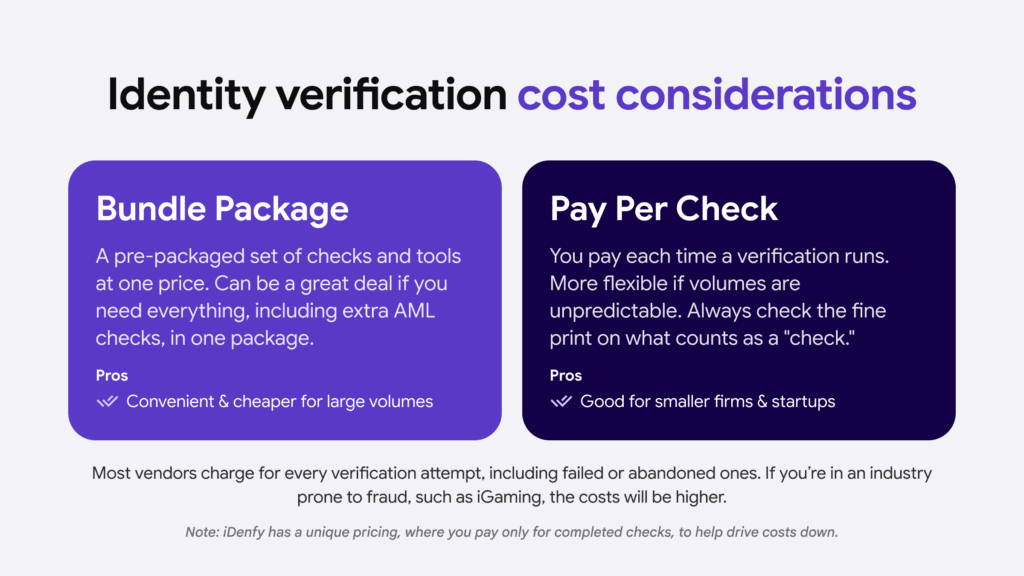
- Subscriptions are a logical decision when you’re switching verification providers or already know your IDV volume. This way, it’s easier to calculate the ROI and expected costs.
- Bundles are provided by the vendor that often have three tiers and offer credits for multiple KYC-related services. If you require specific checks, like extra AML screening or criminal background checks, review whether the KYC provider includes those specific features in their pricing plan to save money. This also helps you avoid separate licensing fees.
However, while it’s a cliché, it’s true that choosing the cheapest option (and budgeting on compliance) is not realistic if you actually need to stay compliant in all markets and prevent fraud.
Questions You Should Ask Before Jumping Into ID Verification Vendor Calls
First things first. You need to be prepared on your end and know what to look for in a KYC solution. There are a few universal questions that help to achieve this:
1. Fraud
How relevant is fraud and various techniques/attempts to bypass KYC in your business? If that’s a real issue, what are the most common techniques (forged IDs, deepakes, etc.)? There are leading indicators of fraud (such as an IP address from a sanctioned country or a blocklisted IP) that help flag a high-risk user instantly. In contrast, there are lagging indicators that are post-factum signals that the fraud has already happened (for example, a real account takeover or a chargeback). A good solution helps with both and deals with post-onboarding risk signals as well.
2. Data Storage
Will you store sensitive KYC data yourself or have the vendor handle it? Naturally, each service provider has different payment plans. Some offer a number of free verifications, or, for example, iDenfy doesn’t charge for abandoned KYC sessions (including those that failed due to poor lighting and similar conditions). Of course, an important factor is compliance standards in different regions (if you operate in multiple countries, a global KYC vendor is more suitable than multiple local solution integrations).

3. Regulations
What markets do you operate in, and what compliance standards apply to your industry? There are different KYC requirements in the US (especially, for example, if you’re dealing with different states and you’re a gambling operator, and in the EU, Asia, etc. A vendor that’s fully compliant in one jurisdiction can leave you exposed in another. Often, you need a solution that handles multi-jurisdictional compliance, making it easy for you to create different IDV workflows without having to partner with multiple vendors.
4. Demographics
How skilled are your users? And how global is the user base (perhaps you’ll plan to scale in the future)? Less tech-savvy users, such as senior citizens, struggle with KYC verification, especially if they are asked to scan QR codes, switch devices, or need to go through more manual input (like selecting the document issuing country manually vs the system detecting the location automatically). Operating in different markets means that you add challenges like document support or language complexity to your stack.
5. Success Metrics
Are you optimizing directly for conversion speed or more for fraud prevention and high-risk cases? Evaluate if high-risk cases take up more of your analysts’ time, and know what a good workflow for your particular use case looks like to ensure a fair analysis of the potential vendors. Often, a KYC vendor optimizing for conversion will tell you more details about pass rates and drop-off reduction during demo calls, while others that are more focused on fraud prevention will stress false positive/negative rates and fraud identification rates.
To make a more detailed review of each vendor, you need to have your own KPIs and expectations that would help assess if the ID verification solution matches what your analysts and risk team actually need and not just fall for impressive-sounding statistics that don’t actually speak to your business.
Related: How to Improve KYC Verification? Tips For a Frictionless User Experience
What Features Go into the Stack of a Good ID Verification Solution?
Aggressive sales pitches or the longest list of features doesn’t necessarily mean that the vendor will be a good fit for you. You want an IDV solution that won’t cause headaches (when it comes to integration) or won’t put you in debt.
Accuracy and compliance (KYC/KYB and AML) are also a must, above other factors like:
- A clean dashboard and logged results to monitor and improve KYC conversions over time.
If a verification fails, you should know why. For example, which KYC session failed, at what step (ID capture or selfie verification, for example), and what the failure reason was. Solutions that return only a pass/fail result without structured failure codes make it impossible to identify systemic issues or improve your onboarding flow. Some vendors even make it difficult to export your verification history log in a portable format, like a PDF, which creates dependency. This becomes a real problem when you want to switch vendors or need to show records for a standard regulatory audit.
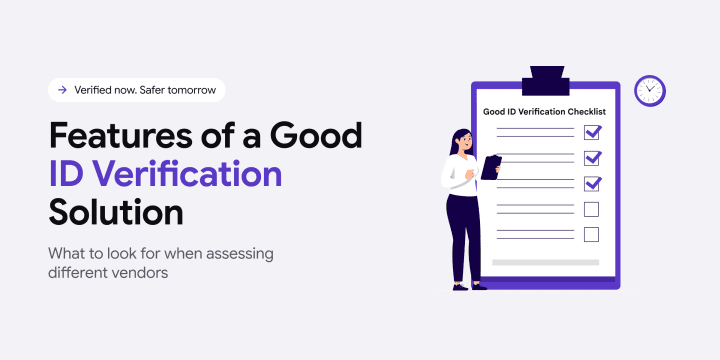
- Overall, practical checklist features that help filter out poor solutions: document coverage, dynamic/custom workflows, a clean API/documentation, proven track record with big/known brands, etc.
If you’re operating in a highly regulated industry, looking for vendors that offer in-house KYC reviews on top of edge cases might be a good idea (since it’s considered costly to have your own skilled analyst team, especially dedicated directly to ID verification only). That said, keep in mind that not every firm needs this approach. Manual re-checks can slow down your customer onboarding and then increase drop-offs, especially in low-risk scenarios where genuine users are waiting in the queue.