The metaverse – a digital world that blends physical and virtual realities – is transforming how we work, connect, and do business online. With all the excitement comes real challenges, like keeping our identities and assets secure and, most importantly – earning users’ trust. There is a way to address these issues in the metaverse, and it is through Know Your Customer (KYC), a reliable and fast process that checks user identities to prevent financial crimes and keep the system safe.
So, why is KYC so important for the metaverse? Let’s discuss why it matters, its difficulties, and how organizations can implement solid KYC practices.
What is the Metaverse, and Why Does KYC Matter?
The metaverse is a substantial digital domain into which users can enter with their avatars and conduct multiple activities, such as socializing, playing games, shopping, attending work, and with the help of Virtual Reality (VR), Augmented Reality (AR), and blockchain technologies, it offers new features and opportunities for citizens and companies to engage in all kinds of digital interactions.
Major corporations are investing billions in developing their metaverse presence, fully realizing its potential to transform digital experiences.
Most transactions within the metaverse involve digital assets or some cryptocurrencies, so it makes the virtual worlds more vulnerable and increases cryptocurrency crimes, as well as making virtual worlds an easy target for cybercriminals.
KYC exists to confirm that people are who they claim to be – keeping fraudsters out and giving everyone else a safer environment to operate in.
Related: A Definitive Guide on KYC for Crypto [Updated]
Automate your KYC process
iDenfy verifies customers from 200+ countries in seconds. AI-powered, compliant, and trusted by 1,000+ companies.
Explore KYC SolutionChallenges of Implementing KYC in the Metaverse
The metaverse wasn’t built with verification in mind. Anonymity is part of the appeal, the infrastructure is decentralised, and the regulatory framework is still being figured out. That combination makes KYC genuinely difficult to implement. Here are some of the main obstacles:
Pseudonymity and User Privacy
The metaverse is built on the idea of anonymity and pseudonymity; people love the freedom of exploring virtual worlds without revealing their real identities, but there’s one tricky part: applying KYC protocols requires users to verify who they are to prevent fraud and finding the right balance between privacy and security, and it isn’t that easy. Metaverse platforms must determine how to respect user privacy while ensuring proper verification.
Decentralized Systems
Many metaverse platforms run on decentralized networks, a big part of blockchain technology’s work. Because these networks are decentralized, making a single KYC standard is challenging. Instead of having one central authority in charge of KYC, users may have to deal with different verification protocols depending on their platform.
Regulatory Uncertainty
The metaverse is still pretty new, and regulations haven’t entirely caught up with how fast it’s growing. Many places don’t yet have specific virtual spaces or rules for digital assets. This gray area makes it challenging for businesses to follow KYC regulations to figure out this landscape. The lack of clear guidelines can lead to inconsistent implementation and confuse users.
Technological Integration
People come to the metaverse for seamless, immersive experiences – stopping to upload documents or wait for identity checks doesn’t fit that expectation. The technical challenge is real: verification processes that work fine on a banking app feel jarring in a virtual environment. Platforms need to find ways to run those checks without pulling users out of the experience entirely.
Related: How to Improve KYC Verification? Tips For a Frictionless User Experience

Why KYC Matters for Businesses in the Metaverse
Companies looking to enter this rising digital world must know that KYC isn’t just about following the rules but creating a trustworthy ecosystem. Here’s why KYC is so important for businesses in the metaverse:
Building Trust Among Users
People stick around on platforms where they feel secure. When users know who they’re dealing with – and know that others have been verified too – it changes how they engage. That sense of accountability is what turns a platform into a community.
Fraud and Financial Crime
The same anonymity that makes the metaverse attractive also makes it an easy environment for fraud and money laundering. KYC is the first real checkpoint – it introduces accountability where there otherwise isn’t any, and makes it significantly harder for bad actors to operate undetected.
Keeping Up With Regulation
Regulators are paying more attention to the metaverse, and formal requirements are coming. Businesses that have KYC infrastructure in place now won’t be scrambling when those rules land – they’ll already be compliant, or close to it.
User Experience
KYC has a reputation for slowing onboarding down, and historically, that’s been fair. But modern identity verification tools have closed that gap considerably. Done well, it doesn’t have to feel like a hurdle – users get through faster, and the platform stays secure without making people jump through hoops to get started.
Related: How Identity Verification is Helping Combat Cryptocurrency Crimes
Critical Strategies for Effective KYC in the Metaverse
We could say that the “magic” formula for effective KYC in the metaverse, considering its challenges, would involve an intelligent balance between what is private, secure, and compliant. Achievable by leveraging innovative strategies that can help build trust within a secure environment. Here are the key strategies for an effective KYC in the metaverse:
Decentralized Identity (DID)
Decentralized identities – DIDs – are one of the more practical answers to this problem. Built on blockchain, they give users a verifiable digital identity without handing control of their personal data to a platform. You get the compliance piece without the privacy trade-off.
Biometric Verification
Facial recognition and fingerprint scanning add a layer of security that’s hard to fake and doesn’t ask much of the user. For the metaverse, where traditional identity checks are harder to enforce, biometrics fill that gap well. The technology has also matured to the point where integrating it into virtual platforms is no longer the technical lift it once was.
Working With Regulators
The regulatory picture around the metaverse is still taking shape, which creates real uncertainty for businesses trying to stay compliant. One way to get ahead of that is to engage with regulators directly rather than waiting to see what lands. When businesses and policymakers work through these questions together, the resulting guidelines tend to be clearer and more practical – better for compliance, and less disruptive for users.
Reputation-Based Frameworks
In a decentralized metaverse, sticking only to static KYC checks can soon fall short, since identities tend to shift and user activities often stretch across multiple platforms. Reputation frameworks provide a stronger option here. Instead of handling KYC as just a single verification step, such frameworks see identity as an ongoing process, shaped and confirmed by what users actually do over time. Each action – whether it is completing a purchase, taking part in a community event, or adding to a Decentralized Autonomous Organization – helps build a digital reputation score. This score works like a transferable mark of trust, showing how reliable someone is in different virtual contexts. It is similar to the way credit scores help establish financial trustworthiness in the metaverse; reputation systems could play that central role for digital interactions.
Bringing in reputation portfolios, platforms can evolve from strict compliance rules to more responsive and context-based ways of building trust. Those with a reliable history of positive, verified engagements might find smoother entry points, faster processing, and lighter regulatory requirements. Anything suspicious, on the other hand, would bring the score down – triggering extra security steps or restrictions on what the user can do. Over time, the system starts to regulate itself. Good behavior is reinforced, problems get flagged early, and the burden on whoever’s running the platform is considerably lighter. The bigger effect, though, is cultural. When people know their actions have consequences within the community, they tend to think twice. It stops being about rules imposed from outside and becomes something closer to a shared standard that people actually buy into.
How Automation is Transforming KYC in the Metaverse
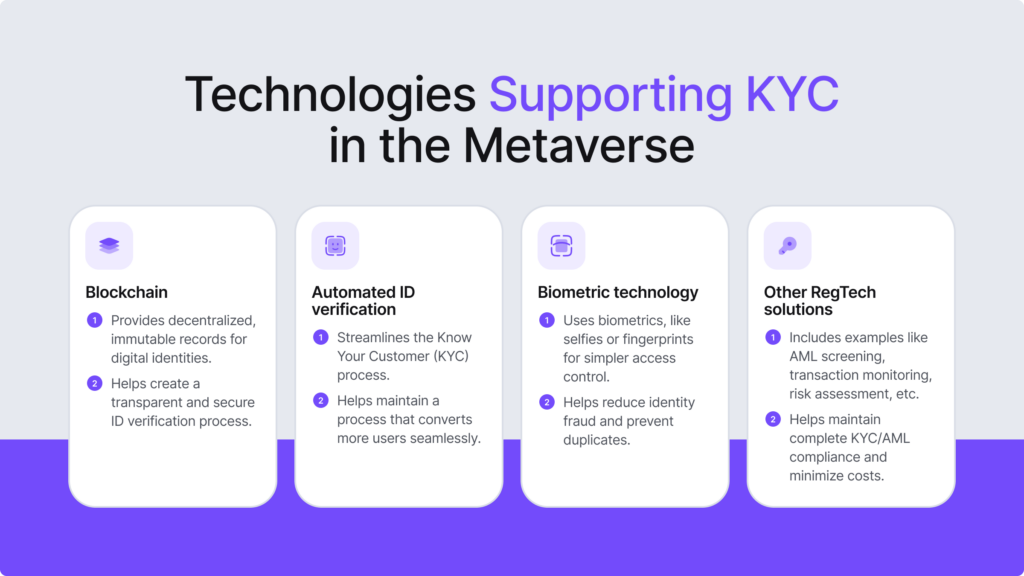
Thanks to new technologies, the metaverse is evolving fast. Blockchain-based decentralized identities, AI-driven risk analysis, and biometrics are all helping to create a safer and more trustworthy virtual world.
Blockchain handles identity verification in a way that’s decentralized and difficult to tamper with. AI picks up on high-risk behavior that would otherwise slip through. Biometrics – facial recognition and the like – make the verification process faster without sacrificing security. None of it works in isolation, though. Getting the metaverse to a place where it’s both safe and worth being in requires businesses, users, and regulators to actually work together, not just alongside each other.
The future of the metaverse is exciting, with a high potential for both users and organizations. With the great possibility for opportunities, challenges exist, and one of the most critical is trust and security. KYC has become one of the significant tools in the metaverse, and with it, it will be a secure place for all users. Through verification, organizations can keep users safe, prevent fraud, and build trust so virtual communities can enjoy it without obstacles.
Related: KYC Verification [3 Main Components & More]
Conclusion
To effectively implement KYC in such a singular environment, you need a thoughtful approach that balances security against user privacy, integrates new technologies, and anticipates regulations. Decentralized identities, biometric verification, and cross-platform KYC standards are fine solutions for creating a secure digital world without sacrificing users’ immersive experience.
Collaboration will be necessary as the metaverse rises. Organizations, users, and regulators must join hands in developing effective yet user-friendly solutions. Sort these problems out, and the metaverse delivers on what it promises – a digital space that’s actually worth being in.
Book a free demo to see how iDenfy handles identity verification.