This guide compares the top KYB software providers for 2026, covering topics like business registry coverage, UBO identification depth, AML screening integration, AI agent/automation workflows, questionnaires, risk scoring, API flexibility, and pricing models. Review it to find the right Know Your Business (KYB) solution for your concrete use case, based on your onboarding volume, budget and operating markets.
| # | Provider | G2 | Capterra | TrustRadius | Gartner | Average |
|---|---|---|---|---|---|---|
| 1 | iDenfy | 4.9 | 4.8 | 5.0 | 4.8 | 4.88 |
| 2 | Vespia | 5.0 | — | — | — | 5.00* |
| 3 | Persona | 4.8 | 4.5 | — | — | 4.65 |
| 4 | Sumsub | 4.5 | 4.7 | — | — | 4.60 |
| 5 | Middesk | 4.4 | 4.3 | — | — | 4.35 |
Last updated:
* Vespia score is G2 only (limited review volume). Rankings reflect feature coverage, compliance depth, and available review scores.
Notable Mentions
| # | Provider | What They’re Known For |
|---|---|---|
| 6 | ComplyAdvantage | Financial crime intelligence platform with real-time sanctions, PEP, and adverse media data. Strong in AML-layer KYB for financial institutions. Proprietary risk database updated every 15 minutes. |
| 7 | Dotfile | KYB-first platform for automating AML procedures and cutting business onboarding friction. Good fit for fintechs and regulated marketplaces that need a lightweight solution up and running fast. |
KYB Software Feature Comparison (2026)
Side-by-side feature breakdown of the top KYB software providers.
| Feature | iDenfy | Vespia | Persona |
|---|---|---|---|
| Supported Countries (Registry) | 180+ company registries, 120+ countries | 100+ countries | Global (varies by country) |
| UBO Identification | ✓ (full ownership structure) | ✓ | ✓ |
| Automated Company Data Crossmatch | ✓ (AI-powered discrepancy detection) | ✓ (AI-driven) | ✓ |
| Registry Document Verification | ✓ | ✓ | ✓ |
| KYC for UBOs / Directors | ✓ (auto-triggered on form fill) | ✓ | ✓ |
| AML Screening for Company + UBOs | ✓ (sanctions, PEPs, adverse media) | ✓ | Via integrations |
| Ongoing AML Monitoring | ✓ (dashboard + webhook) | ✓ | Contact Persona |
| Automated Questionnaires | ✓ (custom templates, auto-send) | ✓ | ✓ |
| Risk Assessment / Scoring | ✓ (weighted custom categories) | ✓ | ✓ |
| AI Company Report | ✓ (AI-generated summary) | ✓ | ✗ |
| Perpetual KYB (pKYB) | ✓ | ✓ | Contact Persona |
| API + SDK | ✓ | ✓ | ✓ |
| No-Code / Low-Code Integration | ✓ (Zapier, magic link) | Contact Vespia | ✓ |
| ISO 27001 + SOC 2 | ✓ | ✓ | ✓ |
| Cyber / E&O Insurance | ✓ (Lloyd’s of London) | No public info | No public info |
| Pricing Model | Pay per approved (KYC-integrated) | Custom quote | Custom quote |
| Feature | Sumsub | Middesk |
|---|---|---|
| Supported Countries (Registry) | 220+ countries (IDV); KYB coverage varies | US-focused |
| UBO Identification | ✓ | ✓ |
| Automated Company Data Crossmatch | ✓ | ✓ |
| Registry Document Verification | ✓ | ✓ |
| KYC for UBOs / Directors | ✓ | Via integrations |
| AML Screening for Company + UBOs | ✓ | ✗ |
| Ongoing AML Monitoring | ✓ (workflow builder) | ✗ |
| Automated Questionnaires | ✓ | ✓ |
| Risk Assessment / Scoring | ✓ | ✓ |
| AI Company Report | ✗ | ✗ |
| Perpetual KYB (pKYB) | ✓ | Contact Middesk |
| API + SDK | ✓ | ✓ |
| No-Code / Low-Code Integration | ✗ | ✗ |
| ISO 27001 + SOC 2 | ✓ | ✓ |
| Cyber / E&O Insurance | No public info | No public info |
| Pricing Model | Pay per completed ($1.35/check) | Custom quote |
The market for Know Your Business software has become saturated, with many solutions that, at first glance, provide similar flows and features. However, agentic AI and the changes in expanding regulatory requirements have set some clear industry leaders. Now, having an automated KYB process is not enough. The dashboard needs to be simple, customizable, and features like automated questionnaires for faster corporate document collection are no longer a nice-to-have, but an absolute must.
Where compliance teams once relied on manual registry lookups and spreadsheets, they now expect KYB onboarding software to handle company data collection, UBO mapping, AML screening, and risk scoring in a single automated flow. The KYB vendors listed in this review represent the strongest options this year, evaluated across the criteria that matter most in a real compliance environment: registry coverage, UBO depth, AML integration, and how well the tool actually handles different edge cases, such as opaque ownership chains, cross-border structures, or clients coming from high-risk jurisdictions.
Criteria for Comparing KYB Providers
Not all KYB tools work the same way. We looked at whether each one covers the core requirements — not just the basics, but the parts that matter in a real audit. A check that misses an ownership layer or runs on stale registry data isn’t just incomplete; it’s a compliance risk.
The core requirements for any business verification flow:
- Company information collection with necessary documents uploaded;
- Identifying UBOs and the full ownership structure;
- AML screening and ongoing monitoring for UBOs;
- KYC verification for company representatives and shareholders;
- Record keeping for audit purposes;
- Cross-checking submitted data against official registry documents or credit bureau records;
Because an automated KYB tool can approve a company that your manual process would have flagged, the vendor needs to be reliable — not just fast. Speed without accuracy creates regulatory exposure. Choosing between the best KYB providers ultimately comes down to fit. A fintech onboarding hundreds of SMEs per week has different needs from a bank running EDD on a handful of high-value corporate clients each month. The best KYB providers will offer configurable workflows that adapt to both scenarios (rather than forcing compliance teams to work around a rigid product).
Beyond the basics, compliance teams usually want:
- A risk scoring tool with configurable thresholds — by country of incorporation, industry, UBO nationality, or other factors your framework uses;
- An automated data crossmatch that checks what the client submitted against the official registry and surfaces the gaps;
- Perpetual KYB (pKYB) — alerts when a monitored company changes ownership or gets added to a watchlist, without re-running the check manually;
- Automated questionnaires — templates customisable per client type, sent automatically, with responses stored in the verification record.
A strong KYB software continuously monitors corporate registry and risk-data changes across jurisdictions (especially if you operate in different markets, the US alone has different databases for each state) and generates proper real-time alerts when AML hits are found, or changes (often, custom-tailored, based on your workflow or pre-made industry templates) occur.
The difference operationally is enormous. So, instead of re-reviewing every account periodically, compliance teams can prioritize extra reviews based on actual risk events with a good KYB vendor. For example:
- Status changes
- Director changes
- Ownership modifications
- Adverse media findings
- Sanctions exposure updates
- Registry dissolution notices
When evaluating KYB vendors, also check whether the tool supports your specific jurisdictions out of the box, since registry coverage gaps in key markets often only surface after a contract is signed. And consider whether you need standalone know your business software or a platform that unifies KYB with KYC and AML in a single dashboard. That’s because switching tools mid-workflow is far more disruptive than getting this decision right upfront.
KYB Compliance Requirements
The rules differ by region, but all follow standard recommendations like those provided by the Financial Action Task Force (FATF).
- EU (AMLD5/AMLD6): UBOs at 25%+ ownership must be identified and verified against official registers. Ongoing monitoring is mandatory. AMLD6 added personal criminal liability for compliance officers.
- US (Corporate Transparency Act (CTA)): Most US companies must now report beneficial owners to FinCEN — including millions that had no such obligation before.
- UK (MLR 2017 + ECCT Act 2023): CDD required on all business clients, UBOs verified via Companies House. The 2023 Act tightened what Companies House actually verifies, making registry data more reliable than it was.
- Crypto / VASPs: Under the Crypto Travel Rule and MiCA (EU, effective 2026), VASPs must apply KYB to business counterparties, not just individual users.
What to Look for in a KYB API
Finally, consider whether the KYB onboarding software you choose can grow with your compliance program and is actually easy to use (and, at the same time, supports the essence of KYB from the end-user’s side, which is a fast and smooth onboarding process). From a vendor perspective, many APIs advertise coverage numbers and registry access. But operationally, compliance teams care about something much simpler: does this API reduce investigative work, or create more of it?
Before committing to a KYB provider, ask if they offer:
- Registry coverage and update frequency — How many countries, and how fresh is the data? Stale registry data causes false positives and manual review backlogs.
- UBO depth — Does it trace through parent companies, subsidiaries, and trusts, or only return direct shareholders?
- Webhook alerts — When a monitored company gets sanctioned or changes ownership, does the system push an alert, or do you poll for it?
- Questionnaire support — Can you send onboarding questionnaires via the API and receive responses programmatically?
- Combined KYB + KYC — Can the same API trigger both company verification and individual UBO checks, or do those need separate integrations?
A good KYB API should:
- Standardize fragmented registry data
- Surface ownership risks clearly
- Support ongoing monitoring, not just onboarding
- Produce consistent outputs across jurisdictions
- Help analysts make faster, defensible decisions
- Reduce manual work for analysts (approx. 40 hours per week, if the volumes are huge)
That means supporting new jurisdictions, additional screening layers, and evolving regulatory requirements without requiring a full integration rebuild each time the rules change.
How We Evaluated All Listed KYB Vendors
Our ratings are based on other reviews and legitimate comments about what users say when evaluating each KYB software. We gathered sources like G2, Capterra, TrustRadius, and Gartner Peer Insights, based on published reviews as of May 2026. A dash indicates no published reviews were available on that platform at the time of review. However, the rankings are not based on ratings alone; we comment on each feature and its coverage based on what analysts need most when using KYB automation.
#1 iDenfy

#1 iDenfy
4.88 Average Score · (4.8 Capterra | 4.9 G2 | 5.0 TrustRadius | 4.8 Gartner)
iDenfy runs the full KYB process in one place — business verification, UBO mapping, KYC on individuals, AML screening, and ongoing monitoring, all in a single flow. In contrast, most KYB tools are modular by design. That means you get business verification here, KYC somewhere else, and AML monitoring integrated yet again from another third-party vendor. The platform connects to 180+ company registries across 120+ countries, pulling real-time data directly from government and credit bureau sources. The AI Company Data Crossmatch checks what the client submits against registry data and flags the gaps.
Key KYB Features
- Business verification across 180+ company registries in 120+ countries
- Full UBO ownership graph, including multi-layer structures
- Company Data Crossmatch — automated discrepancy detection against live registry data
- AI-Generated Company Report — structured verified entity summary produced at case close
- Automated questionnaires and KYB workflows with custom templates, auto-sent to company representatives
- Auto-triggered KYC verification for all related company individuals and shareholders on form submission
- Built-in AML screening (sanctions, PEPs, adverse media) for the company and all connected individuals
- Perpetual KYB (pKYB) with dashboard alerts and webhook notifications
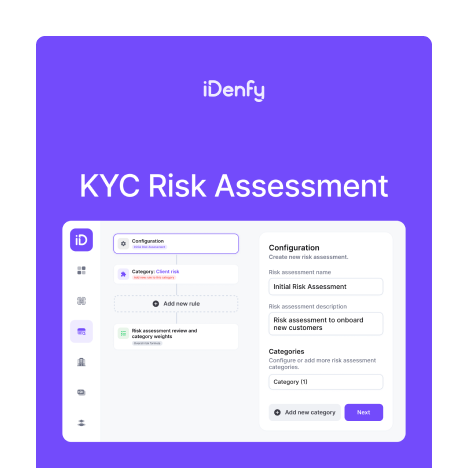
- Weighted risk assessment with configurable category thresholds
- EIN/TIN verification and Secretary of State (SOS) Search for US businesses
- ISO 27001 + SOC 2 certified, GDPR compliant, cyber and E&O insurance underwritten by Lloyd’s of London
Best for: Compliance teams that need KYB, KYC, and AML in one place — and don’t want to revisit vendor selection the next time a regulator adds a new requirement. Also a strong fit for businesses onboarding US & EU/UK entities alongside international ones, given the native EIN/TIN and SOS search support.
What We Want to Highlight Specifically
One feature that genuinely stands apart from the other providers on this list: the AI-Generated Company Report. At the end of the verification process, iDenfy produces a structured entity summary (which includes an ownership graph, screening results, and found risk flags), provided by the system automatically after it uses AI to run through large volumes of datasets. It’s the kind of document that used to require a compliance analyst to pull together manually. If the registered address doesn’t match, if a director is missing from the submission, or if the ownership percentage doesn’t add up, iDenfy’s KYB software shows these risk signals before a compliance officer even opens the case. All comments by analysts are logged and provided for all analysts working on the case to see.
iDenfy maps multi-layer UBO chains, including parent companies and subsidiaries, and automatically triggers KYC verification for each identified UBO and director the moment the company form comes in. If ownership changes or the company or any of its UBOs appear on a new sanctions list, your team gets a dashboard alert or a webhook. That means no manual re-checking required. For US-incorporated businesses specifically, EIN/TIN verification and Secretary of State (SOS) Search are available as part of the same workflow. AML screening (sanctions, PEPs, adverse media and global watchlist checks, including extra features, like a Criminal Background Check) runs in parallel for both the company and all connected individuals.
Integration Specifics
Integration is available via API, dashboard, or a no-code application connection for teams without engineering resources. Starting package prices are cheaper than most vendors (for example, 6k vs 3k for the same features on iDenfy’s dashboard). Integration documentation is provided with full support from iDenfy’s account managers.
Read the documentation here.
#2 Vespia
5.00 Average Score · (5.0 G2 | Reviews pending on Capterra and TrustRadius)
Vespia website: vespia.io
Vespia is an AI-powered KYB platform built for companies verifying business clients at scale. It covers company data collection, UBO mapping, document verification, and AML screening. Its G2 score is 5.0, but review volume is still low — take that number with context. It’s a good fit for fintechs, crypto platforms, and B2B marketplaces that need multi-country KYB without building their own verification stack. The G2 score is 5.0, but that’s based on two reviews (both positive, both from small businesses).
Vespia is a genuinely strong KYB platform. Vespia’s commercial register coverage spans 300+ jurisdictions (broader than most vendors on this list), and it returns registry data in seconds. That volume and efficiency are the primary reasons fintechs, crypto platforms, and B2B marketplaces (with heavy cross-border onboarding volume, which is a plus for KYB compliance). The AML layer screens all connected entities automatically and applies smart filtering to reduce false positives (a practical detail that matters when you’re running high-volume onboarding and don’t want to create a manual review queue out of noise).
Update: There’s an important context note before getting into the product: Veriff announced the acquisition of Vespia in 2025. As of now, Vespia is still operating independently under its own brand and platform, but the product roadmap, pricing, and support structure are expected to shift as the integration progresses. If you’re evaluating Vespia seriously, confirm directly with their team what changes are planned and on what timeline. Veriff is currently a new player in the KYB field and is more known for its KYC solutions.
Key KYB Features
- Full UBO identification and ownership mapping
- Customizable onboarding flows and questionnaires
- Business verification and registry data returned in under 30 seconds
- KYC verification — 7,000+ document types, 190+ countries, with liveness detection for high-risk cases
- AML screening across 4,000+ sanctions, PEP, and adverse media lists for all connected entities
- Smart false-positive filtering on AML screening
- Ongoing AML monitoring with real-time alerts on ownership and sanctions changes
- Risk scoring and case management
- Audit-grade PDF export — full case log including registry extracts, screening results, and analyst notes
- API-first architecture; white-label web SDK available
- ISO 27001 + SOC 2 certified
What Clients Say About Vespia
One reviewer from a marketing and advertising firm noted the platform solved exactly the foreign client sanctions problem they needed, but flagged that user manuals could be improved; the account manager support smoothed that over. Another reviewer from a law practice praised having all the necessary information in one place, but noted the feature depth was initially overwhelming before onboarding support clarified the workflows.
What Vespia does better than almost anyone else in this space is continuous monitoring after onboarding. When ownership structure changes or a sanctions hit comes in for a monitored entity, the system pushes an alert. Most KYB tools treat onboarding as a one-time gate; Vespia was designed from the start with the assumption that the post-onboarding risk monitoring is just as important as the initial check.
What to watch: Pricing is not publicly listed (requires a sales conversation). US-specific data depth (credit bureau, EIN/TIN, SOS) is thinner than that of other vendors, including the previously mentioned iDenfy. Additionally, the Veriff acquisition means the product direction over the next 12–24 months is still settling. That’s not a dealbreaker, but it’s worth factoring in if you’re signing a longer contract.
Best for: Fintechs, crypto platforms, and financial institutions that need unusually broad jurisdictional registry coverage, especially for markets that most KYB providers deprioritize, and that onboard complex multi-layer corporate structures as a routine part of their business, not an edge case.
#3 Persona
4.65 Average Score · (4.8 G2 | 4.5 Capterra)
Persona website: withpersona.com
Persona handles both identity and business verification. It’s a major industry player, used across companies from early-stage startups to large platforms. Gartner placed it first for “Ability to Execute” in their inaugural Magic Quadrant for Identity Verification, which the company greatly advertised, along with other rewards and a bunch of big players that they have partnered with. Generally speaking, it’s one of the more established names in this blog post and has real institutional weight behind it, with companies like OpenAI or LinkedIn.
Key KYB Features
- Business verification across global registries, 200+ countries and territories
- UBO identification and ownership structure mapping
- Unified KYB + KYC flow — company and individual verification in the same workflow
- No-code configurable workflow builder — compliance teams can modify logic without engineering
- AML screening
- Document collection and verification
- Fraud signals and link analysis to surface connected fraud rings across accounts
- Case management dashboard with customizable review workflows and audit trails
- SAR/STR filing support directly from the case management interface
- Risk scoring with configurable thresholds
- Easy API integration
- SOC 2 Type II, ISO 27001, GDPR, HIPAA, PCI-DSS, and iBeta ISO 30107-3 liveness certified
The workflow builder is genuinely no-code in practice. Compliance teams can configure verification steps, adjust friction based on risk level, and modify the process’s logic when a regulation changes (or whenever needed) without spending hours on implementing the changes.
What Clients Say About Persona
Good developer documentation and clean no-code flow setup are where it stands out. AML screening isn’t native. It comes via third-party integrations, so factor that in if AML is a hard requirement. For KYB specifically, Persona’s primary advantage is how tightly it unifies business and individual client onboarding tasks.
Rather than treating KYB as a separate module, the platform runs company verification and UBO identity checks in a single orchestrated flow. For example, this combined KYB-KYC approach is exactly what converted one G2 reviewer who described it as the deciding factor: “The pairing of KYC and KYB in one system is what really sold us on Persona.”
Its client list reflects how broadly the platform is deployed: Etsy, Twilio, Square, Reddit, Ripple, etc. use Persona, mainly for their KYC checks. That level of volume across marketplaces, fintechs, infrastructure companies, and consumer platforms means the platform is widely tested across use cases that are genuinely different from one another, not just variations of the same KYB onboarding flow.
What Requires Closer Attention
Pricing isn’t publicly listed, but the general narrative is that Persona is more on the costly side, especially due to the list of their partners, with giants like OpenAI. So, several reviewers flag cost as a consideration once volume scales. However, one Capterra reviewer noted that switching from Stripe Identity improved verification success rates noticeably, yet pricing lands “around the market standard.”
What to watch: Pricing requires a sales conversation. Teams without a compliance engineer should budget setup time before go-live.
Best for: Mid-size to enterprise companies that need unified KYB and KYC at scale, operate across complex multi-geography onboarding flows, and want enough configurability to adapt workflows themselves.
#4 Sumsub

4.60 Average Score · (4.7 Capterra | 4.5 G2)
Sumsub website: www.sumsub.com
Sumsub runs both KYC and KYB through the same workflow builder, which is useful if you want one dashboard for both processes. Yet, based on our list, every provider has this duality on their KYB platform. Sumsub covers 220+ countries, processes 50,000+ verifications daily, and includes AML screening natively. One thing to factor in: pricing is per completed check, including rejected ones. If your KYB rejection rate is high, costs add up faster than with a pay-per-approved model. Its KYB names include Bybit, Bitpanda, DiDi, TransferGo, etc. For companies already in the fintech or especially crypto compliance conversation, Sumsub comes up constantly.
When registry data isn’t available, Sumsub’s in-house compliance team manually reviews corporate documents from 140+ countries, with an average turnaround of 15 hours. That fallback matters more than it sounds — anyone who has tried to verify a business registered in a smaller or less-digitized jurisdiction knows that automated registry checks frequently come back empty, and having a human layer that doesn’t require you to handle the escalation yourself.
Key KYB Features
- Business verification across 220+ countries; 500M+ commercial records, registry check in ~15 seconds
- Ownership and control check across 345M+ shareholder records
- UBO verification in under 30 seconds
- Corporate Documents Review feature, powered by Sumsub’s in-house compliance team (140+ countries, ~15 hours average turnaround) for cases where registry checks return no data
- Customizable KYB workflow builder — configure per country, risk tier, entity type, etc.
- Document collection and automated data extraction with cross-registry validation
- AML screening (sanctions, PEPs, adverse media, the whole deal) for the company and its connected individuals
- Ongoing monitoring with configurable workflow rule triggers and periodic rechecks by risk level
- Transaction monitoring (with a special focus and a solution for Travel Rule compliance designed for crypto entities and VASPs)
- Risk assessment and scoring
- Customizable questionnaire analysis for additional due diligence
- SOC 2, ISO 27001, GDPR compliant; follows FATF recommendations and local requirements, including FINMA, FCA, CySEC, MAS, BaFin
The KYB flow runs alongside KYC in the same workflow builder, AML screening is native, and transaction monitoring is part of the broader platform. For crypto platforms and VASPs that need Travel Rule compliance on top of KYB, Sumsub covers that in the same contract. That’s the practical case for Sumsub over more specialized tools: if your compliance stack has multiple overlapping requirements, fewer vendor contracts is worth something.
What Clients Say About Sumsub
Reviews across G2 and Capterra are broadly positive on the product itself. A Capterra reviewer running B2B onboarding at a telecom company described the platform as the operational “heart” of their business — their entire 15-minute customer sign-up promise only holds up because Sumsub’s automated verification doesn’t create a queue. Another reviewer noted Sumsub’s Workflow Builder runs essentially on autopilot once set up, and that documentation quality, specifically webhooks and sandbox reliability, was useful and strong for developers.
The recurring critical themes, which show up consistently across both platforms, are specific: support response times slow down for non-enterprise accounts during high-demand periods; pricing transparency on custom volumes can be a bit limited. One G2 reviewer put it like this: “A bit pricey but does what it promises.” In this context, you also need to keep in mind that Sumsub also has minimum KYB monthly commitments.
What to watch: Support quality scales with account tier, so confirm your SLA before go-live if you’re not on an enterprise plan. Some clients have pointed out that advanced API features have documentation gaps.
Best for: Fintechs, crypto exchanges, neobanks, and regulated platforms that need KYC, KYB, AML, transaction monitoring, and Travel Rule compliance under one contract. Less ideal for compliance teams where KYB rejection rates are high and predictable, per-approved billing matters more than a bunch of features in one place.
#5 Middesk
4.35 Average Score · (4.4 G2 | 4.3 Capterra)
Middesk website: www.middesk.com
Middesk does one thing better than any other KYB platform on this list, and that, ladies and gentlemen, is US business verification. It was purpose-built for it, and the infrastructure reflects that. Middesk has direct connections to all 50 Secretary of State offices (however, iDenfy also has the SOS Search feature), the IRS records, and additional federal and state government agencies — meaning it pulls authoritative, primary-source data on 100% of registered US businesses. This is different from aggregated data taken and implemented from third parties.
For example, when a US-registered company submits its EIN and business name during onboarding, Middesk cross-checks it against government records and returns verification status, legal name, registration details, formation documents, good standing status, UBO information, and OFAC screening, without the applicant uploading a single document. For those whose client base is predominantly US businesses, that zero-document-upload architecture materially reduces onboarding drop-off.
Key KYB Features
US business verification via direct connections to all 50 Secretary of State offices and the IRS (covers all registered US businesses)
- Business credit and financial health data
- UCC lien history, bankruptcy, and litigation flags
- Licensing and good-standing status by jurisdiction
- Risk assessment and business scoring
- Automated company data retrieval
- EIN/TIN verification and tax registration status
- UBO identification and ownership structure mapping
- AML screening
Over 500 customers trust Middesk, including two of the three largest US banks, 100+ regional banks and credit unions, and names like Plaid, Bluevine, Rippling, and Novo.
What Clients Say About Middesk
A TrustRadius reviewer described Middesk as the most straightforward way for financial services companies to verify and monitor business customers, specifically noting how much time it saved on onboarding automation and CIP compliance — while flagging that the UI could be more intuitive and that login workflows could be smoother. The pattern among all reviews is consistent: strong on data quality and API reliability, weaker on UI polish and documentation clarity for non-standard states or edge-cases, which is common for all KYB providers.
Keep in mind: The scope limitation is real and worth being direct about. Middesk is US-only. If you onboard international businesses (even a meaningful minority of them), chances are you’ll need a separate vendor for that coverage. Pricing is not public and tends to be positioned at the higher end relative to simpler EIN-lookup tools, though the data depth justifies the comparison.
Best for: US-focused fintechs, banks, lenders, credit unions, marketplaces, or payroll platforms that onboard predominantly US-registered businesses and need the deepest available primary-source US business intelligence.
Final Thoughts on Choosing the Right KYB Software
Everything always boils down to compliance requirements (on how many features do you actually need), your budget (how much you’re willing to pay for the software and is it worth it), and the experience (how the analysts working the platform will feel and if it’s really automating the KYB tasks that cause the most headaches). The cheapest vendor does not equal the best vendor. Missed red flags or complex integration for your team costs way more.
One thing’s standard: before committing or switching to a new KYB vendor, test each listed platform against one another to see which performs better, and see if the Sales pitches were just a marketing tactic or were valid points that translated into practice and a smoother business onboarding for your clients. In this sense, you’ll also get to test the API documentation quality and see how much effort it will take to successfully implement the new solution.
DISCLAIMER
This information is collected from public sources and vendor websites; it is not our final verdict or opinion. The information, in some cases, could be outdated. You should contact the vendor directly to get recent information. If there is missing information, please contact the website owner.

 Download PDF