The crypto landscape isn’t stopping or pushing back in terms of development. Many cryptocurrency platforms are just starting to scale, which has put regulators around the world to work. In the US alone, back in April 2026, FinCEN and OFAC proposed rules to implement the GENIUS Act, introducing AML and sanctions requirements for payment stablecoins. Then, in August, the SEC proposed a new framework, Regulation Crypto Assets, that could allow certain platforms to avoid registration.
Yet, standard AML rules and Know Your Business (KYB) requirements remain the foundational ground for crypto businesses that want to avoid penalties or fines. KYB crypto, in particular, also simply known as business verification for crypto entities, helps assess B2B relationships, verifying if another business, such as a potential partner, is legitimate and in line with your internal risk assessment. Since many jurisdictions treat crypto platforms the same way as any fintech or payment service provider, the same level of scrutiny applies, and KYB verification is part of that.
I’ll review how KYB crypto works and what compliance rules you need to follow while working in this industry.
How Does KYB Differ from KYC?
KYB is designed to verify other companies before starting to work with them. It serves as a safety measure, for example, to avoid partnering with a non-compliant payment provider or getting involved with a business whose ownership structure later appears to consist of sanctioned individuals.
In contrast, KYC is simpler and works like individual identity verification designed to verify people. KYC checks are part of KYB compliance because crypto entities and other firms are required to not only check direct details about the company, but also about the people behind it.
-> Both processes aim to prevent fraud and unlawful crypto activities.
Related: KYB vs KYC — What is the Difference? [Explanation Guide]
KYC for crypto and blockchain
Stay compliant with evolving crypto regulations. iDenfy helps exchanges and DeFi platforms verify users globally.
Explore Crypto SolutionWhat Documentation Does Business Verification Entail?
Business verification requires crypto firms to collect documents, such as:
- Crypto wallet addresses used by the business
- Source of funds or wealth information, where higher-risk relationships require it
- Proof of business activity
- Articles of Association
- Ultimate beneficial owner (UBO) information and supporting documents
- Business licenses and regulatory approvals
- Description of crypto activities and services provided
- Certificate of incorporation or other business registration documents
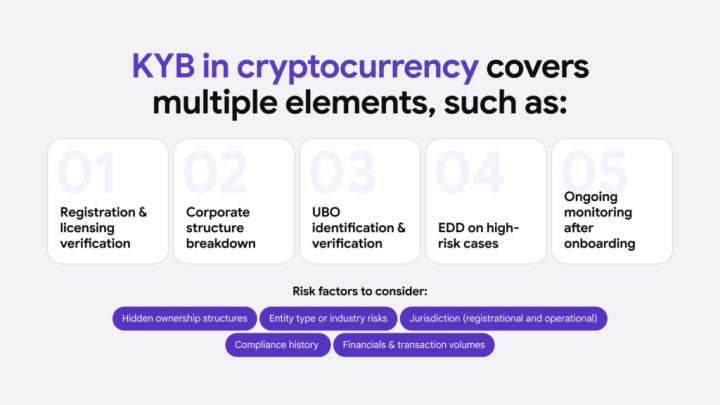
Apart from standard documentation collection, your business verification processes should follow a risk-based approach, depending on your own and the other company’s (that being onboarded and verified via KYB) risk assessment results.
-> Common frameworks to assess risks in KYB are based on risk factors, such as the entity’s jurisdiction, business type, ownership structure, transaction patterns, and overall history, such as whether it was previously linked to non-compliance.
How Does KYB Verification Work in Crypto?
KYB verification in the crypto industry consists of various due diligence checks and both KYC and AML processes aimed at confirming the legal ownership and legitimacy of another entity. This check is required before onboarding the other business and allowing them onto your platform. In simple terms, you do a KYB check when you want to know who you’re doing business with. The same principle applies to all regulated firms, not only crypto players.
However, there are industry-specific risks that crypto platforms need to be aware of. For example, cryptocurrency companies tend to register in low-tax jurisdictions or greylisted regimes with less strict AML rules. Crypto in general is a sector that’s known to be at the centre of the narrative that it’s linked to financial crime or sanctions risks. However, this might be an exaggeration at some level since crypto platforms are now more transparent and less anonymous than they used to be a decade ago.
A Standard KYB Workflow for a Crypto Platform
If you’re a crypto platform that conducts KYB checks, your process should look something like this:
1. Collect Company Details
The company’s representative who’s completing the KYB check on behalf of the company needs to provide basic company details so that later on, you can cross-check them and see if they’re correct. Sometimes, depending on the KYB API (or software), basic details are pre-filled and extracted automatically from a corporate government registry. Despite that, you should often require extra documentation, such as a certificate of incorporation or registration
2. Verify the Collected Details
Official records, such as the mentioned government registries, credit bureaus, internal blocklists that you might have, as well as extra databases, like PEPs and sanctions, are used to verify that the provided information about the company during KYB is reliable and correct. Sometimes, gaps come up, and analysts are required to follow up and remind the applicant to submit or re-submit missing documents.
Also, during this stage, simple information like looking up on Google Maps what the company’s office looks like (if it’s a proper office building, for example, and not an abandoned house) or the entity’s website is appropriate and part of standard due diligence. Adverse media checks are also beneficial to potentially see if the entity isn’t involved in scandals or previous breaches for non-compliance and other similar situations that would also affect your own reputation.
3. Verify the People via KYC
Often, most kyb service providers have the option to use built-in KYC checks on related individuals, and iDenfy is one of them. It depends on your risk appetite, but all high-risk individuals, for example, identified UBOs due to their share percentage and power, need to be KYC’d. This often also includes the company’s directors and other higher-ups that represent the entity you’re onboarding during KYB.
Keep in mind that UBO thresholds differ. For example, from July 10, 2027, EU CASPs must use a fixed 25% beneficial ownership threshold. In the US, most crypto platforms are registered as money services businesses (MSBs), which are outside FinCEN’s CDD Final Rule, so that means exchanges set their own threshold.
Related: Beneficial Ownership Information (BOI) Reporting [Guide]
4. Assess Related Risks
Crypto-related risks include checking declared wallet addresses for potential links to sanctions or scam activity, as well as mixer exposure. Once again, check licensing. For example, an unauthorized CASP working with EU clients might not be the final reason to reject the company altogether, but you should definitely treat it as a high-risk factor. Identified Politically Exposed Persons (PEPs) should also be looked into due to their high-risk profile in terms of general AML rules.
You should look into the industry, operational geography and the other entity’s offered services as part of your internal and final risk assessment during KYB. A complex ownership structure or not complying with your request to provide information is also an AML red flag. Parent companies that look suspicious or shelf companies that emerge during KYB should also be looked into.
Some software solutions can calculate the overall score of the entity that’s being onboarded via built-in tools, such as iDenfy’s automated KYB risk assessment. This helps analysts review the flagged high-risk cases with a suspicious score and, at the same time, onboard genuine and low-risk entities faster.
5. Make the Final Onboarding Decision
Based on your workflow, you can approve the business and give them the green light to pass the KYB check. Other options are to reject their application or flag them for further review and apply Enhanced Due Diligence (EDD). Suspicious activity, if not a false positive, must be reported by filing a Suspicious Activity Report (SAR) with your local regulatory authority.
Ongoing monitoring using periodic re-checks after the initial onboarding and approval stage is also important because risk profiles change. For example, sanctions change, especially with today’s geopolitical landscape and the nature of the crypto industry.
What Issues Does KYB Solve in Crypto?
AML measures like KYB checks help solve these common challenges in the crypto industry, such as working with:
- Unlicensed crypto counterparties. There are specific registers, such as the ESMA register (which provides a list of authorized providers), that will help you determine if the business is operating as a licensed, compliant entity. All markets should be covered. For example, in the EU, a crypto-asset service provider generally needs authorization under MiCA, and your responsibility is to check that during KYB.
- Hidden entities with layered ownership structures. It’s a common tactic to stack crypto structures using offshore holding entities and multiple ownership layers, such as nominee directors (also known to have potential links to tax evasion and other illicit activity). KYB verification helps detect real owners and verify natural persons behind the entity, even below the standard 25% shareholding line.
- Sanctioned businesses or shell institutions. Depending on the jurisdiction, you can be banned from working with sanctioned firms and shell institutions (for example, the EU’s Anti-Money Laundering Regulation (AMLR) backs this). Since KYB consists of multiple checks, such as name-matching, identifying and screening UBOs, screening sanctions lists and detecting red flags regarding ownership, you avoid getting involved with an entity that’s prohibited.

On top of that, the challenge is also to identify whether you need to comply with regulatory requirements, as there’s still a gap in defining which crypto firms need to follow AML/KYB rules. This question is also raised by global watchdogs and their recommendations, such as the FATF and its recent update on VASPs. This matters because the crypto industry continues to be exploited for fraud.
Examples of Crypto Companies Using KYB Checks
There are different types of companies that use KYB verification before onboarding other businesses. This includes:
Standard Crypto Obligated Entities
These require conducting due diligence to ensure compliance with KYB. For example:
- Crypto exchanges
- Tokenization platforms
- Custodians/wallet providers
- Crypto lending platforms
- Brokers and OTC desks
- Payment gateways and crypto payment processors
- Other virtual asset service providers
Entities Required to Check Other Crypto Businesses
This includes examples like:
- Stablecoin issuers (onboarding businesses that use/distribute stablecoins)
- Crypto-friendly banks (for onboarding crypto businesses as banking clients)
- Brokers and fintechs (that offer white-label infrastructure for crypto platforms)
- On- and off-ramp providers (responsible for converting between fiat and crypto)
Related: How Does AML Apply to Crypto? [With Examples]
What is the Crypto Travel Rule?
The Crypto Travel Rule, also simply known as the Travel Rule, is a global regulatory framework aimed at improving crypto transaction transparency by identifying and sharing details about the sender and recipient of such a digital asset transfer.
In practice, all virtual asset providers (VASPs), including exchanges, banks, custodians and other financial services, need to share information if a specific transaction threshold is reached, as a safety measure to prevent fraud.
| Jurisdiction | Threshold |
|---|---|
| FATF recommendation | USD/EUR 1,000 (maximum permitted exemption) |
| United States | USD 3,000 |
| European Union | No threshold (applies to every transfer) |
Banks were already obliged to do so regarding their wire transfers for decades before the Travel Force was presented by the FATF in 2019. That said, the Travel Rule was extended as part of the FATF Recommendation 16, which targets virtual assets. It’s a “recommendation” for a reason, because countries have their own specific requirements.
How is KYB Crypto Related to the Travel Rule?
As part of crypto compliance processes, KYB checks and the Travel Rule help verify who you’re working with.
Both elements cover different parts in terms of the information that’s being verified/provided:
- KYB verifies the business before onboarding
- The Travel Rule applies to qualifying crypto transactions, requiring certain information about the sender and recipient to travel with the transfer
Crypto platforms need to:
- Collect and provide required information about the sender and recipient for covered crypto transfers.
- Keep required records of Travel Rule information for the applicable retention period.
- Maintain a risk-based compliance program, such as an AML/KYB system, to identify and manage risks, including Travel Rule-related financial crime risks.
Global Regulations for KYB in Crypto
FATF has set the baseline for adding stricter rules for crypto firms, including KYB verification (beneficial ownership identification in particular), under its general AML framework. However, FATF’s seventh Targeted Update, published in July 2026, highlighted crypto KYB, noting that many countries still struggle to identify the persons and entities actually conducting VASP activities. This makes structures like offshore VASPs operating outside effective supervision a steady risk.
The rules that matter most for crypto KYB include:
🇪🇺 -> MiCA, which outlines the regulatory basis for authorizing crypto platforms, similar to KYB checks, which require verifying if the other entity is licensed and properly registered, or legitimate and adequate to work with.
🇺🇸 -> The Bank Secrecy Act, which states that Crypto exchanges and administrators register as MSBs, requiring due diligence measures like KYB checks. However, at the same time, FinCEN’s CDD Final Rule overlaps, which applies to mutual funds, broker-dealers and banks, but not MSBs. Keep in mind that US crypto entities still do KYB cheks since global payment service providers, third parties, or state regulators require them.
So, there’s no unified rule that will solve all of your KYB-related challenges, especially if you juggle multiple partners and have a large volume of clients in different markets. However, non-compliance becomes an easily achievable goal if you miss something, even if the slip-up was unintentional.
Final Thoughts
In brief:
- Crypto KYB verifies crypto businesses before a company starts working with them, helping confirm that the business is legitimate while also identifying the people behind it.
- Even if not mandatory in some jurisdictions, KYB checks help get access to payment providers and other services that would be either blocked or result in a lengthy process.
- KYB is important for crypto companies because it’s a high-risk industry that faces fraud risks.
- Automating KYB crypto checks helps businesses speed up onboarding. For example, iDenfy’s business verification solution automated KYB compliance for FTMO, saving its in-house analysts at least 40 hours per week, with custom workflows for UBO verification and automated corporate document collection.
With crypto KYB, platforms are expected to comply in every market and every jurisdiction, and the pressure to onboard another entity can often become a huge headache, especially for teams who are just setting up their crypto platform.
I recommend reaching out to the professionals. iDenfy’s KYB API is an end-to-end solution (KYB/KYC and AML elements are used in the same dashboard) that helps crypto companies comply with KYB requirements using automation-focused features like AI Company Reviewer or No-Code Questionnaire.


 Download PDF