
When someone buys a used car through an online marketplace, they expect two basic things: that the seller is who they claim to be, and that they actually have the legal right to sell the vehicle.
Unlicensed dealers (often called curbstoners) profit by breaking both assumptions. They do so by masquerading as everyday private owners, dodging dealer licensing rules and vanishing the moment a mechanical defect surfaces. When all that happens, your marketplace is left to deal with angry buyers, chargebacks, and growing regulatory scrutiny.
Curbstoning makes a strong case for introducing Know Your Customer (KYC) and Know Your Business (KYB) checks during seller onboarding. Establishing individual identity and business status early makes it far easier to spot unlicensed dealers trying to blend in with private sellers.
If you’re dealing with unlicensed sellers, this blog post breaks down how to spot a curbstoning scam and use KYC and KYB checks to stop it.
What Is Curbstoning?
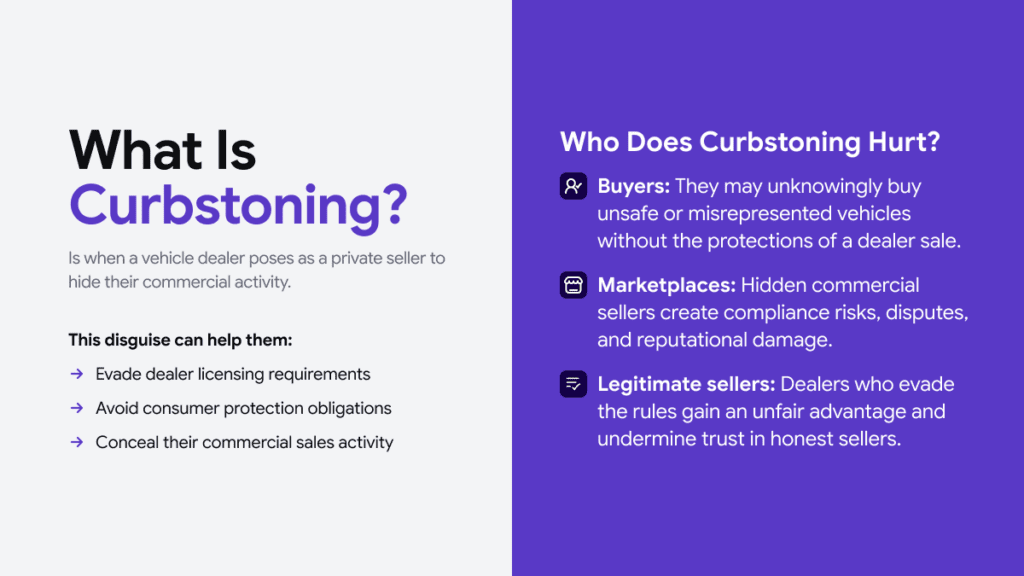
Curbstoning happens when an unlicensed dealer buys and sells vehicles for profit while posing as a private owner. This disguises commercial trading as a personal sale, allowing the seller to evade dealer licensing requirements and the disclosures and buyer protections that apply to licensed dealers.
The term comes from selling cars parked along the curb or in parking lots rather than through an established dealership. The same practice now extends to online marketplaces, where traders advertise vehicles as private sales.
A genuine private sale typically involves someone selling a vehicle they bought for personal use, such as when replacing their family car. A curbstoner buys vehicles to resell commercially while hiding that business activity from buyers.
Curbstoning can also involve title-jumping, which means buying a vehicle and reselling it without first transferring the title into the reseller’s name. Skipping that step can help conceal the intermediary’s involvement and avoid taxes or title fees, leaving a gap in the vehicle’s recorded ownership history.
Automate your identity verification
See how iDenfy helps 1,000+ companies verify customers in seconds with AI-powered KYC.
Explore iDenfyHow Curbstoning Works on Online Marketplaces
Curbstoners use private seller accounts to make a vehicle resale business look like a series of unrelated personal sales. The process typically works like this:
- Buy vehicles to resell. The trader sources used cars, sometimes at auction, intending to sell them for profit. They may avoid transferring titles into their own name, keeping their involvement out of the ownership record.
- Create misleading private listings. They advertise each car as a personal vehicle, sometimes claiming to sell for a friend or relative. Spreading listings across multiple accounts helps disguise how many vehicles they’re selling.
- Complete the sale while concealing their trader status. The buyer deals with someone presented as a private owner, without knowing there’s a commercial seller behind the listing. If problems emerge, that concealed identity can make complaints and ownership disputes harder to resolve.
Why Regulators Push Platforms to Verify Trader Status
It’s no surprise that curbstoning, like other forms of marketplace fraud, attracts regulatory scrutiny. Some rules require covered marketplaces to collect and check seller information. Others govern dealer licensing or prohibit traders from posing as private sellers.
| Law or Framework | What It Covers |
|---|---|
| DAC7 | Applies to platforms reporting seller activity for EU tax residents, with goods reporting triggered above €2,000 or 30 sales per year. Makes multi-account vehicle flipping harder to hide |
| Digital Markets, Competition and Consumers Act 2024 in the UK | Prohibits traders from falsely presenting themselves as private consumers |
| Florida Statutes § 320.27 | Requires motor vehicle dealers to hold appropriate licenses, subject to statutory exclusions. If you sell three or more vehicles within 12 months, you could be classed as a commercial seller |
| OMVIC (Ontario MVDA) | Requires dealer registration, administered by OMVIC, with exemptions for qualifying personal and family vehicle sales |
Related: DAC7 Directive: How Online Marketplaces Should Collect, Verify, and Report Their Data
5 Curbstoning Warning Signs Marketplaces Should Investigate
Whether you like it or not, the best way to prevent curbstoning is to spot the warning signs early. If you stay alert to listing patterns and seller behaviour across your marketplace, you’re far more likely to catch unlicensed traders.
These are the red flags to watch out for:
1. Ownership Documents Conflict With the Seller’s Identity or Claimed Authority
It’s true that most classifieds and peer-to-peer marketplaces don’t check a car’s title or registration before a listing goes live, unless they manage the transaction or a risk trigger prompts a check. Ownership conflicts instead surface when a buyer meets a seller and notices that the paperwork isn’t in the dealer’s name. Curbstoners might claim to be “selling for a friend or relative” who isn’t present.

Buyers might then complain or attempt to report the seller through your platform. When those reports pile up, title-jumping is often behind it. So, you definitely would want to remove such sellers from your platform.
2.Private Accounts Repeatedly List Different Vehicles
If there is one telltale sign that you are dealing with a fake private seller, it’s a steady stream of different cars posted from what looks like a personal account. Just think about how often you sell a car as a private seller. Maybe every few years, but definitely not every few weeks like these fake sellers do.
So, watch for things like:
- Rapid turnover
- Similar driveways or photo backgrounds
- Linked accounts sharing phone numbers, addresses, or payout details
An example from Australia shows how this plays out online. Consumer Affairs Victoria’s research examined 50 vehicles bought at auction by unlicensed traders and subsequently advertised for resale. Of those vehicles, 98% appeared on Facebook Marketplace, while 28% were advertised with odometer readings more than 25,000 km lower than those recorded at auction. One individual had purchased 37 vehicles in just three months.
3. Dealer Credentials Are Missing, Invalid, or Inconsistent
If someone lists cars like a dealership or claims to run a business, their profile on your marketplace should reflect that. You should be immediately alerted if a seller skips the dealer license field on a commercial-looking account, types in a fake license number, or uses a business name that doesn’t line up with company records or bank payout details.
A real dealer will always have a clear business footprint and matching details, while curbstoners wing it and hope they’ll never get caught.
4. VIN, Mileage, and Vehicle-History Information Conflict
Many buyers are savvy nowadays, and before purchase they run vehicle history reports to check the car they’re about to purchase. Most of the time, if the seller isn’t genuine, don’t expect the car history to be genuine, too.
Some common red flags include:
- A VIN doesn’t match the car
- Mileage looks lower than past service or inspection entries
- A report flags hidden damage, salvage status, or active liens
There was a case in Spain where a court conviction involved defendants rolling back odometers on used cars to push prices higher and defrauding twelve buyers of more than €63,000. They also falsified vehicle documents.
While lighter classifieds often don’t do history checks, marketplaces that connect to vehicle data APIs or run automated listing checks can spot these inconsistencies earlier by cross-checking VINs, flagging sudden mileage drops across re-uploads, and comparing history data against seller claims.
5. Sellers Resist Providing Additional Documentation or Independent Inspections
Finally, when you deal with fake sellers, it’s like poking a bear: they won’t be happy to provide additional proof when pressed. Real sellers or licensed dealers might find extra steps a bit inconvenient, but they can usually provide documents you or the buyer needs.
It’s a totally different story when you deal with somebody flipping cars off the books. They can suddenly get defensive and refuse to cooperate.
How to Verify Sellers Before Approving Vehicle Listings
So how, as a marketplace, can you ensure that only legitimate dealers and genuine private sellers operate on your platform? Let’s look at a few measures you can take.
Verify the Individual Operating the Account
The very first thing you should do during the onboarding process is establish who is using the account. iDenfy’s identity verification service combines identity document checks with face matching and liveness detection to help confirm that the person signing up is who they claim to be.
Once the seller submits an ID and takes a selfie, iDenfy checks whether the document is genuine and whether the person matches its photo. The process also helps catch impersonation attempts using photos, recordings, or deepfakes, with human reviewers providing an additional check for errors and fraud signals.
Related: How Fraudsters Attempt a KYC Bypass
Establish Business Status and Check Trading Credentials
Of course, just as important is to establish if the seller operates as an auto business. With iDenfy’s KYB solution, you can check company details against official registry data, identify ultimate beneficial owners (UBOs), and screen directors and owners for sanctions, politically exposed person (PEP) status, and adverse media.
Company registration doesn’t establish permission to sell vehicles commercially, so check dealer credentials separately. For instance, in Ontario, OMVIC’s registrant search lets you confirm active registration and review enforcement history. Compare those records with the seller’s details before approving their profile.
On top of that, you can also use iDenfy’s Criminal Background Check to automatically screen sellers against U.S. court and criminal records, including fraud and identity theft convictions.
Confirm Ownership or Documented Authority to Sell
Curbstoners may sell cars without the proper ownership paperwork, which is a huge risk since buyers could pay for a vehicle they cannot legally transfer into their name. When you decide to request that evidence should depend on your marketplace’s role in the sale.
With basic classifieds listings, ownership paperwork is often left for the buyer and seller to sort out. But, for example, marketplaces like Bring a Trailer request a title photo during listing preparation, while Autotrader’s Private Seller Exchange requires title documentation before completing a transaction.
If you want to trigger additional document checks, configure rules in your listing approval workflow that request paperwork based on risk signals such as:
- Listing several vehicles quickly or repeatedly cycling through different cars
- Making unexplained changes to vehicle details or locations, or pricing significantly below market value
- Requesting payouts or activating payment tools
Compare the documents with the seller’s verified identity and vehicle details. If they’re selling on someone else’s behalf, request documented authorization.
Investigate Linked Accounts and Escalate Inconsistencies
Serial curbstoners can spread listings across multiple accounts to disguise commercial activity as unrelated private sales. You should have a process in place to spot multi-accounting by connecting repeated identities, contact details, and other behavioral signals across profiles.
iDenfy’s Fraud Prevention software helps you investigate these connections through duplicate face and ID document detection, flagging when the same person or document appears across multiple accounts. Combined with device fingerprinting and behavioral analytics, these checks help uncover sellers spreading vehicle listings across seemingly unrelated profiles.
However, always investigate why an account was flagged before rejecting the seller. According to iDenfy’s Cross-Industry Identity Threat Index Report (2026), 87% of e-commerce verification flags were classified as friction, including data mismatches.
Request missing evidence, pause affected listings while material concerns remain unresolved, and assign a reviewer to assess the evidence and document the decision.
Who Curbstoning Hurts
With curbstoning, you really don’t have to look far to see the collateral damage it can cause. It literally hits just about everyone involved.
Buyers
Buyers may purchase cars with undisclosed damage, altered mileage, or title problems. Concealed trader status also makes it harder to identify the responsible business and pursue a complaint.
Marketplaces
Your team spends time investigating complaints, tracing linked accounts, and removing misleading listings. Platforms handling payments may also face disputes and chargebacks, while repeated incidents can damage buyer trust.
Genuine Sellers
Even registered dealers get impacted by this. That’s because they face unfair competition from traders avoiding licensing and compliance costs. Honest private sellers can also encounter more skeptical buyers and additional verification steps as platforms respond to abuse.
Strengthen Marketplace Seller Verification With iDenfy
Spotting early listing red flags and pairing them with targeted seller verification stops curbstoners before they damage your marketplace’s reputation. It all comes down to buyer trust. Buyers want to know you take every practical step to keep listings genuine and hold sellers accountable.
If you want stronger seller checks without adding hassle for genuine users, iDenfy can help you build a verification flow that fits your platform.
Talk to us and get a quick dashboard tour.


 Download PDF