The internet is bombarded with users searching for ways to attempt a KYC bypass. Some want to keep their identity private and don’t believe in sharing their personal information at all online, or are accessing more edgy or spicy services, such as adult content. Others are underage, and with stricter regulations, even social media sites or platforms like Reddit are now triggering random KYC checks for already existing users.
Another reason why bypassing is a real thing is that some users are blocked due to disobeying the rules, like selling replica items as the real deal on an e-commerce marketplace, which then leaves them with no choice but to try to re-register using another identity and continue to profit from illicit activity. The issue is that with generative AI and deepfakes becoming so mainstream, almost anyone, including less skilled people and not professional criminal groups, can attempt to bypass and manipulate identity verification solutions.
I explain when some systems might still fail to detect misuse and show good examples of how to construct a workflow that’s effective against fraud.
What is a KYC Bypass Attempt?
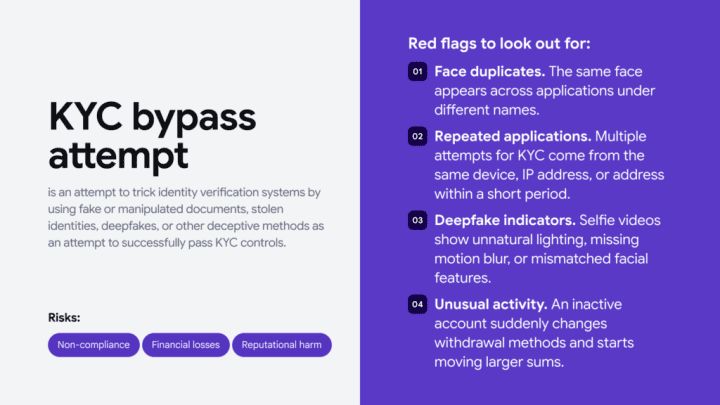
A KYC bypass attempt is a fraudulent effort to try to complete an identity verification session using various methods, often using document forgery, stolen or borrowed IDs and manipulated images or videos, including other more “early-stage” KYC methods, such as putting on masks during the biometric verification step of IDV.
Since a regular KYC process on a banking or trading platform is the same (ID doc check + liveness + Proof of Address), or differs slightly (regulations do not allow platforms to create random workflows), fraudsters come prepared to bypass all layers. From a regulator’s perspective, multiple checks during the initial onboarding aim to prevent fraud effectively, and that is why stricter KYC measures are applied in higher-risk industries.
Stop fraud before it starts
From deepfakes to document forgery — iDenfy catches fraud attempts with AI-powered liveness detection and document checks.
Explore Fraud PreventionWhy is AI-based Face Spoofing Dangerous, Even for Modern KYC Systems?
Modern spoofing techniques are more complex and harder to catch because they don’t rely on basic tactics, like stolen ID photos or static images, or even pre-recorded videos. They take it to the next level, for example, by injecting a deepfake as a ready-made video directly into the specific ID verification session that the fraudster has already analyzed.
So, on their part, they’ve studied the steps and the requirements and then used AI to scale their attack and make the spoofing more believable during onboarding.
| Technique | How it works | What it targets | What stops it |
|---|---|---|---|
| Face swap | Replaces the fraudster’s face with the victim’s in real time | Selfie step and active liveness prompts | 3D liveness, human review |
| Image-to-video animation | Turns one stolen photo into a moving selfie video | Liveness checks that only look for movement | 3D liveness, face match to the ID photo |
| Fully synthetic face | AI creates a face that belongs to no one, often placed on a fake ID | Document and selfie checks together | Document forensics, NFC chip reading, database checks |
| Face morph | Blends two faces so more than one person can match the same ID | Face matching | Duplicate face detection, blocklists |
| 3D avatar | A rendered digital head is animated to follow on-screen prompts | Active liveness | 3D liveness, human review |
| Injected deepfake | A virtual camera or emulator feeds the fake straight into the session | The capture step, skipping the real camera | SDK-only capture, device checks, no uploads |
In practice, criminals try out different AI-based attack methods for KYC to see which ones are the most likely to bypass KYC verification. They often reuse the same source or facial features to create multiple deepfakes and visual elements that are then duplicated on their part to find the “perfect” bypass submission.
This is dangerous simply because such attempts are coordinated and organized in a way that if you juggle large KYC volumes or work with a more manual-based onboarding model, you might have errors that could let a spoof through like a legitimate verification.
Reasons Users Try to Complete KYC Verification Fraudulently
An account that’s already verified or approved and belongs to someone else means that the real owner is verified and has a clean history. But to achieve this, fraudsters need to take over an account, use a money mule (another person to launder funds, for example), or bypass KYC during the initial registration and user onboarding stage.
If that happens, that’s not only a non-compliance issue for the platform, but also a general risk that you’ve just welcomed a criminal into your space. Now they could potentially receive stolen funds or move dirty cash with an identity that can’t be traced back to them.
“There are cases where verified accounts are sold, lent, or just passed on to a blocked player. Whoever signed up first might not be the same person after a month or two.”
Robert Kotov, Head of Partnerships at iDenfy
The Financial Crimes Enforcement Network (FinCEN) described this issue back in 2024 already, explaining why Enhanced Due Diligence (EDD) is needed and why reviewing high-risk, edge cases is still vital since some deepfakes can slide and go undetected. In their report, criminals managed to open accounts using IDs altered with AI and then successfully laundered money via loan fraud and other scams, collecting deposits from many locations and funnel accounts.
3 New Fraudulent KYC Misuse Approaches
Fraudsters try to bypass KYC checks using several new methods, like:
1. Camera Injection
This is a fraudulent approach to KYC bypassing (targeting selfie identity verification), which criminals use to feed their device’s physical camera with manipulated videos/images, often AI-based deepfakes, directly into the system when they are attempting to pass their IDV session in real time.
Common camera injection methods, from the easiest to the most technical
| Method | How it works | Typical signal |
|---|---|---|
| Virtual camera | Software registers a fake webcam and streams a video file or live deepfake into the browser | Known virtual camera drivers, perfect frame timing, no sensor noise |
| Emulator | The verification app runs on an emulated phone that accepts any video as “camera” input | Emulator fingerprints, missing hardware sensors |
| Hooking on a rooted or jailbroken device | Tools intercept the camera function inside the app and swap the frames | Failed device integrity checks, modified app signature |
| API tampering | The attacker skips the app and sends images straight to the verification API | Requests with no valid SDK session or device data |
| Hardware capture device | A capture card or USB device poses as a real camera | Unusual camera model or hardware IDs |
This works from the fraudster’s side because some KYC flows aren’t able to tell where the injected media came from. For example:
- A fraudster uses a “selfie” and uploads a file or uses a browser that accepts any camera that the operating system offers, but the system only sees pixels.
- The KYC system doesn’t determine where the pixels came from, whether it was a real person using their phone’s camera, or a virtual camera playing the system with a deepfake.
In this case, the criminal doesn’t show their face. Instead, this sort of impersonation attack is used via tools like an emulator, specialized app, or a virtual camera driver.
2. Presentation Attack
This approach to KYC bypass attempts is based on some sort of physical artifact, like a printed photo or a silicone mask, including realistic costumes placed during the KYC session as a way to impersonate another person during the facial recognition step in the onboarding process. For example, a criminal can combine a stolen, real passport with a high-quality mask they made specifically to resemble the document’s rightful owner as a way to attempt account registration under that person’s identity.
“People, especially in high-risk industries like gambling or entertainment, do this very, very often. They use iPads, prints, even silicone masks. You wouldn’t believe how people misbehave when they’re trying to avoid verification.”
Domantas Ciulde, the CEO of iDenfy
That’s why fraudsters use this method to trick the camera and make artificial representations appear as if they are a real person. Similar to injection, a presentation attack also targets the gaps in camera-based facial recognition technology.
3. Generated ID Documents
AI is often used for the greater good, but in this case, it’s the opposite. Criminals use generated identity documents, often using special image-editing software and then attempt to create synthetic/altered passports or IDs to bypass digital KYC onboarding systems. An illustration that shows the scale of this issue is OnlyFake, a now-notorious fake ID brand that pleaded guilty in February 20206 for selling 10,000+ fake digital IDs via its services.

Some factors that make generated IDs appear legitimate at first glance:
- The KYC details are consistent. For example, an average ID generator can now calculate the format and the right digits for security elements like the machine readable zone (MRZ).
- The face isn’t matched to an existing record. In this case, there’s no primary record or an existing fraudster duplicate that you can link the KYC session to because the photo is AI-generated (does not belong to a real person, so you can report or ban the user).
This is a red flag for KYC vendors because the number of counterfeit documents nowadays has risen because no practical “forgery” skills are needed due to AI. In iDenfy’s own research of 131,762 flagged KYC sessions, 17% involved the same face appearing on different identity documents, which goes to show that bypassers keep reworking the same documents until one gets through. AI tools make this approach faster and cheaper.
Related: Geography of Identity Fraud: What the Latest Data Shows
Key Red Flags Indicating That The User is Trying to Bypass KYC
Some signs that show a user might be trying to bypass their KYC check include factors like:
- A login attempt from a new device/country right after the initial user onboarding, or changing contact details (especially information such as the address or IBN) soon after
- An identity document that has clear signs of inconsistent fonts or out-of-place artifacts
- The same user repeatedly trying to pass their KYC over and over again, especially if they get rejected during the liveness stage and their movements are unnatural
- A user who submits their face but it doesn’t match the ID photo, or they look much younger/older than their stated age
- Multiple users appear to share technical or visual similarities (for example, an IP address or selfie image) that can be a sign of coordinated fraud
Related: 10 AML Red Flags [A Quick Breakdown]
What Steps Does a Typical KYC Verification Process Involve?
A typical workflow consists of a few KYC verification layers:
1. Document Verification
This is the first step in KYC, where the user is asked to capture their ID document (passport, driver’s license, or ID card). The document verification software then extracts the user’s information, such as their nationality, full name, and date of birth, using Optical Character Recognition (OCR) while running security checks in the background (to see if there’s no tampering).
-> How criminals try to bypass this: Using IDs that belong to a relative (anyone else), buying stolen documents on the dark web, or using a real ID as a template and then altering it.
2. Biometric Verification
This includes asking the user to take a selfie or record a short video, or to do certain actions, such as looking to the right and left to move the head and face so that the liveness detection (in this case, active liveness) can check the biometric features and ensure a real person is completing the KYC verification at that time.
Biometrics are then compared to the picture on the ID document to see if there are any mismatches. This also helps spot duplicates or known fraudsters trying to bypass KYC over and over again.
-> How criminals try to bypass this: Using AI-based deepfakes, face swaps and special filters, pre-recorded or manipulated videos and other spoofing attempts.
3. Proof of Address (PoA) Verification
Also simply known as address verification, this step requires the user to provide some sort of extra documentation where their full current residential address is visible (not older than three months). Often, users attach a utility bill or a bank statement. Depending on the solution, the software runs the check on the submitted PoA and then informs the user wether the passed or not and how long is the expected waiting time (if there is one, depending on the KYC provider).
-> How criminals try to bypass this: Altering PoA documents using certain fabricated elements, such as company logos or formatting, or using AI to edit the name and create a synthetic identity further on KYC to make it appear more legitimate.
4. Database Cross-Check
This is an optional step and is used in some cases where an extra reputable source is needed or a certain KYC detail, like a person’s Social Security number (SSN), needs to be cross-matched and compared with another database (like the Social Security Administration’s eCBSV service) against your own in-house database or the information collected in earlier steps (for example, the user’s address).
Popular databases also include credit bureaus and other AML-related watchlists, such as special criminal background checks (popular in the US, depending on the industry).
-> How criminals try to bypass this: Matching contact information (for example, the full name) to other stolen details, such as a phone number or an address, so that the cross-match would pass without the KYC software identifying mismatches.
How to Choose KYC Software to Prevent Identity Verification Bypass Attempts
There are a few areas that I recommend not to miss:
-> Test Out the Sandbox Environment
For example, iDenfy offers a free trial where you can access a real trial and try out the KYC software yourself. Check the abilities, if the KYC solution has ID document checks with accurate OCR detection for the document layer and active/passive liveness for the second selfie verification step.
For example, we worked closely with our partners at Casino.si recently and improved the technology specifically so that the OCR could accurately extract characters like “č” or “ž” from their native IDs. This helped improve accuracy and not reject genuine users with certain names and legitimate ID documents.
You can read the full case study here.
-> Don’t Rule Out Liveness Detection
Adding active liveness and prompting the user adds extra effort from the end-user’s side, but in the end, it positively affects your KYC ROI because manual re-checks cost more. Fraud costs non-compliance fines. And with the scale of AI-generated fraud, at iDenfy, we constantly aim to make all of the KYC steps as simple as possible, with minimal manual effort.
For example, the document country is automatically detected based on the user’s IP address, which is identified for this reason. The same principle is applied for the document capture step. The user no longer needs to press the button to “photograph” their ID. Once they correctly position it into the frame, iDenfy captures their ID for them.
Related: Choosing a Good Identity Verification Solution [Buyer’s Guide]
-> Look for that Extra Mile in Communication
Sometimes potential clients come to us with an already existing problem. Most of the time, we know how to solve it with our existing stack. But there are industry-specific or niche cases that an ordinary KYC stack doesn’t cover, which is why, when assessing vendors, pay attention to how they communicate with you and if they are willing to respond to your request.
For example, our team recently worked with an iGaming platform whose team expressed a duplicate credit/debit card issue, so on top of our already existing duplicate detection (for ID documents and biometrics), we built a new Bank Card Verification tool that automatically reads and assesses a user’s credit card, determining if it’s legit and if it was not previously used, as bypassers tried to create multiple profiles.
A new KYC layer was preferred since their team already reviewed payment information manually. That said, some of the biggest players in the KYC market no longer offer dedicated account managers because they have too many clients and the ratio of their support teams simply doesn’t add up. We’re offering the opposite at iDenfy.
Final Thoughts
A KYC workflow that was effective a few years ago is no longer an option for today’s criminals and their level of sophistication. Mainly because AI has opened a portal to very convincing deepfakes, basically helping average, less tech-savvy people vibe-code their way through and trick certain IDV processes.
In summary:
- KYC bypasses use stolen IDs, document forgery, synthetic identities, or other forms of manipulated media
- Deepfakes, camera injection, and AI-generated documents are now more accessible to a wider audience due to AI
- A combination of doc-based ID verification checks, selfie verification and KYC data cross-matching can help prevent misuse effectively
To solve this, carefully test out and choose software that offers multiple, customizable IDV workflows but is still easy for the end-user to keep a good conversion rate.


 Download PDF