This guide is focused to breakdown the key characteristics in choosing the KYC vendor, focusing on the regulations, countries and territories coverage, AML integration, Risk Assessment and KYB business verification. If your business primarily focuses on the biometric verification and document scanning to prevent fraud, you can explore our Identity Verification Service.
Best KYC Providers: Top 5 Software Providers
| # | Provider | G2 | Capterra | TrustRadius | Gartner | Average |
|---|---|---|---|---|---|---|
| 1 | iDenfy | 4.9 | 4.8 | 5.0 | 4.6 | 4.825 |
| 2 | Sumsub | 4.6 | 4.7 | 4.35 | 4.5 | 4.53 |
| 3 | Veriff | 4.5 | 4.7 | — | 4.3 | 4.50 |
| 4 | GBG | 4.5 | — | — | 4.4 | 4.45 |
| 5 | Trulioo | 4.4 | 3.9 | 5.0 | 4.0 | 4.42 |
Notable Mentions
| # | Provider | What They’re Known For |
|---|---|---|
| 6 | Jumio | An end-to-end compliance platform with continuous monitoring and a strong enterprise footprint. Trusted by major financial institutions and airlines for high-volume, high-stakes onboarding. |
| 7 | LexisNexis | Established in 1970, a key player in global regulations and compliance. Deep database-driven KYC for financial institutions across 80+ countries. |
| 8 | Focal | Full-cycle KYC/KYB/AML platform with highly customizable workflows. Handles 50,000+ verifications daily across 220+ countries. |
| 9 | SEON | SEON is a digital fraud intelligence platform that builds user risk profiles by enriching submitted data with signals from email addresses, phone numbers, IP addresses, device fingerprints, and social media presence — then scores that composite profile in real time. |
| 10 | ComplyAdvantage | AML-first compliance platform with a proprietary risk intelligence database covering PEPs, sanctions, and adverse media across 200+ countries. Strong fit for financial institutions that need a dedicated, deep AML screening layer. |
| 11 | Identomat | AI-powered KYC/AML platform with 8,800+ supported document types — the largest document library in this comparison. Covers 193+ countries, supports passive, active, and adaptive liveness detection (iBeta Level 2 certified, ISO 30107-3), and uses a hybrid automated + human-in-the-loop model. |
Criteria for the best KYC software provider
When choosing the right KYC software, key considerations include the vendor’s experience with KYC and AML, Risk Assessment, Address Verification, and business verification. Not every vendor covers all three at the same depth. Some are strong on document coverage but thin on AML. Others have solid biometrics but no KYB layer, meaning you’ll eventually need a second contract to cover corporate client onboarding.
The core requirements for any KYC service flow:
-
Document verification with multi-country and multi-type coverage;
-
AML screening for PEPs, sanctions, and adverse media – including ongoing monitoring post-onboarding;
-
KYC Risk scoring with configurable thresholds by country, document type, or user attribute; A huge bonus if risk assessment is supported for both businesses and individuals.
- Proof of Address verification options: manual or fully automated; detection of spoofed documents.
-
Integration options that match your technical stack – whether that’s a full API build, a no-code flow, or a third-party plugin integration;
-
A clear KYC pricing model that doesn’t turn your fraud rejection rate into a billing liability;
Because an automated KYC tool can reject a legitimate customer that a human reviewer would have passed, the vendor needs to be reliable. The best KYC providers offer configurable workflows that adapt to different use cases and support customer onboarding and broader compliance tasks rather than forcing compliance teams to work around a rigid product.
How we compiled this list
We’ve used our expertise and gathered industry insights over the years to evaluate various KYC vendors. We also reviewed publicly available G2 scores, Capterra reviews, documented feature sets, and other key factors, such as regulatory compliance coverage and customer case studies. We decided to cover 5 KYC providers in depth, while keeping others in notable mentions for further review.
Ultimately, we assessed each KYC software solution across seven dimensions: (1) document and country coverage, (2) AML/PEP screening capabilities, (3) Risk Assessment integration, (4) integration flexibility (API, SDK, no-code), (5) pricing options (Pay per approved/Pay per completed), (6) verified customer reviews from G2 and Capterra, and (7) regulatory compliance coverage (GDPR, AML5/6, eIDAS). Scores represent a weighted composite of these factors.
Keep in mind that iDenfy is included in this list as the publisher of this post. We’ve disclosed our own platform’s capabilities as transparently as possible so you can compare them against alternatives.
Compatibility of business verification software with KYC
Since the 5th AML directive, business verification has become an important part of the KYC process because customer due diligence now sits closer to KYB. For businesses, key requirements include identifying UBOs, verifying gathered company information against registry reports, and ongoing sanctions checks. KYB has more requirements, but those relate to the correct business verification process, not necessarily KYC.
If you need to onboard both individual and corporate clients, the best fit for you is a solution that carries both KYC and KYB Software capabilities under the same roof and supports compliant customer relationships over time.
Mandatory features that a good KYB solution has include:
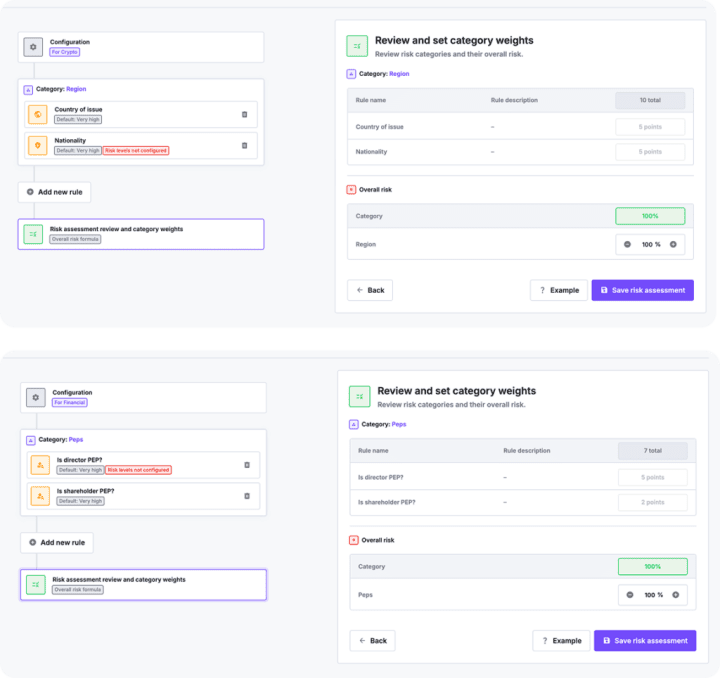
Business verification Risk Assessment. You must be able to create custom rules and define values (e.g., country, shareholders’ information, company activity, etc.) directly within onboarding forms.
AML checks for individuals. KYB needs an automated way to include shareholders in daily AML monitoring software, with enhanced due diligence for higher-risk ownership structures or flagged individuals.
Automated questionnaires. This includes a pre-made template that lets you add custom questions and automatically sends them to complete, along with the required corporate documents, regardless of industry.
Comparison of each feature supported within seven dimensions
| Feature | iDenfy | Sumsub | Veriff | GBG | Trulioo |
|---|---|---|---|---|---|
| Supported Countries and Territories | 200+ (Blocklist feature included) | 220+ | 195+ | 195+ | 195+ |
| Document Types Coverage | 8 (incl. visa, military) | 5 | 4 | 8,500+ ID documents | 4 |
| PEP Screening | ✓ (All 4 levels) | ✓ | ✓ | ✓ | ✓ |
| Sanctions Screening | ✓ (daily, per-country filter) | ✓ (1,300+ watchlists) | ✓ | ✓ (UN, EU, OFAC, OFSI + local lists) | ✓ (6,000+ watchlists) |
| Adverse Media | ✓ (Proprietary context-aware algorithm to reduce false positives) | ✓ | ✓ | ✓ | ✓ |
| Ongoing AML Monitoring | ✓ (dashboard + webhook) | ✓ (real-time) | Partial | ✓ | Partial |
| Proof of Address Verification | ✓ (auto + manual) | ✓ | ✓ | Partial (address data verification via Loqate) | ✓ |
| Risk Assessment KYC | ✓ (categories, rules, weights) | ✓ | Partial | ✓ (risk scores + business rules) | ✓ |
| KYB (ID check for an individual) | ✓ | ✓ | ✗ | ✓ (directors + UBOs) | ✓ |
| KYB (AML Screening) | ✓ (individuals + companies) | ✓ (custom scoring) | ✗ | ✓ (individuals + companies) | ✓ |
| KYB (Risk Assessment) | ✓ (categories, rules, weights) | ✓ | ✗ | ✓ (adjustable risk criteria) | ✓ |
| KYB (Questionnaire) | ✓ (weighted categories) | ✓ (custom scoring) | ✗ | Not stated | ✗ |
| No-Code Integration | ✓ (Shopify, WooCommerce, WordPress, Magento, Zapier) | Partial (API/SDK; no e-commerce plugins) | Partial (API/SDK; no e-commerce plugins) | ✓ (GBG Go journey builder + templates) | Partial (API/SDK; no e-commerce plugins) |
| ISO 27001 + SOC 2 | ✓ | ✓ | ✓ (ISO 27001) | ✓ (ISO 27001:2022 + SOC 2 Type 2) | ✓ (SOC 2) |
| Cyber / E&O Insurance | ✓ (Lloyd’s of London) | No public info | No public info | ✓ (PI + cyber insurance) | No public info |
| Pricing Model | Pay per approved / Pay per completed | Pay per completed | Pay per completed | Custom quote | Pay per API call |
#1 iDenfy

4.825 Average Score · (4.8 Capterra | 4.9 G2 | 5.0 TrustRadius | 4.6 Gartner)
iDenfy website: iDenfy
iDenfy runs the full KYC compliance process in one place – document verification, PEPs, sanctions, and Adverse media screening, and a 24/7 human review layer, all in a single flow for the broader know your customer workflow. The hybrid model is the core differentiator: AI processes the session first; a trained reviewer handles anything that comes back flagged, before it ever reaches your compliance team’s queue.
Beyond the core KYC product, iDenfy provides the full compliance suite under a single contract, with seamless integration into existing systems: know your business solution; KYC and KYB Risk Assessment; AML screening software; automated Proof of Address via utility bill verification; bank account and IBAN verification.
What Clients Say About iDenfy
G2 reviewers across fintech, iGaming, and crypto consistently highlight two things: verification accuracy and the responsiveness of the human review team on flagged sessions. A G2 reviewer from a crypto exchange noted that after switching from a different IDV provider, the false rejection rate on legitimate users dropped noticeably – and that iDenfy’s team handled integration questions faster than expected. Another reviewer running an iGaming platform flagged document coverage depth as a decision factor, specifically noting that document types from markets their previous vendor struggled with were verified without issue.
We process a large number of identity checks every day, and iDenfy has remained stable even during peak periods. Verification results come back quickly, and the system reliably flags suspicious documents without creating an excessive number of false positives. We also appreciate the continuous monitoring features that support ongoing compliance. Integration with our existing systems was straightforward, and it has required very little maintenance since launch.
– Raechal G. from G2
Pros
- Pay-per-approved pricing available: you only pay for successful verifications, not rejected ones.
- No-code integrations for Shopify, WooCommerce, WordPress, Magento, and Zapier alongside a full REST API and native iOS/Android SDKs.
- In-house KYB and AML on the same platform: no second vendor needed for business verification or ongoing screening.
- Lloyd’s of London insurance coverage for cyber and errors and omissions liability.
Cons
- Pricing can feel high for early-stage companies at low verification volumes.
- No native transaction monitoring module (available via partner integrations).
- No direct Travel Rule solution for crypto companies.
#2 Sumsub

4.5375 Average Score · (4.7 Capterra | 4.6 G2 | 4.35 TrustRadius | 4.5 Gartner)
Sumsub website: www.sumsub.com
Sumsub runs both KYC and KYB through the same workflow builder, which is useful if you want one dashboard for both processes. Yet, based on our list, every provider has this duality on their KYB platform. Sumsub covers 220+ countries, processes 50,000+ verifications daily, and includes native AML screening. One thing to factor in: pricing is per completed check, including rejected ones. For companies already in the fintech or especially crypto compliance conversation, Sumsub comes up constantly. For a more detailed breakdown, see our Sumsub comparison.
What Clients Say About Sumsub
Sumsub’s review footprint is large (109 reviews on G2). Reviewers consistently highlight the platform’s depth across KYC, KYB, AML, and transaction monitoring. The Workflow Builder gets specific praise for letting compliance teams automate verification logic per region without engineering involvement. That said, non-technical users and smaller teams flag a steeper onboarding curve and less pricing transparency than they’d like.
I think that end-customer-facing features can still be better, also in terms of user experience and customization. Second, part is webhooks information that do arrive within the customer verification process. We are unable to extract sufficient details from the user flow for analytics. – Review from G2
Pros
- All-in-one compliance platform: KYC, KYB, AML screening, and transaction monitoring under one contract, reducing the need for multiple vendor integrations.
- Highly customizable Workflow Builder: verification logic can be automated per region with flexible rules, saving significant manual review time.
- Fast SDK setup: reviewers on Capterra note the Web SDK can be live in staging in under an afternoon.
- Strong regional compliance knowledge: helps teams scale to new markets with local compliance rules handled automatically.
- Crypto-specific coverage: includes travel rule software and transaction monitoring, making it a strong fit for crypto businesses.
Cons
- Pricing feels high for startups and smaller firms; minimum monthly commitments can strain cash flow at low verification volumes.
- Non-technical users face a steeper learning curve – the platform’s depth can be overwhelming without dedicated onboarding support.
- Support response times can slow during high-demand periods, per G2 reviewer feedback.
- False positives occur and require manual review, adding operational overhead for compliance teams.
- Limited pricing transparency for custom volume tiers.
#3 Veriff

4.50 Average Score · (4.7 Capterra | 4.5 G2 | — TrustRadius | 4.3 Gartner)
Veriff website: www.veriff.com
Veriff’s primary differentiator is document breadth: over 12,000 identity documents supported, with non-Latin script coverage for Arabic, Cyrillic, Chinese, Korean, and Japanese – making it one of the widest document libraries in the market for businesses onboarding users across genuinely diverse regions. In particular, the platform combines automated AI verification with a human expert layer, and its main focus is maximizing onboarding conversion rates through a smooth, fast user experience.
What Clients Say About Veriff
G2 reviewers consistently rate Veriff highly (61), but it is noticeably lower than Sumsub or iDenfy. The core difference is that almost every reviewer mentions a great user experience and a friendly UI/UX.
Veriff is a reliable, high performance program for verifying the identity of all customers of your products and services, offering the best digital structure for checking backgrounds and verifying the personal data of each of your business’s consumers. In addition, Veriff quickly integrates with the best work systems and applications, facilitating registration with each of its digital verification tools and functions. – Review from G2
Pros
- One of the widest document libraries available: 12,000+ document types with non-Latin script support (Arabic, Cyrillic, Chinese, Korean, Japanese).
- Fast end-user experience with high onboarding conversion rates.
- Hybrid AI plus human review layer for improved accuracy on edge cases.
- AML Screening included in the Self-Serve plans.
- Consistently rated highly on G2 (63 reviews, 4.6 stars) for ease of setup and ease of admin.
Cons
- Pricing is per completed check: you pay for rejected verifications, not only successful ones.
- Sensitive to camera quality and lighting conditions, which can prompt users to retry and add friction to the flow.
- Higher price point compared to newer market entrants, per G2 reviewer feedback.
- Some reviewers cite concerns around biometric image data handling and privacy.
- Limited support for local-language documents in some regions.
#4 GBG

4.45 Average Score · (— Capterra | 4.5 G2 | — TrustRadius | 4.4 Gartner)
GBG website: www.gbg.com
GBG is a global identity and fraud prevention provider that serves banks, payment companies, gaming operators, and other regulated businesses. Its GBG Go platform combines document authentication, biometric and liveness checks, identity data verification, and AML screening against PEP, sanctions, and adverse media lists. Businesses get 80+ verification checks through a single API, with document coverage of 8,500+ ID types across 195+ countries.
For business onboarding, GBG automates director checks and UBO mapping using 200+ beneficial ownership registries and 600M+ business records. The GBG Trust Network adds fraud signals drawn from identity data beyond a single company’s own customer base.
What Clients Say About GBG
GBG has fewer public reviews than the top five, but its fintech and financial services customers keep pointing to the same results: higher pass rates, fewer applications sent to manual review, and a team that works hands-on to tune verification during setup. St. James’s Place reported a 9% increase in its customer pass rate after switching its KYC checks to GBG. Some users note that pricing sits at the higher end of the market.
In our top four markets – France, UK, Germany, and Italy – customer match rates increased by 25 percentage points. That’s one in four applications no longer going through our fallback manual verification flow. As a business, we’re saving time and money while delivering a better customer experience.
Angus Preston, Product Lead, Onboarding, myPOS (GBG customer story)
Pros
- KYC, KYB, and AML screening in one platform, which cuts down on the number of vendors you manage
- Broad document coverage, with 8,500+ ID types across 195+ countries
- 80+ verification checks available through a single API
- Built-in UBO discovery and director verification for business onboarding
- Fraud insights from the GBG Trust Network, drawn from beyond your own customer data
Cons
- Pricing is quote-based and not published, which makes early budgeting harder
- Can be on the expensive side for smaller teams or lower volumes
- The modular product range can take time to configure for a specific use case
- Fewer public user reviews than the top five providers
#5 Trulioo
4.42 Average Score · (3.9 Capterra | 4.4 G2 | 5.0 TrustRadius | 4.0 Gartner)
Trulioo website: www.trulioo.com
Database-first KYC, AML and KYB software covering 5B+ people across 195 countries. Strong in data-matching and electronic ID checks – useful where document uploads aren’t practical or required.
What Clients Say about Trulioo
There are 40 reviews in G2, and across all of them is a strong focus on the financial sector and its support.
We are in the financial services space and use Trulioo to verify clients’ identities to meet anti-money laundering requirements. Trulioo works well to verify identity details quickly without going back to our clients to get them to complete more steps. We collect their verification details and put it into Trulioo. It checks those against their credit record quickly, and it’s done! – Adam P. Chief Compliance Officer
Pros
- Database-first approach with no document capture required: covers 5 billion+ people across 195 countries.
- Supports 13,000+ document types and 700 million+ business entities for KYB verification.
- 6,000+ watchlists for sanctions and AML screening.
- Helpful account managers and strong uptime reliability, per G2 reviewer feedback.
- Well suited to financial services eKYC flows where document uploads are not practical.
Cons
- Match rates in non-core markets can be inconsistent: coverage breadth does not always translate to accuracy depth, per G2 reviews.
- No ongoing list screening capability, according to G2 reviewer feedback.
- Less suited to flows where biometric liveness and document capture are the primary verification channel.
- Lower G2 rating (4.4/5 from 40 reviews) relative to leading alternatives.
Final Thoughts on Choosing the Right KYC Software
Every decision here ultimately comes down to three things: choosing a provider that helps maintain financial security while meeting compliance needs at scale, what your budget can sustain at your verification volumes, and how your team will live with the tool day to day. The cheapest vendor is not the best vendor. A missed red flag, or a manual review queue that scales with your fraud rejection rate, costs more than the per-check savings that made a cheaper option look attractive in the first place.
One pattern shows up consistently in KYC vendor evaluations: teams underestimate the operational cost of platforms without a vendor-side human review layer. The per-check pricing looks clean. The edge case rate looks manageable at low volume. If 5-10% of your sessions are legitimately ambiguous: damaged documents, unusual formats, address verification issues, lack of company details support across the governmental registries sources, non-standard scripts – and they all land in your internal queue, that’s a headcount cost that doesn’t appear in any pricing comparison.
Before committing or switching to a new KYC vendor, test each shortlisted platform against your actual document mix and user geographies.
DISCLAIMER
This information is collected from public sources and vendor websites; it is not our final verdict or opinion. In some cases, the information could be outdated. You should contact the vendor directly to get recent information. If any information is missing, please contact the website owner.


 Download PDF