Verifying bank card details might sound like another step and added friction in the Know Your Customer (KYC) onboarding process. However, it can be implemented as a standalone check and the only verification check when a system detects risk signals linked to a profile’s credit card information. So, using an automated bank card verification tool might not be a revolutionary new approach, but it sure is an effective way to avoid payment-related fraud and attempts to bypass identity verification checks online.
In brief:
- Bank card verification is the process of verifying the card’s credentials, determining that the card is real and belongs to the user completing this security check.
- Platforms that use this method can trigger it as an extra security check in high-risk situations, such as a potential account takeover, or use it as an initial step in the traditional KYC verification process during onboarding/account opening.
On top of that, AI and fraud attempts have been working against such platforms in a sense that fraudsters can now scale their attacks faster. This happens to include issues like successfully bypassing surface-level verification systems and having their transactions authorized, resulting in at least $1 billion in losses due to scam-related card activity within months, as reports from giants like Visa show. This affects various industries that have money flowing, not just banking or fintech. For example, in iGaming and sports betting, a simple bank card check ensures that a blocklisted player or those working in bonus abuse rings don’t cash out with another card that doesn’t belong to them.
I review in more detail how standard bank card checks work and why you might find this payment fraud prevention approach beneficial for your own platform.
What is Bank Card Verification?
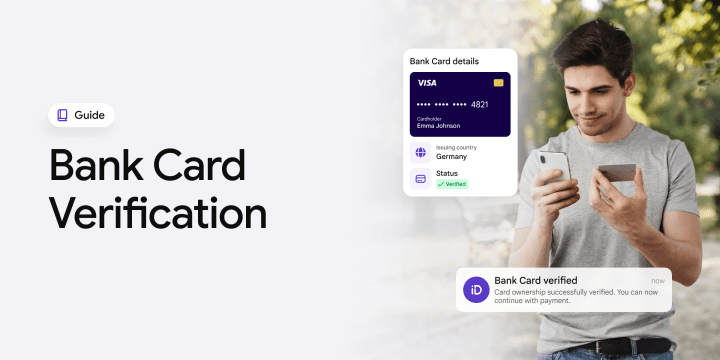
Bank card verification is a security measure designed to verify the legitimacy of a card used online before accepting it as a valid payment method for a user’s account.
The goal of the bank card verification process is to:
- Verify card ownership and confirm that the payment comes from a legitimate cardholder.
- Prevent fraud and payment method abuse, including linked bypassing attempts, such as adding stolen card credentials.
Often, the user is asked to take out their physical card and capture its photo. The system then automatically reads the information and extracts the card number (often, a portion of the digits), cross-checking it with another database (for example, manually entered card details that were already linked to the user’s account) or their full name to see if the details match.
-> A common KYC verification workflow looks like this: 1) ID document capture; 2) selfie biometrics with liveness; 3) bank card verification.
Automate your identity verification
See how iDenfy helps 1,000+ companies verify customers in seconds with AI-powered KYC.
Explore iDenfyBank Card Verification vs Bank Account Verification
Both processes aim to confirm that either the bank card or the bank account is legitimate and isn’t used for fraudulent purposes. However, card checks are simpler, and the user themselves needs to participate in the verification by displaying the card so that the system can read it. In contrast, bank account verification works based on open banking technology, and businesses integrate this check via an API so that they can access the user’s whole financial activity automatically. The user only needs to enter their standard banking login credentials.
Related: Bank Account Verification [Guide]
Why is Bank Card Verification Considered a KYC Onboarding Measure?
Bank card verification solutions help automate manual card information lookups or reviews that analysts working with payment data and KYC data need to check during the user onboarding process. This is extremely helpful in high-risk, regulated industries, such as iGaming, where a large portion of new users are fraudulent and attempt to register fake, stolen, or card info that doesn’t belong to them.
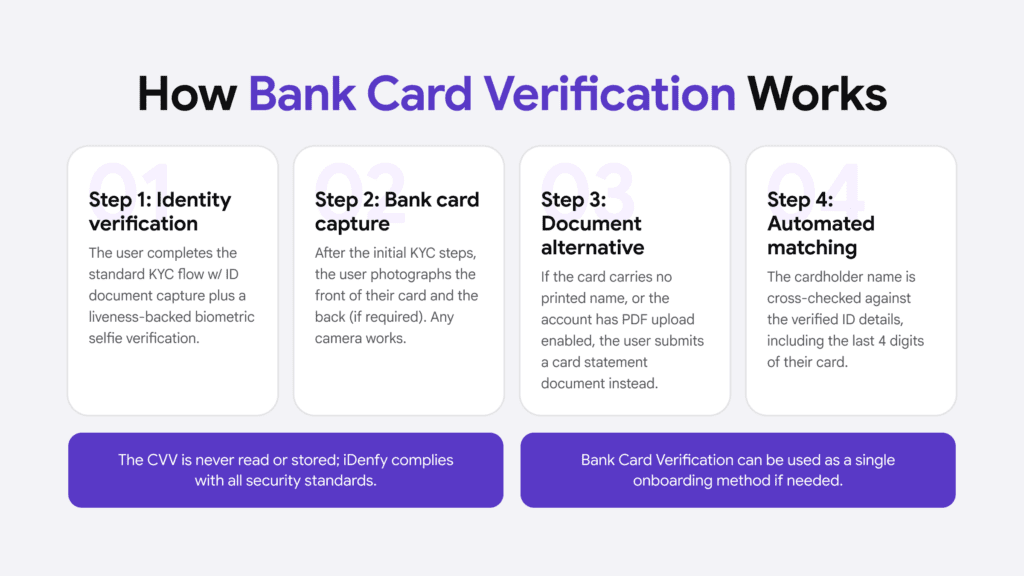
A popular situation is when banned users, whether it’s a simple e-commerce marketplace or an iGaming site, attempt to bypass KYC and use multi-accounting and a relative’s credit card to re-access the platform. When a multi-layer KYC check is integrated, it’s much harder for the fraudster to bypass all layers.
How Built-In Bank Card Verification Works in Practice During KYC Checks
Paired with a standard KYC check, which consists of checking if the user’s ID document is legitimate and if they are present during the biometric verification step, bank card verification helps:
- Compare the KYC data (full name) and match it with the information on the submitted bank card.
- Flag risks in real-time; for example, once the system detects a mismatch or a stolen, known card from a pre-registered database, then compliance analysts need to act on it manually.

Manual bank card reviews run during office hours, costing analysts time on every card, with possible errors, like analysts reaching different, ambiguous decisions. Bank card verification runs in seconds, 24/7, before the deposit clears, applying the same rules to every card. All matches get a green light to complete the KYC with built-in card verification and can access the platform. This helps save hours of manual work daily, especially if the company has a lot of users registering to access their services daily.
Related: Top 3 KYC Automation Benefits for Businesses
Industries That Use Bank Card Verification During KYC Checks
There are many online platforms and apps that have bank card checks as a security measure due to the potential for fraud. For example:
Gambling and iGaming Platforms
Players tend to abuse the system by depositing and trying to play as little as possible, then use card-not-present (CNP) fraud to withdraw their earnings. Self-excluded players also try to slide through sometimes by opening new accounts and altering their card information to try and access the service again. Bank card verification detects both cases and eliminates the chances of accepting such users into your network.
Related: Responsible Gaming: Tips & Controls for Operators
Crypto Exchanges
Money mules and card-funded deposits are a good combination for fraudsters who specifically use accounts that were already KYC’d. This gives them the leverage and a facade that the source-of-funds trail is real, and not just a payment token. To avoid that, exchanges can verify the card on top or trigger reverification and a simple standalone card check as a precaution to ensure the person behind the deposit is the real account holder.
Car Rental and Sharing Mobility Firms
Some countries are known for their high deposit rates, which tempt buyers to add fake cards and bypass the deposit fee to avoid paying for potential car damages. Some firms prevent unwanted losses by banning virtual cards or card issuers that are known to have higher fraud rates.
However, the better approach would be to add the bank card verification step as another onboarding measure, next to the driver’s license verification. This ensures that the funds can be potentially recovered and that the deposit sits on the real renter’s card.
Related: What is AAMVA Verification? [Driver’s License Check]
Telecom and eSIM Service Providers
eSIM services are completely remotely activated, and in some jurisdictions, are accessible without any KYC checks. In this sense, the card can become a proxy for a ready-made, bank-verified identity. Fraudsters use it for SIM-swap fraud and other similar activity, which for businesses can result in chargebacks and losses. A single bank card verification check allows you to ensure the customer is using the payment card that belongs to them, making it harder to slide with stolen credentials and obtain mobile services that are later used for further crimes.
E-Commerce Marketplaces
Some marketplaces that are global, monetized, and have hundreds of thousands of users are also used as channels for fraud. Seller accounts are stolen via account takeover (ATO) fraud and phishing. Once that happens, if there is no verification, the fraudster can add their IBAN, delete card payment information, change other KYC details, such as their name, and make it look like it suddenly matches.
Afterwards, they pay out to the new account and steal funds that the real owner worked hard to earn. In this sense, processes like face authentication as a reauthentication measure before a suspicious transaction and card verification during the registration stage are vital.
Which Payment Fraud Types Can Bank Card Verification Help Prevent?
This extra verification layer specifically targets payment-related fraud, such as:
- Card testing fraud, stopping bots and fake accounts from using stolen card batches.
- CNP fraud, preventing stolen credit card numbers and verifying the person owns the card.
- Payment method abuse, preventing bypass attempts and users who try to add cards that don’t belong to them repeatedly, reducing the chances of unauthorized funding.
- Third-party funding, detecting deposits made with someone else’s card (whether borrowed or stolen for money laundering).
- Friendly fraud, minimizing the chances of fake unauthorized transaction claims with concrete proof of ownership provided at deposit.
Related: 5 Popular Types of Financial Fraud Explained
What Does the Bank Card Verification Checker Process Look Like for Users?
Often, three simple steps complete the bank card verification flow, which requires the user to:
1. Consent
The end-user is asked to agree to move forward with the card verification check. It explains important details about the general process and data security standards, such as the fact that the CVV isn’t stored. Most proper and legal card verification checker systems, like iDenfy, do not store the user’s full card number and ensure that card ownership is still fully verified in line with regulatory compliance and data security standards.
It’s important to choose a well-designed bank card verification software that has an easy UX because then the user drop-off rates are minimized and the user feels more likely to complete the whole verification process once they are guided and see what else needs to be done on their side.
2. Capture
The user sees a frame, similar to how one is displayed during the selfie verification step in KYC onboarding. The difference is that they’re asked to capture their card. The AI-powered bank card system checks the captured card photograph to validate whether it’s real (not a forged copy or a printed fake, for example).

With iDenfy, there’s also an alternative workflow when the user doesn’t have their physical bank card with them. In this case, the system triggers the bank statement upload flow where the user can present this sort of proof instead:
-> iDenfy supports multi-page bank statement files
-> If the statement mentions multiple cards, the system detects every one of them
-> The user is then asked to pick one card from the list for the verification
-> Both flows follow the same logic: the cardholder name, digits and expiry details are compared exactly as they are on the user’s photographed card
Keep in mind that iDenfy’s Bank Card Verification tool is officially certified and complies with PCI DSS requirements.
3. Completion
The user gets a confirmation of whether their card is OK and accepted or not. If their bank card details match, they are verified and can access the platform. However, the specific result and the “no match” tag are never shown to the end-user.
For example, iDenfy’s card checker is designed this way on purpose because it doesn’t give the potential fraudster any information about why their bank card verification failed and which fields were a mismatch. Your analysts using the dashboard see the complete result log instead, via the API and webhook.
-> For a more detailed explanation of iDenfy’s Bank Card Verification flow, I recommend checking our documentation.
Final Thoughts on the Issue that Online Bank Card Verification Solves
Fraudsters pay with a card that isn’t theirs. Without a bank card check, their identity check can get approved. The deposit then clears, but the real card owner disputes it. You’re left to cover the refund. That’s why automated, easily completed online bank card verification checks reduce the costs that businesses spend on compliance teams looking at card information daily and the linked costs that directly affect revenue.
Other important challenges that a single bank card verification step can help you resolve:
- Prevent unauthorized card use before it turns into a chargeback that you have to cover for.
- Improve your already existing ID verification workflow without adding unnecessary friction (low-risk users complete the standard KYC flow, for example, while high-risk ones are asked to complete the simple card check).
- Replace manual analyst reviews and automate repetitive bank card checks 24/7, instead of creating backlogs or accepting cards only during office hours.
Get started using iDenfy’s Bank Card Verification tool, or jump into a quick demo call with our Sales team for more info.