The Know Your Vendor (KYV) process is a known identity verification term that’s used as a solution alongside other branches, like Know Your Business (KYB), Know Your Customer (KYC), and others. Know Your Vendor, in particular, is a strategic, risk-based framework that lets businesses understand, assess, and monitor their third-party relationships. This is vital, as third-party risks introduce unwanted consequences and can even turn you into a channel for money laundering, sometimes doing such illicit activities without you noticing.
Whether you are a startup sourcing cloud services or a global enterprise managing thousands of vendors, knowing your vendor is a business necessity, not a luxury. Let’s talk about it more, learn what it means, why it matters, the steps you need to build a KYV program, compliance and cybersecurity considerations, and the trends rising for the future.
What Does the Know Your Vendor (KYV) Process Include?
“Know Your Vendor” is a due diligence process that businesses use to evaluate and monitor third-party vendors, contractors, and service providers. It covers such things:
- Initial vetting (before onboarding a vendor)
- Ongoing monitoring (throughout the vendor relationship)
- Risk scoring
- Compliance verification
- Contractual controls and accountability
This year, especially, KYV is digitally driven, AI-assisted, and integrated with cybersecurity. Although it is just a start, KYV has such features – it is really exciting what the future will bring.
Automate your identity verification
See how iDenfy helps 1,000+ companies verify customers in seconds with AI-powered KYC.
Explore iDenfyHow Does KYV Work in Mergers, Acquisitions and Strategic Partnerships?
KYV is a strategic asset, especially during mergers, acquisitions (M&A), and high-value partnerships, pursuing growth through consolidation, expansion, or joint ventures. Vendor risk becomes a hidden landmine that can derail deals or create long-term liabilities if not properly managed for organizations.
During M&A due diligence, the acquiring company inherits third-party risk – unstable suppliers, non-compliant data processors, or vendors exposed to geopolitical, cybersecurity, or financial threats – meaning that, without a structured KYV process, these risks can remain invisible.
A proper KYV program allows deal teams to rapidly assess the vendor ecosystem of a target, including reviewing critical vendor contracts, evaluating their compliance with regulations, identifying risk possibilities (for instance, reliance on a single cloud provider), and recognizing red flags such as past breaches, sanctions exposure, or violations.
Overall, KYV in the context of M&A and partnerships is about protecting value. It prevents organizations from walking into inherited liabilities, ensures continuity of critical operations, and supports confident decision-making. In today’s high-stakes business environment, failing to evaluate third-party exposure before the deal closes is a strategic risk.
Why is KYV Important?
Third-party risks were just background noise before, but that is no longer the case.
Here’s why KYV matters:
-
Cybersecurity Threats
According to some reports, over 60% of data breaches now originate from third-party vendors. In the age of KYB APIs, interconnected platforms, and cloud integrations, your vendor’s vulnerability becomes your vulnerability. For this reason, it’s important to choose a compliant KYB or KYV service provider if you’re thinking about integrating another solution and not building a system from scratch.
The more automation you need, the fewer third-party vendors you need to integrate, so if you are also required to do AML checks and transaction monitoring, look for end-to-end vendors like iDenfy who specialize in security and complete compliance. This automates your vendor due diligence and minimizes the risks of bad data retention protocols or missed audit logs because you have everything documented and safely kept under a single dashboard.
Related: Third-Party Money Laundering Risks Explained
-
Global Compliance Demands
While regulations don’t always require the “KYV” process, they increasingly expect businesses to understand who they work with. And that’s why Know Your Vendor is becoming part of the broader mandatory KYB and third-party risk management measures. It helps assess whether your suppliers, investment partners, agents, and other third parties involved in the chain are legitimate.
Also, a risk like complex corporate structures or finding an entity that’s registered in an offshore jurisdiction but operates in another location is not automatically a straight-up ban but requires deeper checks to see if the entity is in line with your risk apetite before taking it on as a business partner.
Related: How to Check if a Company is Legitimate [10 Steps]
-
Reputational and Financial Impact
A single vendor failure – whether it is a data leak or maybe a service disruption – can lower user trust and lead to major fines. Businesses must protect their brand and bottom line by implementing KYV into governance processes.
The Main Elements for Building an Effective KYV Program
It is important to build a full “lifecycle” view of vendor risk for a strong KYV program. These are the main components for conducting the KYV program every business should have in place:
-
Vendor Inventory and Classification
We suggest that the company start with a complete vendor inventory because, obviously, you can’t manage what you do not know.
Segment vendors into risk tiers based on:
- Services
- Geographic and legal exposure
- Access level (network access, sensitive data)
Risk Tiers (High-Low):
- Tier 1: Cloud providers, payment processors, strategic suppliers
- Tier 2: HR platforms, marketing tools, office management
- Tier 3: Vendors with no access to systems or data
There are various tools that you could use to automate and visualize this.
-
Risk Assessment and Scoring
Conduct a multi-factor risk assessment:
- Cybersecurity condition
- Regulatory compliance
- Financial health
- Operational systems
AI-powered risk engines help with threat intelligence feeds and third-party risk signals to generate dynamic vendor risk scores.
-
Risk Controls
Add KYV practices into contracts:
- Right to audit
- Security breach notifications and clauses
- Compliance certifications
Smart contract platforms using blockchain-based audit trails are gaining traction in regulated sectors for compliance tracking.
-
Ongoing Monitoring and Alerts
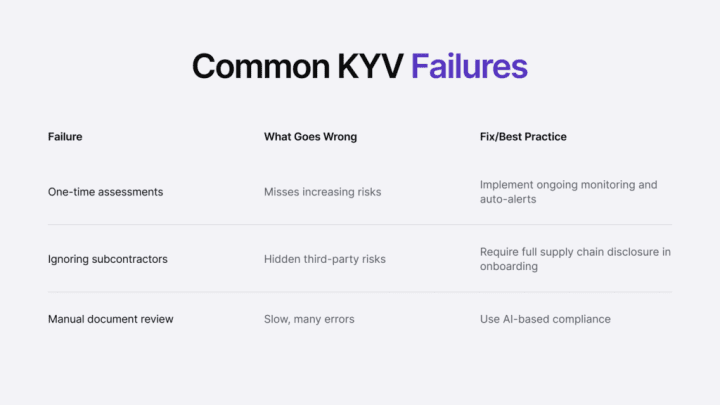
You can’t forget about KYV, since a simple “set it and forget it” approach won’t guarantee you compliance. You will need to:
- Monitor risk continuously
- Automate alerts for security
- Reassess annually
-> There are also a lot of various tools online to customize workflows for ongoing monitoring and setting up alerts.

Related: KYB for Import/Export: How to Verify Partners [Business Verification Guide]
Examples of Regulatory Rules Linked to KYV
There are regulations that require active vendor management, not only documentation. Here’s how KYV maps to 2026 compliance expectations:
DORA (EU)
-> Requires identification, classification, and monitoring of third parties.
GDPR
-> Includes strict due diligence for data processors and introduces liability for controllers and vendors in case of data breaches.
SEC Rules
-> Demands readiness to report vendor-related cybersecurity incidents that may impact investors or organizational risk posture.
How to Use Know Your Vendor With AI and Automation
KYV is more intelligent and more predictive thanks to technology.
Let’s check out what is trending at the moment:
✅ AI-Powered Due Diligence
Models now summarize risk documents, security whitepapers, and compliance certifications – reducing manual review time by a significant amount.
✅ Predictive Risk Modeling
Using historical data, machine learning anticipates vendor performance or security incidents before they even happen.
✅ API-Driven KYV Ecosystems
Modern KYV tools integrate directly with procurement and other platforms to automate tasks like risk flagging or reassessments.
Conclusion
Know Your Vendor is about knowing who you rely on, and how that reliance could impact the business, so just ticking the box for it won’t be enough. Maybe it is data security or operational stability – third-party relationships have real risks with them that need to be actively managed.
The organizations that get KYV right are the ones that treat it as part of how they operate, not just something they do during audits, building processes that bring visibility to vendor risks early, adapt when things change, and make sure the right people stay informed.


 Download PDF