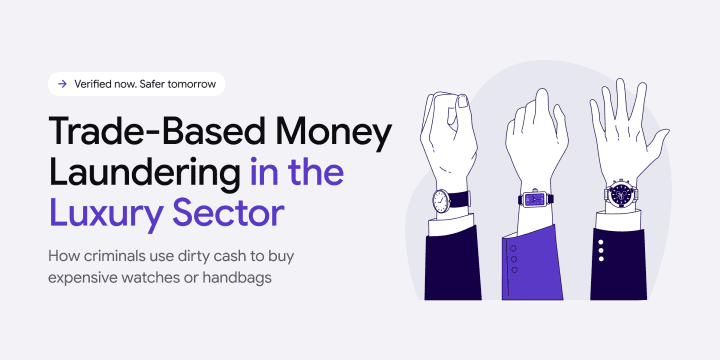
Imagine this: an organized crime group spends their day-to-day earning a living from selling drugs. This money must be squeaky clean to be successfully used and not get tracked or hit with an Anti-Money Laundering (AML) alert by financial systems that use monitoring to detect discrepancies in real time. For that, an expensive item like a small AP watch or Chanel bag can be an ideal channel for the “cleaning” step to keep the cycle running smoothly. The luxury goods then move abroad. Once that happens, if the items are resold, it eliminates any paper trail using international trade.
In brief:
- The world’s best-known regulatory watchdog, the Financial Action Task Force (FATF), describes trade-based money laundering as the process where dirty cash is covered up using “international borders” and “legitimate trade transactions”.
- In the luxury sector, this approach to money laundering is extremely attractive.
- To this day, high-value goods are considered to be the number-one choice for some launderers simply because the regulations are looser if we compare them to the OGs like finance or fintech.
Below, I use real-life examples to explain how the system of trade-based money laundering works in the luxury sector, while also covering the other side, or the regulatory perspective that directly targets this issue.
How Does Trade-Based Money Laundering Work?
Trade-based money laundering follows the same three stages of money laundering (placement -> layering -> integration), which are designed to move the illicit funds into the general financial system without getting caught. The paperwork shows a whole different story from the deal and the funds that were actually used, hiding their true origin.
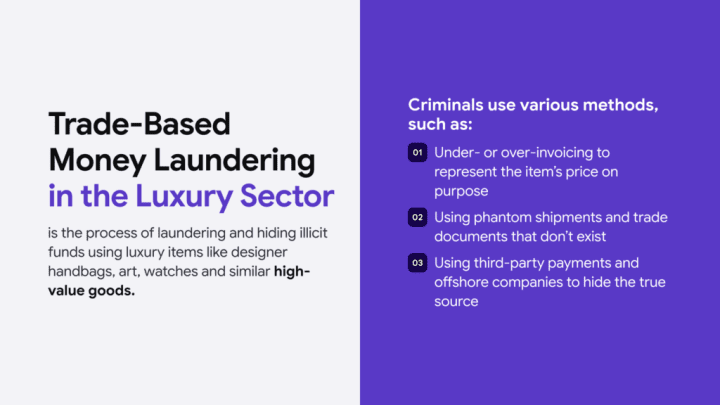
This is achieved by various illegal practices, such as physically moving the dirty cash through trade in goods, including wildly expensive luxury items or services, such as renting out private charters. In other words, trade transactions are used by criminals, who can manipulate the price or the quantity of luxury items that are being traded, moving them across borders.
That’s why, in AML compliance, cross-border trade is considered to be higher risk because it involves multiple jurisdictions, different currencies, and complex supply chains, making it difficult for financial institutions or even parties like customs authorities to spot suspicious activity.
Related: KYB Software for Trade Finance: Top Features to Consider
Automate your identity verification
See how iDenfy helps 1,000+ companies verify customers in seconds with AI-powered KYC.
Explore iDenfyWhy is the Luxury Sector Prone to Trade-Based Money Laundering?
Launderers have special schemes they choose intentionally, and the combination of the luxury sector and money laundering is appealing for criminals because they can take watches, for example, and concentrate the high value into a small, portable item. On top of that, luxury items like this aren’t generally suspicious while in transit.
So it all boils down to these three features:
- Low weight but high value (easy to carry in luggage or in personal packages)
- Good resale opportunity (resellers or auction houses take in luxury items easily)
- Standardized cash-based market (historically, it’s become standard to accept one-off trades for items like watches in cash and not go into deeper due diligence)

A traveler can carry a designer handbag onto a flight without raising concerns. While smaller contraband items like cigarettes are also used for trade-based money laundering and rely on the same principle, they rely on a high volume of sales and distribution networks due to the price being much lower.
Nonetheless, this issue is still a mystery, as it seems the number of laundered funds is getting higher. “Thanks” to trade-based money laundering, an estimated $1.6 trillion in illicit funds moves globally. Geopolitics and trade barriers, such as Russia’s war against Ukraine, have been fueling sanctions evasion and criminals’ tactics to use international trade to clean and move dirty cash.
Related: Examples of Money Laundering and Prevention Methods
Is the Luxury Sector Linked to Terrorism Financing?
Yes, the luxury industry has a dark trail when it comes to terrorism financing, and that’s why AML laws (that target fraud, money laundering and terrorism financing altogether) are getting stricter for those who sell or trade these expensive goods.
For example, in an informal value transfer system, also known as hawala, the funds are settled through intermediaries, not conventional bank transfers. A system like this instantly becomes attractive for laundering money through high-value watches and similar items.
| Area | Red flag |
|---|---|
| Customer | Out-of-profile spending: a student or retiree buys high-end goods in volume. |
| Multiple identities: the same person buys under different names, or ID details change between visits. | |
| No interest in the item: no questions about size, color, condition or aftercare. | |
| Payment | Structured cash: repeated large cash purchases, or purchases split to stay under reporting thresholds. |
| Multiple payers: several cards or third parties pay for one buyer’s purchases. | |
| Unconnected funds: money comes from accounts or countries with no link to the buyer. | |
| Goods | Bulk buying: repeat purchases of the same in-demand models, especially limited editions. |
| Quick flips: items are exported or resold soon after purchase. | |
| Trade documents | Mispriced invoices: prices far above or below market value. |
| Mismatched paperwork: vague goods descriptions, or invoices that don’t match shipping documents. | |
| Illogical routes: goods move through free zones or transit hubs with no commercial reason. | |
| Business partners | Disproportionate income: a reseller or luxury merchant earns far more than its size suggests. |
| Opaque ownership: nominee directors, hidden beneficial owners or recently formed companies. | |
| Staff | Insider help: staff override checks, tip off customers, or repeatedly serve the same high-cash buyer. |
The 2015 case of a Hezbollah-linked network illustrates the risk of terrorism financing in the luxury sector. The criminal group used hawala operatives to collect the funds from drug sales in the EU. Then, they spent the cash on luxury jewelry, cars, and watches, which were resold in Lebanon and West Africa. US investigators claimed that part of the profits were also used to buy weapons for fighters in Syria. At one point, Europol estimated the network laundered around €1 million a week.
3 Key Trade-Based Money Laundering Methods Involving High-Value Goods
Luxury items have become the new currency for criminal groups who try to gamble their way through and lure more victims into their chain. Oliver Bullough, a British writer who investigates the world of crime, corruption and fraud, has provided some interesting examples of trade-based money laundering, highlighting the capacity of the issue in his Everybody Loves Our Dollars book. There, he talks to a police officer in the UK who estimates that:
As much as 80% of luxury watch purchases are linked to crime and dirty cash that thrives on the fact that people want to showcase their fake wealth by funding organized crime and illicit high-value goods.
A shiny new watch on the wrist might not be the reality for a student unless they buy it off a criminal gang for a much lower price.
This is all possible due to:
1. Underpricing Luxury Goods
A vintage Chanel bag can be declared to be worth €50,000 in a cross-border deal, when, in reality, it’s at least €30,000. Trade invoices can also be manipulated. For example, a shipment of high-value watches can be disguised as simpler, cheaper accessories as a way to hide the true value of the trade. It’s also common to write off real, valuable designer items as replicas to cut the declared value.
A good example of this sort of trade-based money laundering scheme is the Hong Kong case from 2023. Customs found out that synthetic diamonds were sold as natural ones, also involving India and a large-scale export scheme that targeted Special Economic Zones and countries with inflated diamond values:
The stones were overvalued by 100x times.
Around $65 million was laundered by the criminal gang that exported cheap synthetic diamonds from Hong Kong to India, declared as high-value natural stones, and moved their dirty funds this way.
2. Using Buyers Genuinely Interested in Luxury Fashion
Criminals misdescribe items on purpose, but they can also use the same shipment and invoice it more than once. This is possible by opening accounts at different banks to make it look like each payment came from a separate sale. Sometimes, phantom shipments are also used, meaning the luxury items aren’t actually shipped at all.
In Everybody Loves Our Dollars, Bullough once again uses the police officer’s POV as an argument: “Factories in China ship drugs to British gangsters, who then give payments in cash to Chinese students studying at UK universities. The students either take cash to Bicester Village or first pay it into their bank accounts.”
“They buy Gucci handbags or whatever and ship them back to China, where the criminals sell them to fashion victims.”
Bullough describes how criminals use this location, Bicester Village, a very popular luxury shopping destination in England, to move money across borders. This location is chosen not by accident. It’s very popular among Chinese tourists who spend a lot on luxury designer goods. What’s interesting is that Chinese students allegedly use cash linked to drug trafficking to buy designer handbags there, which are then shipped to China and resold, while the deal is arranged through mainstream communication apps like WeChat.
3. Using Shell/Front Companies
Shell companies hide the real beneficial ownership behind the sales in the luxury sector, while front businesses mix money laundering and dirty cash with occasional legitimate purchases. For example, a vintage designer bag company can use illicit funds to buy stock and then make the money seem like it came from ordinary retail activity.
You might remember the Rolex trader who went viral for his own video footage, where he, at that time, sang the famous Dirty Cash song. The case’s investigating officer commented that the trader, who operated from his flat in Kent, “went great lengths” to conceal his criminal activity and aimed to run the “shop” as a clean, legitimate watch resale job while recruiting others to handle the drugs, and this way, distance themselves from the true culprit.
He received a sentence of 15 years in jail for running drug money through his luxury watch shop. On top of that, the police seized over thirty watches, mainly Rolex, worth over £400,000.
To avoid detection, companies from foreign countries are used as well. Another alternative is to use a money mule or shoppers who buy the expensive watches or designer bags on someone else’s behalf. This helps hide the true buyer and their source of funds.
Related: How Complex Corporate Structures Conceal True Ownership [KYB Guide]
What AML Compliance Gaps Does the Luxury Watch and Jewellery Trade Face?
It’s an overdue discussion, as the luxury sector simply does not face the same level of scrutiny as banks do.
KYC verification for buyers taking in cash well above the reporting threshold isn’t used. KYB on other companies and potential luxury stone providers isn’t applied. In contrast, banks and similar regulated financial institutions stick to strict due diligence measures, including using AML screening (to detect the red flags in real-time) and transaction monitoring.
Luxury watches and jewellery remain exposed because they combine:
- High prices
- Well-known brands
- Strong resale demand
What’s worse is that the businesses themselves have a commercial benefit here and can find the buying process of potentially illicitly funded luxury goods convenient for their own sake and profit. And with fewer mandatory checks, such suspicious chains and trade-based money laundering are harder to detect.
Credit: Luxury goods seized in Singapore’s S$3 billion money laundering case, Singapore Police Force, © Government of Singapore
Historically, AML measures were applied to some high-value goods dealers, art auction houses, or those that are involved in trading precious metals, for example, but the regulations vary from country to country, mostly still turning a blind eye to the luxury sector.
Related: Identity Verification in the Art Market: KYC/AML Checklist to Prevent Fraud
AML Rules Targeting Trade-Based Money Laundering and the Luxury Sector
The newest framework hit the EU with expanded obligations via the Anti-Money Laundering Regulation (AMLR) (2024/1624) for certain high-value goods traders.
-> The AMLR applies from 10 July 2027.
-> Businesses in the luxury sector will have to verify beneficial owners, assess transaction risks, and maintain records.
This will help luxury retailers identify who supplies their goods and assess whether transactions involve unusual intermediaries or suspicious trade patterns, all common risks linked to potential trade-based money laundering. This approach is similar to Know Your Business (KYB) checks, which are already mandatory for financial institutions.
Specified reporting thresholds will also be set for different categories in the luxury sector. For example, aircraft and watercraft -> more than €7.5 million, and watches and jewellery -> more than €10,000.


 Download PDF