Selling goods internationally and having your business scale fast can be challenging, especially when you’re dealing with different suppliers and operating in multiple markets. That’s why banks and other financial institutions step in and help fill in the gaps with trade finance, providing the assurance that the company needs and ensuring the supplier will be paid. The issue is that all key elements in the chain need to be verified through Know Your Business (KYB) processes. For that, nine times out of ten, specialized KYB software is used.
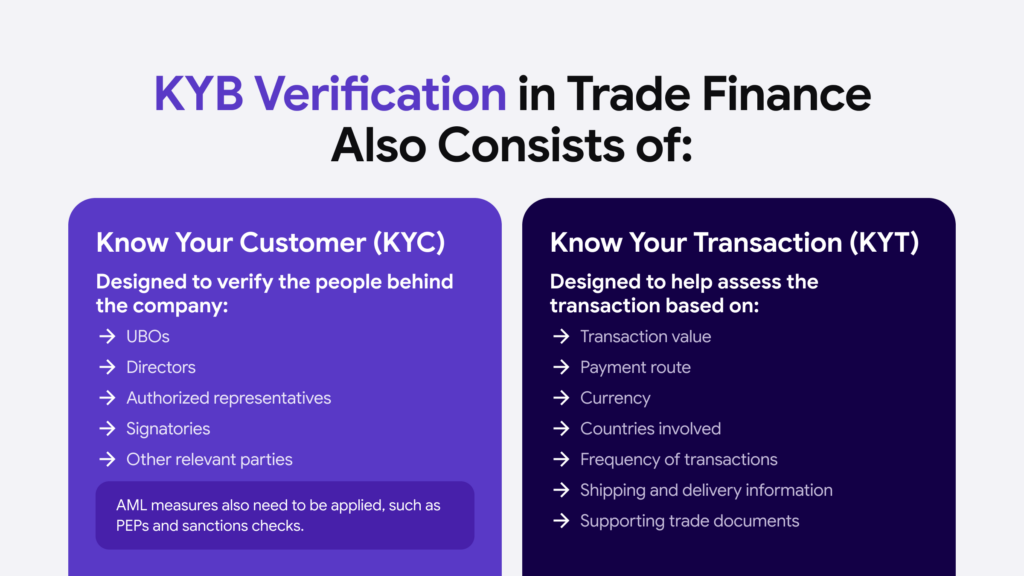
In trade finance, KYB compliance software is used to verify the company involved in a trade transaction before providing financing, yet it often involves multiple parties. Compared to a standard loan, trade finance companies need to check the entity, its ownership details, and business activity, as well as verify sellers, buyers, and other intermediaries before entering into a new B2B relationship. This can be challenging, especially since risks such as sanctions evasion and cross-border transactions are common in this sphere.
In brief:
- KYB software verifies whether another business is legitimate, checking key details such as its legal status and registration or ownership structure.
- Trade finance companies need to verify multiple components for their KYB checks, including documentation that proves the underlying trade is genuine and the financing is backed by real goods.
- Certain industry-specific risk factors are common in trade finance, making the KYB process more complex. That’s why Know Your Customer (KYC) and Anti-Money Laundering (AML) checks, such as sanctions screening, are also used as built-in software to check all parties (both individuals and companies) involved.
I review how KYB works and which components, software-wise, are worth looking into if you work in trade finance.
What is KYB Software?
KYB software is a tool for automating KYB-related tasks, such as corporate document collection via built-in tools like AI-powered questionnaires (that are then turned into end-user templates that the applicant from the company needs to simply fill in or attach the stated document), corporate registry checks, credit bureau information, and other details, including the AML part.
This means proper KYB software has all the necessary elements, including the option to trigger a KYC check for a company’s director or get an AML screening result to check if there are any sanctions matches.
Why is Trade Finance Considered High-Risk?
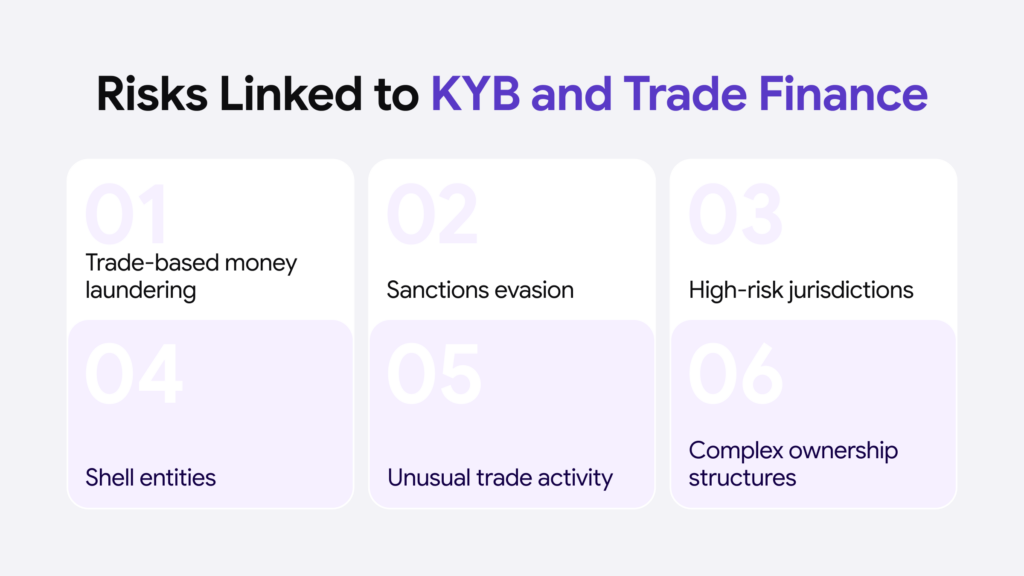
According to the global regulatory watchdog, the Financial Action Task Force (FATF), trade-based money laundering is a threat and considered an actual risk that’s linked to trade financing.
The main reasons for that include:
- Altered or manipulated trade documents. For example, a common practice for criminals is synthetically changing the price or quantity of goods to move illicit funds that are actually worth a different value.
- Cross-border transactions add to the complexity. This simply makes it harder to track all the parties linked to the financial transaction, since different currencies and financing arrangements complicate the chain, which is not in favor of KYB checks.
- Large trade volumes are often the standard. The scale of international trade hides individual transactions better, which then makes it harder to detect fraudulent transactions because they’re mixed into the general cash stream. That’s why real-time transaction monitoring is important.
If you hire a legal advisor or a law firm, they’ll put pressure on you to conduct KYB verification with the full package of KYC checks on related individuals and a look into all parties’ financial histories before moving forward with a trade finance deal.
-> The same goes for finding a new partner, such as a payment processor. If they know you already have all KYC/KYB and AML processes in place, the due diligence and approval process for you will be much easier and more efficient. I also talk about this in iDenfy’s case study with CSGOWin.
Mistakes Trade Finance Companies Make When Choosing KYB Software
These are some popular limitations that can be a challenge when looking for a new vendor or choosing the wrong KYB onboarding solution:
- Being able to verify only the borrower. The KYB software should help you automate workflows for the full trade finance chain (brokers, forwarders, importers, etc.).
- Using a single process for all related parties. That’s simply not possible due to differences in corporate structures. For example, a sole proprietorship or an exporter requires different documentation, which means you need a flexible KYB tool.
- Focusing on the coverage but not knowing why it matters. For example, a slogan that the KYB tool supports “200 countries” isn’t enough; you need to look into the registry coverage, which is vital for corporate clients in trade finance.
- Testing the KYB software only on standard cases. Similar to some new AI-related technologies, they are trained on common templates and low-risk cases. You need to test the software to see how it performs with less-covered markets and more niche cases.
- Not detecting UBOs automatically. As ownership can run through several holding companies, you need a solution that’s able to trace the full ownership layers with custom workflows or rules for UBO detection, and then KYC verification on top, if needed.
“Extra automations, like requests for documents at any stage or automatically triggered KYC for UBOs and directors during ownership verification, were also a plus.”
Krzysztof Skupinski, a Team Leader at FTMO, when asked about why iDenfy’s KYB software was the right fit.
Other important factors that you can’t miss are the option to reverify/rescreen your partners after the KYB onboarding process. Transaction monitoring that’s used on top of the KYB software is also a nice-to-have because then you don’t need to juggle multiple vendors if the same integration offers you end-to-end compliance.
This saves time for analysts and is generally easier to manage and keep track of account activity, unusual patterns, and all existing customer risk profiles that can change over time.
Valuable KYB Software Features to Look For
I recommend assessing multiple Know Your Business software options, but leave out only the top ones that have the most value and ROI-focused automation features to match all KYB requirements:
Access to Registries and Credit Bureaus
Multiple databases are required to comply with KYB requirements. That means the number one capability should be direct access to multiple registries (official filings) and credit bureaus:
- Registry lookups confirm legal existence, status, directors, and ownership (depending on the registry and the particular country, since formats slightly differ)
- Credit bureau reports show whether the counterparty is financially active (for example, based on data points like current status, VAT registration, activity classification, and the date of the latest filed accounts/the last recorded change, which is vital for trade finance companies).
This way, analysts can access a full breakdown of an entity within the same portal. If you operate in the UK, you’ll need Companies House. If you’re in the US, Secretary of State search is also a vital KYB feature.
-> For example, iDenfy’s KYB platform covers 180+ official business registries across 120+ countries and four major credit bureaus, with access to more than 540 million company records. You can customize and download PDF reports to build a full case management file.
AI Compliance Agent
This is a relatively new feature that not all KYB service providers have. The main idea is that the “agent” works faster than a human analyst. Based on custom settings that the analysts configure, the KYB system runs all KYB-related tasks at the same time.
It can be UBO verification, document collection and verification, AML checks, and similar required automations that are part of KYB onboarding. The AI agent in KYB:
- Flags mismatches and points the compliance team in the right direction.
- Onboards low-risk entities without any manual assistance, 24/7, even on the weekends or special occasions like bank holidays when analysts aren’t working.
The AI agent then provides a summary-like description, just like a human analyst would do with their own comments and briefs on the case, but it takes less time.
-> For example, iDenfy’s AI Compliance Agent approves, denies, or flags a counterparty that has mismatches, forwarding only high-risk cases to analysts and saving up to 40 hours of work weekly.
Dynamic Workflows
This feature might seem complex, but it’s not, as it’s mainly focused on collecting information about the entity faster. Dynamic workflows in KYB compliance are no-code, pre-made templates, often in a questionnaire form. Analysts set the questions and choose the elements for the required documentation, such as VAT/EIN or any other document, like asking the applicant to add articles of incorporation; then, the KYB software that has this feature turns it into an end-user response form.
The “dynamic” part is that you can choose multiple workflows and define questions based on the entity type. In trade finance, this saves time because exporters or freight forwarders might need different KYB forms.
-> iDenfy also supports this feature and offers custom questionnaires that are easy to set up without any technical/coding skills. Analysts themselves don’t need to reach out to special Support teams and can use dynamic workflows to create risk-based KYB processes for various counterparty types.
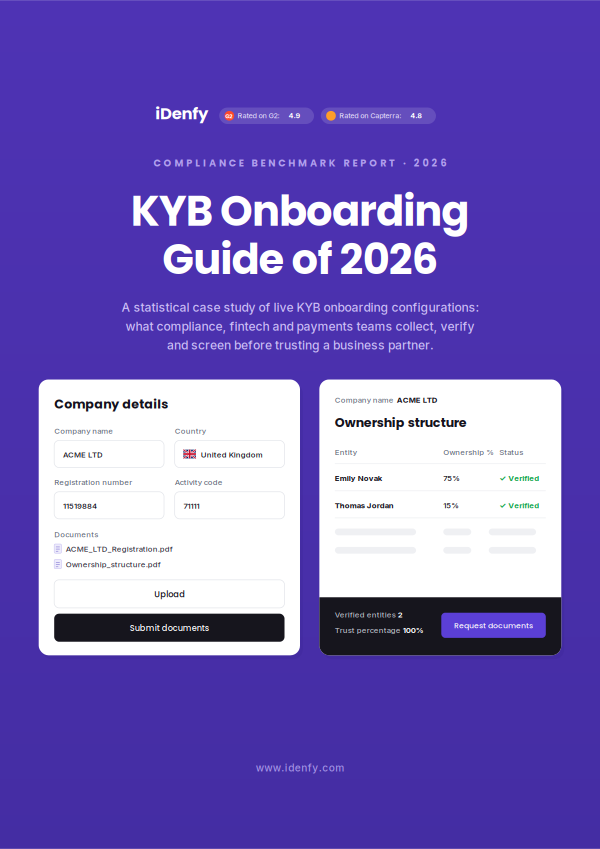
More about real use cases of iDenfy’s Questionnaire automation in our new report on KYB onboarding.
How to Conduct KYB Verification in Trade Finance?
A standard system for verifying a single entity won’t be enough for KYB verification for trade finance. You need to cover multiple workflows using your chosen KYB software. That means verifying a chain of counterparties that touch the goods using automation, aka the more efficient way. The financed invoice needs to be verified both before onboarding and at the transaction level.
All counterparties working with invoices and goods need to be approved. For trade finance, you need to follow this KYB checklist:
1. Verify License and Registration
You need to verify that the counterparty is real and do a registration lookup, confirm it is active, and is in line with their profile and business activity descriptions before starting to review the trade documents.
In practice, the most standard way to do that is to:
- Check the business registry and look up details like the company’s country of incorporation. Most KYB software solutions, including iDenfy, already have corporate registries in their system, meaning you don’t need to go on Google and look for certain databases, as you’ll have direct access to all of them at once.
- Review invoices and similar documents to cross-match the legal name with the registry records.
- Assess permits and licensing to see if they exist and if they’re valid.
- Verify the registered address. Check if the address seems reasonable. For example, if the office spaces turn out to be real office locations and not random spaces that don’t align with the declared information. Google Maps or your KYB software, depending on the specific solution, will do the trick.
Sometimes, newly incorporated companies are flagged as high-risk due to their blank history of trading. However, some businesses try to bypass this and get a faster KYB approval process by buying shelf companies that were already “sitting on the shelf” for a while, just to later bring that facade of a more reputable entity. So it all comes down to flagging risks and manually reviewing them in case there’s suspicion of fraud or you need extra documentation to prove certain points about the business.
Related: KYB for Import/Export: How to Verify Partners [Business Verification Guide]
2. Verify Beneficial Ownership
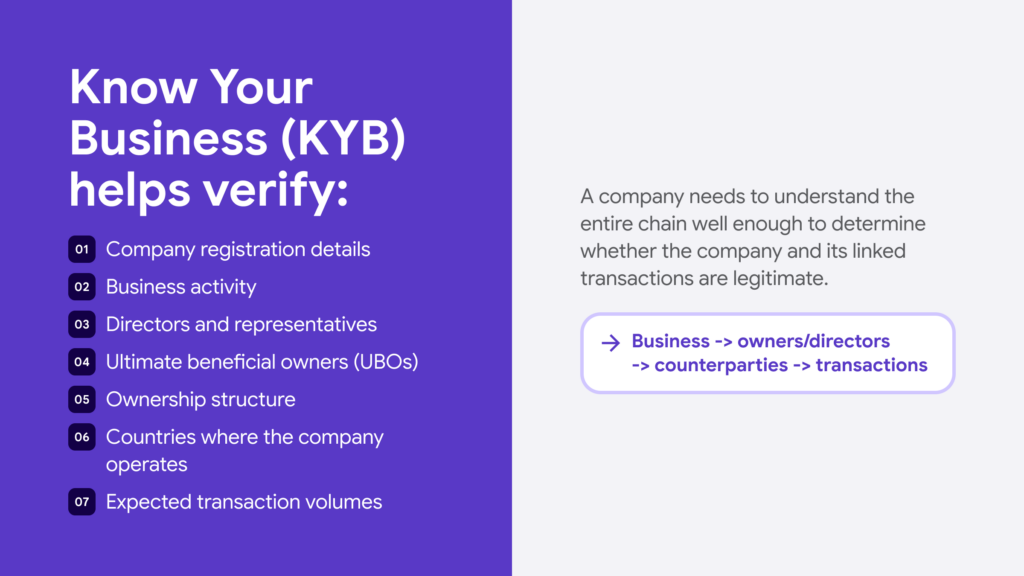
KYB is best known for its background checks on the entity itself, but it’s a popular misconception that KYC isn’t part of it. Verifying related individuals and beneficial ownership is vital because this part of due diligence tells you who controls/owns the entity.
Practical tips to assess ownership:
- Trace all UBO levels and reach the natural person who owns/controls the business.
- Don’t avoid complex structures, like nominee directors, holding companies, or jurisdictions with poor AML rules (registries then leave gaps since the jurisdiction doesn’t require filing beneficial ownership info).
- Cross-match information using multiple sources, for example, by looking at the applicant-filled form and the provided documents or the corporate registry records.
Any attempt to disguise the parties behind a transaction is a red flag, as well as other linked ones, such as shell companies (though not automatically fraudulent). Some connections, even if unexpected, might be worth looking into because they might be a sign that the counterparty is trying to keep the relationship undisclosed.
3. Conduct AML Screening
You need to check the names against AML databases to identify high-risk individuals or entities that either need to be rejected (for example, due to sanctions) or might require extra due diligence checks due to being identified as high-risk.
AML screening involves:
- Screening sanctions lists (various jurisdictions, including OFAC, UK sanctions list, EU, UN lists, etc.)
- Detecting Politically Exposed Persons (PEPs) (for example, by screening beneficial owners against PEP lists)
- Searching for adverse media (often using keywords, such as the entity’s legal name or related people’s names and aliases)
Keeping a complete audit trail with timestamps and comments on why a certain decision was made after AML findings is crucial to be compliant and to collect evidence in case you need to file a suspicious activity report (SAR). For that, automation is used, and that’s why you need to look for KYB software that has this capability.
4. Verify Trade Documents
After all counterparties are verified, the stage that’s no less important is to verify the trade itself. To make sure that it’s legitimate, you need to verify documents and look for potential inconsistencies or red flags.
Important steps that help verify trade documents mean that you need to:
- Look for duplicates, such as the same invoices under different financing requests
- Compare shipment and invoice timelines to detect unusual gaps or backdated documents
- Verify payment details by confirming that the bank account listed is not random and belongs to the counterparty you’re verifying during the KYB check (built-in tools like iDenfy’s Bank Verification help)
Mismatched tax IDs or altered totals and other inconsistencies should be looked at separately and with extra human review to determine if it’s a genuine mistake or a real red flag, requiring Enhanced Due Diligence (EDD).
Related: How to Prepare Business Formation Documents
Final Buyer’s KYB Software Checklist for Trade Finance
A trade finance KYB platform should cover all these tasks using automated KYC/AML built-in tools. That means it should:
-> Automate access to global corporate registries
-> Cater to every counterparty workflow (borrower, broker, etc.)
-> Screen names against PEPs and sanctions (preferably also against global watchlists, criminal background details, or adverse media before and after KYB onboarding)
-> Help you collect and manage corporate documents
-> Identify and do KYC on UBOs (including in niche cases where cross-border ownership needs to be traced)
-> Easily integrate into your existing workflow
Good news! iDenfy’s Know Your Business software ticks all of these boxes. For a more personalized experience on how you can use it in trade finance, book a free demo.


 Download PDF