The concept of safer gambling policies isn’t new. However, while it has become a mandatory part of a safe iGaming or gambling environment, stricter rules are still being enforced, such as the EU’s EN 18144, as a way to set clearer examples of how to detect gambling-related harm. Monitoring risk indicators is mandatory, but this is not the only example of a safer gambling intervention.
The real question is how you automate and implement alerts as an operator, such as encouraging a break or setting limits and providing real support before the situation escalates and reaches unwanted heights. You need to respond to players’ actions in real time with initial warnings and then continue to monitor their behavior. Automated workflows for follow-up interventions, such as pausing a promo offer or temporarily restricting the player’s account, can be necessary.
In brief:
- Delaying these safer interventions, whether you’re using manual methods or automated tools, means you’re gambling with your players and their safety.
- Automated tools help platforms spot harm earlier and trigger follow-up actions, even when the player ignores multiple warnings.
In this blog, I provide examples and explain how you can ensure responsible gaming practices by protecting players using automation within a single system that doesn’t always require manual intervention.
What are Safer Gambling Interventions?
Safer gambling interventions are actions designed to ensure safe and fair gambling activities. Gambling and iGaming operators are required to implement such measures as a way to prevent harmful gambling behavior and protect their users who can potentially be at risk.
These interventions should be based on a proactive and timely approach, which in practice often involves automated player and their transaction monitoring (for example, as a way to spot financial risks linked to gambling harm, such as overspending). However, interventions don’t revolve around financial risks only; they need to be based on different risk indicators. Otherwise, you can’t accurately assess the player’s risk profile.
Correctly implemented gambling interventions help detect:
- Longer or more frequent gambling sessions
- Sudden increases in spending/deposits
- Attempts to return after a long period of being inactive with atypically high activity
- Attempts to bypass identity verification even in cases of self-exclusion or other restrictions/bans
- Unusual betting patterns and gambling frequency
- Continued play after losses as a way to “recover” them
Related: Responsible Gaming: Tips & Controls for Operators
KYC built for iGaming
See how iDenfy helps gambling and betting platforms meet compliance requirements while keeping onboarding fast.
Explore iGaming SolutionKey Types of Harm Indicators
iGaming operators need to monitor different activity patterns that then help spot and react to gambling-related harm.
Potentially harmful activity in gambling is categorized into seven key types:
- Customer spend (how much a player loses and deposits)
- Spending patterns (the changes in how often/how much the player spends)
- Time spent while gambling (how long the player is on it and how frequently)
- Gambling behavior (overall actions or indicators that potentially show the risk of harmful play)
- Customer-led contact (hints of distress via calls or messages, especially if the player is asking for help or showing concern about their losing streak)
- Use of gambling management tools (changes to certain settings, such as increasing deposit limits or cancelling their withdrawals)
- Other account indicators (behavioral account-related changes, such as adding and using multiple payment methods)
In practice, many gambling and iGaming platforms use automation to identify these harm indicators because real-time alerts are required to prevent the player from putting themselves at greater risk. Alerts work like behavior-based triggers, which show up to the player as on-site/app warnings.
The mechanism behind such automated workflows can be based on risk thresholds and auto risk scoring (either using a number, such as 1-100, or the low-medium-high risk scoring method). If the risk is high, a stricter intervention method, such as restriction or a message encouraging the player to take action using available safer gambling tools, is used. High-risk players are always prioritized.
Why are Automated Gambling Interventions Important for Ensuring Safer Gambling?
Any sort of automation, if enabled and implemented correctly, helps manage risks. It’s also relatively cheaper to have AI assistants or custom workflows instead of a big analyst team, especially if you’re operating a high user volume. This way, firms can respond to harmful behavior before it escalates.
Several reasons make automation in your safer gambling program important, like:
- Earlier risk detection and faster support response (for example, a sent warning or an auto break encouragement)
- Easier documentation and follow-up process (for example, you can trigger another interaction with the player after they consistently showed signs of risk while recording these actions in a single, unified and compliant/audit-ready dashboard log)
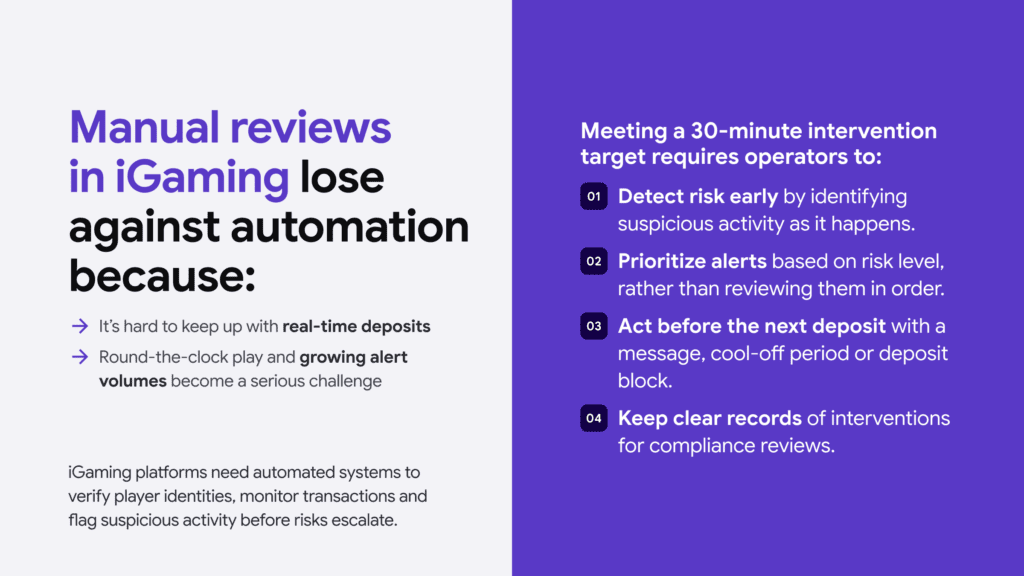
Staff also don’t need to manually monitor every player alert (low-risk, for example):
“You decide when to act and intervene. So setting the thresholds per license, acting within the regulator’s deadline, and proving it afterwards. Monitoring also works for volume of stakes, how much, how often, including failed deposits, cancelled withdrawals, player contact with support, gambling time, products played, safer gambling tools or net losses over time.”
Richard Lawrence, Head of Sales (UK) at iDenfy, when talking about safer gambling interventions and iDenfy’s platform
It’s also impossible to spot every risk without some sort of software, which makes automated gambling interventions a non-negotiable for some, especially larger, iGaming companies. In this sense, operators use predefined rules and AI-powered behavioral risk signal tracking to trigger appropriate actions to each detected user’s risk signal or harmful action.
How is AML Compliance Linked to Safer Gambling Measures?
Anti-Money Laundering (AML) compliance processes are closely tied to safer gambling measures due to the obligation to monitor and detect atypical/unusual player behavior and respond to these risks.
However, they focus on different types of harm:
-> AML aims to prevent financial crime, such as money laundering, while
-> Safer gambling aims to prevent gambling-related harm.
One covers whether the money is legitimate, and the other ensures that the player is not being harmed. For example, both AML red flags and risk assessment measures require monitoring financial patterns. Whether it’s a fintech app or an online casino, both are responsible for looking into their clients’ activity and intervening (for example, blocking a high-risk transfer or deposit if it doesn’t match the typical profile of the account).
| Comparison | AML compliance | Safer gambling |
|---|---|---|
| Primary objective | Prevent criminals from using gambling platforms to launder money or finance terrorism. | Prevent gambling-related harm and protect players from financial and behavioral risks. |
| What operators monitor | Transaction values, deposit and withdrawal patterns, payment methods, source of funds, and suspicious financial activity. | Deposit frequency, betting patterns, gambling duration, net losses, changes in spending, and markers of harm. |
| Key risk indicators | Unexplained wealth, unusual transactions, third-party payments, rapid deposits and withdrawals, and suspicious fund movements. | Chasing losses, increased spending, extended sessions, repeated limit breaches, and signs of financial vulnerability. |
| Regulatory frameworks and examples | FATF Recommendations (international standards), EU AML Regulation 2024/1624, and the US Bank Secrecy Act (BSA) and casino AML rules under 31 CFR Part 1021. | EN 18144 (European standard on markers of harm), the UK Gambling Commission’s License Conditions and Codes of Practice (LCCP), and the New Jersey Division of Gaming Enforcement’s responsible gaming regulations. |
| Possible interventions | Request additional financial documentation, conduct enhanced due diligence, restrict or pause transactions where appropriate, and submit suspicious activity reports (SARs). | Send safer gambling alerts, encourage breaks, apply deposit or loss limits, suspend marketing, introduce time-outs, or close accounts. |
One of the cases where AML overlaps with social responsibility in gambling was highlighted by the UK Gambling Commission, which showed a gambling firm being fined more than £2,000,000 for non-compliance due to the operator relying on “self-reported finances” instead of independent evidence:
One customer deposited around £64,000 soon after opening an account and lost £50,000 within a month, without being asked for their source of funds (SOF) information.
That’s why gambling firms (sports betting sites, online casinos, and related establishments) are regulated, meaning compliance processes (KYC verification and AML screening with monitoring) are mandatory, as well as safer gambling interventions to ensure a secure and entertaining space for users.
What is Challenging About Maintaining Safer Gambling Processes from the Operator’s Perspective?
Apart from keeping all measures in line with AML and other regulatory compliance requirements, the hardest part about safer gambling processes is to keep them working. This includes triggering the right intervention method even after the player’s behavior changes over and over again.
Simply put, every reputable and legal operator already has some sort of secure gambling system in place, reviewing the risk indicators. The challenge is to decide which follow-up interventions are needed.

For example, a player on your online casino app can be flagged due to matching a threshold for a gambling risk indicator. They then receive an initial warning/intervention, but still continue to show harmful gambling activity later on.
Instead, you should have a clear workflow that consists of:
- A follow-up safer gambling intervention
- An internal risk escalation if needed (for manual review)
- A pause on the player’s promotional activity
- A temporary account restriction (if necessary)
If the process only relies on a delayed reply and manual checks, further action might come in too late. That’s why old-school methods like only relying on extreme approaches like self-exclusion programs or generic pop-up messages with warnings that you’ve been playing for too long might not be effective because the issue already exists and has escalated.
What Happens When iGaming Operators Detect a Risk of Harmful Behavior?
Once the risk is detected, gambling platforms need to take action. This includes proportionate interventions, such as suggesting depositing limits, arranging a personal interaction, sending a simple message, or temporarily restricting account access.
Ultimately, after you identify harmful gambling behavior, you need to follow an intervention system:
- Flag risky behavior. Monitor player activity to detect suspicious signs or changes in player activity, such as attempts to bypass deposit limits.
- Assess the level of risk. This dictates the response to the trigger. Determining the “level” of your intervention method.
- Trigger a gambling intervention. Match the method with the risk by applying the risk-based approach, not a universal process for every player.
- Keep records. Document the intervention method and all of the logs of the follow-up actions to maintain compliance and proof, showing the decision was based on evidence, not a subjective opinion.
- Ensure ongoing monitoring. Escalate to manual review or trigger another warning when necessary and when stronger intervention methods are needed.
A clean history of a player doesn’t automatically mean they won’t ever receive follow-up action or monitoring. For example, if the user ignores the initial warning after receiving their typical spending limit and continues to chase losses, they should receive further warning, also known as the follow-up interaction (for example, a pause on promo offers).
Safer Gambling Intervention Tiers By Risk Level
Some regulators, such as the UK Gambling Commission, legally require operators to match the intervention method to the identified risk signal.
-> The exact threshold or custom rules are the gambling firm’s responsibility and should be defined internally.
| Risk level | Operator response | Example interventions |
|---|---|---|
| Early signs of potential harm | Take preventive action to encourage safer gambling before risks escalate. | Show informational pop-ups, reality checks, and deposit limit reminders. |
| Persistent or increasing risk | Step up the response when risky behavior continues after an initial warning. | Send personalized messages, contact the customer directly, and run a manual risk assessment. |
| Strong indicators of harm | Act immediately instead of waiting for several rounds of review. | Stop direct marketing and block access to new bonus offers. |
| Severe or unresolved risk | Escalate when earlier interventions fail or the player shows signs of acute vulnerability. | Restrict the account, limit access to specific gambling products, or close the account. |
Risk tiers follow the standard levels of:
Early Measures
If the risk is lower, the goal of early safer gambling measures is to provide the player with the right information. In low-risk scenarios, a simple pop-up with the details of how much the player has already spent within a certain period is enough. Further action examples include prompting them to set deposit limits and sending out extra details, such as an email with safer gambling tools.
Medium Measures
When the simple actions don’t influence the player’s behavior, switching to a medium-risk approach is required. For example, this includes cases where the player ignores the messages and safer gambling warnings and repeatedly continues to increase their deposit limits. An intervention measure example here would be to cut all direct marketing campaigns to that player and potentially forward the account for a call with the support team.
Stronger Measures
For higher-risk indicators of potentially harmful gambling activity, operators respond in real time and immediately take action (blocking access to bonus offers, setting spend limits, or applying a time-out) for the player. The player is no longer recommended to take action; they are suspended by the platform. High-risk automation workflows can be fully automated and enabled for the player without manual intervention as a way to avoid delays and exposing the player to further harm.
Very Strong Measures
This includes the most extreme interventions, such as refusing to provide services for a certain period of time or even banning and blocking the player from ever entering the gambling platform. The strictest measures should protect players who avoid all previous warnings.
Manual review is required in high-risk cases like this because the final decision should be made by a person on your in-house team, especially since it includes bans or restrictions that often lead to support tickets and clients reaching out for more information on why they were treated this way.
When Do Safer Gambling Interventions Require Manual Review?
Gambling and iGaming operators have in-house teams and analysts who still review edge or niche and some high-risk cases manually. Automation can’t entirely replace the final decision of a skilled professional.
Reviews are often needed when you need to:
- Reassess account restrictions (for example, before lifting a block, time-out, or spend limit)
- Contact the player directly after an intervention (for them to understand their circumstances better)
- Adjust safer gambling monitoring thresholds and review false positives (as a way to avoid unnecessary interventions on low-risk players)
- Decide if closing the player’s account is necessary (when the risk of harm is high despite the previous measures)
That means you’re responsible for managing and assessing individual cases if needed. On top of that, regulations, such as the UK Gambling Commission Requirement 11, give players the legal right to challenge the “automated decisions”, requiring operators to review their impact on individual customers.
How iDenfy’s Responsible Gaming Monitoring Helps
iDenfy is an end-to-end RegTech service provider, combining multiple tools (KYC/KYB and AML) in a single platform. With the new approach to safer gambling, our team designed special automation workflows for the iGaming and gambling industry.
The new launch of our Transaction Monitoring platform provides operators with a new way to collect and monitor multiple data points about their players, including age, KYC details, AML risks, payment information via bank account or bank card verification services, as well as gambling activity and potential harmful risk indicators.
How it Works
-> With iDenfy, you can monitor:
- Net losses over different time periods
- Night-time play and extended sessions
- Ignored warning/checks and repeated limit increases
- Deposit frequency, failed deposits, and reversed withdrawals
- Risk indicators in support chats and emails
-> When a player’s risk level changes, you can use iDenfy’s workflows to trigger new interventions, such as:
- Session or login restrictions
- Reality checks and cool-off periods
- Follow-up tasks for safer gambling teams
- Removal from VIP, bonus, and marketing lists
iDenfy’s scoring system evaluates potential harmful play and all indicators together, comparing the player’s activity against both predefined thresholds and their usual behavior patterns. Operators can assign low, medium, or high risk levels. Webhooks send actions to your platform and log each delivery status.
-> Talk to us and get a quick dashboard tour.
-> Download our free Responsible Gambling Monitoring guide for more details.


 Download PDF