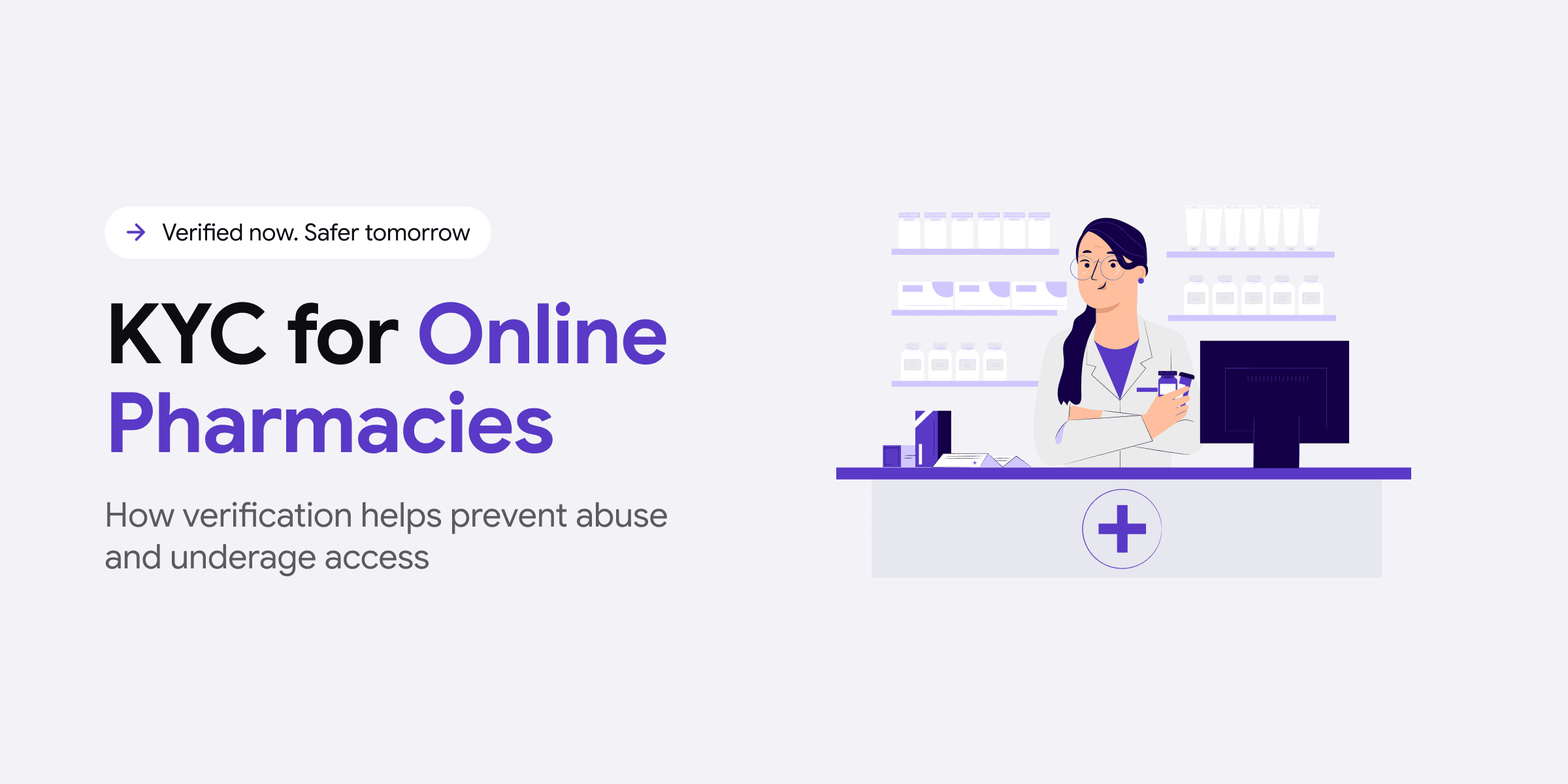
With many traditional physical businesses taking a huge step forward and moving up the user-experience ladder, e-commerce is booming and offering more niche items or services remotely. Buyers don’t have to leave their sofa if they want to have a certain item delivered to their doorstep. But what about high-risk industries, where security is still more important than any convenience that’s offered to the customer with it? One example that illustrates this perfectly is online pharmacies with controlled-substance e-prescriptions.
To see if the patient is eligible to access the medicine online, as this sort of institution, you need to implement identity verification measures, similar to how a bank needs to do a Know Your Customer (KYC) check before allowing you to open an account. With medical data and patient identities, healthcare remains one of the most vulnerable sectors in terms of the importance of keeping personal records safe. Misverified patients, gaps in due diligence on business partners, or no checks on prescription eligibility are all factors that simply aren’t an option. Online pharmacies need to ensure the safety of recurring medications while securing patient data and keeping every single party involved in a secure chain, which starts with a proper identity verification and KYC processes.
What is KYC?
KYC, or Know Your Customer, is a regulatory requirement, often in high-risk industries that deal with financial transactions (due to the risk of money laundering and financial fraud) or offer sensitive items or services. In this case, an online pharmacy offering medical-related services or items requires KYC before checkout or before the patient creates their profile and confirms their account on the platform to access their subscriptions.
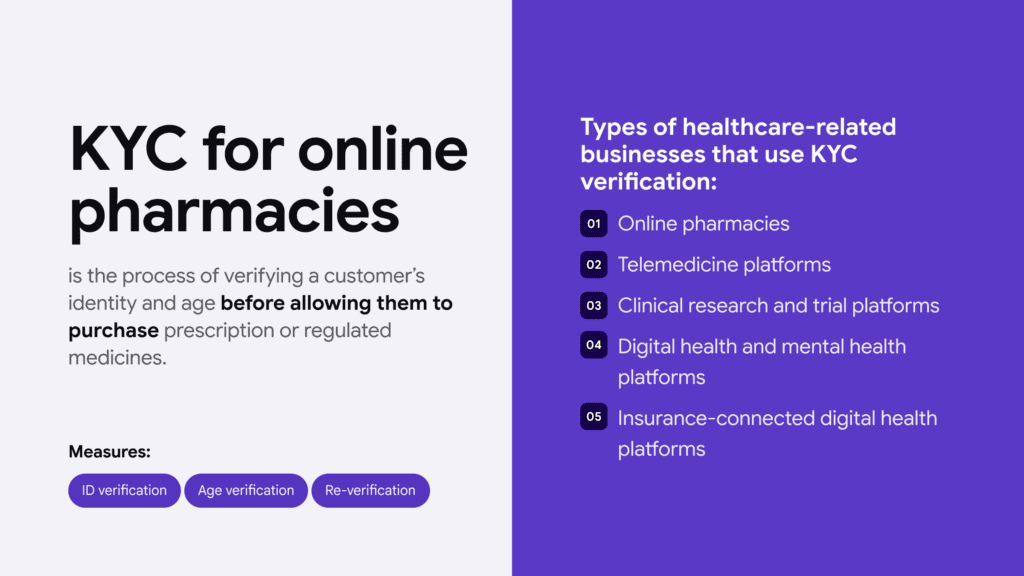
There are different variants of a KYC check; it depends on the mandatory laws (each industry differs, at least a bit) and the concrete use case. For example, KYC-related measures can also include age verification on adult-only platforms where the user needs to prove their age. For online pharmacies that need to ensure prescribed medication reaches the right hands, verifying the person’s government-issued ID document helps ensure they’re legitimate and have the right to access the medication, even if it’s all happening remotely.
Related: 3 Steps to KYC [Compliance Guide]
Automate your KYC process
iDenfy verifies customers from 200+ countries in seconds. AI-powered, compliant, and trusted by 1,000+ companies.
Explore KYC SolutionWhat is Know Your Patient (KYP)?
KYP, or Know Your Patient, is the process of verifying identities in healthcare, checking if the patient data is correct and matches internal systems, using methods like government-issued ID verification, biometric checks, or database cross-matching. KYP is a term used in this industry, but it’s an equivalent of KYC verification, just describes the same ID verification process in a more detailed manner when talking about healthcare-related fraud and risks, like medical ID theft, in particular.
Why Does Healthcare KYC Carry a Higher Risk than Banking?
Online pharmacies are under the radar because they a) use sensitive information and healthcare-related KYC details on top; b) are required to prevent fraud and ensure extra identity proofing measures simultaneously. In contrast, for financial institutions, KYC is a more straightforward process and is traditionally more well-known in this field, which makes compliance relatively easier due to the standard frameworks that have been developed earlier.
Online pharmacies, on the other hand, are a newer concept and require special treatment. In the EU, data security rules, including the GDPR (Article 9), target health-related information under special-category personal data, which then requires explicit consent or a narrow statutory exception. Additionally, like with many compliance rules, different regions require different measures, and if you’re operating in all these markets, you need to be compliant in all of them. Healthcare platforms also have to verify two audiences: patients and providers.
Examples of Verification and Security Measures for Controlled-Substance E-Prescribing Under EPCS
For example, in the US, there’s the rule for Electronic Prescriptions for Controlled Substances (EPCS), which requires businesses to verify users if they provide any sort of e-prescribing controlled substances via identity proofing measures and compliant audit logs. Under EPCS, the Drug Enforcement Administration (DEA) is the regulator that healthcare and e-pharmacy services need to follow.
In practice, this results in various measures that need to be used. For example:
- A telehealth platform needs to onboard a new prescriber. In this scenario, the company needs to run a lookup using database verification (for example, against the NPPES registry) and then capture a live selfie (biometric authentication), often matched against the patient’s medical license ID.
- A doctor on a platform needs to e-prescribe a prescription drug. In this situation, the business needs to verify the prescription event, often with a hardware security key or a special authenticator app. That means a simple session cookie from a login would be a non-compliant approach.
- A DEA audit requires an online pharmacy to provide proof. In this case, the business needs to show all prescribing logs as a controlled-substance dispensing platform. Internal records aren’t enough; a tamper-evident export and verified provider credentials are required.
Reasons Why Online Pharmacies Need KYC Verification
The main idea around KYC for an online pharmacy or a health-related app is simple. You can’t see the patient or the buyer, so you need to ensure they’re using real data. That means it’s not stolen and doesn’t belong to someone else, and they’re actually eligible to access the items or medicine they’re requesting.

Other areas that illustrate why an e-pharmacy would implement KYC measures include:
- The need for age verification for restricted medications. Many drugs, like some antihistamines or contraceptives, carry consent and age verification requirements. Any health-related products should not be accessible to minors and should be age-restricted, prompting KYC checks to ensure verified patient identities.
- The importance of fraud-free transactions and risks like prescription fraud. Unfortunately, some patients use stolen, forged, or simply duplicated prescriptions as a way to get access to controlled substances (especially drugs like opioids that are later resold on the black market). A platform without verification means that the buyer can fill out prescription forms and access the medicine under multiple names.
- The mandatory regulatory compliance rules, including license requirements. Specific regulations, not only in the US, like the Ryan Haight Act (US), GPhC rules (UK), and the EU Falsified Medicines Directive, require online pharmacies to verify who they’re providing their services to. There are also specific telemedicine-related requirements, where pharmacists are required to verify that the identity of the person picking up a controlled substance prescription matches the patient.
What are the Key ID Verification Requirements for Online Pharmacies?
Online pharmacies need to integrate identity verification and confirm their patients’ identities. To achieve this goal, different KYC verification measures can be applied.
For example:
1. Document Verification
The system in the online pharmacy uses the patient’s government-issued photo ID (driver’s license, passport, or national ID card) as the first KYC layer. The user’s name, DOB, photo, etc., are captured automatically by the AI-powered software, which means the user isn’t disrupted and everything happens within seconds. If not, you’re using the wrong KYC vendor. This helps validate the document: its overall format, security features, like the machine-readable zone, expiry, and whether the document type is actually valid in the patient’s claimed jurisdiction.
Related: How to Combat Document Forgery
2. Biometric Verification
This is the second step of the KYC process for online pharmacies, which includes capturing a real-time selfie or short video. This data is then compared to the person’s photo on the submitted ID doc. Liveness checks specifically test that the image is of a live person, not a printed photo, a silicone mask, or a deepfake.
In today’s context and knowing how AI has massively improved, active liveness is more effective, even though it can introduce friction to the KYC onboarding (for example, if the user is asked to move their head and complete a movement during their selfie video recording). In the meantime, passive liveness (detecting a live face without requiring the user to perform an action) has become the standard for prescription flows where friction needs to stay low.
Related: How to Improve KYC Verification? Tips For a Frictionless User Experience
3. Age Verification
For age-restricted medications, in the US, the online pharmacy needs to verify the patient’s date of birth and extract it from the document. It then needs to be validated against the prescription type. This prevents misuse and stolen identities, like a teen accessing prescription opioids after getting a hold of their parent’s ID. Generic age gating methods and buttons for confirming you’re “over the 18” threshold aren’t secure. Even medicine like Accutane requires a verified patient age.
| Check | Why an online pharmacy needs it | How iDenfy covers it |
|---|---|---|
| Patient ID document check | Confirms the patient exists and the ID is genuine before the first order or subscription | Document verification with automated data extraction, plus NFC chip reading for ePassports and eIDs |
| Selfie match and liveness | Stops stolen IDs, printed photos, masks and deepfakes from getting through onboarding | Biometric verification with passive liveness, iBeta ISO 30107-3 certified |
| Age check by medication class | Some medicines have age limits above or below 18, so a checkbox age gate isn’t enough | Age verification using the DOB taken from the ID, and age estimation for lower-risk flows |
| US driver’s licence validation | Confirms that US licence data matches issuing-state records | AAMVA check |
| Delivery address check | Makes sure medication ships to the verified patient in a jurisdiction where it can be dispensed | Proof of address and utility bill verification |
| Re-verification on repeat orders | Stops account sharing or takeover on refills and subscriptions | Face authentication, which re-verifies returning patients in about 15 seconds |
| Payment card match | Catches synthetic identities that use someone else’s card for a first shipment and then charge back | Bank card verification, which matches cardholder data to KYC data |
| Pre-KYC risk signals | Flags throwaway emails, virtual numbers and VPN or proxy use before a full check runs | Email, phone and proxy detection checks, with results rolled into a fraud score |
| Pharmacy and partner KYB | Wholesalers and telehealth partners need to confirm a pharmacy is real, licensed and trading from a real address | KYB solution and UBO verification |
| Ongoing partner monitoring | A licence can lapse or ownership can change after onboarding | Perpetual KYB |
| AML and sanctions screening | Drug diversion and resale create exposure to money laundering | AML screening against sanctions, PEP and adverse media sources |
| Order pattern monitoring | Surfaces high-frequency controlled-substance orders and possible doctor-shopping | Transaction monitoring with custom rules |
4. Pharmacy Verification
Pharmacy verification is the supply-side equivalent of patient KYC or identity verification, which falls under the KYB, or Know Your Business (KYB), compliance term umbrella. Wholesale drug distributors, telehealth platforms and e-prescription engines, and other potential partners that are relevant for B2B relationships in healthcare need to check if the online pharmacy is legit and licensed before working with them. A valid patient identity check routed through an unvetted pharmacy is still an enforcement event.
In practice, to verify a pharmacy, you need to check its:
- License validation against live regulatory registers. The pharmacy’s license number needs to be verified against the issuing authority’s live register, like the GPhC in the UK, state pharmacy boards in the US, and national registers under the EU’s Falsified Medicines Directive.
- Physical address. Registered address and actual operating location need to match and the dispensing operation needs to be real. This is a standard KYB due diligence practice in any industry because criminals tend to register institutions, including fraudulent pharmacies, and then use a residential address to obtain a license.
- Individual practitioner credentials. The pharmacist-in-charge and dispensing staff need individual verification against the relevant professional register, separately from the institutional license. This is why KYB compliance and verifying other businesses is more complex than standard KYC verification, since it includes verifying standard entity details like the pharmacy’s address and then verifying its related individuals to see if they aren’t fraudulent and, in this case, operate under the pharmacy’s valid license.
Related: Why Your KYB Solution for Business Verification Isn’t Working
5. Prescription Validation
This is the step where the pharmacy is required to check if the prescription is genuine and valid, as well as whether it belongs to the right patient. This procedure helps dispense medication correctly, ensuring that fraud or patient ID theft is out of the picture.
For that, information linked to the patient’s identity is checked:
- Prescription details
- Prescriber information
- Prescription status
The best option for online pharmacies is to integrate KYC compliance software and use identity verification to confirm the person placing the prescription order is the same person who is actually authorized to receive the medication. This helps ensure compliance and a smooth end-user experience, as the KYC process is familiar and used in other online services.
6. Transaction Monitoring
In the context of online pharmacy identity verification, transaction monitoring is also very important. This process tracks orders and payment activity to detect unusual transactions that are potentially linked to fraud or abuse of online pharmacies and their provided services. Monitoring helps ensure ongoing compliance and prevent account misuse even after the patient has been using your services for a long time.
Some AML red flags that online pharmacies should track when using transaction monitoring include:
- Any activity that does not match a customer’s usual behavior
- Multiple orders within a very short period of time
- Repeated payment attempts
- Unusual purchase volumes
Risk profiles change, and patient accounts can be stolen; that’s why transaction monitoring helps detect changes in behavior.
Related: Customer Risk Assessment: How to Do it Right [Step-By-Step Guide]
Final Thoughts and Tips For Online Pharmacies For a Smoother KYC Process
The end-user experience and the layout of how the U/X of the KYC looks are extremely important as well, not just compliance and security. All patients who are prompted to go through a KYC verification check, whether it’s before checkout or later on, as a reverification measure, need to feel safe. Otherwise, a huge issue in KYC onboarding is drop-offs. Redirects, different logos, and colors that don’t match the overall brand of your online pharmacy can be viewed as red flags from the end-user’s side. That’s why you need to choose a KYC vendor that offers a custom-tailored approach to ID verification, such as iDenfy.
This also directly affects your revenue. Patients leave the platform and register with another competitor if they see that the registration process is simpler there, or if they compare their previous KYC experience and make a conclusion that something is off. When it comes to sensitive information, medical advice and prescription drugs that need to be accessed, KYC needs to be secure, simple, easy, fast and fully automated, with most checks (such as cross-matching with government databases) running in the background.
Look for KYC vendors that use:
- Automated extraction of patient identifiers from the ID document itself (rather than asking patients to type their name and date of birth or selecting the document’s issuing country)
- Proper, prescription-level audit logs that are above patient-level, with a trail that shows when who prescribed, when, to which verified patient identity and, on top of that, a clear mechanism showing the user’s right to delete data, report abuse, close their account, etc
- Clear guidelines during the whole KYC process on the platform, including in cases when the ID verification failed (it should show the reason code for the person and explain why the session was unsuccessful, for example, due to the document being expired or poor lighting)


 Download PDF