A certificate of incumbency is a document that’s often used for Know Your Business (KYB) onboarding to verify and confirm the company’s ownership structure and who legally represents it. The document shows who is authorized to act on a company’s behalf.
Key takeaways:
- A certificate of incumbency lists the identities of those who can legally bind a company. This includes directors, shareholders, the registered office, and other details.
- This formal document is required for KYB verification, but also in standard cases when the business needs to open a business bank account and needs to provide some sort of proof to the bank.
- It’s provided by an authorized representative, such as a director, registered agent, or a company secretary, depending on the jurisdiction.
However, the issue is that regulated businesses that do KYB checks are required to collect and verify various business documents, depending on the entity that’s being onboarded and its operating markets. Some offshore locations, like the British Virgin Islands, don’t have public registries that you can look up or take the documents yourself. On top of that, documents like incumbency certificates are relatively easy to forge because they don’t have a standardized format or an official template that all countries follow.
I explain what you need to know about this document and how it’s used in business verification in a short but detailed way.
What is a Certificate of Incumbency?
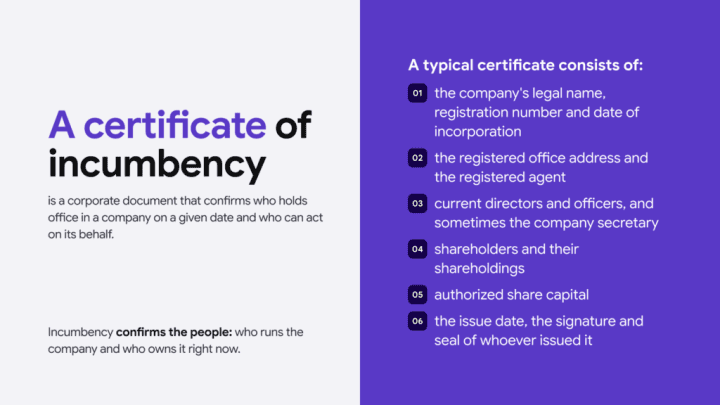
A certificate of incumbency, also called an incumbency certificate, is a formal corporate document that includes details like the company’s registration number, legal name, date and place of registration and the names of directors, senior officers and shareholders.
In KYB verification, it helps establish the ownership structure and confirm that the people behind the business are actually legally authorized to carry out business activities. A certificate of incumbency works like an extra tool to help verify that the company is legitimate, but it needs to be authenticated and compared with other corporate documents, such as a certificate of good standing.
-> If the company provides this document, it doesn’t automatically mean they’ve passed the KYB check, as other measures also need to be applied.
Verify businesses, not just people
Automate company verification, UBO checks, and business due diligence with iDenfy KYB.
Explore KYB SolutionWho Issues the Incumbency Certificate?
It depends on the country. It can be an authorized representative (secretary, corporate service provider, etc.), such as the company’s registered agent. For example, this approach is popular in offshore locations, such as the Cayman Islands or the BVI, where the registered agent is responsible for signing the certificate and preparing it.

Source: sec.gov, an example of a Certificate of Incumbency
For example, in the US, a certificate of incumbency can be signed by the corporate secretary, while in Hong Kong, it’s represented by the solicitor, company secretary, or Certified Public Accountant (CPA). The goal is the same: to confirm and certify the company’s corporate records.
What Information Does a Certificate of Incumbency Hold?
It includes details like:
- Company’s details (legal name, incorporation number, date and the jurisdiction of registration)
- The registered office (address and the registered agent)
- Current directors and officers (with the names and positions, including company secretaries and other established personnel that manage the business)
- Shareholders (and their shareholdings and ownership percentages; however, this varies, depending on the jurisdiction)
- Authorized signatories (with the names and signatures of those who are permitted to sign contracts in the company)
- Other details (the issue date and, sometimes, the notarial authentication or corporate seal to validate the certificate)
Simply put, a certificate of incumbency lists the current management structure and the individuals in a company who are legally authorized to represent it.
Related: How to Prepare Business Formation Documents
How Can I Use a Certificate of Incumbency in Business Transactions?
Aside from being an important part of KYB onboarding and corporate due diligence, you might use a certificate of incumbency in various scenarios.
For example:
- Confirming signing authority (especially in cross-border transactions, as they are considered higher risk)
- Checking such documents for audits (including as part of ongoing monitoring)
- Verifying company details (during investments, mergers, or acquisitions)
- Signing contracts (including partnership agreements or leases)
- Opening a business bank account (and updating authorized signatories)
It’s also used for smaller-scale checks, for example, to assess whether another potential business partner can legally act on the company’s behalf. This is common in cases where the company isn’t legally required to do a full KYB check but still follows internal protocols and does background checks.
Related: KYB Onboarding Report [Free PDF Guide]
Which Jurisdictions Use a Certificate of Incumbency?
In offshore jurisdictions and financial centres, regulated businesses use a certificate of incumbency as a way to provide additional verification or “proof” of their current management. Yet, this document isn’t exclusive to offshore companies.
Some examples include:
United States
In the US, it’s generally not mandatory to obtain a certificate of incumbency, as other documents are also used (for example, a certificate of officers or a secretary’s certificate).
| State | Relevant practice |
|---|---|
| Delaware | Commonly used for LLCs and corporations, particularly in international banking and business transactions. |
| Wyoming | Useful for confirming LLC managers and members because these details are not generally listed in public formation filings. |
| New York | Incumbency certificates are also used; for example, New York City provides a corporate incumbency certificate template. |
| Nevada | Companies can prepare incumbency certificates to confirm current officers and authorized signatories. |
| Florida | Similar certificates can be used to document corporate officers and signing authority. |
In states like Delaware, Nevada, and Wyoming, companies prepare incumbency certificates to verify their current officers, directors, managers and authorized signatories, especially when this information is not available in public records. This is a universal KYB issue when you’re required to onboard companies from different jurisdictions.
Hong Kong
The Hong Kong Companies Registry does not issue certificates of incumbency. However, companies can obtain certificates of incumbency through their company secretary, corporate service provider, or law firm. Alternatively, they can get a Company Particulars Report from the registry as an alternative document to verify a company.
Related: How to Use Corporate Registry Checks for KYB Reports
Cayman Islands
Companies registered in the Cayman Islands aren’t obligated to make their shareholder records public, but they are legally required to share details about the entity’s directors. The portal is designed to help others access this info and order official corporate certificates.
This helps access information about the company, especially when the registry isn’t publicly available or doesn’t have all the needed information for verification (compared to the UK’s Companies House, offshore jurisdictions and their registries leave informational gaps during KYB checks).
British Virgin Islands
Companies in the BVI are required to appoint a registered agent to file corporate records, but the registered records aren’t automatically available to the public. This makes it a bit more difficult to verify the company because you need to request company documents directly from the registered agent. A certificate of incumbency fills this gap, as it has the key summary, providing up-to-date details about a company in the BVI.
Why are Incumbency Certificates Used in KYB Verification?
In KYB verification, information listed on incumbency certificates helps cross-validate company representatives, especially if this information is not provided in the registry.
“The main check should be done with the registry, so real-time registry data is pulled and will be shown to you, which you can cross-match with whatever the customer provides.”
Robert Kotov, Head of Partnerships at iDenfy, when talking about iDenfy’s KYB platform and the importance of automated registry checks
This is an important part of corporate onboarding, because without this information, you can’t fully create another company’s risk profile and assess associated risks. For example, complex corporate structures can be a red flag that you need to look into, as hiding the true ownership might mean that the company doesn’t want you to know who owns it.
Using nominee directors can be a form of that. In some jurisdictions, a certificate of incumbency can disclose beneficial ownership, which is required to identify and later verify (using separate KYC on related company individuals) Ultimate Beneficial Owners (UBOs).
This is why this document works like a gap filler, helping provide summary-like information about the directors, officers and, sometimes, shareholders required for KYB. Without this step, you can’t guarantee that the representatives aren’t linked to fraud and aren’t attempting to act on the company’s behalf in a fraudulent way, for example, using fake or outdated company information.
Related: How to Use Corporate Registry Checks for KYB Reports
How to Verify a Certificate of Incumbency
You should follow a similar workflow:
Check the Issuing Party
Review who signed the certificate and who’s responsible for preparing it. Confirm that the issuing agent has a license. For example, the BVI Financial Services Commission or the Seychelles Financial Services Authority, depending on the jurisdiction. A certificate issued by a registered agent in the company’s country of incorporation also provides useful information for KYB verification.
Review the Date
Once the certificate was issued, it means that it only shows the company’s details and its structure at the time it was issued. You don’t want outdated information, as it would harm your assessment. Similar to how individual customers at a bank are requested to provide their Proof of Address (PoA) that’s not older than three months, here, the preferred timeline is within the last three to six months. However, this depends on your risk assessment rules. Check if the incumbency certificate was properly notarized or apostilled as well.
Cross-Match the Company Info
Compare the details on the certificate with the application data, which you collected using a KYB questionnaire or, alternatively, extracted from a corporate registry. In practice, this means cross-checking the key details, like the entity’s legal name, registration number, address and incorporation date.
If there’s a mismatch, you need to ask the representative to provide new documents or apply Enhanced Due Diligence (EDD) measures, depending on the risk and your internal risk appetite.
Verify Directors and Shareholders
Cross-check the provided information about the company’s directors and representatives with the corporate registry again to see if they match. Check the shareholders as well. For that, you can use, once again, a custom questionnaire, such as the one iDenfy has on its KYB platform.
Using it, you can collect relevant corporate documents, such as:
- Certificate of incorporation or registration
- Certificate of incumbency or good standing
- Articles of incorporation, association, or registration
- Memorandum of association or company bylaws
- Statement of information
- Partnership or operating agreement
- Trust agreement, deed, or declaration of trust
- Other, customized document requests
If that’s the case, you can ask the applicant who’s completing the form to upload all of the certificates at once so that your analysts can easily compare all of the data at once. This makes it easier because you don’t have to go back and forth and exchange multiple emails, as you already have all of the needed supporting documents in most low-risk cases.
Related: A Guide to KYB APIs: What to Compare
Run KYC and AML Checks
Check higher-risk company individuals using a proper KYC check (such as asking them to capture their ID document and complete a quick biometric check) and run Anti-Money Laundering (AML) screening on UBOs, or in cases where the company’s personnel are Politically Exposed Persons (PEPs), which can potentially have links to fraud and be prone to a higher risk of money laundering and sanctions evasion.
Keep in mind this is an extra step and depends on your company’s risk management strategy. In KYB verification, verifying the certificate of incumbency alone is not enough.
Related: PEPs and Sanctions Checks Explained [AML Guide]
Look Out for Signs of Forgery
Finally, check if the certificate of incumbency looks genuine and that it has all the necessary elements. Even if the data on it matches, it still can be altered or forged.

Check if:
- The company name, registration number, directors and shareholders match official records
- The file’s creation and modification dates make sense (alongside the certificate’s issue date)
- The named signatory has a stated role at the agent
- The certificate was issued by the company or an authorized certifying officer
- The name and signature are not scribbled (a generic seal or contact details can also be a red flag)
- The names, signatures, or officer details were added or modified after the certificate was created
- The overall file seems like it was edited, especially if the PDF metadata shows signs of some sort of software used (the layout and template should still be universal)
Don’t forget the obvious signs, such as spelling mistakes or suspicious formatting. If something doesn’t add up, it’s best to trust your gut. Check the regulator’s licensee list or the agent’s official website. Keep proof and the assessment that you made regarding the certificate to provide to the regulator.
How iDenfy Helps
Checking the company’s certificate of incumbency is just a small part of a complex KYB onboarding process. But it doesn’t mean that it has to cause headaches for your compliance team or take days due to a company and its applicants not responding to your request to provide corporate documents.
iDenfy solves KYB-related issues, saving your time at least 40 hours of manual work weekly, using a single Know Your Business solution that’s designed to ensure complete compliance:
-> KYC verification for company-related individuals (directors, shareholders, UBOs, etc.).
-> AML screening (both on the company and the individuals: PEPs, sanctions, watchlists, adverse media).
-> Transaction monitoring for assessing financial-related risks.
-> KYB custom, no-code questionnaire and workflow builder that helps collect and verify any document, including the company’s certificate of incumbency.
-> Extra features, such as the KYB AI agent that reviews collected information for you and flags mismatches automatically, including onboarding low-risk, genuine applicants for you 24/7, without any manual intervention.
iDenfy also has its official Claude Connector, powered by MCP, which lets compliance teams adjust their KYB workflows directly in Claude, without having to switch between multiple dashboards.
Talk to us to find out more.


 Download PDF